The winter of 1944 was closing in, and the Third Reich was teetering on the edge of annihilation. On both the Eastern and Western Fronts, German forces had been pushed back relentlessly, and defeat seemed inevitable. But Adolf Hitler, a man whose grip on reality had long since slipped, refused to accept the inevitable. He had one final, audacious plan—a plan that would either change the course of the war or seal Germany’s fate forever.
In a secret meeting at Ziegenberg Castle, Hitler forced his terrified generals to sign their support for an offensive through the Ardennes, a region of dense forests and snow-covered hills. “We will never surrender. We may perish, but the whole world will fall with us,” he had declared. The generals, stripped of their weapons and humiliated, had no choice but to comply. The stage was set for the Battle of the Bulge.
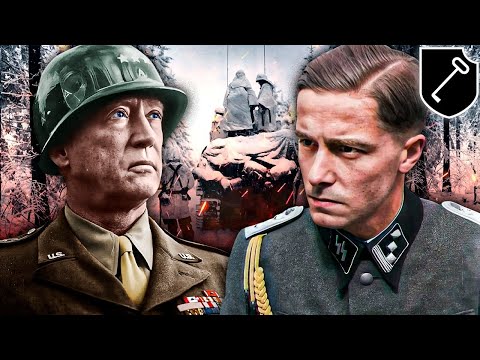
The plan was as bold as it was reckless. Hitler aimed to split the Allied forces in two, capture the vital port of Antwerp, and force the Western Allies to reconsider their alliance with the Soviet Union. But to achieve this, he needed his most loyal and fanatical troops—the Waffen SS. At the spearhead of the offensive was the 1st SS Panzer Division Leibstandarte SS Adolf Hitler, an elite unit known for its ruthless efficiency and unwavering loyalty to the Führer.
Opposing them were the battle-hardened soldiers of the US Army, including the famed 101st Airborne Division and the 82nd Airborne, along with the armored might of General George S. Patton’s Third Army. Patton, a man whose name struck fear into the hearts of his enemies, was poised to unleash his forces in a counterattack that would become legendary.
As the first waves of German infantry and tanks rolled through the Ardennes on December 16, 1944, the world held its breath. The initial assault was devastating. American units, caught off guard and outnumbered, fought desperately to hold their ground. The skies, initially favoring the Germans with fog and snow that grounded Allied aircraft, soon cleared, allowing the Allies to unleash their air power.
But the most dramatic confrontation was yet to come. In the small town of Malmedy, SS troops under the command of Joachim Peiper committed one of the war’s most notorious atrocities, executing 84 American prisoners of war. The news of the massacre spread like wildfire, fueling a fierce desire for revenge among the American soldiers.
“No mercy should be shown to captured German soldiers,” became an unspoken order among some US units, leading to retaliatory killings that would haunt the moral conscience of the war.
As the battle raged on, the Germans pushed deeper into the Ardennes, but their advance was slowing. Fuel shortages, fierce American resistance, and the sheer impossibility of the plan began to take their toll. The 1st SS Panzer Division, once the pride of the Reich, found itself bogged down, its tanks running dry and its soldiers exhausted.
Meanwhile, Patton’s Third Army was executing a remarkable maneuver, turning its forces north to relieve the besieged town of Bastogne. In a race against time, Patton’s tanks smashed through German lines, their engines roaring in the frozen air. The showdown was imminent.
The siege of Bastogne had become the fulcrum upon which the entire Ardennes offensive balanced. Inside the encircled town, the men of the 101st Airborne Division huddled in frozen foxholes, their ammunition dwindling and their rations stretched thin. Yet their commander, Brigadier General Anthony McAuliffe, had already delivered his immortal reply to a German surrender demand: “Nuts!” The single word had electrified the American ranks and become a rallying cry across the frozen front.
On December 23rd, the skies finally cleared, and the drone of C-47 Dakotas filled the air above Bastogne. Supply drops rained down—ammunition, medical kits, and even small Christmas parcels—while Allied fighter-bombers strafed German positions with impunity. The besiegers, who had expected the weather to remain their ally, suddenly found themselves exposed and bleeding.
But the Germans were not finished. On Christmas Day, the 5th Panzer Army hurled itself against the Bastogne perimeter once more, determined to break the American resistance before Patton could arrive. Panther and Tiger tanks rumbled through the snow-covered fields, only to be met by a wall of artillery fire and the deadly accuracy of American bazooka teams. Dozens of German tanks were set ablaze, their crews perishing in the flames.
South of the town, Patton’s relief column was fighting its own desperate battle. The roads were choked with ice and German ambushes, and every kilometer was bought with blood. At the village of Chaumont, a German paratrooper ambush cost the Americans eleven Sherman tanks and sixty-five dead, but Patton’s juggernaut refused to halt. “We’re going to hit them in the flank and drive them straight to hell,” Patton had promised, and his soldiers believed him.
On the afternoon of December 26th, the lead elements of the 4th Armored Division finally punched through the German cordon south of Bastogne. The siege was broken. The men of the 101st, ragged and frostbitten, emerged from their foxholes to greet their rescuers with hoarse cheers. But the battle for the Ardennes was far from over—it was only entering its most brutal phase.
Meanwhile, in the northern sector, Joachim Peiper’s Kampfgruppe had been living on borrowed time. Cut off from supply lines and surrounded near La Gleize, Peiper made the grim decision to abandon his remaining vehicles and lead his men on foot back toward German lines. Thirty-six tanks, seventy half-tracks, and hundreds of irreplaceable vehicles were left behind in the snow. Peiper himself escaped, but his unit had been gutted—a symbol of the offensive’s fading momentum.
As January approached, the German high command faced an unmistakable truth. The fuel reserves were exhausted, the Luftwaffe had been shattered on New Year’s Day during Operation Bodenplatte, and the Red Army was massing in the East for a winter offensive that would dwarf anything seen in the West. Hitler, however, refused to authorize a withdrawal. “The Ardennes must be held at all costs,” he ordered, even as his generals privately acknowledged the catastrophe unfolding around them.
The Americans, now reinforced by British XXX Corps and overwhelming air power, began their counteroffensive on January 3rd, 1945. The fighting that followed was among the most savage of the entire war—a grinding, snow-choked advance in which every village and crossroads was contested with bayonets and grenades. German rearguards fought with the desperation of men who knew the war was lost, and the snowdrifts of the Ardennes were soon stained red.
By mid-January, the bulge in the American lines had been erased. The Germans were in full retreat, abandoning the ground they had seized at such terrible cost. On January 28th, 1945, the last German soldier crossed back over the border into Germany, and the Battle of the Bulge was officially over. The Ardennes had been a gamble, and it had failed.
The cost, when the final accounting was made, defied comprehension. The Americans had suffered more than 89,000 casualties—killed, wounded, and missing—making the Battle of the Bulge the bloodiest single engagement in the history of the United States Army. The British and their allies added another 1,400 to that grim tally. In a single month of fighting, the Western Allies lost more men than they had in the entire campaign since Normandy.
For Germany, the figures were equally damning. Some 80,000 to 100,000 men were killed, wounded, or captured, and with them vanished the last great reserve of armor, fuel, and veteran soldiers the Reich would ever assemble. The divisions that escaped the pocket were shadows of their former selves—skeleton crews manning broken tanks, boys and old men pressed into service to replace the dead.
Yet the most consequential loss was not measured in casualties or wrecked vehicles. It was measured in time. Hitler had gambled everything on the belief that the offensive would buy Germany the months it needed to perfect its secret weapons and shatter the Allied coalition. Instead, the Ardennes consumed the very reserves that might have delayed the Soviet advance on the Eastern Front.
On January 12th, 1945, just as the German retreat from the Ardennes was gathering pace, the Red Army unleashed the Vistula-Oder Offensive. Nearly four million Soviet troops, supported by thousands of tanks and guns, tore through the depleted German defenses in Poland. The timing was no accident. Stalin had been waiting for the Western Allies to bleed the Wehrmacht white in the Ardennes, and now he struck with overwhelming force.
Within weeks, Soviet spearheads had reached the Oder River, barely fifty miles from Berlin. The German armies in the East, stripped of reinforcements to feed the Ardennes offensive, collapsed in a rout that dwarfed anything seen in the West. Guderian, the architect of Germany’s early blitzkrieg victories, wept openly at his headquarters as the reports flooded in. He had warned Hitler that the East was on the brink of catastrophe, and his warnings had been dismissed.
The strategic irony was bitter beyond measure. Hitler had launched the Ardennes offensive to split the Western Allies from the Soviets, to force a rupture in their coalition. Instead, the offensive had accelerated the very collapse he feared—and it had done so by weakening the Eastern Front at precisely the moment the Red Army was preparing to deliver the killing blow.
In the West, the Allies now stood on the threshold of the Rhine. The German border lay open, and the once-mighty Wehrmacht had nothing left in reserve. Eisenhower, his forces regrouped and resupplied, began planning the final drive into the heart of Germany. Montgomery, Patton, and Bradley—rivals throughout the campaign—now competed for the honor of crossing the Rhine first.
But the Ardennes had left scars that went deeper than the battlefield. The Malmedy massacre and the retaliatory killings at Chenogne had poisoned the conduct of the war. On both sides, soldiers who had once fought with a measure of professional restraint now fought with a cold, unforgiving fury. The unwritten rules of warfare, fragile at the best of times, had been shattered in the snows of Belgium.
For the men who survived, the memories would never fade. The frozen foxholes of Bastogne, the burning tanks on the roads to La Gleize, the bodies of executed prisoners lying in the snow—these images would follow them home and haunt their dreams for the rest of their lives. The Battle of the Bulge was over, but for those who fought it, the war would never truly end.
In the decades that followed, historians would debate whether the Ardennes offensive ever had a chance. Some argued that a more limited strike, aimed at the Meuse crossings rather than distant Antwerp, might have achieved a tactical victory. Others insisted the campaign was doomed from the first artillery salvo—a fantasy born in a bunker, sustained by fear, and paid for with the lives of boys and old men.
What no one could dispute was the human cost. Villages that had stood for centuries were reduced to rubble. Families across Belgium and Luxembourg returned to homes that no longer existed, their fields sown with mines and their orchards splintered by shellfire. The snow eventually melted, but it revealed a landscape scarred beyond recognition.
For the United States, the Bulge became a defining trial. The 101st Airborne’s defiance at Bastogne entered the nation’s mythology, and “Nuts!” became a phrase every schoolchild would one day learn. Yet the victory was purchased at a price that sobered the triumphant generals: the flower of American youth, buried beneath Belgian soil.
For Germany, the meaning was starker. The Ardennes consumed the last reserves of a dying regime, and the Soviet juggernaut rolled westward unopposed. Hitler’s final gamble had not saved the Reich—it had merely hastened its end. The war would grind on for four more months, but the outcome was no longer in doubt.
And in the quiet forests of the Ardennes, where foxholes still pockmark the earth and rusted tank hulls rest among the pines, the question lingers for every generation that passes: what is the true price of a leader’s vanity, and who pays it when the snows fall?
Report this article
Select a reason for reporting:






