December 17, 1944. Bullingen, Belgium. A frozen crossroads village in the Ardennes that most maps do not bother to name. A column of German armored vehicles from Kampfgruppe Peiper, the spearhead of the 1st SS Panzer Division Leibstandarte, has just rolled through an American position abandoned hours earlier. The Americans pulled back in the chaos of the first morning of the Ardennes offensive. What they left behind is scattered across the snow.
Kampfgruppe Peiper’s men captured roughly 50,000 gallons of American gasoline at Bullingen that morning—fuel they desperately needed to keep their Panzers rolling west. American prisoners were forced at gunpoint to help refuel the German vehicles. But it was not the gasoline that left the deepest impression on the German troops who swept through those abandoned American foxholes and supply points. It was what else they found.
In the bottom of a foxhole the Americans had dug the night before, half covered by a poncho, were small wax-coated cardboard boxes printed in English: K-rations, standard issue. Inside one was a tin of processed cheese, a packet of biscuits, hard candy, chewing gum, a small envelope of soluble coffee—real coffee. Not the roasted barley and acorn mixture German troops had been drinking for years. And tucked along the side, a four-pack of cigarettes, Chesterfields, sealed, dry.
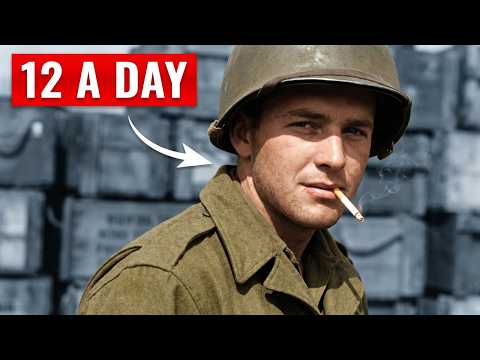
Four American cigarettes in a single meal ration. A second box held more coffee, four more cigarettes. A third box held four more cigarettes—12 cigarettes in total. One day’s food for one American private, and it contained more real coffee and more real tobacco than most German soldiers on that offensive had seen in a month.
The arithmetic was simple and devastating. If this was one American soldier’s daily ration, and a squad had 12 men, then a single American squad was carrying 144 cigarettes and 12 packets of real soluble coffee just for one day. German soldiers on that same offensive were officially allocated six cigarettes per day when they could get them at all. By December 1944, many could not.
The question that German soldiers in half a dozen captured positions across the Ardennes were asking that same morning is the question this entire investigation is built around. What kind of country can afford to give every private soldier what a German sergeant cannot get?
That question sounds like it belongs in an economics textbook. It does not. It belongs on a battlefield because the answer to it decided the outcome of the war in Western Europe as surely as any tank battle or bombing campaign. Coffee and cigarettes did not win the war, but the system that could deliver them to every foxhole every day across an ocean and a continent was the same system that delivered the fuel, the ammunition, the replacement parts, and the reserves that buried the Wehrmacht in 1944 and 1945.
And the fact that the American military chose to include coffee and cigarettes as a standard part of that system tells you something about how the United States thought about the men who did the fighting. Something the German High Command never understood and never matched.
To see where this story begins, we cannot start in the Ardennes. We cannot even start in this war. We have to go back 80 years before D-Day to a different American army in a different century to understand why coffee was not a luxury in the United States military. It was a weapon.
1861, the American Civil War. The Union Army is mobilizing the largest military force the Western Hemisphere has ever seen. Hundreds of thousands of young men from farms and factories and small towns are being formed into regiments and marched south. They carry Springfield rifles. They carry ammunition. They carry hardtack, the dense flour and water biscuit that would become the most hated food in American military history. And they carry coffee.
Every Union soldier was issued 36 pounds of coffee per year. That is not a misprint. 36 pounds per man per year. Green coffee beans, unroasted, packed in sacks that rode in the supply wagons alongside the powder and shot.
But coffee had already been woven into the American military identity for nearly a century before the Civil War began. After the British imposed a tax on tea in the 1770s, drinking coffee became a patriotic act. In a letter to his wife Abigail in July 1774, future President John Adams wrote that he had drank coffee every afternoon since and had borne it very well, that tea must be universally renounced, and that he must be weaned from it, and the sooner the better. From the Revolution forward, coffee was the American drink. And the American soldier drank more of it than anyone.
John Green Span, a curator at the Smithsonian National Museum of American History, spent years reading through Civil War diaries and letters. He went in looking for the grand themes—war, slavery, freedom, Lincoln. What he found was coffee. The word coffee appeared in Union soldiers’ diaries more often than the words war, bullet, cannon, slavery, mother, or Lincoln. One soldier wrote home with evident surprise at his own survival, saying that what kept him alive must be the coffee. Green Span later said that you can only ignore what they are talking about for so long before you realize that is the story.
The ritual of making it was as important as the drinking. When a Union regiment halted for the night, the scene was the same from Virginia to Mississippi. One diarist described little campfires rapidly increasing to hundreds in number, shooting up along the hills and plains. The encampment would buzz with the sound of thousands of hand grinders crushing beans. Soon, tens of thousands of tin coffee pots—the soldiers called them muckets—gurgled with fresh brew. The men crushed the beans with their rifle butts. They used bayonet handles.
In 1859, the Sharps Rifle Company had begun manufacturing a carbine with a hand-cranked grinder built into the buttstock. The grinder was designed for processing grain and horsefeed, not coffee. But the legend that Union soldiers used it to grind coffee beans took hold almost immediately and has never been fully dislodged. Whether any of them actually did is still debated. But the fact that the story persists tells you something about the culture. These were men for whom coffee was so central to daily life that a legend about grinding beans with your rifle felt entirely plausible.
Civil War veteran John D. Billings of the 10th Massachusetts Battery wrote a memoir called Hardtack and Coffee that captured the ritual better than any official history. He described how a soldier would drop out of the marching column, build a small campfire, cook his coffee, take a nap behind the nearest shelter, and when he woke, hurry on to overtake his company. The officers knew it happened. They allowed it. They understood, in the practical way that American officers have always understood their men, that a soldier with coffee in his belly would march farther and complain less than a soldier without it.
The Confederacy, on the other hand, was cut off from coffee imports by the Union naval blockade almost from the first month of the war. Confederate soldiers were reduced to roasting rye, sweet potatoes, peanuts, chicory, and acorns to make something that resembled coffee in color but in nothing else. General George Pickett is said to have received a homemade coffee substitute from his wife and written back with the desperate enthusiasm of a man who has lowered his standards considerably, declaring that no mocha or java ever tasted half so good as this rye and sweet potato blend.
Coffee had been officially added to the American military ration in 1832, replacing the daily whiskey or rum allotment that had been standard since the Revolution. The change was driven by temperance sentiment, but the result was that for the next 112 years, through every conflict the United States fought, the American soldier’s daily rhythm was built around coffee—not tea, not alcohol, not water. Coffee.
By the time the United States entered the Second World War, coffee was not merely part of the ration—it was the ration. Everything else was organized around it. And the man who designed the system that would deliver it to millions of soldiers across two oceans was a physiologist from the University of Minnesota named Ancel Keys.
In 1941, with American entry into the war increasingly certain, the War Department asked Keys to design a compact, non-perishable, ready-to-eat meal that a soldier could carry in his pocket during assault operations. Keys went to a grocery store in Minneapolis. He bought hard biscuits, dry sausage, hard candy, and chocolate. He assembled a 28-ounce package delivering roughly 3,200 calories and tested it on soldiers at Fort Snelling, Minnesota. The reviews were lukewarm. The soldiers rated the meals palatable and better than nothing—which by military standards counted as a success.
The package was designated the K-ration, with the letter K reportedly chosen to honor Keys himself, though the army also liked that K was phonetically distinct from the existing C and D ration designations. By 1942, K-rations were in mass production, and by 1943, they were feeding millions of American soldiers on every front.
The K-ration came in three units: breakfast, dinner, and supper. Each one was sealed in a wax-coated cardboard box small enough to fit in a cargo pocket. The wax coating was not a small detail. It was engineered to keep the contents dry in rain, mud, surf, and snow. But the soldiers quickly discovered that the coating served a second purpose that no one at the Subsistence Research and Development Laboratory in Chicago had anticipated.
The wax-coated cardboard burned beautifully. A single ration box, crumpled and lit, produced a hot, clean flame that lasted just long enough to boil water in a canteen cup. Within weeks of the first K-rations reaching combat units, the ritual was established. Open the box, set aside the food, tear the empty box into strips, stack the strips, light them, balance the canteen cup on a rock or a helmet, and brew coffee.
Roger P. Casey of the 30th Infantry Division later wrote that the wax-impregnated box, when set on fire, would burn slowly and just long enough to heat up a canteen cup of water for coffee, and that it was a luxury to them.
The breakfast unit contained a tin of chopped ham and eggs or veal loaf, biscuits, a compressed fruit bar, sugar tablets, a stick of chewing gum, a packet of instant soluble coffee, and a four-pack of cigarettes with matches. The dinner unit replaced the coffee with a powdered drink mix, but included its own four-pack of cigarettes. The supper unit carried bouillon or a chocolate bar, and four more cigarettes.
Read those numbers again. One American soldier eating K-rations for a single day received 12 cigarettes and at least one packet of real soluble coffee as part of his standard field ration—not as a bonus, not as a special issue, as a baseline. The cigarettes were commercial brands: Chesterfield, Camel, Philip Morris, Old Gold, Raleigh, Chelsea, Fleetwood, and occasionally Lucky Strike. The coffee was supplied by firms including Nestlé, whose Nescafé brand became the primary source of soluble coffee for American military rations.
A soldier could brew it using the wax-coated ration box itself as kindling to boil water in his canteen cup. The box burned hot, burned clean, and the men figured this out within days of receiving the first shipments. The C-ration, which was bulkier and used when vehicles could bring supplies forward, also included soluble coffee in its B-unit along with sugar tablets. Beginning in March 1943, each C-ration B-unit included a small three-cigarette pack, though this was discontinued later that year and replaced with other accessory items.
The army’s own assessment of the K-ration included a passage that reveals how seriously the military took these items. It stated that an excellent feature of the K-ration was the cigarette component, noting that cigarettes were among the hardest things to supply, and that while carrying priority made it difficult to justify placing cigarettes in the same class as food and ammunition, they were near it.
That last phrase deserves to sit for a moment. Near it. The United States Army was officially stating, in an internal logistics assessment, that cigarettes were nearly as important as ammunition. This was not an accident. This was doctrine. The American military had decided, based on experience going back to the Civil War, that the man in the foxhole was a human being first and a weapon system second, and that if you wanted the weapon system to function, you had to take care of the human being.
This philosophy had a price tag. American soldiers consumed an average of 32 and a half pounds of coffee per person per year during the war. That figure comes from military procurement records. For comparison, rationed American civilians were consuming about eight and a half pounds per year during the same period. The troops were drinking roughly four times what the people at home were allowed to buy, and the people at home were being asked to accept the shortage because the army had claimed the supply. In November 1942, the War Production Board took control of all coffee imports into the United States and placed coffee on civilian rationing. Each eligible adult over the age of 15 was limited to one pound of coffee every five weeks. The rationing lasted until July 1943. The reason was simple. The military needed the coffee more.
The cigarette numbers were even more staggering. In 1943, American tobacco companies produced a record 219 billion cigarettes. Thirty percent of that production went overseas, directly into the hands of servicemen. Across the entire war, the army, as the lead procurement agent for military cigarettes, distributed by one estimate nearly 350 billion cigarettes to roughly 17 million servicemen through rations, morale items, and post exchange sales. Soldiers could also buy discounted packs of 20 at army post exchanges for a fraction of the civilian price. The result was that an American combat soldier in the European theater had access to between one and a half and two packs of cigarettes per day.
The coffee saturated American military culture so thoroughly that it may have even changed the drinking habits of the countries the Americans liberated. According to a widely repeated origin story, American soldiers in Italy, encountering the strong Italian espresso, found it too concentrated for their tastes and watered it down. Italian baristas supposedly began calling this diluted version caffè Americano—the American coffee. Whether the story is precisely true has never been confirmed, but the name persists on coffee shop menus around the world to this day. And the connection between American soldiers and their insistence on familiar coffee is documented beyond any doubt.
The supply of cigarettes was treated so seriously that when it failed, even briefly, the consequences were immediate and severe. During the Bulge, front-line deliveries stopped because supply troops in Paris were diverting shipments to the French black market. The army court-martialed multiple officers and well over a hundred enlisted men.
Now hold those numbers and cross the line. Germany had been cut off from overseas coffee since 1939. What the German soldier drank was Ersatzkaffee—roasted barley, rye, chicory, acorns. The troops called it Muckefuck, from the French Mocca faux. False coffee. Brown, hot, and caffeine-free.
Real bean coffee was treasure on the German side—hoarded, hidden, traded on the black market. Tobacco was almost as bleak: six cigarettes a day officially, and by 1944 often none at all, while the regime ran one of the modern world’s most aggressive anti-smoking campaigns against its own soldiers.
This was not a gap. It was an abyss, and the men on both sides of it knew exactly what it meant.
So here is the verdict. What kind of country gives every private what a German sergeant cannot get? A country that decided the private matters. Not as a number on a strength report, but as a man—cold, tired, scared, far from home—who fights better if someone in the supply chain remembered his morning coffee.
That choice, tucked into a wax-coated box, decided more than most people will ever know. If your grandfather served, what did he carry in his pocket—and what did he miss most from home? Tell us in the comments.
Report this article
Select a reason for reporting:






