March 3rd, 1943. The Bismarck Sea, north of New Guinea. A Japanese destroyer cuts through the water when the crew hears a sound that doesn’t belong—not the high drone of bombers, but something lower, flatter, skimming the waves. Then the nose of the aircraft erupts in fire: eight .50-caliber machine guns opening at once, a solid wall of rounds that walks the deck and doesn’t stop. Every man at an anti-aircraft gun is gone before he can swing it around. That is the last thing many Japanese sailors ever saw.
The aircraft was a converted American medium bomber, flown at mast height by men who had decided the only way to sink a ship was to fly straight down its throat. The Japanese had answers for high-altitude bombing. They had almost nothing for this.
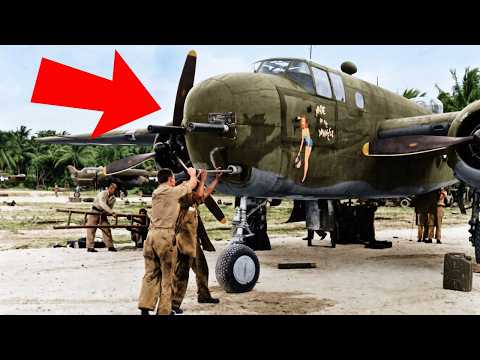
And the man who built it wasn’t an engineer. He was a former Navy flyer turned airline pilot, with his wife and four children locked inside a Japanese prison camp.
To understand the horror, you have to understand the failure it grew out of. When the Pacific War began, American air power had one answer for enemy shipping: fly high above the fighters and flak and drop bombs through a Norden bombsight from 25,000 feet. Against a factory, it worked. Against a ship that could see you coming and turn, it was close to useless.
A bomb let go from 25,000 feet takes the better part of a minute to fall. In that minute, a destroyer making 30 knots simply put its rudder over and steered into the empty sea where the bombs were about to land. The numbers were brutal. In the late summer of 1942, medium bombers of the young Fifth Air Force dropped more than 800 bombs on Japanese shipping. 28 hit anything at all. Three ships went down.
Over the approaches to New Guinea, B-17 crews watched it happen again and again. They held formation through flak, dropped on a convoy, and watched the pattern boil the ocean a hundred yards astern while the ships sailed on untouched. And the ships could not be allowed to sail on. Every convoy that got through carried fresh troops into New Guinea, where the Japanese were fighting to throw the Allies back into the sea. High bombing could not stop them. Something had to.
The man who changed it had almost no business being in uniform. Paul Gunn was a former Navy flyer—one of the rare enlisted men trained as a pilot—who had left the service as a chief petty officer and gone to Manila to run a small airline. When the Japanese overran the Philippines, they seized his wife and four children and put them behind the wire at Santo Tomas camp. Gunn took a commission in the Army Air Forces and spent the next three years flying like a man with a private score to settle. Everyone called him Pappy.
He was not an aeronautical engineer. He was something more useful: a pilot who understood machines with his hands and didn’t much care what the manual said. General George Kenney, the new commander of air power in the Southwest Pacific, gave him a job. Strip the bombardier and the bombsight out of the nose of a B-25 and cram the space with as many .50-caliber machine guns as would fit. Gunn and a North American Aviation field man named Jack Fox went at it with hacksaws and sheet metal. They set four heavy machine guns into a solid nose where the glass had been, then bolted two more to each side of the fuselage in blister mounts. Eight guns, all fixed, all aimed straight ahead, all fired by the pilot with one button. Aim the airplane and you aimed every gun it had.
Guns were half the problem. The other half was getting a bomb into a hull. The trick came from Major William Benn, who had his crews run in low and skip 500-pound bombs across the surface like a stone across a pond, so they struck a ship square in the side at the waterline. Benn proved it in combat in October 1942. He did not live to see what it became; he was lost early the next year. Turning it into a killing routine fell to Major Ed Larner, who commanded the 90th Bomb Squadron, the Para-Dice. Through early 1943, Larner drove his pilots at a half-sunk wreck on the reef outside Port Moresby over and over—30 and 40 runs a man—until putting a bomb into a ship at 100 feet was pure reflex. Kenney went down and watched them work. His verdict came in two words: “They didn’t miss.”
On the last day of February 1943, the target sailed out of Rabaul. Eight transports, eight destroyers, close to 7,000 men of the Japanese 51st Division, bound for Lae to hold the line in New Guinea. It was the largest reinforcement convoy the Japanese had risked in those waters. Their own planners had war-gamed the run and expected to lose half the transports before it reached port. They sailed anyway because Lae had to be held.
The Allies knew they were coming. Codebreakers had pulled enough from the traffic to know the route and the timing. Kenny and an Australian officer, Group Captain William Garing, built an attack that stacked the sky in layers. Heavy bombers up high to scatter the formation. Australian Beauforts down on the deck to kill the gun crews. Then Larner’s strafers to skip the bombs home. P-38 fighters overhead to hold off the Zeros.
On the morning of March 3rd, it all came together over open water. The Australians of Number 30 Squadron went in first. Four cannon and six machine guns packed into every nose, straight down the length of the ships. The Japanese captain saw aircraft coming low and fast and made the natural mistake. They read it as a torpedo attack and turned their bows toward the planes to make themselves thin targets. It was exactly wrong. It laid the long flank of every ship open to the bombers coming in behind.
Then Larner’s B-25s arrived at mast height, and the thing the Japanese had no answer for began.
See it from the deck of a transport. An American bomber flat on the water, swelling in the eye until it fills the sky. Then the whole nose lights up. Eight .50-caliber guns firing together do not sound like gunfire. They sound like the air itself being torn in half.
The stream sweeps the deck from bow to stern. Gun crews, officers, soldiers packed at the rail—all of it goes down in the length of a single breath. And behind the guns comes the bomb. Released a few hundred feet out, it skips once, twice, and slams into the hull at the waterline. A delayed fuse lets it drive deep inside before it lets go.
Ship after ship. Run after run. No high angle to climb to. No altitude to hide in. Nothing to shoot back at but a shape already screaming past the mast and gone. The escort had trained for torpedo bombers and for high bombers. Nothing in their drills covered an enemy that flew in below the height of their own bridge.
In something like fifteen minutes the battle was decided. Every one of the eight transports was sunk or sinking. Four of the eight destroyers went down with them—the Shirayuki, the Arashio, the Tokitsukaze, the Asashio, gone. The escort commander, Rear Admiral Masatomi Kimura, was wounded and hauled off his burning flagship. Of the 7,000 men who set out for Lae, roughly 1,200 reached it. Many with nothing but the soaked uniforms they had swum in.
What came after belongs in the record, too. And it has to be said plainly. For days, Allied aircraft and patrol boats went back across that stretch of sea and strafed the lifeboats, the rafts, and the men in the water. The reasoning at the time was cold and exact: these were combat troops, and the shore was near enough that survivors would reach it and fight another day. The airmen who flew those runs took no joy in them. Some carried them in silence for the rest of their lives. By early 1943, the Pacific had already hardened into a war of no quarter on both sides, and the Bismarck Sea is where that logic showed its full and terrible face.
A handful of men survived the sea itself. Days later, a submarine picked more than fifty of them off a spit of land near Goodenough Island and carried them back to the front. Others drifted for hundreds of miles. Most of the 51st Division simply never arrived.
Now look again at what did the killing. Machine guns and bombs—not a cannon. Because the picture most people carry of the B-25 gunship, the one with a tank gun jammed into its nose, was not even in the theater yet. And when it finally arrived, the truth of it was stranger than the legend.
North American did build a Mitchell with a 75-mm cannon bolted into the nose—first the B-25G, then the lighter B-25H. The gun came from the same family as the 75-mm weapon on the Sherman tank. Inside an airplane, it was a monster: better than nine feet long, and a crewman fed it by hand, one shell at a time. On paper, it was a nightmare. A bomber carrying a field gun.
In the air, the pilots were not sold. You might get off three or four rounds in a single pass before you had to break away. Every shot slammed the whole airframe backward. The gun was slow, it was heavy, and against a small ship that could turn it usually missed. In one trial, a cannon-armed Mitchell put five 75-mm shells into a destroyer and changed nothing that mattered.
So the men in the Pacific did what men in the field always do with a bad idea. They tore the cannon out and bolted in two more machine guns. The wall of .50-caliber fire was the real weapon all along. The tank gun was the story people preferred to tell.
By 1944, the strafer had spread through the whole Fifth Air Force, and the men who flew it had turned mast-height attack into a science. In August 1943, more than 60 B-25s came in low over the Japanese airfields around Wewak and caught entire squadrons of bombers lined up with engines running. Kenney wrote afterward that the parked aircraft were ablaze almost at once under the fire of more than 200 machine guns. In a matter of minutes, the strongest Japanese air base in New Guinea was a field of burning wreckage.
That November, the strafers flew into Simpson Harbor at Rabaul itself, the center of Japanese power in the South Pacific. Major John Hennebry, who had taken over the Para-Dice after Larner was killed in a crash that spring, led B-25s across the anchorage at wave-top height through a wall of flak and swarming fighters. They came out the far side having torn into the shipping below, but it cost them badly—one of the hardest single days the Fifth Air Force had yet paid for. The strafer was a killer. It was never a safe way to make a living.
By the final year of the war, the technique had become pitiless in its precision. On a single sweep off the China coast in the spring of 1945, the Mitchells of the 345th Bomb Group, the men who called themselves the Air Apaches, went after a line of Japanese destroyers. They dove to the deck, leveled at 30 feet, opened fire from half a mile out with 10 guns throwing something near 7,000 rounds a minute, then rolled a pair of 500-pound bombs into the waterline and pulled up over the masts. Two of their four squadrons sank three destroyers. Two squadrons were enough.
The Japanese took the lesson at the Bismarck Sea and never let go of it. After March 1943, the order came down: no more large convoys within reach of Allied land-based air power. From then on, New Guinea was fed by submarine, by fast destroyer dashes in the dark, and by small barges creeping the coastline at night. Never again did Japan send a major troop convoy into those waters. A staff officer of the Combined Fleet, looking back after the war, called that defeat the biggest cause of the loss of New Guinea.
The strafer crews paid for what they did. Flying at mast height meant flying straight into every gun a ship or a shore battery could bring up at a range where neither side could miss. The Air Apaches alone lost 177 aircraft and 712 men before the war ended. A miss at that height did not mean a long walk home. It meant the water or the jungle or capture by an enemy that often killed downed airmen on the spot.
And the legend—the tank shell driving clean through a hull—was mostly just a legend. What actually broke the convoys was simpler and far harder to live through: guns to sweep the deck clean and a bomb skipped into the side of a ship at 100 feet. Four of the cannon-armed B-25H models still survive. One of them still flies with its 75-mm gun in the nose, the last of its kind in the air anywhere on Earth.
Pappy Gunn lived to see the Philippines freed and his family walk out of Santo Tomas alive. He stayed with airplanes after the war. In 1957, he flew a small one into a storm over the same islands he had fought across, and this time he did not come out the other side.
The men who flew the strafers remembered the same thing when they were old. Never the specifications. The water. How close it was. Thirty feet of air between the belly of the bomber and the waves, the spray coming back over the windscreen, the whole aircraft shuddering as the guns in the nose threw their fire.
That is what a Japanese sailor saw in his last moment on the deck of a sinking transport in the Bismarck Sea. Not a tank gun in the nose of a bomber. Just a converted medium bomber flown by men who had decided the only way to kill a ship was to fly straight down its throat—and who had practiced until they did not miss.
What would you have done, standing on that deck, hearing the sky tear open?
Report this article
Select a reason for reporting:






