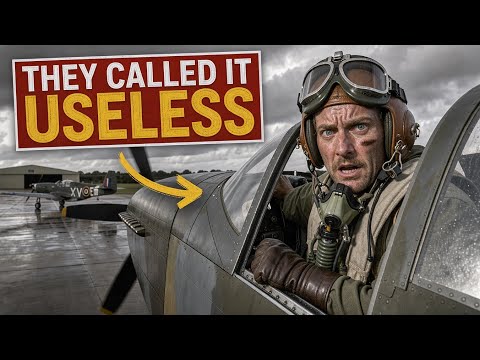
The first thing the Royal Air Force said about the P-51 Mustang wasn’t praise. It wasn’t criticism either. It was a warning.
In the autumn of 1941, a cargo ship arrived in Liverpool carrying aircraft in wooden crates. According to one account, the ship was bombed while crossing the Atlantic, but the crates remained intact. Inside was a single-engine fighter from a California company almost no one in Britain had heard of.
Mechanics assembled it, fueled it, and prepared it for flight. Before it took to the skies, the gunners had to be warned. Because the new American fighter looked very much like a Messerschmitt 109 from the ground. Square wingtips, a long slender nose, a sleek and narrow profile. To the anti-aircraft crews who had spent over a year learning to shoot first and ask questions later, this meant enemy.
So orders went out to the batteries and fighter stations. This aircraft is ours. Leave it alone. Soon, many frontline Mustangs carried bright yellow bands across their wings so British pilots wouldn’t mistake them for German planes in the heat of battle.
That was the beginning. Over the next three years, a long line of RAF pilots climbed into this aircraft for the first time and climbed out with a private opinion. Test pilots and squadron pilots. Men who learned their trade on biplanes, men who fought the Battle of Britain in Spitfires. Some of what they said was dismissive, some was wrong, and some sounded like fantasy at the time.
This is the story of those judgments in the order they were made. One of those opinions, written the morning after a single half-hour flight by a man who had never fired a shot in battle, would put a British engine in an American airframe and change what was possible in the air war over Europe. His employer’s reward for that opinion was a raise of one pound a week.
To understand why so many experienced pilots misjudged this plane, and why one man judged it correctly, we must start with the reason it existed at all. Nobody asked for it.
In the spring of 1940, Britain wasn’t looking for a masterpiece. It was looking for anything with wings and guns. France was on the verge of falling, and the RAF couldn’t build fighters fast enough for what was coming. In New York, the British Purchasing Commission was combing the corridors of the American aircraft industry, trying to buy anything that could be delivered soonest.
What the British really wanted was more Curtiss P-40s, a sturdy and unexciting fighter already in production. Curtiss had no extra capacity. So the commission turned to North American Aviation, a start-up in Inglewood, California, whose most famous product was a trainer. The RAF knew that trainer well. They called it the Harvard, and thousands of British pilots had learned to fly on it.
The British proposal was direct. Build us P-40s under license. North American’s president, a blunt former Army pilot named James Kindleberger, known to everyone as ‘Dutch,’ refused. He argued that tooling up to build another company’s fighter would take as long as designing a better one. His engineers would offer Britain a completely new fighter of their own design, and quickly.
The British accepted the bet, having no other choice. The design team, led by Raymond Rice and an engineer of German descent named Edgar Schmued, worked in a smoke-filled room directly above Kindleberger’s office. Sixteen-hour days were normal. One of them later recalled that Sundays felt different only because the neighboring factory kept quiet.
The heart of the design was a gamble on the wing. North American chose a new laminar-flow wing, based on research from the National Advisory Committee for Aeronautics, the American government flight lab. The idea was to keep air flowing smoothly over the surface for much farther than on a conventional wing, greatly reducing drag. No one had ever trusted such a wing on a mass-produced fighter.
When the first wind tunnel results came back looking wrong, the engineers suspected the tunnel itself was too small and spoiling the airflow around the model. So they loaded the model onto an airliner and flew it north to a larger tunnel in Seattle, where it behaved exactly as they hoped. Before the Mustang ever flew, its wing had already flown as a passenger on another aircraft.
The first airframe was rolled out 102 days after the contract was signed, while it was still waiting for its engine. On October 26, 1940, a freelance test pilot named Vance Breese took it up from Mines Field in Los Angeles, the ground that today lies beneath the city’s international airport. That December, the British gave it a name. They called it the Mustang.
Rapid production followed. The first Mustang built for the RAF flew in California in April 1941, and by that autumn, the crates were crossing the Atlantic, heading for Liverpool and the gun crews who had to be told not to shoot.
But one choice in all of this mattered most, and at the time, it didn’t even look like a choice. The engine was the Allison V-1710, the same basic engine as the P-40, reliable, American-made, and available. The version North American could use had a single-stage supercharger. As the plane climbed into thinner air, the engine lost power gradually. At low altitude, the engine was strong. At high altitude, where the fighter battles over Europe were fought, its performance weakened.
No one at Inglewood could fix that, and for the next eighteen months, this flaw colored everything the RAF said about its new aircraft.
The first detailed British evaluations came from people whose job was to be unimpressed. New aircraft arriving in Britain went to RAF testing units, where pilots flew them with a stopwatch and wrote down exactly what they found, without exaggeration.
There is a story, later told by North American personnel themselves, that after an early demonstration in England, the performance figures seemed so implausible that British officials refused to believe them and ordered the flights repeated. Whether every detail of that story is true or not, the numbers that followed were real. They were also very strange.
In the spring of 1942, the Air Fighting Development Unit at Duxford pitted a Mustang against a Spitfire V, the backbone of Fighter Command. At 5,000 feet, the Mustang was about 30 mph faster. At 15,000 feet, it was about 35 mph faster. And the Spitfire was achieving that with a more powerful engine. The American plane was faster on less power, and there was only one explanation. Its design was slipping through the air more cleanly than anything the RAF had.
Then the testers took it higher, and the picture flipped completely. Above 15,000 feet, the Allison engine began to weaken. At 20,000 feet, the Mustang’s top speed dropped to about 357 mph, slower than the Spitfire V and slower than the Messerschmitt 109F. It was supposed to fight at that performance. Climbing to that altitude took about 11 minutes. The Spitfire V did it in seven.
That was the assessment that mattered in the end. Fighter Command fought its war at 25,000 to 30,000 feet over northern France. So a fighter that lost power at 18,000 feet was of no use to it. Accordingly, the Mustang was politely ignored and handed over to Army Co-operation Command, the part of the RAF that worked for the soldiers in reconnaissance, photography, and attacking ground targets.
If you were an Army pilot in early 1942, that wasn’t a disappointment. It was more like a Christmas present. Think of the kinds of aircraft some of those men had been flying before. Many of their units had spent the early war with the Westland Lysander, a high-wing, fixed-gear machine designed to land in fields and spot artillery. Others had the Curtiss Tomahawk, the RAF’s name for the early P-40. Now they were handed a fighter faster at low altitude than a Spitfire.
No. 26 Squadron at Gatwick received these aircraft first in early 1942. And for pilots coming from older types, the step up was enormous. By British standards, the cockpit seemed roomy, with space to move and an American design that took some getting used to. At low altitude, the engine ran smoothly and strongly. The plane carried an unusual weight of weapons and enough fuel to go a long way and come back safely.
Behind the pilot’s seat, the RAF installed a sideways-facing camera so the pilot could fly along a coast or a railway line and photograph everything he passed. On May 10, 1942, a pilot of No. 26 Squadron, Pilot Officer G. N. Dawson, made the Mustang’s first operational sortie, crossing to France to strafe aircraft hangars and attack a train. By midsummer, 11 squadrons had Mustangs.
The work they did was lonely. Mustangs crossed the Channel in pairs, sometimes alone, flying low enough to evade German radar. They chased locomotives, barges, and trucks. They photographed beaches, bridges, and gun positions the Army might one day need to know about. The idea was to be fast and low and gone before anyone could respond. And down there, at 100 feet above the fields, the Allison engine that had failed its high-altitude test in its ideal home was in its element.
So what did those pilots say about the Mustang? Mostly they said it to each other in crew rooms, mess huts, and canteens. Very little survives on paper. Lines in squadron operations records noting takeoff time, landing time, target, and result. A locomotive damaged near a French town. A photo mission along a stretch of coast. One aircraft missing. Hundreds of similar sorties were flown in 1942 from a handful of airfields in southern England. Almost none of them were filmed or told to anyone outside the squadron.
And so most of the detail of this war happened in reality. Not only in the famous battles, but in small, repeated acts by people no one filmed. One airfield among hundreds, one sortie among tens of thousands. The same kind of story repeats again and again in places no camera ever reached. There are far more stories of this kind than any channel could contain. Eleven of them were here, told in full, until I removed them myself. Now, they exist in only one place, an audio collection called ‘Behind the Wire.’ Eleven complete stories of the war, nearly 6 hours of narration, and a companion booklet to keep beside it. You can’t watch it anywhere anymore, but you can still hear it. The link is in the description.
Ten days before Dawson’s crossing to France, a very different kind of pilot had already climbed into a Mustang at Duxford. His name was Ronald Harker, and he belonged neither to the RAF’s testing establishments nor to a fighter squadron. He belonged to Rolls-Royce.
Harker was born in Tynemouth in 1909. He joined Rolls-Royce at sixteen as an engineering apprentice, and when the Depression hit, the company let him go. He kept flying anyway at flying clubs with his father’s help. In 1934, Rolls-Royce took him back, and when the company started its own flight testing at Hucknall near Nottingham, he became its first test pilot. He also served in an Auxiliary Air Force squadron, and when the war broke out, he joined it full-time until the squadron was sent to France in 1940 and Rolls-Royce called him home. He never flew in combat. He fought his war in other people’s cockpits, behind a desk, and over the telephone.
By 1942, he was the company’s senior liaison pilot. His job was to visit RAF units, fly whatever they had, and figure out how Rolls-Royce engines could make it perform better. He also test-flew the new two-stage Merlin engines himself, the engines that were about to transform the Spitfire. Few people in Britain understood better what those engines could do at high altitude.
In April 1942, his phone rang. On the line was Wing Commander Ian Campbell-Orde, the officer in charge of the Air Fighting Development Unit. His unit had a Mustang. The official view of it was already settled. Excellent at low altitude, useless at high altitude. But Campbell-Orde had watched it fly, and he wanted a second opinion from a man whose profession was thinking about engines. Would Harker come and try it?
On April 30, Harker flew the Mustang for about half an hour. We don’t have a precise moment-by-moment account of that flight. But it’s not hard to imagine the feeling of a man like him in that situation. He knew the Merlin engine intimately. He knew exactly how a Spitfire behaved at every altitude. Now he was sitting in an American plane with a less powerful engine, and wherever the air was thick, it matched a Spitfire V and then beat it. The controls felt perfect. The airframe was clean. Then, as he climbed, the power faded from beneath him like a receding tide. He could feel precisely where the plane was still capable, and where the engine had given up.
When he landed, Harker’s conclusion wasn’t that the Mustang was a bad fighter. It was an excellent fighter with the wrong engine. This was very likely the answer Campbell-Orde had hoped for. But it wasn’t an answer the rest of the system was ready to hear.
He wrote it down the next day, May 1, 1942. He liked the ease of control. He noted the heavy armament and the large fuel load, far more than a Spitfire carried. He found the airframe advanced and maneuverable up to 20,000 feet. He wrote that its characteristics closely resembled a Messerschmitt 109F. Then came the most important recommendation. Fit it with a Merlin 61, the new engine being built for the Spitfire IX, and the Mustang would be much faster than both the 109 and the Spitfire V.
Other pilots had felt the same power collapse above 15,000 feet and recorded it as a defect. Harker read it as a specification. He was flying with the very engine that could fix it. Nor did he wait for his report to go through official channels. He telephoned Ray Dorey, who ran Rolls-Royce’s flight test establishment at Hucknall, and asked a very practical question. How quickly could a Merlin 61 be fitted to one of these aircraft?
Within 48 hours, Dorey took the question to Ernest Hives, the man who ran Rolls-Royce. Hives put the proposal to Sir Wilfrid Freeman, one of the most influential figures in British aircraft production. On May 13, representatives of the Air Ministry and Rolls-Royce met to discuss it. Here the idea almost died completely.
Every Merlin 61 was already spoken for. The RAF needed them urgently for the Spitfire IX, its real answer to the Focke-Wulf 190, the German fighter that had outclassed the Spitfire V since the previous autumn. That same spring, the unit at Duxford reported that the Spitfire IX was significantly better than the V, especially above 20,000 feet. Everyone wanted those engines. Diverting any to an American plane the RAF had already rejected seemed to many in the Ministry like an expensive distraction.
The doubts were real, and Harker had to keep pushing. What settled the argument was mathematics. Beatrice Shilling, Rolls-Royce’s aerodynamics expert at Hucknall, took the Mustang’s numbers and the power of the Merlin 61 and calculated what the combination could achieve. Her answer was about 441 mph at 25,600 feet. That was faster than a Spitfire IX in a plane carrying far more fuel. Freeman backed the idea with his full weight, and by early June, the conversion was approved.
Mustang airframes began arriving at Hucknall. Rolls-Royce engineers worked quickly. The Merlin engine went into the Mustang’s engine bay with little trouble. A new internal radiator was fitted under the nose, giving the plane a distinctive chin. The three-bladed propeller was replaced with a four-bladed one. For the engine itself, they chose the Merlin 65, nearly the same as the Spitfire IX’s, so the two fighters could be compared fairly.
The first converted aircraft carried the serial number AL975 with a letter G added at the end. The G stood for ‘Guard.’ That meant the plane was secret enough to require an armed guard at all times.
On October 13, 1942, Rolls-Royce’s chief test pilot, Captain Ronald Shepherd, flew AL975 with a Merlin in its nose for the first time. Consider what that moment meant at Hucknall. For four months, a small group of engineers had bet their reputations on slide-rule calculations and a liaison pilot’s intuition, using engines the Ministry would have preferred to see in Spitfires. Now the plane was in the air, and every flight that followed would prove them right or kill the idea entirely.
Over the following weeks, the numbers ended the argument. One converted aircraft, AM208, reached 433 mph at 22,000 feet. AL975 reached an absolute ceiling above 40,000 feet. The plane the RAF had considered useless above 18,000 feet was now faster at high altitude than the Spitfire it had borrowed its engine from.
While the engineers worked, the Allison Mustangs in the squadrons kept proving their worth. On August 19, 1942, during the raid on Dieppe, Mustang pilots flew reconnaissance sorties over the landings and paid a heavy price for it. But one of them, Hollis Hills, an American volunteer flying with No. 414 Squadron of the Royal Canadian Air Force, shot down a Focke-Wulf 190, scoring the Mustang’s first aerial victory ever.
Two months later, on October 21, Mustangs of No. 268 Squadron flew low across the Dutch border into Germany itself, attacking targets along the Dortmund-Ems Canal. No single-engine fighter based in Britain had reached Germany before. The Mustang couldn’t climb, but it could certainly travel.
By then, the idea had already crossed the Atlantic. Its most important American promoter in London was a man named Tommy Hitchcock, whose life read like a novel. At seventeen, he left school to fly with the French in World War I. His plane was shot down, he was captured, then escaped by jumping from a moving train, hiding by day and walking by night until he reached Switzerland. Between the wars, he became one of the greatest polo players history has known, and F. Scott Fitzgerald is said to have drawn on him for more than one character. Now he was an assistant air attaché at the American Embassy, and he had flown the Mustang himself. He told Washington it was among the best fighter airframes anyone had built, perhaps the best ever, and that it should be fitted with a Merlin engine.
He was backed by the American ambassador, and the matter reached General Henry Arnold, head of the Army Air Forces. North American was thinking along the same lines, and it had what Rolls-Royce lacked, industrial scale. Packard, the luxury car maker in Detroit, was already building Merlin engines under license. On November 30, 1942, the first American Mustang with a Merlin engine, later designated XP-51B, flew in California. The Army Air Forces had ordered 400 of them in August before the first Merlin Mustang ever left the ground. The order soon rose to more than 2,000. North American opened a second plant in Dallas to keep up. Britain provided the diagnosis, and America would provide the numbers.
Those numbers arrived just in time, because in 1943, the American daylight bombing campaign over Germany was bleeding to death. The Eighth Air Force had come to England convinced its heavy bombers could fight their way to the target in daylight and back. The Luftwaffe spent 1943 proving otherwise. On August 17, 376 bombers set out for Schweinfurt and Regensburg, and 60 never returned. On October 14, a day crews would remember as ‘Black Thursday,’ 291 bombers went back to Schweinfurt, and another 60 fell over the continent.
Fighter escorts had to turn for home near Aachen. Their fuel was nearly gone, and the German fighters simply waited for them to leave. Bomber crews called their escort ‘Little Friends.’ In the autumn of 1943, the Little Friends always had to leave early. Imagine it from inside a bomber. You are five miles up, the temperature outside is 40 below zero, and the fighters that have been circling over your formation all morning wiggle their wings and turn back. A few minutes later, the first German fighters appear, because they were waiting for that exact moment.
A bomber crew needed 25 missions to complete their tour. That autumn, many of them did the math and didn’t like the answer.
And that winter, the first Merlin Mustangs entered service from England with the Americans. By spring, the Little Friends weren’t leaving early at all. In early March 1944, Mustangs escorted American bombers to Berlin and back, the first time single-engine fighters from England had covered such a distance. Pilots used to one- or two-hour sorties now sat in the same cramped cockpit for six or seven hours straight, in cold and discomfort, with the North Sea between them and home.
And the RAF took back the Mustang it had once dismissed as a fighter. In late 1943, No. 65 Squadron at Gravesend began trading its Spitfire IXs for the Mustang III, the RAF’s name for the Merlin-powered P-51B and C. Nos. 19 and 122 followed, and together they formed No. 122 Wing, flying the new type operationally from February 1944.
So what did Spitfire pilots say when they first flew the plane their own air force had once sent to photograph railway lines? The first thing many of them noticed was the view from the cockpit, and they didn’t like it. Early Mustang IIIs had a heavily framed canopy that boxed the pilot in and made it hard to see behind, the place a fighter pilot needs to look more than anywhere else. The solution was British. R. Malcolm and Company produced a bulged sliding hood, much like a Spitfire’s, and when fitted to the Mustang, it widened the view to the sides and gave the pilot a little more room above his head. American pilots saw the Malcolm hood and wanted it for themselves. There was never enough for everyone.
The second thing they noticed was that this plane was not a Spitfire and never would be. The Mustang was bigger and heavier. It didn’t turn with a Spitfire’s grace, and a pilot who tried to fight it like a Spitfire might find himself in trouble. But it was fast, it dived beautifully, and it could stay in the air for hours. The Spitfire was built to defend a small island at close range. The Mustang was built to cross distances.
The third thing was time. A Spitfire pilot learned to keep an eye on his fuel from the moment he crossed the enemy coast. In a Mustang with drop tanks under its wings, a sortie could last three or four hours or more. The source of worry changed. It wasn’t whether the fuel would last. It was whether the pilot could stay awake, warm, and sharp enough to fight at the end of that long ride.
The RAF used Mustangs heavily. They escorted bombers, flew over France, and covered the invasion beaches in June 1944. Polish pilots flew them in their own squadrons too. That summer, when V-1 flying bombs began falling on southern England, Mustangs were among the fighters that chased them over Kent. Later, from bases in Scotland, RAF Mustang squadrons flew long escort missions across the North Sea to the Norwegian coast, protecting strike aircraft attacking German ships. For most Spitfires, that kind of distance was simply out of reach. For the Mustang, it was routine.
But the heaviest burden in the Mustang war was carried by the Americans. In early 1944, the Eighth Air Force changed how it used its fighters. Instead of staying glued to the bomber formations, Mustang pilots were turned loose to hunt German fighters wherever they could find them, in the air and on the ground. Through the first months of that year, the Luftwaffe’s daylight fighter force was drained in a war of attrition it couldn’t afford. When the invasion fleet crossed to Normandy in June, the German air force barely appeared.
That’s how history books usually tell it, in speeds and dates and results. But every one of those missions also produced paper and records. When formations returned to base, pilots sat with intelligence officers to fill out encounter reports. Gun camera films were sent to be developed and assessed. And when a pilot didn’t return, someone wrote a missing aircrew report, noting the last time anyone saw him, the last radio call, the weather, and the map coordinates. Then a telegram arrived at a door in Ohio or Oregon or Georgia, and the family knew exactly as much as the Army could or chose to tell them.
For many families, that was almost all they had. And in 1973, a fire at the National Personnel Records Center in St. Louis destroyed most Army personnel files for men discharged between 1912 and 1960. Army Air Forces personnel were part of the Army. So today, a grandson or granddaughter often starts with almost nothing. A name, a photograph of a young man in uniform, and a shoebox full of things no one ever explained. A cloth patch, a pair of wings, a foreign coin. If such a box exists in your home, the young man in that photo might be your grandfather, and his war might not be as lost as it seems. Directly below this video is a guide I put together called ‘Find Your Grandfather’s War.’ It walks through the process of reconstructing one American serviceman’s World War II record from just three things: a name, a photo, and a box of unexplained objects.
Tommy Hitchcock, the man who carried the Mustang’s case to Washington, never saw how the story ended. By the spring of 1944, he was still working closely with the plane he had championed. In April, he took a P-51B on a test flight near Salisbury and the plane crashed. He was 44 years old. He lies in the American cemetery just outside Cambridge, not far from Duxford, where Ronnie Harker had first flown a Mustang two years earlier.
Meanwhile, the RAF’s Mustangs finished the war doing something that would have seemed absurd in 1942. Since the autumn of 1944, with the Luftwaffe greatly weakened, Bomber Command had begun sending its Lancasters over Germany in daylight again. Among the fighters accompanying them were RAF Mustangs performing the same long-range job as their American counterparts. The plane once thought fit only for photographing railway lines was now escorting British heavy bombers over German cities in broad daylight.
More than 15,000 Mustangs were eventually built. They fought over Europe, the Mediterranean, Burma, and the Pacific, and served in air forces around the world for years after the war. Three years after warning British gunners not to shoot at that silhouette, German pilots learned to recognize it too, but for the opposite reason.
Ronnie Harker stayed with Rolls-Royce after the war, testing new types and later serving as the company’s consultant for military aviation. He was awarded the OBE. For that half-hour flight and the report that followed, Rolls-Royce raised his salary by one pound a week. When the company collapsed into receivership in 1971, he retired reluctantly. In time, he settled in New Zealand, where he could fish and fly. In 1997, at the age of 88, he took the controls of a Mustang again at an airshow there. He died two years later in Taupo at the age of 90.
The RAF’s judgments on the Mustang came in stages. First, don’t shoot at it. It’s one of ours. Then, fast but useless at high altitude. Then, perfect for the Army. And after that, a man who understood engines better than most pilots and flew better than most engineers came back after 30 minutes to say, in essence, that everyone had been judging the right plane by the wrong engine. He didn’t design the plane, and he didn’t build the engine. What he did was look at the same numbers everyone else looked at and read them differently. Everything that followed flowed from that one opinion, written on May 1, 1942. The Merlin in the nose, and the Mustangs pouring out of Inglewood and Dallas by the thousands. The Little Friends who escorted the bombers all the way to Berlin. It was worth far more than a pound a week.
Report this article
Select a reason for reporting:






