Imagine watching your mother dragged from her bed, hacked to death with swords, and then set on fire, all inside your own palace. Now, imagine that you are 11 years old when it happens, and the people who did it are the same people who will one day steal your entire country. That was the childhood of Yi Cheok, the boy who would grow up to become the last emperor of Korea.
His reign lasted barely three years. His empire, over five centuries old, was erased from the map, and the dynasty that had ruled for 27 generations was reduced to a collection of broken, exiled, and forgotten people scattered between psychiatric hospitals and foreign palaces, stripped of everything, even their names.
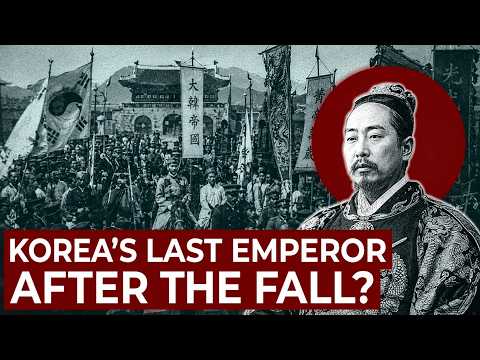
This is not just the story of one man losing a throne. This is the story of an ancient kingdom being swallowed whole, of a family turned into political hostages, and of a nation whose grief was so deep that even funerals became revolutions. And the most haunting part of all of it is that some of the last members of this royal family were still alive well into the 1980s, living out their final days in the very same palace where their ancestors once ruled, except now nobody was bowing.
To understand how Korea’s last emperor lost everything, we need to go back a bit further to the world he was born into. Because his downfall didn’t begin with a treaty or a battle. It began with a murder.
Korea in the late 1800s was a kingdom caught between giants. To the west, China’s Qing Dynasty still considered Korea a tributary state, a younger sibling in the Confucian order. To the east, Japan was rapidly modernizing after the Meiji Restoration, industrializing at a pace that stunned the Western powers and terrified its neighbors. And from the north, the Russian Empire was creeping southward, hungry for a warm water port on the Pacific. Korea, or Joseon as it was known then, sat at the exact center of all three ambitions, and it had almost no military capability to defend itself.
The man on the throne was Gojong, the 26th king of the Joseon Dynasty. He had been placed on the throne in 1863 when he was just 11 years old, handpicked by his father, the powerful regent known as the Heungseon Daewongun. The Daewongun was a fierce isolationist. He despised foreign influence and wanted Korea sealed shut from the outside world. He expelled Christian missionaries, fortified the coastline, and executed anyone who dared suggest opening the country to trade.
But Gojong’s wife, Queen Min, had other ideas entirely. She was brilliant, politically ruthless, and she understood something that the Daewongun refused to accept: Korea could not survive alone. The world was changing too fast. Western gunships were already forcing open ports across Asia, and if Korea didn’t adapt, it would be devoured. Queen Min aligned herself with the Chinese, then pivoted toward the Russians, always searching for a counterweight to Japan’s growing influence on the peninsula. And because she was arguably the most powerful political mind in the court, the Japanese considered her the single greatest obstacle to their plans for Korea.
So, they killed her.
On the 8th of October, 1895, in the pre-dawn darkness, a group of Japanese agents, soldiers, and hired swordsmen stormed into Gyeongbokgung Palace in Seoul. They were led by Miura Goro, the Japanese minister to Korea, a man who had personally commissioned the assassination. The attackers moved through the palace corridors searching for the queen. They killed three women suspected of being her, forcing a court lady under torture to identify the real Queen Min. Once they confirmed her identity, they dragged her outside and hacked her to death with swords. Then, they doused her body in kerosene and burned her remains. This was not a battlefield. This was a royal bedroom. And the people who did this were diplomats and government officials acting under the implicit authority of the Japanese state. Documents discovered over a century later confirmed what many had long suspected: that this was not the work of random writers. It was a state-sanctioned assassination carried out by Japanese intellectuals, military officers, newspaper editors, and politicians.
Now, remember Gojong’s son, Yi Cheok, the future Emperor Sunjong, was 21 years old at the time. He had been married to his first wife, Empress Sunmyeong, a woman from the same powerful Min clan as his mother. Historical accounts suggest that Yi Cheok may have been cognitively impaired from a young age, possibly from an incident where he was poisoned as a child. Some records indicate that during an earlier assassination attempt on his mother, a poisoned beverage intended for the queen was accidentally consumed by the young prince, damaging his health permanently. Whether or not this account is entirely accurate, what is clear is that Yi Cheok was never a strong or assertive figure. He was quiet, passive, and largely overshadowed by the political forces swirling around him.
His mother’s assassination, the most traumatic event of the era, galvanized Korean resistance against Japan. Guerrilla fighters known as the Uibyeong, or righteous armies, took up arms across the countryside. Gojong, terrified for his life, actually fled to the Russian legation in Seoul in 1896 and governed from there for over a year—a humiliating but pragmatic move that temporarily shielded him from Japanese pressure.
In 1897, Gojong made a bold symbolic move. He declared the creation of the Korean Empire, elevating himself from king to emperor, and renaming the country Daehan Jeguk. The message was clear: Korea was no longer a tributary of China. It was a sovereign empire, equal in status to Japan and the Western powers. Yi Cheok was appointed crown prince of this new empire. But symbolism could not stop what was coming.
In 1904, during the Russo-Japanese War, Japan invaded Korea and forced Gojong to sign a treaty allowing Japanese troops to use the peninsula as a military base and Japanese advisers to infiltrate the Korean government. The following year, in 1905, came the Japan-Korea Protectorate Treaty, known in Korea as the Eulsa Treaty. This agreement stripped Korea of its right to conduct foreign affairs and placed a Japanese Resident General in Seoul to oversee the country. The treaty was signed under extreme duress. Japanese soldiers surrounded the palace and pro-Japanese ministers were pressured into affixing their seals to the document. Gojong never personally ratified it. He considered it illegitimate from the moment it was imposed.
And Gojong was not the type of man to accept his fate quietly. In 1907, he launched one of the most audacious diplomatic gambits in Korean history. He secretly dispatched three emissaries to the Second Hague Peace Conference in the Netherlands, hoping to bring Korea’s case before the international community and have the Eulsa Treaty declared invalid. The three men—Yi Sang-seol, Yi Jun, and Yi Wi-jong—traveled under false names, funded covertly from Imperial Palace resources, evading Japanese intelligence agents who monitored every aspect of Korean government activity. They made it to The Hague, but when they arrived, the conference refused to seat them. The Japanese delegation blocked their participation, arguing that Korea, as a protectorate, had no standing to send its own representatives. The international community looked the other way. No major power intervened. Out of sheer despair, one of the emissaries, Yi Jun, died at The Hague. Korean national memory regards him as a martyr, though the exact circumstances of his death—whether from illness, grief, or suicide—remain debated.
The mission failed, and Japan’s retaliation was swift and merciless. When word of the secret mission reached Tokyo, the Japanese Resident General, Ito Hirobumi, confronted Gojong directly. He compared the emperor’s actions to a declaration of war against Japan. Pro-Japanese ministers in the Korean cabinet demanded that Gojong travel to Tokyo and personally apologize to Emperor Meiji, or abdicate. Japanese troops tightened their grip on the capital. On the 19th of July, 1907, Gojong was forced to step down. And so, the crown passed to his son, Yi Cheok, who became Emperor Sunjong, the last emperor of Korea.
His coronation was not a celebration. It was a funeral for sovereignty.
Neither Gojong nor Sunjong were present at what the Japanese described as the accession ceremony. Gojong never formally agreed to abdicate. The entire transfer of power was engineered by Japanese officials and their Korean collaborators, stage-managed to give the illusion of legitimacy. Sunjong’s reign, if you can even call it that, lasted exactly 3 years, 1 month, and 10 days. He had no power whatsoever. Every decision of any consequence was made by the Japanese Resident General. The Korean cabinet was filled entirely with pro-Japanese politicians. Sunjong was an emperor in name only, a puppet sitting on a throne that no longer meant anything.
During this time, Japan moved to dismantle what remained of Korean independence. They disbanded the Korean military in 1907, which triggered armed resistance at the Namdaemun Gate in Seoul and across the country. Disbanded soldiers joined the guerrilla resistance, and the conflict between Korean independence fighters and Japanese forces intensified. Then, in 1909, something happened that shook the Japanese establishment.
An Jung-geun, a Korean nationalist and independence fighter, assassinated Ito Hirobumi at a train station in Harbin, China. Ito had been the architect of Japan’s takeover of Korea, the man who personally oversaw the protectorate system and the forced abdication of Gojong. His assassination was celebrated by Korean nationalists but gave Japan the political cover it needed to move toward full annexation.
On the 22nd of August, 1910, the Japan-Korea Annexation Treaty was signed. The first article stated that the emperor of Korea ceded all sovereignty over Korea to the emperor of Japan. This clause officially ended the Korean Empire and erased Korea from the map of independent nations. Over 500 years of the Joseon Dynasty and 13 years of the Korean Empire were over in a single stroke of ink. There was no public announcement in Korea for a full week, no referendum, no parliamentary debate—just a handful of collaborators, surrounded by Japanese military forces, signing away the independence of 20 million people. The streets of Seoul were silent, not from acceptance, but from shock. Any attempt at public protest would have been crushed immediately by the tens of thousands of Japanese troops occupying the peninsula.
And what happened to Sunjong? He was stripped of his title of emperor and demoted to a lesser designation. The Japanese allowed him the title of King Yi of Changdeok Palace, a hollow ceremonial label that carried no authority whatsoever. He and his wife, Empress Sunjong, were confined to Changdeokgung Palace in Seoul, where they would live for the rest of their lives, essentially as prisoners. The palace that had once been the seat of royal power was now a gilded cage.
Sunjong never produced an heir. His first wife, Empress Sunmyeong, had died in 1904 at the age of 31, reportedly from severe depression following the assassination of her mother-in-law, Queen Min. His second wife, Empress Sunjong, was 20 years younger than him, and they had no children together. So, the succession passed to Sunjong’s half-brother, Yi Eun, the son of Gojong and a consort named Lady Eom.
And this is where the story of Korea’s imperial family takes its darkest turn.
Yi Eun was just 10 years old when, in 1907, the Japanese Resident-General Ito Hirobumi personally arranged for the boy to be sent to Japan. The official reason was education. The real reason was hostage-taking. By removing the Crown Prince from Korea and raising him in Japan, the colonial authorities could sever the last symbolic connection between the Korean people and the royal family. Yi Eun was enrolled in the Gakushuin, the elite school for Japanese nobility, and raised alongside children of Japan’s ruling class. He would not return to live in Korea for over 50 years.
In Japan, Yi Eun was groomed to become a loyal subject of the Japanese emperor. He entered the Imperial Japanese Army Academy, rose through the military ranks, and eventually achieved the rank of Lieutenant General. He commanded Japanese forces during the Second Sino-Japanese War and served on Japan’s Supreme War Council. On paper, he was a high-ranking Japanese military officer. In reality, he was a living symbol of Korea’s subjugation—a prince turned into an instrument of colonial propaganda.
In 1920, the Japanese arranged his marriage to Princess Masako of Nashimoto, a member of the Japanese Imperial Family. The marriage was entirely political. It was designed to further assimilate the Korean royal line into the Japanese imperial structure, to show the world that the two nations were being harmoniously unified, even though the reality was anything but harmonious. Interestingly, Princess Masako had originally been considered as a potential bride for the future Emperor Hirohito himself, but she was passed over for various reasons and instead directed toward the Korean prince. Despite the forced nature of their union, Yi Eun and Masako reportedly developed a genuine affection for each other over time.
But tragedy followed them relentlessly. Their first child, a son named Yi Jin, was born in 1921 but died in infancy under circumstances that many Koreans found suspicious. Some whispered that the child had been poisoned. A second son, Yi Gu, was born in 1931 and survived, but his life would be marked by displacement and cultural dislocation.
Meanwhile, back in Korea, Sunjong lived his final years in quiet obscurity within the walls of Changdeokgung. He was entirely cut off from political life, watched constantly by Japanese officials, and allowed almost no contact with the outside world. His father, the former Emperor Gojong, had been confined to a separate palace, Deoksugung, under similar conditions.
On the 21st of January, 1919, Gojong died suddenly at the age of 66. The official cause was a cerebral hemorrhage, but rumors immediately swept through Korea that he had been poisoned by Japanese agents. Some accounts claimed that his body showed signs of poisoning, with his teeth blackened and his body swollen. Whether the poisoning allegations were true has never been definitively proven, but the Korean people overwhelmingly believed it. And that belief became the catalyst for one of the most significant events in Korean history.
Gojong’s funeral became a flashpoint. On March 1st, 1919, 33 leaders read a declaration of independence at a Seoul restaurant, sparking the March 1st Movement. Nearly 2 million Koreans joined protests across 1,500 demonstrations. Japan’s response was brutal: thousands killed, tens of thousands arrested. Among the martyrs was 16-year-old Yu Gwan-sun, tortured to death in prison.
Sunjong died in 1926, still a prisoner in Changdeokgung. His funeral triggered the June 10th Movement, another wave of defiance. The Japanese had hoped to erase Korea’s memory, but every imperial death only fueled the fire of resistance.
After liberation in 1945, the family remained scattered. Princess Deokhye, institutionalized in Japan for 15 years, finally returned in 1962. “I miss my motherland even while I was in my country,” she said near the end. She died in 1989, the last princess of Korea.
Today, their palaces are museums, their stories a reminder that sovereignty can be stolen but spirit cannot. So, what do you think: can a nation truly heal when its royal family was erased?
Report this article
Select a reason for reporting:






