On the morning of September 1, 1939, the world awoke to a new kind of conflict—one that would not just redraw borders, but shatter the very boundaries between soldier and civilian, battlefield and home. As German tanks rolled into Poland, the fragile peace that had held Europe together for two decades collapsed, and with it, any illusion that war could be limited. This was not the war of trenches and distant front lines that the previous generation had known. This was something far more terrifying: Total War.
But how did the world arrive at this point? The seeds were sown long before the first shots were fired. In the aftermath of World War I, the Treaty of Versailles imposed harsh terms on Germany, fueling resentment and a desire for revenge. The League of Nations, conceived as a guarantor of collective security, proved powerless as aggressive nations tested its resolve. From the invasion of Manchuria to the brutal bombing of Guernica, the interwar years were punctuated by conflicts that foreshadowed the horrors to come. Each crisis normalized the unrestrained violence that would soon engulf the globe.
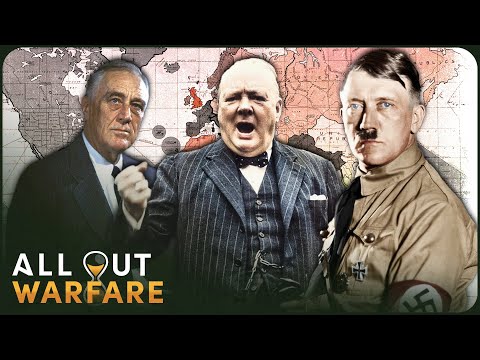
The concept of Total War was not new—Prussian military theorist Carl von Clausewitz had described “absolute war” a century earlier—but the scale and ferocity of World War II made it a devastating reality. Entire economies were mobilized, populations conscripted, and cities reduced to rubble. The distinction between combatant and non-combatant blurred as aerial bombing campaigns targeted civilians and sieges starved whole populations. Ordinary people found themselves making impossible choices, their lives mortgaged to the demands of a war that spared no one.
In the Pacific, Japan’s imperial ambitions had already ignited a brutal conflict in China, with atrocities like the Nanjing Massacre shocking the world. In Europe, Hitler’s Nazi regime pursued its ideology of racial purity and living space, leading to the Holocaust and a war of annihilation in the East. The Soviet Union, under Stalin, mobilized its vast resources and people in a desperate struggle for survival. Britain, with its empire and later American support, fought to keep the sea lanes open and bomb Germany into submission. This was a war that would be decided not just on battlefields, but in factories, on farms, and in the hearts of civilians.
As the 1930s drew to a close, the world had witnessed the failure of appeasement, the sham of non-aggression pacts, and the relentless march of aggression. The invasion of Poland was the final spark. But the story of Total War is not just one of battles and leaders—it is the story of ordinary people caught in the maelstrom, their lives forever changed by forces beyond their control.
In the following pages, we will explore how Total War unfolded across the globe, from the Blitz to the Eastern Front, from the deserts of North Africa to the jungles of Southeast Asia. We will examine the mobilization of economies and societies, the suffering of civilians, and the moral dilemmas faced by leaders and individuals alike. This is the complete story of World War II—a conflict that reshaped the world and left scars that still linger today.
To understand how the world reached this point, one must look beyond the battlefield and into the boardrooms, the factories, and the schoolrooms. The interwar years were not merely a pause between wars; they were a laboratory for the techniques of mass mobilization. Governments learned to manage economies, manipulate propaganda, and conscript not just soldiers but entire societies.
In the Soviet Union, Stalin’s Five-Year Plans transformed a largely agrarian nation into an industrial powerhouse, albeit at a staggering human cost. Millions perished in the forced collectivization of agriculture, yet the resulting industrial base would prove decisive when the German invasion came. The Soviet system was brutal, but it was built for Total War.
In Germany, Hitler’s Four-Year Plan aimed for economic self-sufficiency, or autarky, to sustain a future conflict. Yet the Nazi war economy was chaotic and inefficient, plagued by competing fiefdoms and a lack of standardization. Germany entered the war with 425 different types of aircraft and 150 models of trucks—a logistical nightmare that would haunt the Wehrmacht.
Britain, meanwhile, pursued a dual strategy of rearmament and appeasement. The Royal Navy remained the largest in the world, and the Royal Air Force was among the most powerful, but the British Army stayed small. Britain sought to fight Total War at arm’s length—using naval blockades and strategic bombing rather than conscripting millions.
France invested in defense, constructing the Maginot Line as a barrier against German invasion. But the line was a relic of trench warfare, designed for a static conflict that would never come. When the Blitzkrieg arrived, it bypassed the fortifications entirely, rendering them useless.
Across the Atlantic, the United States clung to neutrality, wary of foreign entanglements and still recovering from the Great Depression. Yet even as isolationist sentiment prevailed, President Roosevelt began to shift American industry toward defense production. The Lend-Lease Act of 1941 would transform the nation into the Arsenal of Democracy, supplying Britain, the Soviet Union, and China with billions of dollars in aid.
But the road to war was paved with missed opportunities and broken promises. The League of Nations, stripped of American participation, proved incapable of enforcing collective security. Japan’s invasion of Manchuria, Italy’s conquest of Ethiopia, and the Spanish Civil War each demonstrated that aggression would go unpunished. By the time Hitler turned his gaze eastward, the world had already grown accustomed to the unthinkable.
When the war finally came, it came to everyone. The bombing of cities, the starvation of sieges, the forced labor of millions—these were not aberrations but deliberate strategies. Total War meant that no one was innocent, and no one was safe.
The German invasion of Poland in September 1939 was not merely a military campaign; it was a template for the total war that would consume the world. Within weeks, the Polish army was shattered, and the country was divided between two totalitarian powers: Nazi Germany and the Soviet Union. The speed of the collapse stunned the world, but the brutality that followed—the systematic murder of Polish elites, the forced relocation of millions, and the establishment of ghettos for Jewish populations—signaled a new kind of conflict, one where the civilian was as much a target as the soldier.
For the next eight months, the war in the West settled into an uneasy quiet that some called the “Phoney War.” But this pause was not peace—it was the calm before the storm. In April 1940, Germany struck north, invading Denmark and Norway. Denmark fell in a day, its government choosing surrender over destruction. Norway fought on, aided by British and French troops, but the German war machine proved unstoppable. The Wehrmacht’s combination of air power, armor, and speed—the Blitzkrieg—overwhelmed every defense it encountered.
Then, on May 10, 1940, the storm broke over Western Europe. German forces poured into the Netherlands, Belgium, and Luxembourg, and then, in a move that shocked the Allies, through the Ardennes Forest—terrain the French had deemed impassable for tanks. The Maginot Line, France’s great defensive barrier, was outflanked entirely. Within days, German panzers reached the English Channel, trapping the British Expeditionary Force and French armies in a pocket around Dunkirk.
The evacuation from Dunkirk, Operation Dynamo, was a desperate gamble. Over 338,000 Allied soldiers were rescued by a flotilla of naval vessels and civilian boats—a “miracle” that saved the army but could not save France. On June 22, 1940, France signed an armistice with Germany, and the country was divided into an occupied zone in the north and a collaborationist regime in the south, headquartered in Vichy.
Britain now stood alone. Churchill’s defiant speeches rallied the nation, but the threat of invasion was real. Hitler’s air force, the Luftwaffe, launched a massive campaign to destroy the Royal Air Force and gain air superiority over the Channel. The Battle of Britain raged through the summer and autumn of 1940, with British fighter pilots—Churchill’s “Few”—scrambling day after day to intercept German bombers.
The Luftwaffe failed to break the RAF, and Hitler postponed his invasion plans indefinitely. But the bombing did not stop; it merely shifted targets. From September 1940 to May 1941, German bombers pounded London and other British cities in the Blitz, killing over 40,000 civilians and destroying vast swaths of housing. The British people endured, their morale unbroken, but the experience foreshadowed the horrors that would soon be visited upon German cities in return.
Meanwhile, in the East, Hitler was preparing his greatest gamble. Operation Barbarossa, the invasion of the Soviet Union, was launched on June 22, 1941—the largest land invasion in history. Three million Axis soldiers, supported by thousands of tanks and aircraft, surged across a front nearly 2,000 miles long. Stalin, despite warnings, was caught off guard. The Red Army, weakened by purges and poor leadership, collapsed in the face of the German onslaught.
Within weeks, German forces had encircled Leningrad, reached the outskirts of Moscow, and seized Kiev. But the Soviet Union did not break. As the Germans advanced, the Soviets evacuated entire industries eastward, dismantling factories and rebuilding them beyond the Ural Mountains. This herculean effort, combined with the vastness of the country and the onset of the brutal Russian winter, would prove decisive.
The war in the East was fought with a ferocity unmatched elsewhere. Both sides understood that this was a war of annihilation. German forces treated Soviet civilians and prisoners of war with appalling cruelty, starving them, executing them, and deporting them for forced labor. Millions of Soviet POWs died in German captivity—a crime that would be addressed at Nuremberg. The Soviet Union, in turn, mobilized its entire society for the war effort, conscripting women into combat roles and partisans into the forests behind German lines.
The siege of Leningrad, which began in September 1941 and would last nearly 900 days, became a symbol of civilian endurance. Cut off from all supply routes except across the frozen Lake Ladoga, the city’s population faced starvation, cold, and relentless bombardment. An estimated 650,000 civilians died in Leningrad alone, most from hunger. Yet the city never surrendered.
As 1941 drew to a close, the war had truly become global. On December 7, Japan attacked Pearl Harbor, bringing the United States into the conflict. Four days later, Germany declared war on America. The stage was set for a conflict that would consume the entire world, and the concept of Total War would reach its fullest and most terrible expression.
As the war entered its final year, the Allies closed in from east and west, and the full accounting of Total War’s cost came into view. Factories that had once built cars now rolled out tanks by the thousand; women who had never worked outside the home now welded hulls and loaded shells. The boundaries between soldier and civilian had dissolved so completely that no one could say where the battlefield ended.
In the Pacific, island after island fell in brutal amphibious assaults, while in Europe the firestorms of Hamburg and Dresden and the firebombing of Tokyo demonstrated that the bomber would always get through—and that no city was safe. When the atomic bombs fell on Hiroshima and Nagasaki in August 1945, the logic of Total War reached its ultimate conclusion. Japan surrendered, and the deadliest conflict in human history came to an end.
The aftermath was a world of ruins and refugees, of tribunals and new institutions built on the hope that such horror would never repeat. The United Nations, the Geneva Conventions, the Marshall Plan—each was a response to the devastation Total War had wrought. Yet the scars remained, in bodies and minds, in cities rebuilt on the bones of the dead, in families forever incomplete.
Total War had revealed both the best and worst of humanity: courage and cruelty, sacrifice and savagery, all on a scale the world had never seen. The question it left behind was not whether such a war could happen again, but whether humanity had truly learned its lessons.
What do you think—has the world truly learned from the age of Total War, or are we simply waiting for the next storm?
Report this article
Select a reason for reporting:






