Imagine stepping into the boots of a World War II hero—not just on screen, but in life. For the actors of Band of Brothers, that unimaginable honor became a reality, forging friendships that would last a lifetime. These weren’t mere portrayals; they were transformations, fueled by the real men who lived through the horrors of war. In this video, we uncover ten of these extraordinary bonds, from the first handshake to the lasting legacy that changed both veteran and actor forever.
What sets Band of Brothers apart from other war dramas is the profound connection between the cast and the real-life soldiers they embodied. Before filming even began, actors like Peter Youngblood Hills traveled to remote corners of America to meet their counterparts, forging bonds that would transcend the screen. These weren’t just research trips; they were pilgrimages into the past, where the echoes of war still lingered.
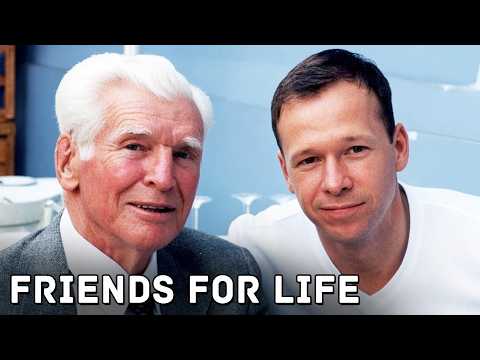
Take Peter Youngblood Hills, who portrayed Sergeant Darrell “Shifty” Powers. He journeyed to Clinchco, Virginia—a town so remote that Shifty’s backyard served as a shooting range without complaint from neighbors. There, Shifty welcomed him with his M1 Garand rifle, offering shooting lessons despite his failing eyesight due to macular degeneration. Peter is believed to be the only cast member to have fired live ammunition from an M1 Garand, a testament to the authenticity of his preparation. But it was more than training; it was a bonding experience that went beyond the battlefield.
Peter spent so much time with Shifty that he even stayed at his home. Growing up just an hour away in the mountains of northeast Tennessee, Peter felt a kinship with Shifty, both sharing Cherokee heritage. They would sit on the porch, listening to Shifty’s war stories, including the pride of his father when he shot his first squirrel—a tale that highlighted the marksmanship that defined Shifty’s service.
As Peter learned more about Shifty, he became fiercely protective of the man he was portraying. When a scene in Episode 6 called for Shifty to sing in a foxhole in Bastogne, Peter refused to do it. “Because I know Shifty’s time in those foxholes was not a good time for him, or anyone,” he said. “I didn’t think it was right for him to be shown in that scene. I was responsible for telling his story.” He spoke to the producers and was ultimately written out of much of that episode—a decision that underscored his commitment to honoring Shifty’s true experience.
Interestingly, some of Peter’s dialogue was taken directly from Shifty’s own words, like the line in Episode 7: “My dad could shoot the wings off a fly.” Peter recalled, “That was literally from Shifty’s mouth. He actually said that.” The bond between them grew so strong that Shifty’s daughter Margo became friends with Peter’s mother. Peter and Shifty remained in touch, their connection deepened by shared heritage and mutual respect.
But the most poignant moment came on the day Shifty passed away. Peter recounted strange occurrences: a coyote appeared in his yard, trying to cross the road but constantly interrupted, eventually turning back. Later, he noticed odd characters loitering around a restaurant and a movie theater—coincidences that aligned with Shifty’s sense of humor. “It was like Shifty sent these ‘shifty characters’ to let me know he’d crossed over,” Peter reflected. Soon after, he received a text from Ian Bailey confirming Shifty’s death. The next day, Peter saw the coyote again, crossing the road successfully. “I thought, ‘Okay, he found his way,'” Peter said. Since then, coyotes have held a special meaning for him. “Wherever I go, they seem to call out, and I always think, ‘Okay, that’s old Shifty. He’s watching over us.'”
Damian Lewis faced a different challenge portraying Major Dick Winters, the backbone of Easy Company. When Winters learned of Lewis’s casting, he remarked, “Oh God, he’s skinny and speaks with an English accent—they couldn’t even find a blonde guy.” Despite the initial skepticism, Lewis was determined to earn Winters’s respect. He was given copies of Winters’s memoirs, which he still treasures. Their first phone call during boot camp was just the beginning; Lewis had to prove himself worthy of portraying a legend.
When Winters visited the set in London for ten days, the two spent hours talking, with Winters sitting right beside Lewis. “This guy was studying me intently,” Winters recalled. Lewis asked countless questions, but Winters was reluctant to discuss the more intimate details of his war experiences. Lewis realized that Winters was highly respected and that he would have to earn that respect in return. The visit was emotionally taxing for Winters, who found it overwhelming to see the accurate historical settings and actors in costume. “I should have stayed longer, but it was too emotional,” he admitted. “The memories it brought back and the realization of what we were doing here, recreating all this, was very emotional and upset me.”
As filming progressed, Tom Hanks sent Winters each episode on videotape for his critique. Winters would watch, take notes for Hanks, and then lock the tape in a safe deposit box to ensure no one else saw it. Winters began to warm to Lewis, often telling him, “Just stand strong.” In the foreword to Winters’s memoir, Biggest Brother, Lewis wrote: “Once we gained his trust, I found a warmth, a surprisingly dry sense of humor, and a willingness to listen that we rarely find in people of influence.” After filming, Lewis visited Winters at his home in Hershey, Pennsylvania, where they shared lunch at Winters’s favorite local restaurant, the Gingerbread Cafe. Winters then took Lewis to his favorite room—his upstairs office, a shrine to his time with Easy Company. Lewis sat in the same leather chair that author Stephen Ambrose had sat in a decade earlier. “We chatted and joked, and he showed me some of his memorabilia,” Lewis said. Winters also gave him a tour of their beautiful farm, which Lewis noted was another great achievement in Winters’s life. “He treated me like a son and told me he thought I did a good job portraying him, though he wasn’t sure at first,” Lewis recalled. “I thought, ‘Yes, that’s it.’ A leader, a mentor, and honest all at once. I felt immense pride in having the opportunity to portray this man, a decorated war hero who entrusted me with his story.”
But the weight of that responsibility was not lost on Lewis. He understood that Winters’s relationship with the series was complicated. “I think Dick’s relationship with Band of Brothers was conflicted at times,” Lewis reflected. “I think he was immensely proud that Easy Company’s achievements were broadcast around the world in this way, but it made them all minor celebrities. And though Dick was a proud man, very proud of what he’d done, the noise of fame wasn’t comfortable for him.”
Yet Winters continued to share the story, driven by a sense of duty to the men beside him and to the memory of what they achieved together. “That was the man he was,” Lewis said. “He remained a leader until the moment he died.” When Dick Winters passed away in 2011 at the age of 92, Lewis wrote a heartfelt tribute: “It’s a sad day today. Major Richard Winters, who was without doubt one of the greatest heroes of World War II, has died. His story and those of the men of Easy Company became famous through HBO’s extraordinary Band of Brothers. I was honored to play, indeed to portray, him on screen.”
Lewis continued: “He was generous in his support of the project and of me personally. He welcomed me into his home in Hershey, introduced me to his loving wife Ethel, and constantly urged me to stand strong. He passed quietly and privately, without fanfare, with the same humility with which he lived his life as one of the most famous soldiers of his generation. I will miss him and thank him. Currahee.”
For Neal McDonough, portraying Lieutenant Lynn “Buck” Compton in Band of Brothers always held a very special place in his heart. Not only did he form a close friendship with the real Buck Compton, but the miniseries was also how he met his wife, Ruve Robertson, a South African model and PR specialist who was working in London at the time of filming. “I’m incredibly lucky,” Neal said. “The first night I arrived in town to film Band of Brothers, I met my wife.”
Since their marriage, Neal has honored his wedding vows by including a clause in his contracts that prevents him from accepting any roles requiring him to kiss another woman on screen. It’s a decision that has cost him many job opportunities, but he has never wavered or regretted it. Neal and Ruve have been married for over 22 years and today have five children.
Neal McDonough first met Buck Compton a few months before filming began. He recounted that moment in the afterword he wrote for Buck’s memoir, Call of Duty: My Life Before, During, and After Band of Brothers. “I wanted to meet Buck in person, so I flew to Washington State where he lives,” Neal wrote. “I arrived in the morning and called Buck. He offered to meet for breakfast at a restaurant. He said he’d already eaten but would eat again with me. I had never seen a picture of him, yet when he walked into the restaurant, I knew instantly it was him.”
Buck shook his hand with massive hands the size of canned hams and ordered a five-egg omelet; his appetite for breakfast reflected his appetite for life. They talked for a while. “Buck is a very direct, no-nonsense guy,” Neal recalled. “Time and again, he would say he was just doing his job. These days, my God, people celebrate humility in excess. Every small achievement is met with self-congratulation. People always want attention for any above-average work. Yet Buck excelled at everything and downplayed his achievements as if they were nothing.”
Buck never said, “Look at me.” “If you do great work, that doesn’t mean you’re great,” Neal learned. “That’s something I learned from Buck. Any time I start boasting about myself, I feel Buck standing at my shoulder saying, ‘What are you doing?'”
Besides their relatively similar appearance—both standing six feet tall—they also shared a love of baseball, having both played in college. Buck Compton played for UCLA, and Neal McDonough for Syracuse University. “During filming, I called Buck several times,” Neal recalled. “I probably drove him crazy with my questions. How did you wear your cap? To the left or right? Which weapon did you prefer? Who did you spend time with among the men?” Buck was very cooperative on many things.
After the series ended, Neal and Buck stayed in touch and continued to visit each other. “I always call Buck on certain days, including the Fourth of July,” Neal said in a 2010 interview with Black Sky Radio. “It’s always wonderful to hear his voice. He’s a tough old guy. He’s truly an exceptional person. He changed my life in more ways than I can express.”
Neal also pointed out the striking parallels between Buck’s career and the roles he himself took on after Band of Brothers. “It was funny—after I played Buck, who played college baseball and then became a police officer, my next role was a police officer in Minority Report,” Neal said. “And then I became an assistant district attorney. My next role was playing an assistant district attorney in Los Angeles, just like Buck did in Boomtown. So it’s really funny how Buck’s career and my career literally intertwined and became very familiar and similar. So, it’s fate, no doubt about it.”
In December 2025, marking the 25th anniversary of filming Band of Brothers, Neal McDonough wrote: “Twenty-five years ago, I had the great honor of portraying Buck Compton in Band of Brothers. It changed my life in many ways, and after a hundred films since, Band of Brothers is still what changed my life enormously. But also, getting to portray a real American hero like Buck Compton and to know him personally was a bright spot in my life.”
He continued: “After World War II, my father came from Ireland and went straight to the Army office and said, ‘I want to become an American.’ They sent him overseas for seven years, and he returned the proudest American you could ever imagine. He instilled those values in his six children, and today I am proud to have had men like these in my life to guide me so that I could instill those values in our children. God bless all the men and women who have served our country and given us the freedoms we enjoy today.”
In the afterword to Buck Compton’s memoir, written while Buck was still alive, Neal wrote: “I would do anything in the world for Buck Compton. It was an absolute honor to portray him in Band of Brothers, and that’s the least I can say. Buck never likes to be called a hero, but that’s what he represents to me.” He didn’t just serve his country faithfully in war; he achieved extraordinary things in his life. “When you look at the scope of what he accomplished—college sports star, paratrooper, detective, lawyer, and judge—doing any one of these is an achievement in itself. But Buck did them all. Personally, I owe a lot to Buck. Portraying him was my big break as an actor. And I wouldn’t have met my wife, Ruve Robertson, if it weren’t for Buck. My life today is full of blessings, and Buck played a big part in that.”
On the ninth anniversary of Buck’s death, Neal said: “It’s hard to put into words what Buck Compton means to me. This man not only changed my career as an actor but, more importantly, helped change my life as a human being. It’s hard to believe it’s been nine years since he passed, but he’s not really gone. He’s always in my mind, in my heart, and in my soul.”
Frank John Hughes first called Bill Guarnere in November 1999. “Just remember, you were a hired killer,” Bill told him. That advice shaped Frank’s performance. They spoke over 250 times during production. Frank even dug foxholes in his backyard to prepare.
Bill and Babe Heffron visited the set in England. Frank met them at the airport in uniform. “It was the first time they could touch the source,” Frank said. After the series, Frank and Bill remained close. They visited VA hospitals together and traveled to Vegas. “He was a dear friend and a hero of mine,” Frank said.
Robin Laing portrayed Babe Heffron. Babe gave Robin his WWII scapular. “You need to take this with you through the war now,” Babe told him. Robin wore it every day of filming. They stayed friends until Babe’s death in 2013. Robin remains close with Babe’s daughter, Trish.
Michael Cudlitz played Bull Randleman. He spoke with Bull’s wife Vera, who shared invaluable details. “She was a lovely, lovely woman,” Michael recalled. They remained close until her death. Scott Grimes portrayed Don Malarkey. Their first calls were tough, but they bonded over a simple question: “Did you smoke?” “Like a chimney,” Malarkey replied. That broke the ice.
James Madio played Frank Perconte. He wrote a letter instead of calling. Frank called back, and a friendship bloomed. “He was a good man, and I mean that,” James said. They traveled to Europe together for a reunion tour. James became an advocate for veterans.
These bonds extended beyond the veterans. The actors themselves became a band of brothers. “We are family,” Frank John Hughes said. They still gather at reunions, honoring the men who inspired them.
As Peter Youngblood Hills shared the prayer read at Shifty’s funeral: “We remember them. As long as we live, they too shall live, for they are a part of us forever as we remember them.” What friendship in your life has been shaped by a shared story of sacrifice and honor?
Report this article
Select a reason for reporting:






