September 20, 1942. Naval Air Station North Island, San Diego. The Japanese characters on the instrument panel stared back at him like a challenge. The cockpit smelled of strange oil and unfamiliar metal. Outside the hangar, armed guards stood watch over a secret that had taken three weeks of round-the-clock work to protect. This single aircraft—repainted with American stars while still bearing its Japanese frame inside—was about to answer the question that had haunted every carrier pilot in the Pacific for eight straight months.
How do you kill something that always turns tighter than you, climbs faster than you can follow, and vanishes before your guns can track it?
Commander Eddie Sanders released the brakes. The engine ran smooth, almost gentle. It did not resemble the snarling monster pilots had described after watching it tear their comrades from the sky. Within an hour, this test flight would expose two hidden flaws buried deep inside the aircraft every American pilot in the Pacific had learned to fear—flaws no combat report from the fleet had ever caught. What Sanders learned in the skies over San Diego would help shape a new American fighter into a machine that hunted this very aircraft for two more years of war with a kill ratio few air forces in history have ever achieved.
None of it would have been possible without a dead Japanese pilot who never intended to give America anything.
The transformation did not begin in that hangar in San Diego. It began five months earlier on a rain-soaked island in the Aleutians, thousands of miles from any headline, where a young Japanese pilot made his final landing without knowing it would be his last.
June 4, 1942. Three hundred miles to the west, American dive bombers were tearing apart four Japanese carriers at Midway—a day that would change the course of the war entirely. But in the Aleutian Islands off Alaska, a smaller drama was unfolding that would prove no less important, though no one would know its details for years.
Petty Officer First Class Tadayoshi Koga was nineteen years old. He had launched his Zero that morning from the carrier Ryujo as part of a diversionary strike meant to pull American attention away from Midway and toward the frozen edge of Alaska. His target was the American base at Dutch Harbor. Like the other young men flying that morning, he had trained for years to reach this cockpit, selected from thousands of applicants for his sharp eyesight and steady hands. And like most of them, he had never once doubted the aircraft he flew.
The Zero was the pride of the Imperial Navy—a fighter that had swept aside every Allied aircraft it met since the first hours of the war. Koga had every reason to believe this day would be no different.
Below him, the landscape unfolded in shades of gray and green—treeless volcanic hills wreathed in cloud, a cold sea crashing against black rocks. It was terrain that offered no comfort to a pilot who went down over it. No shelter, no warmth, nothing but wind and vast distances in every direction.
The mission began exactly as planned despite the terrain. Koga and his two wingmen, Chief Petty Officer Makoto Endo and Petty Officer Togo Shikada, swooped low over Dutch Harbor and tore the base apart. They shot down an American PBY Catalina patrol bomber and strafed the men struggling in the freezing water below with a hail of bullets—tracers cutting through foam that was barely above freezing. The Zero performed exactly as its designers intended: faster and more agile than anything the Americans could send to answer.
For a few violent minutes, the three young Japanese pilots owned the sky over Dutch Harbor completely.
Then a single bullet changed everything.
Ground fire erupted from Dutch Harbor—likely from a .50-caliber machine gun—pierced Koga’s Zero and severed the oil return line. In an engine that depended on precise, continuous lubrication, that single hit was a slow-motion death sentence. Oil began spraying from the cut line, and Koga knew immediately he had perhaps fifteen minutes before the engine seized completely.
He radioed his flight leader about the damage, then turned east toward Akutan Island, twenty-five miles from Dutch Harbor—a point mission planners had designated in advance as an emergency landing site. A Japanese submarine waited offshore, ready to rescue pilots who went into the water.
Inside his cockpit, the fumes of burning oil grew thicker by the minute, the engine’s pitch changing slightly. Only a pilot who trusted his machine completely would have noticed. Koga had about a quarter of an hour to find solid ground before the engine froze entirely and his fighter became a glider over open water.
As Koga approached Akutan, he spotted what looked like a gift from fate—a long, flat stretch of green grass half a mile inland from the coast. The kind of field a pilot dreams of when his engine is dying beneath his seat. His wingmen circled above as he prepared for what should have been a routine landing, lowering his gear and adjusting his speed for a slow final approach over ground that looked from three hundred feet as solid as any airfield back home.
Then on his second pass over the site, Shikada noticed something wrong. Water was glinting between the clumps of grass below, reflecting light in a way solid ground never could. What looked like a meadow was actually a marsh—a layer of vegetation hiding knee-deep mud and stagnant water. A trap laid entirely by geography and bad luck.
He tried to send a warning by radio. But it was too late. Koga had already begun his landing. Gear down, throttle back. There was no choice now but to ride it to the end.
Koga’s wheels touched the grass at nearly eighty miles per hour. For one brief moment, the landing seemed fine. Then the main landing gear sank into the soft earth beneath the grass and caught hard, and physics completed what the bullet had started. The lightweight fighter flipped, its tail still carrying landing speed, in a violent somersault, and slammed upside down into the marsh.
The impact broke Koga’s neck instantly. He died before he could take another breath. His body hung from the inverted cockpit harness. His pistol and sword were still strapped to his waist. His uniform was still neatly pressed except for the medical tape wrapped carefully around his torso.
Above the crash site, Endo and Shikada faced a decision no young man should ever have to make about a friend. Military orders were clear: any disabled Zero must be destroyed before it fell into enemy hands. Its secrets buried with the wreckage in a nameless marsh. They circled the swamp again and again, weapons ready, searching for any sign that Koga had survived—any flicker of movement near the inverted cockpit. But the aircraft looked almost intact from the air, resting upside down in the mud like a turtle on its back, wings unbroken and fuselage untwisted. It did not look like wreckage. It looked like a machine that might simply need to be turned right-side up again.
They could not bring themselves to open fire on that sight. Perhaps he was alive down there. Perhaps he was trapped in the cockpit, injured but breathing, staring up through the glass canopy at the two friendly shapes circling overhead, waiting for a rescue that might come. Neither could bear the thought of ending a friend’s life on the slim chance he was still alive. They made several more passes as fuel ran low, then turned west back toward Ryujo, empty-handed in every way that mattered, carrying only the weight of a decision that would haunt them with doubt for the rest of their lives.
The submarine sent to recover downed pilots searched the coastal waters near Akutan for hours before being driven off by the American destroyer USS Williamson. Koga’s body and his aircraft remained in the Aleutian wilderness, five thousand miles from Japan, carrying secrets that would ultimately help destroy the very air force he died defending.
For five weeks, no one touched the wreckage. The crash site was too far from shipping lanes and regular air patrol routes, hidden in a small valley that saw only six days of clear visibility per month. Through the near-permanent Aleutian fog, rain fell on the inverted fighter almost daily, drumming on the exposed belly of the fuselage, pooling in the marsh around the broken cockpit. Bering Sea winds worked the fabric control surfaces night and day. No search party came. No submarine returned. The Japanese carrier forces that could have organized a real search had already withdrawn west after the disaster at Midway. Their attention was fixed on far greater losses than a single missing fighter pilot. The fate of a nineteen-year-old became just another line in a casualty ledger. In a war turning sharply against the nation he served, his name was filed by clerks who never saw him and would never know exactly where he lay.
There is a special kind of silence that settles over a place where something terrible happened and no one remained to mourn it properly. The Aleutian island held that silence for thirty-five days. No birds nested near the wreckage. No fishing boats passed close enough to notice the strange shape half-buried in the marsh grass. The only witnesses were the wind, the tide, and the slow, patient work of rust beginning to spread through exposed metal joints. Somewhere beneath the inverted cockpit, Koga’s body remained exactly where the crash had left it—still in his flight suit, still carrying his personal weapon and sword, a young man frozen in the moment his war ended.
None of the men who flew away from Akutan that evening would ever know what they left behind. They believed they had honored a friend by refusing to destroy his body with his aircraft. In truth, that single act of mercy would help inflict on their country the only advantage it still possessed in the skies over the Pacific—an advantage built entirely on secrecy, and on an enemy who did not yet understand the machine he was fighting.
Every American pilot who had faced the Zero since Pearl Harbor carried the same silent fear—that this enemy fighter simply could not be beaten on its own terms. It turned tighter, climbed faster, and appeared out of nowhere at the worst possible moment. That fear shaped tactics, doctrine, and morale across the entire Pacific Fleet, and it happened without a single intact Zero ever falling into American hands.
Somewhere in that quiet, fog-choked valley, a fighter that had terrified Allied pilots since the first morning of the war waited undiscovered—intact enough to fly, patient in a way no living thing could be. The marsh that killed Tadayoshi Koga had also, without intending to, preserved the very evidence that would help defeat the empire he served.
All it required was one American pilot to stray slightly off course on a day when the fog lifted just long enough to reveal something that did not belong among the grass and stagnant water of an island most maps never bothered to name.
On July 10, 1942, a Catalina patrol plane under Lieutenant William Thies did exactly that. Through a momentary break in the clouds, his crew spotted a shape in the marsh below—sharp angles and strange geometry that did not belong. The bright red circles painted on the wings were unmistakable even from altitude. Within hours, a recovery team stood at the crash site, staring in disbelief at what would become the greatest intelligence prize of the Pacific War to that point.
The marsh had acted as a massive shock absorber, distributing the violent forces that would have shattered the airframe on solid ground. Apart from a cracked windscreen, bent propeller blades, broken landing gear, and some wingtip damage, the fighter was essentially intact—a near-complete specimen of the aircraft that had terrified American pilots since the first morning of the war.
They gently removed Koga’s body from the cockpit and buried him with military honors on a hill overlooking the crash site, noting the medical tape wrapped carefully around his torso—evidence of an earlier injury he had likely been flying with. His pistol and sword were taken and classified as intelligence material. Then came the truly hard part: extracting an entire fighter from a muddy marsh with little more than human muscle, wooden rollers, and relentless determination.
The recovery took nearly three weeks of brutal labor in one of the least forgiving environments on Earth. Sailors built a temporary road of timber and planks, then dragged the captured fighter across half a mile of treacherous, waterlogged ground toward the coast where it could finally be loaded onto a barge. The entire operation ran in constant wet cold, with equipment rusting and freezing overnight, and hands numbing around frozen tools. Yet no one assigned to the task needed to be told the value of this single aircraft.
By late July, the Zero was loaded aboard a freighter bound for the United States, sailing south through waters that had been a battleground of clashing fleets only weeks before. It arrived in Seattle on August 1, 1942, then was transported by barge down the coast to Naval Air Station North Island near San Diego, arriving in mid-August under a blanket of strict military secrecy. Military police provided round-the-clock guard to keep curious sailors and souvenir hunters away from the hangar where the real work was about to begin.
Word of the capture spread through naval aviation like an electric current. For the first time since the Zero’s devastating debut at Pearl Harbor, American engineers and pilots could finally examine the legendary fighter up close, piece by piece, instead of studying wreckage or secondhand combat reports. Captain William Leonard, who later commanded an air group aboard a carrier in the Pacific, described it as a treasure trove that revealed many secrets at a time when those secrets were needed most.
Lieutenant Commander Kenneth Walsh, who survived the war as an ace with twenty-one confirmed victories, said that knowing exactly how to react when a Zero was behind him—knowledge drawn directly from this captured aircraft—had saved his life more than once.
Restoration proceeded at a pace dictated by desperate necessity. Every day the fighter sat idle in that San Diego hangar was another day American pilots continued to face an enemy they did not fully understand. Engineers worked around the clock to document every rivet and fitting carefully even while repairing crash damage, because this aircraft was not merely a machine to fly again. It was a textbook waiting to be read.
What they found taught them as much about Japanese engineering philosophy as any test flight could. One engineer noted that the Zero was designed with the precision of a Swiss watch—flush rivets everywhere, guns mounted flush with wing surfaces to minimize drag. Every component was engineered for minimum weight and maximum efficiency, sometimes at direct cost to durability. The instrument panel was starkly simple, almost ascetic—no unnecessary gauges, nothing to distract the pilot from the few readings that actually mattered in combat. Inspection panels opened with a simple finger press at a specific point, releasing hidden latches. The entire aircraft was designed to be maintained with minimal tools on primitive island airstrips thousands of miles from any real depot.
The numbers told their own story. Fully loaded, the Zero weighed between 5,300 and 6,165 pounds, depending on fuel and ammunition—roughly 2,000 pounds lighter than the American F4F Wildcat. Its performance in combat was humiliating. That weight savings came from choices no American designer would have accepted. There was no armor to protect the pilot. No self-sealing fuel tanks, meaning a single well-placed hit could turn the aircraft into a fireball in seconds. The airframe had just enough strength for expected flight loads, with almost no safety margin for the brutality of actual combat. It was a fighter built entirely on the philosophy of winning through agility rather than surviving through toughness—a bet that Japanese pilots would simply not be hit in the first place.
By September 20, 1942, just forty-one days after its arrival in San Diego, the restoration was complete. Engineers replaced the shattered windscreen, straightened the tail and rudder, rebuilt the crushed landing gear, and repainted the entire aircraft. New American blue circles and white stars covered the red Japanese markings. It looked, as one witness put it, like an American plane wearing Japanese clothes underneath.
Commander Eddie Sanders, chosen as the project’s chief test pilot, had spent the previous week sitting in the cockpit for hours on end, memorizing the layout of the unfamiliar Japanese instruments and controls, preparing himself mentally for a flight unlike any he had ever experienced. If the combat reports from the fleet were accurate, this aircraft could outclimb, outturn, and outrun anything he had ever flown. And if those reports were wrong—or if the crash had left some hidden, undiscovered damage in the airframe—Sanders might not survive his first flight in this machine.
On the morning of September 20, Sanders climbed into the cockpit for the first time as a pilot rather than a student. The engine ran smoothly and settled into idle with steady confidence, proving that the restoration team’s hard work had paid off. Sanders taxied the aircraft toward the runway, fully aware that engineers, intelligence officers, and senior Navy commanders were watching from the tower and flight line, waiting to learn what this captured enemy would reveal.
He pushed the throttle forward, and the lightweight fighter leaped down the runway with startling eagerness, lifting off after a remarkably short run and climbing at a rate that would have impressed any pilot in any American aircraft.
Over the next hour, he carefully explored the aircraft’s flight envelope, testing stall behavior, executing basic maneuvers, and slowly building a feel for how the machine actually handled in the air rather than merely on paper. What he discovered that morning—and across twenty-four separate test flights over the following twenty-five days—would rewrite the rules of air tactics for the entire Pacific War.
Almost immediately, Sanders noticed that the ailerons stiffened dramatically at speeds above 200 knots, roughly 230 miles per hour, making the aircraft sluggish and heavy in roll and requiring enormous physical force on the control stick. At low speed, the Zero remained exactly as Japanese pilots had described it—able to outturn any American fighter with minimal effort. But once past that critical speed threshold, the fabric-covered control surfaces ballooned under air pressure, and roll maneuvers that should have taken an instant became a wrestling match against the controls themselves. American fighters with metal-skinned surfaces maintained full control authority at every speed in their range.
Sanders discovered a second, equally dangerous weakness during negative acceleration. Whenever he pushed the stick forward sharply, the Zero’s engine coughed and quit entirely for several seconds, starved of fuel by a float-type carburetor that simply could not function properly under negative-G forces. The engine restarted the moment positive acceleration resumed. But during those few seconds, the most feared fighter in the world became nothing more than a heavy, silent glider.
The tactical implications were immediate and obvious to Sanders as he recorded his findings. American pilots being chased by a Zero that outmaneuvered them finally had a real answer. “Go into a sharp dive using negative-G whenever possible,” he wrote, to open distance while the Zero’s engine sputtered and died. Near 200 knots, break hard right before the pursuing pilot could bring his guns to bear, exploiting the aileron stiffness that had nearly cost Sanders his composure on that first flight.
Over the following weeks, Sanders fought mock dogfights against American fighters flown by other test pilots, systematically mapping the complete picture of the Zero’s strengths and exploitable weaknesses. Once his report was assembled, it was distributed across the fleet with unprecedented urgency. Pilots preparing for combat received detailed briefings built entirely on Sanders’s findings. Instructors incorporated the high-speed dive and hard right break directly into training programs for every new pilot heading to the Pacific. Veterans who had already survived encounters with the Zero learned for the first time exactly what they were fighting and how to beat it precisely.
That knowledge reached the engineers at Grumman just as they were putting the final touches on their new fighter’s configuration. The timing was not deliberate. It was simply fortunate. The aircraft’s basic shape, engine, and general dimensions had been settled months earlier, but production had not yet begun in earnest, meaning there was still a narrow window to refine the design based on confirmed data rather than rumor and fear.
The Grumman team studied the physical evidence from the captured Zero with intense focus. The Zero, at just over 6,000 pounds fully loaded, would face a new American fighter weighing over 12,000 pounds—more than double—a gap that could only be bridged by raw engine power and disciplined design. Where the Japanese aircraft sacrificed protection for performance, Grumman’s engineers made the exact opposite bet, refusing to sacrifice pilot armor, self-sealing fuel tanks, or a rugged structure merely to save weight. That additional size was met with the brute force of the R-2800 engine and by meticulous engineering free of compromise.
That decision shaped everything that followed. The new fighter’s ailerons were designed with metal skinning and hydraulic boost, ensuring full responsiveness at the high speeds where the captured Zero stiffened in Sanders’s hands. The fuel system used a pressure carburetor rather than the float type, so the engine would keep running smoothly through the very negative-G maneuvers that stopped the Japanese fighter cold in the air. Its structure was built to withstand the punishing high-speed maneuvers that would have torn the fragile Zero apart, meaning American pilots could fly aggressively without fear of breaking their own aircraft in the process. Six .50-caliber machine guns replaced the Wildcat’s four, giving American pilots the concentrated firepower needed to shred an aircraft with no armor and no self-sealing tanks in a single burst. The cockpit was placed higher on the fuselage, exactly as O’Hare had urged in April, giving pilots a clear forward view to spot threats before they could ambush from behind.
None of these choices was dictated by the captured Zero alone, but every one of them was refined, confirmed, or improved based on what Sanders learned in that cockpit over San Diego.
On October 3, 1942, just two weeks after Sanders completed his first round of test flights, the first production version of the new fighter—designated the F6F Hellcat—flew for the first time. Grumman built an entirely new factory in Bethpage specifically to produce the Hellcat, and completed aircraft began rolling off the line before the building itself was finished around them. Jake Swirbul, the production genius behind the effort, organized a supply chain that coordinated engines built in three separate Pratt & Whitney plants and nearly 20,000 individual parts sourced from hundreds of contractors across the country. At peak production in 1944, the plant produced 644 aircraft in a single month—nearly one ready Hellcat rolling off the line every working hour, a production record unmatched since.
Many of the men and women who built these fighters had never assembled an aircraft before the war began, learning the work from scratch in factories transformed overnight from peacetime production. Between the first production flight in October and the end of the war, Grumman delivered 12,275 Hellcats from that single sprawling industrial complex—an industrial achievement Japan, still building most of its aircraft largely by hand in smaller, scattered facilities, could not realistically match in any form.
The first operational Hellcats reached Fighting Squadron Nine in February 1943, embarking aboard the carrier Essex for training and workup in local waters before deployment. The reaction of pilots who had spent the previous year fighting in Wildcats was immediate and enthusiastic. After months of struggling against a faster, more agile enemy, the Hellcat seemed like an entirely different class of machine. It was faster, climbed better, was better armed, and far easier to see from than anything they had ever flown.
But what surprised many veteran pilots most was how easy the new fighter was to handle and how forgiving it was of mistakes. Grumman had deliberately designed the Hellcat to be flown safely by relatively inexperienced pilots, accurately anticipating that the rapid wartime expansion of naval aviation would soon flood the fleet with young men fresh out of flight school with barely a few hundred hours of flight time. The Hellcat had almost no annoying quirks, no hidden problems that might surprise a careless pilot at a distracted moment. It flew predictably at low speeds, recovered smoothly from stalls, and forgave the kinds of small errors that might have killed a pilot in less forgiving designs.
Even carrier landings, historically the most dangerous and demanding task in naval aviation, seemed relatively easy in the Hellcat. Its rugged landing gear absorbed the hard impacts that would have wrecked a less sturdy aircraft. Its elevated cockpit gave pilots a clear, steady view of the carrier deck all the way to the moment of touchdown.
The tactical lessons learned from facing the Zero were integrated into every aspect of these new squadrons’ training and combat. Pilots learned to avoid slow-speed turning fights with Zeros unless they enjoyed clear advantages in altitude or numbers, preferring instead to dive from above, make a single firing pass, then climb back to safety before a more agile opponent could turn to pursue. The “Thach Weave,” a mutual defense tactic developed earlier in the war by Lieutenant Commander John Thach, became standard doctrine in every Hellcat squadron, with pilots flying in pairs who alternated roles back and forth so that any Zero chasing one aircraft found itself directly in the gunsights of the other.
Combined with Sanders’s specific findings about aileron lockup and engine cutoff under negative-G, these tactics gave American pilots something they had not possessed since the earliest days of the war: a real, tested plan for turning the Zero’s greatest strengths into lethal weaknesses.
By early 1944, the Hellcat equipped fifteen separate fighter squadrons across the fleet, rapidly becoming the dominant American fighter in Pacific skies, backed by a supply of trained pilots and ready aircraft that Japan simply had no means to match. The Hellcat first appeared in combat on August 31, 1943—roughly eleven months after Sanders’s first flight in the captured Zero over San Diego—when aircraft from Fighting Squadrons Five and Nine, launched from the carriers Yorktown and Independence, struck Marcus Island. No Japanese fighter managed to take off in time to intercept, and the mission passed without significant aerial incident. A quiet, unexpected debut for a fighter that would soon dominate every major battle fought in Pacific skies.
The first real test came on November 23, 1943, over Tarawa in the Gilbert Islands. About thirty Japanese Zeros rose to meet the American attack, and the resulting battle shredded the sky above the invasion beaches below. Contrails and tracer fire crossed in every direction as pilots on both sides fought at speeds and altitudes that left almost no room for error. When the fighting ended, American pilots reported shooting down nearly thirty Japanese fighters against the loss of just one Hellcat—a result so lopsided that pilots on both sides initially struggled to believe the numbers.
Many of the American pilots that day were on their first real combat mission—men who had been finishing flight school back home only months earlier. Yet they had faced veteran Japanese pilots in aircraft still considered the best in the Pacific and defeated them decisively. It was that combination that Sanders had made possible months earlier in a San Diego hangar: a faster, tougher aircraft flown according to a plan built directly around the enemy’s hidden weaknesses, executed now by young men who trusted that plan completely because it had already been tested and proven.
Tarawa, decisive as it was in the moment, was merely an opening chapter. On June 19, 1944, in the waters west of the Mariana Islands, the largest carrier battle of the entire war erupted as Japan committed nine carriers in a desperate attempt to break the American invasion fleet gathering off Saipan. Hellcats rose from fifteen American carriers—seven large fleet carriers and eight lighter escort carriers—to meet wave after wave of Japanese aircraft. What followed became known among American pilots as the “Great Marianas Turkey Shoot,” one of the most lopsided aerial battles in naval history.
Of the first major Japanese attack of sixty-nine aircraft, forty-two failed to penetrate the wall of Hellcats and anti-aircraft fire to reach the American ships. The second wave of 107 aircraft lost ninety-seven before they could mount any effective attack. Over the course of the entire day, Japan launched roughly 370 aircraft from its carriers. Only about 130 returned. American losses that day ranged from twenty-three to thirty aircraft, with many pilots rescued from the ocean by recovery teams standing ready for exactly that purpose.
The strategic cost to Japan went far beyond the loss of the aircraft themselves. The carrier air groups, carefully rebuilt after the disaster at Midway two years earlier, were wiped out in a single afternoon, and with them died the experienced instructors who could have trained the next generation of Japanese naval pilots. By this stage of the war, Japanese pilots were entering combat with barely a third of the training hours their American counterparts received—an inevitable result of fuel shortages, lost instructors, and a training program strained far beyond its capacity. American pilots, by contrast, were arriving in ever-increasing numbers, trained on aircraft that gave beginners a fighting chance to survive their first encounters with a still-dangerous enemy, allowing them to stay alive long enough to become veterans themselves.
Every Japanese loss became permanent and irreplaceable, creating a gap in experience and skill that no amount of courage could close. Every American loss, by contrast, was quickly replaced through a robust stateside training program producing thousands of new pilots each year. Every pilot reaching the fleet had already been briefed on how to survive the aircraft they would face. It was a death spiral for Japanese naval aviation, widening with every passing month, and the Hellcat sat at the center of that spiral, both cause and symbol of an air war Japan could no longer hope to win.
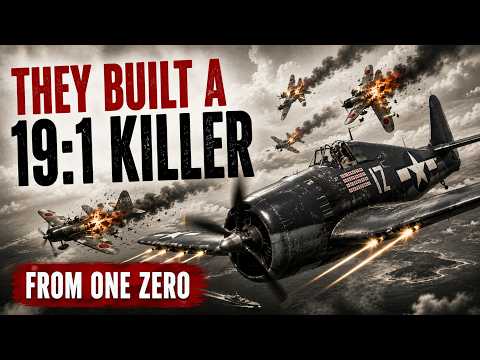
By the war’s end in late summer 1945, the F6F Hellcat had compiled a combat record no other American fighter in the war came close to matching. Navy and Marine Corps pilots destroyed 5,163 enemy aircraft in aerial combat—a number that grew even higher when adding victories scored by British Fleet Air Arm pilots flying Hellcats. Against that, only 270 Hellcats were lost in aerial combat, giving a kill-to-loss ratio of roughly 19 to 1, a figure that remains one of the most astonishing statistics in the entire air war. The aircraft also produced more ace pilots than any other American fighter in the conflict, with over 300 Navy pilots credited with five or more aerial victories while flying it. Commander David McCampbell, the Navy’s top ace of the war, scored all thirty-four of his confirmed victories in the Hellcat, a record still unmatched among American naval aviators.
By the war’s final years, Japanese pilots had begun avoiding direct engagement with Hellcats whenever possible, preferring to disengage or dive for cloud cover rather than fight a battle they had learned the hard way they were unlikely to win. The contrast with the war’s opening months could not have been sharper. In mid-1942, American pilots had been taught, out of sheer necessity, to flee from Zeros whenever possible. By 1945, it was Japanese pilots who ran.
The precise contribution of the Akutan Zero to this transformation cannot be measured with absolute precision, and integrity demands saying so clearly. The Hellcat was not designed because of the captured aircraft, nor were the tactics American pilots ultimately used born solely from studying it. But the captured Zero gave American engineers and test pilots something they had never possessed before: tangible, physical evidence of exactly where the enemy’s best fighter could be beaten—and it arrived at the one moment when that knowledge could shape fighter design and training programs before they took their final form. It replaced fear with specific, practical knowledge, and in a war fought largely by young men with only a few months of training, that knowledge saved lives in numbers history will never fully document.
There is a final, bitter irony that closes this story. The Akutan Zero—the most valuable captured aircraft of the entire Pacific War—survived years of secrecy, testing, and mock battles flown by pilot after pilot studying every reaction it had, only to meet its end far from any battlefield. In February 1945, as an SB2C Helldiver dive bomber was taxiing for takeoff at Naval Air Station North Island, it lost control on the runway and crashed directly into the parked Zero. Its spinning propeller shredded the historic fighter to pieces in seconds. A violent, almost absurd ending for an aircraft that had survived a war spanning an entire ocean.
Captain William Leonard managed to salvage a handful of instruments from the wreckage, later donating them to the National Museum of Naval Aviation, with a few additional pieces ending up in the Smithsonian’s collection. Small metal fragments now rest quietly behind glass, where visitors rarely pause long enough to learn what they once meant. The physical aircraft is gone, destroyed by the very air service it helped defeat. But its legacy lived on in every Hellcat that launched from a carrier deck, in every pilot who understood exactly how to beat a Zero instead of merely fearing it, and in every young pilot who returned home alive thanks to lessons learned from a wrecked fighter pulled from a marsh in Alaska.
Tadayoshi Koga’s body was buried with military honors near the crash site in 1942, then later exhumed by an American team and moved for burial on Adak Island in the Aleutian chain. In 1953, that cemetery was cleared, and the remains believed to be his were among those returned to Japan for final burial, closing a circle opened eleven years earlier on a foggy hill above a marsh no one on either side of the war ever expected to matter.
Historians still debate how much significance should be assigned to the captured aircraft. Some argue it ranks among the most valuable intelligence finds of the entire Pacific War—a single piece of equipment worth entire volumes of decoded radio traffic. Others point out that American industrial power would eventually have overwhelmed Japan regardless of what happened on that June morning on Akutan, and that Grumman’s engineers and Sanders’s fellow test pilots would have found most of these answers eventually, though later and at higher cost measured in American lives.
Japanese Air Self-Defense Force officer Masatake Okumiya, who served on the staff through most of the great carrier battles and watched the collapse of Japanese naval air power from the inside, later said that the loss of that single Zero was, in his estimation, no less serious for Japan than the defeat at Midway itself—an astonishing admission from a man who lived through both.
Whatever the precise truth between these two views, one fact remains beyond argument, clear enough to need no further debate. A nineteen-year-old pilot died alone in an Alaskan marsh, trying to protect a secret his country desperately needed to keep. And within three years, that same secret helped build a fighter that hunted his nation’s air forces at a rate of 19 to 1—flown by young men barely older than he was, helping to end a war his country could no longer hope to win.
So here is the question that lingers over that foggy Aleutian valley: was the Akutan Zero a stroke of American luck, or the final, unintended gift of a doomed young pilot to the enemy he never stopped serving? Tell us what you think in the comments below.
Report this article
Select a reason for reporting:






