In the autumn of 1874, on a remote island in Lake Superior, a mining crew lifted a stone slab from the floor of an ancient pit. What they found beneath it would haunt them for the rest of their lives—and then vanish from the official record as if it had never existed.
The Ojibwe had a name for that island: Minong. They also had a warning. No one was supposed to go down there.
Captain Richard Trevathan was a man who trusted measurements, not stories. He had gone underground at twelve, spent twenty-two years reading rock in the copper country, and kept a leather notebook filled with nothing but facts. Depth. Width. Water. Air. Who got hurt that day.
But on October 14th, 1874, his pencil would record something that didn’t belong in any mine captain’s notebook.
The seventh pit was different from the start. Its walls were almost square. The fill lay in layers—someone had filled it on purpose. At eighteen feet, the men didn’t hit copper. They hit stone slabs, seven feet long and five feet wide, locked together so tightly a knife blade wouldn’t go between them.
And piled in one corner: more than three hundred stone hammers. Stacked. Not thrown. As if someone had set them down and walked away.
Trevathan struck one slab with an iron bar. It didn’t sound like rock. It sounded hollow.
Beneath the slab: a stair. Eleven steps, cut from the rock, no tool marks. At the bottom, a corridor—142 feet long, nine feet wide, perfectly straight. The walls were smooth as if poured rather than cut. Along the floor, a single groove fourteen inches wide, worn soft at the edges. Something had passed up and down this corridor again and again, wearing the stone like feet wear a doorstep.
The corridor ran down under the lake. By the surveyor’s measurements, its end lay eighteen feet below the surface of Lake Superior. Outside, the lake was moving. Down here, not a single drop of water.
At the end: a round opening. Trevathan lifted his lantern. The light went forward and did not come back.
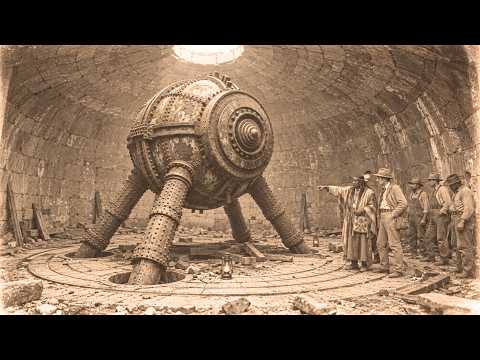
It was a dome. Ninety-one feet across. Fifty-two feet high. Thirty-one courses of interlocking stone rings, no mortar, closing at the top around a fourteen-foot opening choked with rubble. The floor was clean—not one handful of dust.
And at the exact center of the room, at the very edge of the lantern light, stood four legs.
That evening, Trevathan wrote: “A mass at the center standing. I do not know what it is. Marsh to measure tomorrow.”
The next morning, Edwin Marsh, the company’s young surveyor, measured it. His file runs four pages. It is not a report. It is an object file. And the more he measured, the less the numbers belonged in a mine captain’s notebook.
The mass stood on four legs, each as thick as a man’s body, covered in rows of blunt, rounded studs. The legs rested in sockets cut into the floor—sockets spaced evenly around a ring thirty feet across.
But there were not four sockets. There were five.
Four of the sockets each held a leg. The fifth was empty. Its rim was rounded and polished, worn exactly like the groove down the middle of the corridor. Something had settled into that socket and risen out of it many times. Now, it was gone.
Marsh lowered a lantern into the empty socket. At the bottom, there was nothing, not even dust.
The legs carried a drum—twenty feet across, fifteen feet deep. Its underside hung nine feet above the floor. A tall man reaching up could not touch it. The top stood twenty-nine feet high—five men standing on each other’s shoulders.
On the front of the drum was a hub. Six rings, one inside another. At the very center, a round boss three feet across. And at the exact center of that boss, a square socket, a hand’s width across, deep enough to take a man’s arm to the elbow. Fine rings were cut into its inner walls.
Marsh held a candle to the opening. The flame leaned outward. A faint breath of air was coming from inside.
The metal was covered in a flaking crust, greenish-black and brittle as dried mud. Marsh scraped at it with a file. Underneath was a dark reddish metal. It looked like copper. It was not copper. The steel file was dull after three strokes. The metal did not show a single scratch.
Trevathan struck the drum with an iron bar. A mass that size should have rung like a bell. It did not ring. The sound was dull and short, and it died at once, as if the drum were solid, or as if something inside it swallowed the sound.
Then Trevathan took off his glove and laid his palm flat against one of the legs. He wrote one word in his notebook: cold.
The air in the dome was mild. The men had taken off their coats. The metal was as cold as an iron railing on a winter morning.
On the last page of his file, Marsh wrote the measurements of the stair, the corridor, and the drum side by side. The mouth of the stair, four feet by six. The corridor, nine feet wide. The drum, twenty feet across. Under the numbers is a single question. It has no question mark.
How did it get in here?
Three days later, Trevathan stopped the work. The men were brought up. The slab was slid back into place. The fill was shoveled back over it. By evening, the seventh pit looked like any other old pit on the ridge.
That day, Trevathan wrote one line: “Closed my order, not a working.”
But there was someone else on the island who knew. Someone who had stood at the edge of that pit before Trevathan ever went down, already knowing what was below.
And on the night of October 16th, Trevathan went looking for him.
The boatman was down on the shore of the cove, sitting by a small fire, his boat drawn up on the stones. Trevathan brought Joseph La Rondeau, the young Quebecer who spoke Ojibwe, and that night La Rondeau translated while Trevathan wrote. Three pages of the notebook are given to that conversation—longer than any record of the underground.
The boatman did not need a mining company to know the island. For generations, Ojibwe families from Grand Portage had crossed to Minong every summer to fish, to boil maple sugar, to go home before the autumn storms. But there were parts of the island where no one went at all.
Trevathan’s first question was what the boatman had set down at the edge of the pit. The boatman said it was tobacco—a sema, the tobacco the Ojibwe leave when they pray, when they pass through a place, when they take something from it. But that day he had not taken anything. He had been apologizing for something.
Then he talked, and the sentences in Trevathan’s notebook change. Measurements give way to another man’s voice.
“The copper of this island does not belong to people,” the boatman said. It belonged to Mishipeshu—the great lynx under the water, with horns and a spined back and a tail of copper. Storms came from him. Canoes that took copper from the islands went down because of him.
“The ones who dug on Minong long ago did not dig for copper. They dug to cover something over. And when they reached the stones, they stopped. They did not go down. They stacked their hammers in front of the door so that whoever came after would know where to stop.”
“Here, then who cut that stair?” Trevathan asked.
The boatman’s answer is written in quotation marks: “No one went down. Something came up.”
He spoke of a round house under the island, a house under the water that the water did not enter, a house where the sound of the lake could not be heard. And he spoke of the ones who stood in that house. The Ojibwe did not call them people. They did not call them animals, either.
“There were five,” the boatman said.
Trevathan’s pencil must have stopped here, because the next line has been squeezed into the margin later. He said five. No one told him the number of the sockets.
“One of the five went back into the water. Four stayed. They were left behind, and what is left behind is not touched. Its door is not knocked on. Its name is not said out loud.”
Last, Trevathan asked him why he would not go into the pit. The boatman did not say that he knew anything himself. He said his father’s father had known, and had told him those things in a boat on the way to Minong, out on the water—because those things were not told on land, only on the water.
The next morning, Trevathan stopped the work. In his notebook, he draws no line between the two events. He only writes them down in order. First, the boatman’s words. Then the order to close.
But before he gave that order, on the night of October 16th, after talking with the boatman, Trevathan went back down into the dome alone. He does not write why.
He set his lantern on the floor. He laid his ear against the shortest leg, the one of twenty-four feet. At first he heard nothing. Then, in the words of the notebook: “Something very far off, very slow, like a wave on a shore, a sound, then a silence, then the sound again.”
Trevathan looked at his watch. The sounds came four minutes apart. Waves do not come four minutes apart. He waited and counted. He counted eleven of them before his lantern ran low. The gap never changed.
Then he took his ear from the leg and went to the empty socket—the fifth socket. He reached into it, up to the shoulder, and when his fingers touched the bottom, they came back wet. The whole dome was dry. The end of the corridor was dry. The floor was free of dust. That night, the only wet place in the room was the bottom of the socket with nothing in it.
Trevathan held his fingers to the lantern. The water was clear. He tasted it. He wrote one word: “Fresh.”
Lake Superior is a freshwater lake. But eighteen feet below its surface, in a chamber sealed from the lake, the bottom of an empty socket held fresh water that had no business being there.
Trevathan picked up his lantern. He walked back up the corridor. And the next morning, without explaining himself to anyone on the crew, he ordered the slab slid back into place.
No one knows what he heard that night, but the next crew to come to Isle Royale never asked why the seventh pit had been left alone, because by then, no one knew where the seventh pit was.
The Minong Mine opened in 1875. Between 1874 and 1883, the company took more than half a million pounds of copper off the island. Waste rock was dumped over the ancient pits west of McCargo Cove. The seventh pit disappeared under the piles. Year by year, the island went quiet.
In 1953, Roy W. Drier came to map the ancient pits. In a spruce bog beyond the waste piles, a student stepped on a curved stone edge hidden under the moss. A perfect ring appeared, fourteen feet across, filled to the brim with rubble. Cold air came out of the gaps. Drier measured forty-one degrees in August heat. He asked to clear it. The park refused. He photographed it, marked it in the margin of his map, and moved on.
In February 1959, a wolf study plane flew low over that bog. The log noted a round, snowless black patch. A faint vapor hung above it. No tracks. The note went into the wolf records, and there it stayed.
When Marsh’s sketch was laid beside Drier’s map, the ring fell directly over the crown of the dome. Marsh had measured a fourteen-foot opening at the top, choked with rubble. Seventy-nine years later, Drier measured a fourteen-foot ring on the surface, filled with rubble. Neither man knew the other existed. One looked up from below. The other looked down from above.
Trevathan’s notebook is in Houghton. Marsh’s sketch is in Marquette. Densmore’s page is in Minnesota. Drier’s notebook is in Houghton. Four records, four people who never met, meeting in the same place in the same details. Five sockets and five beings. A dry chamber under the lake and a house the water does not enter.
Today, McCargo Cove can be reached only by boat or by a hike of several days. The park closes completely every year from November until mid-April. In winter, there is no one on the island but wolves, moose, and a handful of researchers.
The boatman said five. Four stayed. One went back into the water. Trevathan struck the drum. He knocked on the door. Three days later, he put the slab back with his own hands, and his notebook never says what he understood.
If you know of one of these records—a mine captain’s notebook, a family letter, an account handed down in the copper country—write it in the comments, because this file is still open. Where did the fresh water at the bottom of the fifth socket come from? And in that dry chamber under the lake, what are the four that were left behind still waiting for?
Report this article
Select a reason for reporting:






