Rebecca Torres had spent years staring into the faces of the dead. As a curator specializing in 19th-century American photography at the Boston Historical Society, she had examined thousands of Victorian family portraits—stiff poses, formal clothing, carefully arranged compositions designed to project wealth and respectability. Most were predictable. Most were safe.
But the photograph she had just acquired from an estate sale in Charleston, South Carolina, was different. At first glance, it seemed entirely typical: a prosperous white family from 1899, the father a stern-looking man in his mid-40s seated in an ornate chair, his wife and two children arranged around him like porcelain dolls. The image was peaceful. Ordered. Respectable.
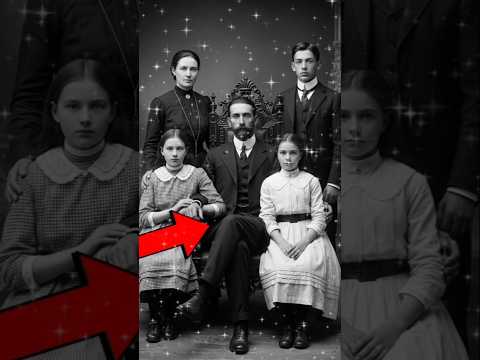
Rebecca adjusted her laptop screen and squinted at the high-resolution scan. Something about the shadows behind the father’s chair felt wrong—too dense, too deliberate. She zoomed in, her pulse quickening as the pixels resolved into a shape.
A figure. Standing directly behind the chair. A face that no one in the family seemed to notice.
She pulled back, her breath catching. The figure was tall, gaunt, dressed in dark clothing that blended into the wallpaper. Its features were blurred, as if the camera had caught something that didn’t want to be seen. But the eyes—the eyes were unmistakable. They stared straight ahead, past the family, past the photographer, straight into Rebecca’s own.
She spent the next three hours cross-referencing the photograph with the estate sale records. The family was identified as the Harlowes—a prominent Charleston clan with a history of tragedy. The father, Edmund, had died less than a month after the portrait was taken. The cause of death was listed as “sudden and unexplained.” The mother, Eleanor, had been committed to an asylum shortly after. The children had vanished from public records entirely.
Rebecca’s fingers trembled as she enlarged the figure again. This time, she noticed something else: the figure’s hand rested on the back of Edmund’s chair, its fingers long and pale, curled possessively around the wood. No one in the family was looking at it. No one seemed to know it was there.
She reached for her phone to call her colleague, but stopped. The image on the screen had changed. The figure was no longer standing behind the chair.
It was standing closer.
Rebecca blinked hard, rubbed her eyes, and looked again. The figure was back behind the chair, exactly where it had been before. She let out a shaky laugh—stress, exhaustion, too many hours in front of a screen. That was all. She saved the file, closed her laptop, and went home.
But she couldn’t sleep. Every time she closed her eyes, she saw those pale fingers curled around the wood, those eyes staring past the family and into her.
The next morning, she pulled the original glass plate negative from its archival sleeve. She had handled hundreds of these plates—fragile, heavy, coated in emulsion that could flake at the slightest touch. But this one felt different in her hands. Colder. Heavier, somehow, as though it carried more than just silver and light.
She set it on the light table and switched on the lamp. The negative glowed, the family appearing in reverse. And there, behind Edmund’s chair, the figure was waiting.
Rebecca had learned early in her career that the dead do not always stay where they are put. Old photographs were her profession, but they had also become her obsession—a quiet, unspoken understanding that some images hold more than memory. She had never told anyone about the other photographs. The ones she kept locked in her bottom drawer. The ones where faces appeared in windows that should have been empty, where children stood in gardens that had been paved over decades before.
She had always told herself those were tricks of the light. Double exposures. Chemical stains.
But this was not a trick.
She placed a call to the Charleston Historical Society and asked about the Harlowes. The archivist on the other end of the line hesitated when she mentioned the name.
“The Harlowes?” the woman said, her voice dropping. “You’re the second person this month to ask about them.”
Rebecca’s grip tightened on the phone. “Who was the first?”
A pause. Then: “A man named Elias Vance. He came in about three weeks ago, said he was researching a family heirloom. He left his card.”
Rebecca wrote down the number, her hand moving faster than her thoughts. When she hung up, she stared at the card in her notebook and then back at the photograph on her desk. The figure behind the chair seemed to have shifted again—just slightly, just enough.
She dialed the number. It rang once. Twice. Three times.
“Vance here,” a voice answered, low and unhurried. “I was wondering when you’d call.”
Rebecca’s mouth went dry. “You knew I’d call?”
“I knew someone would,” Vance said. “The photograph—you found the figure behind the chair, didn’t you? The one nobody in the family ever noticed.”
She glanced at the image on her desk. The gaunt shape was still there, patient as a spider. “Who is he?”
Vance exhaled slowly, the sound crackling through the receiver. “That’s the question, isn’t it? I’ve been chasing the Harlowes for eleven months. Ever since my grandmother died and left me a letter she’d kept hidden for sixty years.”
He told her to meet him. A diner off Boylston Street, noon. He said to bring the negative, and to bring it wrapped in cloth—not paper, not plastic. Cloth. She didn’t ask why. She had a feeling she already knew.
Vance was older than she’d expected, maybe sixty, with the kind of weathered face that had spent too many hours in archives and not enough in sunlight. He ordered coffee and didn’t touch it. Instead, he slid a photograph across the table—another family portrait, this one from 1871, the emulsion cracked like dried riverbeds.
“Look behind the mother,” he said.
Rebecca looked. There it was again. The same tall, gaunt figure, the same dark clothing melting into the shadows, the same pale fingers curled around the back of a chair.
“That’s the Ashford family,” Vance said. “Richmond, Virginia. The father died six weeks after this was taken. The mother went blind overnight. The children—” He stopped. “The children were never found.”
Rebecca set the photograph down carefully, as though it might bite. “How many are there?”
Vance reached into his satchel and pulled out a manila folder, thick with prints. “Twelve that I’ve confirmed. Maybe more I haven’t found yet. Every one of them has the same figure. Every one of them ends the same way. Sudden death. Madness. Disappearances.”
He tapped the folder. “And every single one of these families owned something. A piece of jewelry. A book. A clock. Something they acquired in Charleston in the 1850s. Something that came off a ship called the Palatine.”
Rebecca’s blood ran cold. “The Harlowes—the estate sale. There was a listing for a silver locket. I saw it in the inventory.”
Vance leaned forward, his eyes sharp. “Where is it now?”
She thought of the archive box she’d catalogued that morning, the small velvet pouch she’d set aside without a second glance. “In my office. In a drawer.”
Vance’s hand shot out and gripped her wrist. “Don’t open it. Don’t touch it. And whatever you do, don’t let it see you looking at that photograph again.”
Rebecca pulled back. “That’s not an answer. What is it? What does it want?”
Vance sat back, and for a moment he looked older than his years, hollowed out by something he’d carried too long. “I think,” he said quietly, “it’s a passenger. And I think it’s been looking for a way off that ship since 1857.”
He slid a pen and napkin toward her. “Write down your address. I’ll come by tonight. We need to decide what to do before the next photograph finds a new family—or before the one in your office finds you.”
Rebecca wrote the address. She did not sleep that night either, but this time she kept the lights on and the negative wrapped in a linen cloth she had taken from the archive’s textile collection—a scrap of Civil War–era cotton that had once belonged to a soldier’s uniform. She did not know why she chose it. It felt right. It felt like armor.
Vance arrived at eight o’clock with a leather satchel and a bottle of whiskey he did not open. They sat at her kitchen table, the photograph between them like a patient animal.
“The locket,” he said. “Where is it now?”
She retrieved the velvet pouch from her coat pocket. It was heavier than it should have been, the fabric cold to the touch. Vance did not reach for it. Instead, he pulled a small brass compass from his satchel and set it on the table beside the pouch.
The needle spun wildly, then stopped. It pointed directly at the locket.
“It’s not a compass,” he said. “It’s a fragment of the ship’s original compass. The Palatine went down in a storm off the coast of Maine. The manifest said it carried textiles, furniture, and forty-two passengers. But the ship’s log—what little survived—mentioned a sealed crate in the hold. No one knew what was in it. No one asked.”
Rebecca stared at the needle. “And whatever was in that crate came off the ship.”
“It came off the ship,” Vance said, “and it started collecting. Every family that owned a piece of that cargo ended up in a photograph. And every photograph ended the same way.”
She looked at the locket. Then at the negative. The figure behind Edmund’s chair had not moved. But somehow it seemed closer.
“What do we do?” she asked.
Vance was quiet for a long moment. Then he opened the locket.
Inside was not a photograph. It was a single strand of black hair, tied with a thread of silver, and a slip of paper so thin it was nearly transparent. On it, in faded ink, was a name: Silas Crane. And beneath it, a date: October 3, 1857.
“He was a passenger,” Vance said. “Not a crew member. Not a stowaway. A passenger. He paid for his passage with something the captain didn’t want to refuse.”
Rebecca felt the room grow colder. “And the families?”
“They bought pieces of the cargo. Pieces of him. He’s been trying to put himself back together ever since.”
She looked at the photograph again. Silas Crane was no longer behind the chair. He was standing beside it, his pale hand resting on Edmund’s shoulder. And Edmund—Edmund’s eyes, in the original image, had been closed. Now they were open. They were looking at Rebecca.
She slammed the negative face-down on the table. “What do we do?” she repeated, her voice shaking.
Vance reached into his satchel one last time and pulled out a small iron box, rusted at the hinges. “We put him back,” he said. “All of him. The locket. The hair. The name. We burn the photographs. Every last one. And we scatter the ashes over the water where the Palatine went down.”
Rebecca stared at him. “That’s insane.”
“It’s the only thing that’s ever worked,” he said. “I’ve done it twice. The families stopped dying. The photographs stopped changing. But I’ve never had all the pieces before. This locket—” He gestured to the velvet pouch. “This is the last one.”
They burned the photographs in Rebecca’s backyard at midnight, the flames turning blue at the edges. They scattered the ashes over the harbor at dawn, the iron box sinking beneath the waves. And when Rebecca returned to her office the next morning, the negative was blank.
Not damaged. Not overexposed. Blank. As though the Harlowes had never sat for their portrait at all.
She locked the negative in her bottom drawer with the others. She did not look at them again. She did not need to.
But sometimes, late at night, she wondered if Silas Crane had really been put back together—or if he had simply found a new family to follow.
What would you do if you found him standing behind your chair?
Report this article
Select a reason for reporting:






