The applause faded, the lights dimmed, and the curtain fell on a life that once glittered with unimaginable wealth. But for many of Hollywood’s Golden Age icons, the final act was not a standing ovation—it was a desperate struggle to survive. Behind the glamorous premieres and adoring fans lay a darker truth: fame is fleeting, and fortune can vanish overnight. Judy Garland, the beloved Dorothy of The Wizard of Oz, earned an estimated $40 million—yet died with just $40,000 to her name and $4 million in debts. Her story is not unique. It is a haunting echo of countless stars whose brilliance on screen masked a slow, painful descent into poverty.
How did the most celebrated actors and singers of their time end up penniless? The answers are as varied as the stars themselves: addiction, mismanagement, blacklisting, and plain bad luck. Errol Flynn, the swashbuckling hero of Captain Blood, squandered millions on yachts and legal battles, leaving an estate of only $10,000. Barbara Payton, once a luminous starlet, died at 39 with no money for a funeral. These are not just cautionary tales—they are human tragedies that reveal the brutal underbelly of the dream factory.
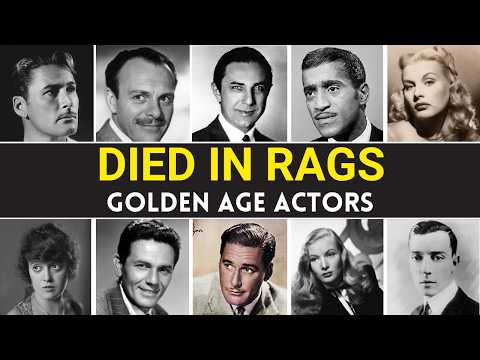
Take Judy Garland. By the time she died in 1969 at age 47, she was performing in small London nightclubs for modest fees, fleeing hotel bills she couldn’t pay. Her third husband, Sid Luft, had squandered much of her wealth on failed ventures. She left behind debts totaling $4 million, including significant unpaid taxes to the IRS. The girl who sang “Over the Rainbow” had nothing left to sing about.
Then there’s Marie Prevost, the silent film siren who captivated audiences in the 1920s. The arrival of sound films destroyed her career—her voice didn’t resonate with the new medium. She turned to alcohol, and by her death in 1937 at 38, she had just $300 to her name. She was found alone in her dilapidated apartment, having succumbed to acute alcoholism and malnutrition. The vivacious star had become a ghost of her former self.
The pattern repeats with heartbreaking consistency. Roscoe “Fatty” Arbuckle, once the highest-paid actor in Hollywood earning over $1 million a year, was blacklisted after a scandal and died with minimal assets. Dorothy Dandridge, the first African-American woman nominated for an Oscar, declared bankruptcy with $150,000 in debt and died with just $24 cents in her bank account. Veronica Lake, famous for her peekaboo hairstyle, spent her final days working as a waitress. Each story is a stark reminder that the spotlight can burn out faster than anyone expects.
What forces drove these legends to ruin? For some, it was addiction—Garland’s prescription drugs, Payton’s alcohol, Lugosi’s morphine. For others, it was betrayal by those they trusted: agents, spouses, and financial advisers who drained their fortunes. And for many, it was the cruel whims of an industry that discarded them the moment their star dimmed.
As we delve deeper into these poignant biographies, we uncover not just the financial ruin but the personal demons and systemic failures that led to such tragic ends. Their stories are a sobering counterpoint to the glitz and glamour we associate with Hollywood’s Golden Age. Fame, it seems, is a fragile thing—and the price of stardom can be extraordinarily high.
The roll call of ruin extends far beyond the names most remembered today. Sammy Davis Jr., one of the most electrifying entertainers of his generation, owed the IRS over $7 million in back taxes when he died in 1990. Even after liquidating his assets, his estate remained $5.2 million in debt. The man who dazzled crowds with his singing and dancing had spent his fortune on multiple homes, luxury cars, and expensive jewelry—living as opulently offstage as he performed on it.
Davis kept touring almost until the very end, battling throat cancer while trying to negotiate with the IRS. His final performances were less a victory lap than a frantic race against the debt collectors. He died at 64, still singing for his supper—and for his creditors.
Then there is Bela Lugosi, forever immortalized as Count Dracula. Typecast as a horror villain, he found it nearly impossible to secure varied roles. His addiction to morphine and methadone—initially taken to ease chronic sciatica—further eroded his career and his finances. By 1955, he had filed for bankruptcy, listing debts of $3,500 against assets of only $11,000.
Lugosi spent his final years accepting low-budget roles for minimal pay, a faded prince of darkness reduced to scraping by. When he died of a heart attack in 1956 at 73, he left behind just $1,900 in cash and a few personal effects. His funeral expenses were paid by Frank Sinatra—a gesture of charity that underscored the meager state of the horror icon’s finances.
Bud Abbott, one half of the legendary comedy duo Abbott and Costello, met a similarly grim fate. During World War II, the pair raised an estimated $85 million in war bonds through their performances—a staggering contribution to the war effort. But the IRS later disallowed $500,000 in tax exemptions they had claimed as bond-raising expenses. The tax bill that followed would haunt Abbott for the rest of his life.
After Lou Costello’s death in 1959, Abbott tried to continue performing, but declining health—he suffered from epilepsy—and a changing industry left him struggling to find work. The IRS seized his home to settle the unpaid taxes, forcing him into a small apartment. In desperation, Abbott made televised appeals to fans for financial assistance, a humiliating spectacle for a man who had once commanded packed theaters.
He died virtually penniless on April 24, 1974, at 78, his remaining assets insufficient to cover his debts. The comedian who had made millions laugh could not laugh his way out of the taxman’s grasp.
And then there is John Garfield, the brooding, intense method actor who brought a new realism to Hollywood in the late 1930s and 1940s. His performances in The Postman Always Rings Twice and Body and Soul made him a star, but the Red Scare of the early 1950s brought his career to an abrupt halt. Subpoenaed by the House Un-American Activities Committee, Garfield refused to name colleagues—and was blacklisted for it.
Studios wary of association distanced themselves, and offers dwindled to nothing. The blacklist stripped him of his livelihood and inflicted deep personal wounds. Friends noted a palpable change in his demeanor; once vibrant and passionate, he grew increasingly despondent. On May 21, 1952, at just 39 years old, John Garfield died of a heart attack in a New York City apartment.
He was not destitute at the time of his death, but the combination of professional exile and personal turmoil had eroded much of the wealth and stability he had built. His passing was a stark reminder of the human cost of fear-driven politics—a life cut short not by excess, but by principle.
These stories share a common thread: the machinery of Hollywood is unforgiving. It elevates its stars to dizzying heights, then watches them fall without a safety net. Addiction, betrayal, blacklisting, illness—the causes vary, but the outcome is eerily consistent. And for every Judy Garland or Bela Lugosi, there are dozens more whose names have faded entirely from memory.
But the litany of loss does not end with the most famous names. Terry-Thomas, the gap-toothed English comic known for those Magnificent Men in their Flying Machines, sold his home and nearly all his possessions to cover medical bills after being diagnosed with Parkinson’s disease in 1971. His treatment cost £75,000 a year—over $100,000 at the time—and his savings evaporated. Friends organized a benefit concert in 1989 that raised £75,000, but it was too little, too late. He died in a modest actors’ retirement home in 1990, having spent nearly every penny on his care.
Veronica Lake’s decline was equally brutal. The peekaboo blonde who once commanded top billing found herself bankrupt by 1951, her career derailed by alcoholism and mental health struggles. In the 1960s, she was working as a waitress and hostess in a New York hotel, a far cry from the glamorous sets of Sullivan’s Travels. She died alone in a Vermont hospital in 1973 at 50, her only assets a small bank account and a few personal belongings.
And then there is Mabel Normand—the spirited comedic genius who lit up the silent screen alongside Chaplin and Arbuckle. Her career was shattered by the 1922 murder of director William Desmond Taylor, a scandal that cast a long shadow she could never escape. Worse still, tuberculosis began to sap her strength and her finances. She spent her final days in a sanitarium, dying at just 37. Though not impoverished, the comfort of her peak years had slipped away like the silent era itself.
What emerges from these biographies is a portrait of an industry that consumes its own. The studio system of the Golden Age offered no pensions, no health insurance, no safety net for the stars who made it rich. When their box-office appeal faded, they were cast aside—left to pay for their own medical care, legal battles, and tax debts with whatever remained of their fortunes.
Some, like Buster Keaton, managed a modest comeback and lived out their days in humble dignity. Others, like Barbara Payton, descended into prostitution and died at 39 with no money for a funeral. The difference often came down to luck, timing, and the mercy of friends.
As we trace these final chapters, a painful truth crystallizes: the applause is temporary, but the bills are forever. The same industry that showered them with diamonds and mansions turned its back when the spotlight moved on. And in the end, many of Hollywood’s brightest stars discovered that the price of fame was everything they had.
Even the brightest flames can burn out in obscurity. Buster Keaton, the great stone face of silent cinema, lost his creative freedom and fortune to MGM’s studio constraints and a costly divorce, yet he clawed his way back through television and supporting roles—living modestly but never destitute. His resilience stands as a rare flicker of hope in this gallery of ruin. But for most, there was no second act.
What remains when the money is gone and the fans have vanished? For these legends, it was the work itself—the films that still flicker in the dark, the songs that still play. Judy Garland’s voice echoes on, even as her debts were settled by others. Bela Lugosi’s Dracula still haunts screens, even though Frank Sinatra paid for his funeral. Their art outlived their bank accounts.
The Golden Age was never golden for everyone. It was a factory that polished stars to a blinding shine, then discarded them when they dulled. No pension. No safety net. No mercy. The same industry that built mansions in Beverly Hills foreclosed on the very people who made it rich.
So what do we take from these cautionary tales? Perhaps this: fame is a loan, not a gift—and the interest is brutal. The applause fades, the lights dim, and the curtain falls. What’s left is the story—and the question of whether we’ll remember the human behind the legend.
Which of these fallen stars’ stories moved you the most—and why do you think Hollywood still struggles to protect its own? Share your thoughts in the comments below.
Report this article
Select a reason for reporting:






