In the heart of the Cold War, a single question echoed through the halls of Congress, shattering lives and careers with ruthless efficiency: “Are you now or have you ever been a member of the Communist Party?” Between 1947 and 1958, the House Un-American Activities Committee (HUAC) turned Hollywood into a battleground, where the line between patriot and traitor blurred into a weapon. Over 320 careers were destroyed, writers were imprisoned, and friends became informants. The hearings weren’t about finding communists—they were about making people betray each other on camera. But the betrayals didn’t start there, and they didn’t end there.
Before the blacklist, Hollywood stars were cozying up to actual Nazis. After it, they were posing on enemy artillery during a war. The line between patriot and traitor turned out to depend entirely on who was drawing it. These are 19 Hollywood stars who were accused of being secret traitors to America. Some of them betrayed their country. Some of them betrayed each other. And some of them did both.
Number 19: Lucille Ball. America’s most beloved comedian was secretly a registered communist. In 1936, Lucille Ball signed a voter registration card listing her party affiliation as communist. She did it again in 1938. She also sponsored a communist candidate for Congress. And according to HUAC investigator Reena Vale, a Communist Party meeting was held in her home. Her name appeared on the state central committee of the Communist Party of California. Though Ball later said she had no idea her name was listed, none of this mattered until September 1953, right at the peak of I Love Lucy’s dominance when the show was drawing the equivalent of 85 million viewers a week. HUAC hauled her in for a closed-door hearing. She’d actually already been through one private session with the FBI in 1952 at the family ranch in Chadszsworth, where she explained that she’d registered to please her dying grandfather, a passionate socialist who’d had a stroke and couldn’t handle arguments. The FBI seemed satisfied, but then columnist Walter Winchell got hold of the story and broke it on the radio. The next morning, newspaper headlines screamed, “Lucille Ball named Red.” The New York Daily News ran “Registered Red in ’36.” Lucille’s husband Desi Arnaz did the talking. At the next taping in front of a live studio audience, he told them, “The only thing red about Lucy is her hair, and even that’s not legitimate.” The crowd roared. Ball was officially cleared and the show went on. But for a terrifying few days, the biggest star on American television was one headline away from losing everything over a voter registration card she’d signed 17 years earlier to make her grandfather happy.
Number 18: Humphrey Bogart. In October 1947, Humphrey Bogart flew to Washington with a group called the Committee for the First Amendment to protest the HUAC hearings. He stood on principle and made speeches and told reporters the hearings were un-American. Then he found out that Sterling Hayden, one of the committee’s own members, had secretly been a Communist Party member the entire time. Bogart was blindsided. Within weeks, Bogart wrote a piece for Photoplay Magazine calling the Washington trip ill-advised and insisting he was not a communist sympathizer. He told the press he’d been duped. His friends on the left felt abandoned. His friends on the right said the recantation had come too late. Bogart, who played fearless men on screen, had backed down the moment real consequences appeared. And he spent the rest of his career avoiding anything that resembled political involvement. The man who starred in Casablanca as a reluctant hero who eventually does the right thing turned out to have a very different instinct when the stakes were his own career and not a movie set.
Number 17: Gary Cooper. When HUAC called Gary Cooper to testify in 1947, he showed up as a friendly witness and declared that he’d rejected communist-leaning scripts because “from what I hear, I don’t like it because it isn’t on the level.” When pressed for specifics—for the names of communists he’d worked with or the titles of communist-leaning scripts he’d turned down—Cooper couldn’t provide a single one. He couldn’t name a name. He couldn’t cite a script. He just didn’t like the sound of communism, which was apparently enough. His testimony was so vague that it was practically useless as evidence, but it gave HUAC exactly what it needed: one of the biggest movie stars in the world on the record telling a congressional committee that communism was a problem in Hollywood. Cooper walked out without a scratch on his career. Ironically, the film he’s most remembered for, High Noon, released in 1952, was written by Carl Foreman, who was blacklisted while the film was still in production. Cooper won his second Oscar for it.
Number 16: Robert Taylor. Robert Taylor went further than most. When he testified before HUAC in 1947, he named names willingly and told the committee he believed suspected communists should be deported from the United States entirely. He singled out actors and writers he’d worked with and called for the government to forcibly remove them from the country for their political beliefs. Taylor was one of MGM’s biggest leading men at the time, and his willingness to cooperate gave the committee enormous credibility with the public. If a star this big thought the communist threat was real enough to warrant deportation, ordinary Americans figured it must be serious. Nobody pressured him into it. Nobody threatened him. He walked in and volunteered everything. And his testimony helped build the foundation that led to the blacklist destroying hundreds of careers over the next decade.
Number 15: Adolf Menjou. Actor Adolf Menjou was so eager to root out communists in Hollywood that he openly called himself a witch hunter—a term most people used as an insult. Menjou didn’t care. He wore it like a badge. When he testified before HUAC, he did so with visible enthusiasm, claiming that communist propaganda was being slipped into American films through subtle changes to dialogue and storylines, and that Hollywood was riddled with subversives who were using the entertainment industry to undermine American values from the inside. Menjou was a founding member of the Motion Picture Alliance for the Preservation of American Ideals, an organization that counted John Wayne, Walt Disney, and Robert Taylor among its ranks, and was dedicated to purging the industry of anyone who leaned left. Menjou claimed he could identify a communist by looking at them—that they had a certain look about them. He treated the blacklist not as a necessary evil or a regrettable consequence of national security, but as a patriotic crusade he was thrilled to be leading. The irony was that Menjou had been born in Pittsburgh to French and Irish immigrant parents and had built his career playing sophisticated Europeans. The man raging about un-American activities had made his name pretending to be foreign.
Number 14: Budd Schulberg. Writer Budd Schulberg had been a Communist Party member in the late 1930s. When HUAC came calling in 1951, he named 15 former associates as party members. Then he teamed up with director Elia Kazan, who had done the same thing, to write On the Waterfront, a film about a longshoreman who informs on a corrupt union and is celebrated as a hero for it. Critics immediately recognized it as a defense of informing. Schulberg and Kazan won Academy Awards for the film. The people they’d named were still out of work.
Number 13: Larry Parks. Larry Parks was the star of The Jolson Story, one of the biggest hits of the 1940s, a film that earned him an Academy Award nomination and made him a household name overnight. When HUAC called him in 1951, he admitted that he’d been a Communist Party member in the early 1940s and that he’d left the party years ago. Then he did something nobody on the committee expected. He begged them not to make him name other members. “Don’t present me with the choice of either being in contempt and going to jail or forcing me to really crawl through the mud to be an informer,” he said. It was one of the most wrenching moments in the entire history of the hearings—a man standing in front of a microphone on camera asking the government not to force him to betray his friends. The committee forced the choice. Parks named names and then Hollywood destroyed him anyway. Columbia Pictures tore up his contract. He never starred in another major film. He spent the rest of his career doing small television parts and dinner theater. The informing didn’t save his career and it cost him his conscience. The committee had already decided he was finished before he walked in the room. They just wanted to watch him break first.
Number 12: Lee J. Cobb. Lee J. Cobb held out for two years. After being named as a communist by other witnesses, Cobb was blacklisted and couldn’t find work in Hollywood. He went broke, his marriage fell apart, and he was staring down the possibility of never working again. He had two children to support and no income. In 1953, after two years of financial and personal devastation, he finally broke and testified, naming 20 former associates as communists. Years later, Cobb described what the experience had been like with brutal honesty. “When the strategy did not work, I was a broken man. I had no money. I couldn’t borrow. I had the prospect of never working again. I had a wife and two kids. And I also had to face the prospect of going to jail.” He called the whole ordeal a kind of psychological torture designed to leave a person with no good options. Cobb’s testimony bought him back into the industry. The following year, he appeared in On the Waterfront as the corrupt union boss, and he went on to deliver one of the most iconic performances in cinema history as Juror Number Three in 12 Angry Men. But the irony of those roles—playing a corrupt leader and a man who refuses to change his mind until the evidence overwhelms him—wasn’t lost on people who knew what Cobb had done to get back in front of a camera.
Number 11: Edward Dmytryk. Edward Dmytryk was one of the original Hollywood Ten, the group of ten directors and screenwriters who refused to cooperate with HUAC in 1947 and were cited for contempt of Congress. The Ten had made a collective decision. They would stand together, refuse to answer the committee’s questions on First Amendment grounds, and fight the entire system. Dmytryk stood with them. He was cited for contempt. He fled to England where he directed two films before returning to face his sentence. He was arrested and sent to a federal prison camp at Mill Point, West Virginia. And then, sitting in that prison, Dmytryk changed his mind. He decided that the Communist Party had manipulated him, that he’d been a dupe, and that the principled stand he’d taken was a mistake. In April 1951, he went back to HUAC as a cooperative witness, and named 26 former associates as Communist Party members, including Adrian Scott, his own colleague and one of his fellow members of the Hollywood Ten. The group had sworn to hold the line. Dmytryk shattered it. His cooperation ended his blacklisting immediately. He went back to directing and had a long career afterward. But the people he named were devastated, and the other members of the Ten, who had gone to prison and stayed silent, considered him the worst kind of traitor—a man who had stood with them in solidarity, gone to jail for the same cause, and then sold them out the moment the cost became too high.
Number 10: Ronald Reagan. Long before he was president, Ronald Reagan was the head of the Screen Actors Guild and a secret FBI informant. Documents declassified and released in 1985 revealed that Reagan and his first wife, actress Jane Wyman, had been providing the FBI with names of actors they suspected of having communist sympathies since the mid-1940s. Reagan’s FBI code designation was T-10. He attended private meetings with bureau agents and reported back on what he saw and heard at guild meetings and industry events. In 1947, Reagan testified before HUAC where he tried to walk a careful line between anti-communism and civil liberties. He told the committee he didn’t believe in outlawing political parties and he said he thought democratic processes were sufficient to handle the communist problem. His public testimony sounded measured and reasonable. But behind the scenes, away from the cameras and the microphones, he was feeding names to J. Edgar Hoover’s bureau. Names of colleagues and fellow actors who may or may not have been involved in anything more dangerous than attending the wrong meeting or signing the wrong petition. The line between protecting the industry and helping the government build a blacklist turned out to be a lot thinner than Reagan’s careful public statements suggested. And the man who later became the most powerful person on earth started his political career as a secret informant reporting on his own union members.
Now, if you’ve been paying attention, you’ve noticed a pattern. Some of these people were communists, some were informants. And you might be asking yourself who the real traitors were—the ones who joined a political party, or the ones who destroyed their friends’ lives to save their own careers. Keep that question in mind, because the next nine entries make it a lot harder to answer.
Number 9: Dalton Trumbo. A member of the Hollywood Ten, Trumbo refused to answer HUAC’s questions and was cited for contempt. He served 11 months in federal prison, then found himself blacklisted. No studio would hire him. So he kept writing under fake names, selling scripts through fronts for a fraction of his old rate. He won two Academy Awards under pseudonyms—Roman Holiday and The Brave One—while Hollywood pretended he didn’t exist. The blacklist finally cracked in 1960 when Kirk Douglas insisted on crediting Trumbo by his real name for Spartacus. But the prison sentence and the years of hiding had already happened. And the men who put him there never served a day.
Number 8: Ring Lardner Jr. Another member of the Hollywood Ten, Lardner delivered one of HUAC’s most quoted lines: “I could answer the question, but if I did, I would hate myself in the morning.” He was cited for contempt, served a year in prison, and was blacklisted for nearly two decades. He wrote for British television under assumed names for poverty wages. His family moved to England. His career, his income, his standing—all of it was gone because he refused to answer a question the committee already knew the answer to.
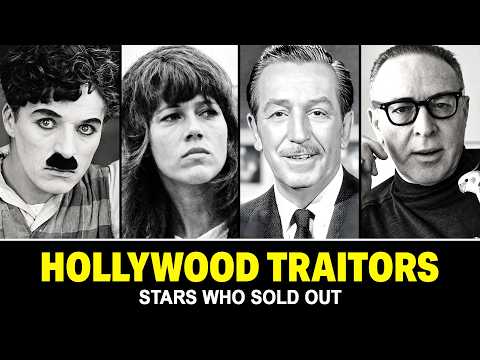
Number 7: Jane Fonda. In July 1972, at the height of the Vietnam War, Fonda traveled to Hanoi on what she called a peace mission. Then she sat down on a North Vietnamese anti-aircraft gun—the same type used to shoot down American planes—and someone took a photograph. The image went around the world. She also made radio broadcasts criticizing the American bombing campaign. The combination earned her the nickname “Hanoi Jane.” Fonda has called the photo a thoughtless and cruel thing to have done. But for many American families who lost someone in Vietnam, the distinction between opposing a war and posing on the enemy’s weapon doesn’t exist.
Number 6: Charlie Chaplin. Chaplin was never a communist. The FBI investigated him for years and never found evidence of party membership. But he was a vocal leftist who made The Great Dictator to mock Hitler when most of Hollywood was still too afraid to name the Nazis directly. J. Edgar Hoover personally targeted him, building a file over 1,900 pages. In 1952, while Chaplin was sailing to London, Attorney General James McGran revoked his re-entry permit. Chaplin, who had lived in the United States for nearly 40 years, was effectively exiled. He settled in Switzerland and didn’t set foot in America for 20 years. When he finally returned in 1972 to accept an honorary Oscar, the audience gave him a 12-minute standing ovation. The country that had thrown him out now wanted to pretend it had always loved him.
Number 5: Sterling Hayden. Hayden was an actual war hero who ran guns to Yugoslav partisans and operated behind enemy lines for the OSS. After the war, he briefly joined the Communist Party, then left after six months. When HUAC called him in 1951, his lawyer advised him to cooperate or face blacklisting. Hayden testified. He named names. But he never forgave himself. In his autobiography, he wrote: “I don’t think you have the foggiest notion of the contempt I have had for myself since the day I did that thing.” A decorated war hero became, in his own estimation, a coward the day he traded other people’s names for the right to keep working.
Number 4: Walt Disney. Disney spent decades as a secret FBI informant. Documents released under the Freedom of Information Act revealed that his relationship with J. Edgar Hoover began in 1936 and lasted until Disney’s death in 1966. He provided the bureau with names of suspected communists in Hollywood. In 1947, he proudly testified before HUAC, branding three of his own former animators as communist agitators. He blamed a 1941 labor strike at his studio on a communist conspiracy. All three animators denied the allegations, and one was later cleared when insufficient evidence was found. But Disney wasn’t done. In 1938, one month after Kristallnacht, Disney personally hosted Nazi filmmaker Leni Riefenstahl at his studio, giving her a three-hour tour. Every other major studio in Hollywood had locked its gates to her. Disney opened his.
Number 3: Errol Flynn. In 1980, biographer Charles Higham published a book claiming Flynn had been a Nazi spy during World War II. The allegations were sensational, and the book sold enormously well. The problem was that the evidence didn’t hold up. Subsequent biographers accused Higham of falsifying documents and distorting testimony. Later researchers found that Flynn actually supported leftist causes, including Fidel Castro’s Cuban Revolution—a strange hobby for a Nazi. But here’s what is true: Flynn’s closest friend for years was Herman Erben, an Austrian doctor who was a confirmed Nazi intelligence agent. He used his friendship with the famous actor as cover for his espionage activities. And Flynn, as far as the historical record shows, either didn’t know or didn’t want to know what his friend was doing.
Number 2: Louis B. Mayer and the studio system. In 2013, Harvard researcher Ben Urwand published The Collaboration: Hollywood’s Pact with Hitler, documenting how the major Hollywood studios cooperated with Nazi Germany throughout the 1930s to protect their business in the German market. MGM under Louis B. Mayer maintained a representative in Berlin who worked directly with Nazi censors. When the Nazis objected to content, the studios changed it. When Berlin wanted positive references to Jewish people removed from American films, the studios complied. The studios removed Jewish employees from their German offices to satisfy Nazi racial policies. The collaboration continued well into the late 1930s, even as the Nazi government’s persecution of Jewish people became impossible to deny. The documented record of what they cut, who they fired, and what they stayed silent about is difficult to read as anything other than a business decision that came at a human cost.
Number 1: Elia Kazan. In April 1952, Elia Kazan walked into a HUAC hearing room and named eight of his former friends and colleagues from the Group Theatre as Communist Party members. He did this voluntarily. Nobody forced him, and his career wasn’t in immediate jeopardy. He had already testified once in January without naming anyone. Then he came back three months later of his own accord and gave them everything. The people he named were actors, writers, and directors he had worked with for years. After Kazan spoke their names into the record, their careers were systematically destroyed. Some were blacklisted for a decade or more. Some never worked in the entertainment industry again. And Kazan didn’t just inform and move on. He defended the decision publicly. He took out a full-page ad in the New York Times explaining why he’d done it and urging others to do the same. Then he teamed up with Budd Schulberg to make On the Waterfront, casting Marlon Brando as a longshoreman who testifies against a corrupt union boss and is celebrated as a hero for doing so. The film swept the Academy Awards. The metaphor was impossible to miss. Kazan had made a movie arguing that informing on your associates was the most courageous thing a person could do. For nearly 50 years, the argument over what Kazan did split Hollywood clean down the middle. When the Academy decided to give him an honorary Oscar in 1999, the ceremony became a national spectacle. Protesters gathered outside carrying signs. Inside, when Kazan walked to the podium, half the audience stood and applauded. The other half sat in stony silence. Ed Harris and Amy Madigan sat with their hands in their laps. Nick Nolte refused to clap. The man presenting the award was Robert De Niro. Some of the people sitting silently in that audience had lost decades of their careers because Kazan had said their names or the names of people they loved into a microphone in 1952. Kazan never apologized and never expressed regret. In his autobiography, he said he’d do it again. And that’s what makes Kazan number one on this list. Not because what he did was the most dramatic, but because it crystallizes the entire question this video has been asking. When the government tells you to betray your friends and you do it willingly and you never say sorry and you make a movie celebrating the decision and you collect an Oscar for it, who exactly is the traitor? Is it the person who joined a political party? Or is it the person who destroyed lives to prove they hadn’t? The blacklist eventually ended. The careers didn’t come back. The prison sentences weren’t overturned. And the committee that started all of it admitted it already knew most of the names before anyone testified. The entire exercise was a loyalty test. And the only thing it proved was how far people would go to save themselves. So here’s the question that lingers long after the credits roll: if you were in that hearing room, with your career, your family, and your freedom on the line, would you have named names—or would you have held the line and paid the price? Let us know in the comments below.
Report this article
Select a reason for reporting:






