The morning of October 14, 1975, dawned cold but clear at RAF Waddington in Lincolnshire, England. The delta-winged Vulcan B2 X-ray Mike 645 stood poised on the runway, its metallic skin glinting under the early light. Inside, seven men went through their final checks, unaware that this routine flight to Malta would end in catastrophe.
At 08:30, the four Rolls-Royce Olympus engines roared to life, their rising whine building to the Vulcan’s signature howl. The bomber accelerated down the runway and lifted gracefully into the crisp autumn air. For the crew, this was just another long-distance navigation exercise—a straightforward transfer to RAF Luqa. But fate had other plans.
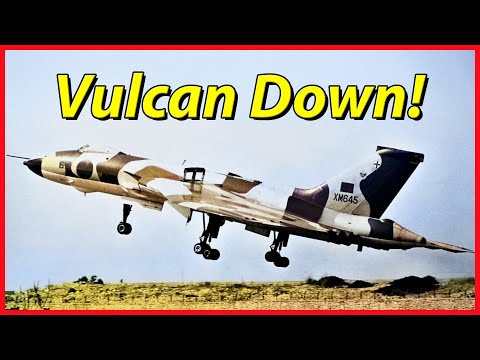
Four hours later, the Vulcan checked in with Malta control, reporting 100 miles out. The controller assigned them runway 24, following a Victor that had landed ahead. Runway 24 at Luqa was notorious: a downhill slope, short length for a heavy bomber, and a deceptive optical illusion caused by the surrounding terrain and bright Mediterranean sun. Pilots often believed they were higher than they actually were.
In the cockpit, Flight Lieutenant Alcock, the captain, decided to let his co-pilot, Flying Officer Alexander, handle the approach. Alexander had landed at Luqa before, so Alcock saw no reason to intervene. But no detailed briefing was given about the challenges of runway 24—a decision that would prove fateful.
At 12:48, the Vulcan began its descent. The initial approach seemed normal, but as the bomber neared the threshold, it sank below the correct glide path. The rate of descent increased alarmingly. Then, with a sickening crunch, the aircraft struck the ground 46 feet before the tarmac. The port undercarriage collapsed, and the wing scraped the runway. For a moment, the crippled Vulcan bounced back into the air.
Alcock, fearing a catastrophic crash that would trap his rear crew—who had no ejection seats—instantly took control. He slammed the throttles forward and pulled the bomber back into the sky. But he didn’t know that the undercarriage had been ripped off, and fuel was pouring from a damaged tank. As he climbed away, air traffic control warned him: the aircraft was on fire.
Four years earlier, Alcock had survived a similar disaster when his Vulcan caught fire over Northumberland. He managed to keep it airborne long enough for his rear crew to escape before ejecting. This time, he hoped for the same outcome. But time was not on his side. As he turned downwind over the town of Zabbar, the controls grew sluggish. The Vulcan was becoming uncontrollable.
Realizing he couldn’t make it back over the sea, Alcock ordered the crew to abandon the aircraft. He and Alexander ejected safely, but moments later, the Vulcan exploded into a fireball, tearing itself apart directly over Zabbar. Burning wreckage and tons of aviation fuel rained down on the town.
On the ground, pandemonium erupted. A Welsh couple touring Malta screeched to a halt as a river of fire cascaded toward them. They fled just in time, their car incinerated. But 47-year-old Vincenza Zamit, who had just closed her haberdashery shop, was not so lucky. She was consumed by the burning fuel—the only civilian killed that day. Around 20 others were injured, and over 100 buildings were damaged.
The five crew members in the rear of the Vulcan had no chance. They perished in the inferno. The board of inquiry later determined that the accident was initiated by a premature descent below the glide path, exacerbated by visual illusions. Both pilots were blamed for errors of judgment, though not gross negligence. The tragedy led to revised training and safety procedures fleetwide.
Today, a memorial in Zabbar stands as a poignant reminder of the seven airmen and one civilian who lost their lives that day. But how did a routine flight turn into such a disaster? The answer lies in a chain of decisions, illusions, and split-second choices that began long before the Vulcan ever left the ground.
The inquiry’s findings sent ripples through the RAF. Runway 24 at Luqa was immediately flagged for review, and approach charts were redrawn with steeper glide paths and prominent warnings about the optical illusion. But for the men who survived, the scars ran deeper than any procedural change.
Flight Lieutenant Alcock and Flying Officer Alexander faced a board of inquiry that cleared them of gross negligence but left their careers forever shadowed. Alcock, who had already survived one catastrophic fire, now carried the weight of a second—this time with five men dead. He requested a transfer to a ground-based training role and rarely spoke of Malta again.
Alexander, the young co-pilot, was haunted by the final approach. In later testimony, he admitted he had felt the Vulcan sinking but trusted his instruments over his instincts. “The runway looked longer than it was,” he said. “The light fooled me.” He never flew a Vulcan again.
For the families of the five rear crew, the pain was compounded by a cruel irony. Sergeant Atkins and Chief Technician Barrow, the two ground crew members, had been on board only to log training hours. They had no ejection seats, no escape hatch within reach—only the lower access door, which was useless in a high-speed break-up.
The board’s recommendation to improve egress options for rear crew was quietly shelved. The Vulcan fleet was already being phased out of the strategic role, and the cost of retrofitting escape systems was deemed prohibitive. Instead, the RAF mandated clearer pre-flight briefings for challenging airfields and stricter supervision during approaches. It was a small victory, but one that would save lives in the years to come.
In Zabbar, the memorial grew into something more than a stone marker. Local residents, many of whom had lost homes or been injured, began holding an annual remembrance ceremony. Vincenza Zamit’s family attended each year, laying flowers alongside the RAF delegation. The two communities—British airmen and Maltese civilians—were bound together by a shared tragedy.
But the story of X-ray Mike 645 did not end with the inquiry. Years later, a retired RAF navigator named Gordon Pullman—no relation to the lost crew—began researching the crash. He discovered a troubling detail buried in the accident report: the Victor that had landed ahead of the Vulcan had also reported a difficult approach, but its pilot’s warning was never passed to Alcock’s crew.
That omission, while not the cause of the disaster, highlighted a gap in communication between air traffic control and incoming aircraft. “If they had known the Victor also struggled,” Pullman wrote, “they might have gone around.” The finding prompted a quiet revision of Luqa’s approach protocols, ensuring that pilot reports of challenging conditions were relayed to following aircraft.
For Alcock, the revelation brought no peace. He had spent years replaying the final minutes, wondering if a different decision—taking control earlier, aborting the landing, requesting a different runway—could have changed everything. The board had called it an error of judgment. He called it a failure of command.
Yet the tragedy also forged an unexpected legacy. The revised training procedures for Vulcan crews became a model for other RAF squadrons operating into difficult airfields. Simulator programs were updated to replicate the Luqa illusion, forcing pilots to recognize the deceptive descent. In the decades that followed, accident investigators would cite X-ray Mike 645 as a case study in visual illusions and human factors.
Those investigators had one question they could never fully answer: why had Alcock chosen to climb away instead of keeping the crippled bomber on the ground? The decision had cost five men their lives—but it had also carried the burning aircraft away from the crowded runway and the control tower, where a crash on landing might have killed dozens more. In the calculus of disaster, it was a choice with no good outcome, only different shades of horror.
What the board could not know was how much of that choice had been shaped by history. Alcock’s survival at Waddington four years earlier had been a near-miracle—his rear crew had escaped with seconds to spare. That memory had become a reflex: climb, gain height, give the men in the back a chance. On the afternoon of 14 October 1975, he had followed the instinct that had once saved lives. This time the aircraft was already too badly wounded.
There was another ghost in the cockpit that day, one neither pilot recognized. The Vulcan’s flight manual contained no dedicated procedure for a wheel-up go-around after a hard impact. Crews had trained for engine fires, hydraulic failure, even nuclear strike missions—but not for the nightmare of an undercarriage torn away on a runway threshold. Alcock improvised under pressure, and the improvisation failed.
In the months after the crash, the RAF quietly began rewriting the Vulcan’s emergency checklists. A new section appeared: Approach and Landing Damage. It was brief, almost clinical, but its message was stark—if the aircraft is damaged on touchdown, keep it on the ground if directional control can be maintained. The logic was brutal but unavoidable: a crash on the airfield, however terrible, was preferable to a fireball over a town.
Yet even as the ink dried on the new manuals, some senior officers objected. Keeping a damaged bomber on the ground meant certain death for rear crew who could not eject. “You are asking men to choose between their own lives and the lives of strangers below,” one squadron leader wrote in a furious memo. The debate exposed a fault line that ran through the entire V-force: the rear crew had always been expendable in ways the pilots were not.
The memorial in Zabbar became a place of quiet pilgrimage for RAF personnel stationed on Malta. Visiting crews would stand before the stone, read the names, and then return to Luqa to fly the same approach. Some admitted to feeling a chill as they crossed the threshold of runway 24, imagining the ground rushing up too soon. A few confessed that they now deliberately flew the approach higher, ignoring the published glide path in favor of their own instincts.
Among the Maltese, the memory took a different shape. For years afterward, residents of Zabbar spoke of the day the sky caught fire. Children were told not to play near the scarred walls where the fuel had burned. An old woman who had watched the Vulcan break apart from her balcony kept a photograph of the crew in her kitchen—she had never met them, but she prayed for them every Sunday.
The two communities grieved in parallel, rarely intersecting except at the annual ceremony. But in 1985, a decade after the crash, something shifted. A group of RAF veterans traveled to Malta and asked to meet the families of those who had died on the ground. They sat together in a small hall in Zabbar, sharing tea and photographs, and for the first time the airmen heard the full story of Vincenza Zamit—her shop, her mother, her walk down Sanctuary Street.
One veteran, a former Vulcan navigator, wept openly. He had spent ten years believing the only victims were his colleagues. “We were so focused on our own loss,” he said afterward, “that we forgot the people beneath us.” That meeting led to a joint fund that repaired damaged homes and paid for the education of children injured in the disaster.
But the deepest wound remained hidden. In a small house in Wales, the couple whose car had been incinerated kept a box of belongings they had salvaged from the Triumph Herald. Among them was a charred map of Malta, its edges burned away. They had never returned to the island. They never spoke of the holiday again.
And in England, a woman named Margaret Davies—the wife of the original co-pilot, Phil Davies, who had requested leave at short notice because she was about to give birth—lived with a different kind of survivor’s guilt. Her husband had been spared by chance. For years she could not bring herself to read the accident report, knowing that another man had died in her husband’s seat.
Phil Davies himself rarely discussed it. He had flown Vulcans for another five years before transferring to transport command. But on the anniversary each October, he would find a quiet corner of the airfield and stand alone, thinking of the crew he had never met and the life he had been given by a twist of timing.
The story of X-ray Mike 645 was never taught in schools. It was not a famous battle or a heroic sacrifice. It was a chain of small errors, a deceptive runway, and a captain’s instinct forged in an earlier fire. Yet those who studied it understood its terrible lesson: in aviation, the line between routine and catastrophe is thinner than the glide path on a bright Mediterranean morning.
The RAF’s final report, declassified decades later, added one more finding that had been withheld from the public. Investigators concluded that had Alcock kept the Vulcan on the ground after the initial impact, the aircraft would likely have veered off runway 24 and ploughed into the crowded terminal apron. The death toll could have exceeded a hundred.
So the captain’s split-second decision—the one that killed five men in the rear—may also have saved scores on the ground. “There were no good choices left in that cockpit,” the report concluded. “Only the least terrible one.”
Today, the memorial in Zabbar bears eight names: seven airmen and one haberdasher. Each October, a lone Vulcan—flown remotely from the mainland—dips its delta wing over the town in salute.
Was Alcock a hero, a scapegoat, or simply a man trapped by an impossible moment? What would you have done with the controls in your hands and seconds left to choose? Tell us in the comments below.
Report this article
Select a reason for reporting:






