The fog was so thick that morning that a sentry on the railway embankment couldn’t see the rooftops of Dernancourt village, barely 180 meters away. It was April 5, 1918, and the Western Front was collapsing. The German Army had torn a gaping hole in the British lines, and the only thing standing between them and the vital railway hub of Amiens was a two-story-high mound of packed earth—and 4,000 exhausted Australian soldiers.
They had been fighting for a week. Some hadn’t slept in three days. Their boots were rotting on their feet. And in the valley below, 25,000 German troops were massing for an attack that the Australian War Memorial would later record as the strongest attack faced by Australian forces during the entire war.
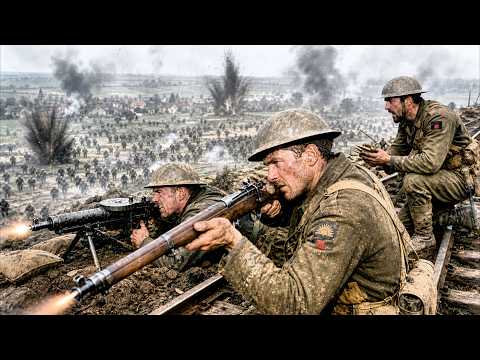
The embankment was everything. From its crest, a soldier could see the entire valley floor—the village, the fields, the men coming toward him. Any attacker would have to scale a wall of compacted earth under a hail of bullets, or squeeze through narrow drainage arches one at a time. It was perfect defensive ground. But it was also a trap. If the Germans broke through, there was nothing behind but open wheat fields and a bare slope rising to the Amiens-Albert road. No cover. No trees. Just sky and death.
Brigades 12 and 13 of the 4th Australian Division had been rushed south to hold this line. They were not fresh troops. Many had been in France since 1916—veterans of Pozières, Bullecourt, Messines, Passchendaele. They knew what a fierce attack looked like. They had buried too many mates to forget.
Eight days earlier, on March 28, the Germans had tried once to take the embankment. A German company slipped through the fog and broke into the Australian positions on the right of the 47th Battalion. In one of those positions stood Sergeant Stanley McDougall, a 28-year-old blacksmith from Tasmania. When a grenade knocked out the Lewis gun crew next to him, McDougall didn’t wait for orders. He grabbed a rifle and attacked the second wave of Germans alone. He shot and bayoneted seven men. He seized a German machine gun and turned it on its crew. He fired his Lewis gun until his hands blistered on the hot barrel, then fired until the ammunition ran out. By the end of the fight, 22 Germans lay dead at that post, and about 30 had surrendered—largely because one Tasmanian sergeant refused to leave his ground. McDougall was awarded the Victoria Cross.
But the Germans learned from that failure. They planned the next attack with precision. They called it Operation Sunshine. Three and a half divisions—roughly 25,000 men in attack waves. Sixteen thousand gas shells for the artillery preparation. Stormtroopers from the 3rd Jäger Battalion to lead the assault along the railway line. They knew about the Lewis guns at the drainage arches. They knew about men like McDougall. They knew this would be harder than the first attempt.
On the night of April 4, an eerie stillness settled over the Ancre Valley. At dawn on April 5, the fog was thick. At around 7 a.m., the German artillery opened fire. For two and a half hours, high-explosive and gas shells pounded the embankment and the Australian gun lines behind it. Signal cables were cut in dozens of places. Runners died in the open. Signal rockets—the only way to call for defensive fire—rose into the fog and were never seen. The Australian 18-pounders waited on the hill behind the line, coughing on gas, for a signal that never came.
At about 9:25 a.m., the shelling stopped. In the sudden silence, the Australians heard something else: whistles. Long, thin, silver whistles—the German infantry attack signal. They couldn’t see them yet. But they could hear them. Footsteps. Rifles clinking against belt buckles. The unmistakable rumble of thousands of men moving together across soft ground.
Along the line, section leaders gave the same order in a low voice: “Hold your fire. Wait. Let them come close. Don’t waste a single round.”
The first shape appeared at the base of the embankment. Then another. Then a line of them, walking, then jogging, then running. The Lewis guns opened fire.
The sound was like a heavy sewing machine—the top magazine chattering and spinning, empty cartridges arcing out in a hot brass spray, the bipod jumping on the packed earth. A trained gunner could put out roughly 500 rounds a minute. Along the crest, dozens of Lewis guns opened at once. Riflemen fired as fast as they could work their bolts. Some had been in France so long they could reload without looking.
The first German wave reached the base of the embankment and vanished into it. Men fell. Men climbed over the dead. Men fell over the dead. On good ground, along an open slope, against massed rifle and Lewis fire, an attack in the First World War could lose half its strength in a single minute. But there were so many of them. Behind the first wave came a second. Behind the second, a third. Behind the third, a whole regiment in reserve.
The 48th Battalion held on the northern side of Dernancourt. Two German reserve infantry regiments—the 261st and 262nd—could not cross the line at all. Two full regiments stopped, and a third reserve regiment behind them stopped too, held back by a single Australian battalion firing from commanding ground. Charles Bean, the official Australian historian, later called it a great feat of arms.
But on the other side of the village, in the 47th Battalion’s sector, things were going wrong. The 47th held the most exposed ground on the whole line, directly opposite the village where the railway curved around the northwest corner. Their front was long, and there were not enough men to fill it. In places the posts were 70 or 80 meters apart. In the fog, they could not see each other. In the fog, they could not know whether the men in the next post were still alive.
The 230th Reserve Infantry Regiment attacked first and was thrown back. Then a second regiment attacked and was thrown back too. Both times, the Australians stood on the embankment, rested their rifles on their shoulders, and shot the men clinging to the earth wall below them. The third attack was different. This time the Germans used the folds in the ground, the smoke of their own barrage, and the rising fog. Small groups crept close to the embankment before they were seen. And when the attack came, it did not come in a straight line across the open. It came in groups, working around the flanks of the 47th at the same time. In their hundreds, they crossed the embankment before anyone at battalion headquarters knew what had happened.
The first sign of trouble at headquarters was a runner coming back with news that the right company of the 47th had been wiped out. That is a hard thing for a company commander to hear. It meant roughly 140 men killed, wounded, captured, or missing. It also meant the ground they had been holding—the ground you were counting on to protect your flank—was now empty, or worse, full of Germans.
The Germans came through the gap in their hundreds, spreading left and right along the back of the embankment, attacking the Australian posts from behind. Men who had been firing forward found the enemy coming at them from the rear through the fog. Without their supporting artillery, which was still gasping from the gas shells, whole platoons of the 47th went down before they could react. Some men fought back to back and were killed where they stood. Others were forced to withdraw at pistol point and driven off as prisoners. The Germans, wanting to keep moving, did not even escort their prisoners to the rear—they simply pointed toward Dernancourt behind them and told the Australians to walk that way and keep walking.
By early afternoon, the Germans had broken through the embankment along a front of about a kilometer. They had taken some of the Australian support trenches in the center of the line. They were now on the open slope behind the embankment, advancing toward the crest. They were about 1,200 meters from the Amiens-Albert road. If they reached the road, they would have cut the last defensive line before Amiens.
At the headquarters of the 4th Australian Division, behind the crest, the commanders looked at their maps and looked at each other. They had to make a decision, and they had to make it fast. The obvious choice was to hold the line where it now stood, on the high ground, and wait for darkness. In the dark, more troops could be moved. British reinforcements might arrive. Perhaps the Germans, exhausted from a full day of climbing the embankment under fire, would not push further.
But the obvious choice was also the wrong one. If the Germans held the ground they had taken, they would spend the night fortifying it. They would site their machine guns behind the embankment, then their field guns behind that. They would strengthen their positions on ground that overlooked every inch of the Australian rear. And in the morning, they would come again from a stronger position. The Australians had to take it back—and they had to take it back before dark.
In broad daylight, on a bare slope, into the heart of what had just shattered the 47th, the order was given. The 49th Battalion from Queensland would counterattack from the center, while the 45th from New South Wales advanced from the left. The 47th, 48th, and 52nd—mauled and scattered—would provide fire support from any position they could find. Zero hour was set for 5:17 p.m.
In early April in northern France, the light would still be bright. Sunset was two hours away. Every Australian in the counterattack knew, before he rose, that he could be seen and shot.
At 5:00 p.m., a short Australian barrage began—improvised, assembled from whatever guns were available. It was better than nothing. Then, at 5:17, the line rose from the reserve trenches as one. Bayonets fixed, rifles pointed at the enemy’s muzzle flashes. Some sergeants ran forward; most men walked. They had trained for years to keep the line together in the last hundred yards.
German machine guns spotted them immediately. Men in the front rank fell as if a wire had been cut behind their knees. The line kept advancing. The second rank stepped over the dead and continued. A witness later said that as the counterattack reached the crest, they met the heaviest machine-gun fire he had seen in his life.
At about 90 meters from the German positions, the survivors did what infantry had done for centuries: they lowered their bayonets and charged. The Germans on that slope were numerically superior, but they were exhausted too. They had climbed a two-story embankment, broken through a battalion, and run hundreds of meters under fire. When the Australian bayonets came out of the smoke, they collapsed. Some fought and died. Some threw down their rifles and raised their hands. Some ran. The Australians broke through and kept going.
In hand-to-hand fighting on the crest, the German advance stopped, then wavered, then rolled back toward the embankment. Charles Bean, watching from division headquarters, later wrote that this counterattack was one of the finest ever carried out by Australian troops. By dusk, the Germans had been driven from most of the ground they had taken. On the right, the Australians regained the embankment itself. In the center and left, they held a line about 1,300 meters back from the embankment in places—but they held.
That line separated the Germans from the Amiens-Albert road. The Germans made no serious attempt to resume the attack. The code name for that day’s operation, Sunshine, quietly disappeared from operational reports. The operation had failed.
In the two battles of Dernancourt—March 28 and April 5—the Australians lost more than 1,100 killed and wounded. The 47th Battalion suffered particularly heavily; its right company simply vanished, its trenches filled with bodies. German losses were also severe. By any measure, three divisions had failed to take ground held by two under-strength brigades, and they paid for the attempt in blood.
Amiens did not fall. Not that day, not the next, not ever. The men who defended that door had marched 27 kilometers through the night. They had fought a battle a week earlier on the same ground. They spent the previous morning under a two-and-a-half-hour barrage mixed with gas. Three divisions attacked them in the fog. They lost their forward battalion in the center, and in the last hours of daylight they counterattacked with what they had left across open ground against machine guns. At 5:17 p.m., the Australian War Memorial recorded a specific sentence in its files about April 5 at Dernancourt: it was the strongest attack faced by Australian forces during the war.
The bridge still stands today. If you walk west from the village of Dernancourt, you can stand at its base. The railway line still runs over it. Trains still pass. Grass has grown over the gravel. In summer, wildflowers bloom along the base of the embankment—including poppies.
Most of the men who fought there came home and didn’t talk about it much. They went back to farms and country towns. They ran hardware stores in Bendigo. They worked the wheat harvest in Western Australia. Some, like Stanley McDougall, went into forestry. He became a forest inspector in Tasmania and was praised for his courage fighting fires. He died in 1968 at age 79 in Scottsdale, Tasmania. His Victoria Cross is displayed today at the Australian War Memorial in Canberra.
Ask any Australian on the street about a WWI battle, and they’ll probably say Gallipoli. Some will say Villers-Bretonneux. Some will say Fromelles. But rarely will they mention Dernancourt. The name never took hold in popular memory. No blockbuster film, no famous poem, no day set aside on the national calendar.
But if you are ever in northern France, and you find yourself in the Ancre Valley, and you walk down to a railway embankment about two stories high beside a small village called Dernancourt, remember what happened there. Remember 4,000 men. Remember three German divisions. Remember five to one. Remember the fog at 7 a.m. and the whistles at 9:25. Remember the third attack that was stopped. Remember the order to counterattack in broad daylight. Remember 5:17 p.m. And remember the sentence the Australian War Memorial keeps in its records: the strongest attack faced by Australian forces during the war. Stopped by two brigades on one earthen embankment on a single April afternoon in 1918. They held the line at Amiens, and the door did not open.
So here’s the question: why do you think some battles are remembered while others—like Dernancourt—fade into the poppies and the wheat fields? Share your thoughts below.
Report this article
Select a reason for reporting:






