Rebecca Torres had examined thousands of Victorian portraits, but something about this one made her pause. The scan was crisp, the family perfectly posed—yet her eyes kept drifting to the shadow behind the father’s chair.
She zoomed in, her pulse quickening. There was someone standing there, barely visible in the gloom. A figure so faint it could have been a trick of the light, but Rebecca knew better.
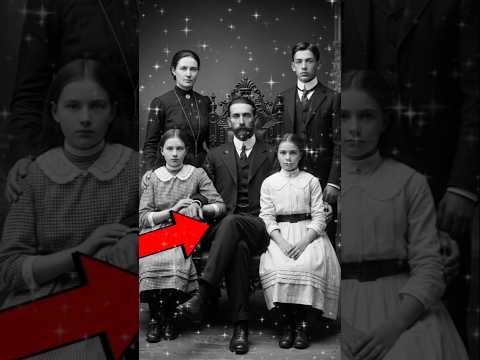
The family: a stern father, a tight-lipped mother, two children stiff as dolls. Typical 1899 Charleston wealth. But the figure behind—a woman in a dark dress, face obscured by a veil. No one in the family seemed to notice her.
Rebecca pulled up the estate sale records. The photo belonged to the Whitaker family, but no woman matched the veiled figure. She wasn’t a relative, wasn’t a servant—at least not one on record.
She adjusted the contrast, and the figure sharpened. The woman’s hand rested on the father’s shoulder, yet he sat rigid, unaware. Rebecca’s skin prickled. This wasn’t a double exposure. It was as if the woman had been there, unseen by all but the camera.
She needed answers. The Whitaker house still stood on Charleston’s east side, now a museum. And its curator had once mentioned a ghost story—a woman in black who appeared in old photographs.
Rebecca reached for her phone and dialed the Whitaker House Museum. The curator, an elderly man named Harold Peele, answered on the third ring. “The veiled woman again,” he said before she could finish. “You’ve found another one.”
Her grip tightened on the phone. “Another one?”
“There are four known photographs,” Harold said. “All taken between 1897 and 1901. All showing the Whitaker family. And in every single one, she’s there—standing behind Elias Whitaker, hand on his shoulder.”
Rebecca pulled up her notes on the Whitaker family. Elias was the stern father in her photograph. A cotton merchant, wealthy, respected. He had died in 1901 under circumstances the newspapers called “sudden and tragic.”
“What happened to him?” she asked.
Harold was quiet for a moment. “Officially? A heart attack. Unofficially, the household staff whispered that he’d been haunted for years. They said a woman in black followed him everywhere—but only he could see her.”
Rebecca looked back at the scan. The veiled woman’s hand on Elias’s shoulder. His face, rigid and pale. Not the calm of a posed portrait—the fear of a man who knew something was behind him.
She spent the next two days digging through Charleston archives. The Whitaker family had employed a young housemaid in 1896—a woman named Margaret O’Connell, an Irish immigrant. No photograph of her survived. But the employment records noted she had “left service” in the spring of 1897.
Left service. Rebecca had seen that phrase before. In the 1890s, it often meant something far darker than a resignation.
She found the coroner’s report buried in a box of unindexed papers. Margaret O’Connell, age twenty-two, died of “accidental drowning” in the Ashley River. The report listed no witnesses and no investigation. Elias Whitaker had signed the burial order himself.
Rebecca stared at the screen. The first photograph in the series was dated October 1897—six months after Margaret’s death.
She opened the scan again and zoomed in on the veiled woman’s hand. The fingers were pale, waterlogged, the skin faintly wrinkled as though she had just climbed out of the river.
Her phone buzzed. A text from Harold: “I found something in the basement. A fifth photograph. You need to see this one.”
Rebecca was already reaching for her coat.
The Whitaker House stood at the end of a cobblestone lane, its portico columns gleaming in the late afternoon sun. Harold Peele met her at the door, his face drawn and gray.
“I’ve worked here thirty years,” he said, leading her down a narrow stairwell. “I’ve never been frightened of this house. Until last night.”
The basement smelled of mildew and old cedar. Harold unlocked a storage room and pointed to a crate on a workbench. Inside, wrapped in yellowed linen, lay a photograph smaller than the others.
Rebecca lifted it carefully. The image showed Elias Whitaker alone in his study, seated at his desk. And behind him—the veiled woman, closer than ever, her face no longer obscured.
Rebecca’s breath caught. The veil had been pulled back. Margaret O’Connell stared out of the photograph with hollow eyes, her lips slightly parted, as though she were about to speak.
But it was the date that made Rebecca’s hands tremble. August 1901. Two weeks before Elias died.
“Turn it over,” Harold said quietly.
On the back, in faded ink, someone had written a single line: “She has come to collect what he owes.”
Rebecca turned the photograph toward the light. Something else was wrong—something she had missed. Elias’s hands were not resting on the desk. They were gripping the arms of his chair, knuckles white.
And on the polished wood of the desk, reflected faintly, were wet fingerprints.
“Harold,” she whispered, “did Margaret O’Connell have any family? Anyone who might have kept records?”
He nodded slowly. “A sister. Bridget. She stayed in Charleston, married a fisherman. Her great-granddaughter still lives here. Runs a small archive of Irish immigrant history.”
Rebecca pulled out her phone. “I need her address.”
Harold hesitated. “There’s something you should know first. The great-granddaughter—her name is Nora. And she’s been trying to get this house to acknowledge Margaret for years.”
He paused, then added, “She claims Margaret didn’t drown by accident. She says Elias Whitaker held her under the water himself.”
Rebecca looked back at the photograph. Margaret’s hollow eyes seemed to follow her. The drowned girl had waited over a century. And now, in five photographs, she was inching closer.
“Call Nora,” Rebecca said. “Tell her I have something she needs to see.”
Nora arrived within the hour, a slim woman in her forties with the same sharp gray eyes Rebecca had seen in the drowned girl’s photograph. She set a worn leather journal on the workbench. “Bridget kept this,” she said. “She wrote down everything Margaret told her before she died.”
Rebecca opened it carefully. The pages were brittle, the ink faded, but the words were clear. Margaret had confronted Elias about the child she carried—his child. He had promised her money, then met her at the river instead.
“Bridget wrote that Margaret’s last words were a promise,” Nora said quietly. “She said she would not go to her grave alone. She would wait for him.”
Rebecca looked at the fifth photograph again. Margaret’s hollow eyes, her parted lips. The wet fingerprints on the desk. “She waited four years,” Rebecca murmured. “Then she collected.”
Harold’s voice was hoarse. “And the photographs? Why would she appear in them?”
Nora touched the image gently. “Because a photograph is a kind of proof. She wanted someone to see her. To know she was there.”
Rebecca felt the weight of it settle over her. Margaret O’Connell had no grave marker, no newspaper obituary, no record beyond a line in a coroner’s book. Only these five images, waiting in an estate sale for someone to notice.
“The museum should display them,” Rebecca said. “All five. With Margaret’s name.”
Nora’s eyes glistened. “That’s all she ever wanted. To be seen.”
They hung the photographs the following spring. In the last one, the veil had fallen away entirely, and Margaret O’Connell looked out at the visitors with something like peace. Rebecca never found a sixth photograph. She never needed to.
But sometimes, late at night, she wondered—if a camera could capture a ghost, what else might be standing just behind us, waiting to be noticed? Have you ever looked closely at an old family photograph and felt someone watching back?
Report this article
Select a reason for reporting:






