Hollywood’s golden age was built on illusion, where flawless faces and perfect bodies were the currency of fame. But behind the shimmering curtain, some of the most iconic stars were hiding secrets that could have destroyed their careers. From a scar that launched a thousand close-ups to a limp that became a trademark, these legends turned their flaws into fortresses of fame. Their stories are not just about survival—they are about the lies we tell to be loved.
Carole Lombard, the queen of screwball comedy, was one such star. At 18, a car crash shattered glass into her face, leaving a scar that ran from her nose to her eye. In an industry obsessed with beauty, she should have been finished. Instead, she became the highest-paid actress in Hollywood, her scar hidden by makeup and meticulous lighting. But the scar was just one of many secrets. Gary Cooper’s famous walk? A result of a childhood hip injury that never healed. Michael J. Fox’s twitchy energy? A mask for Parkinson’s disease. These stars didn’t just overcome their limitations—they made them invisible.
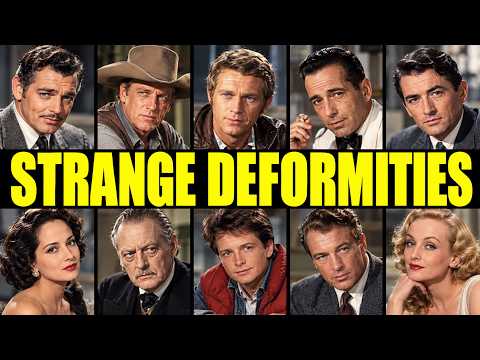
But the illusion came at a cost. Lionel Barrymore, confined to a wheelchair by arthritis and accidents, had his chair written into his roles, fooling audiences for years. Merle Oberon, terrified of her mixed heritage and skin damage, invented a light—the Obie—to hide her scars. Gregory Peck lied about a back injury to avoid questions about his masculinity. Humphrey Bogart’s lip scar became a mystery, with stories ranging from a war wound to a bar fight. Steve McQueen’s dyslexia and deafness were never public, his silent cool a cover for struggle. James Arness’s chronic leg pain from Anzio was masked by cowboy grit. And Clark Gable’s dentures? A secret that stayed hidden even as he kissed Vivien Leigh.
These stars remind us that perfection is a performance. Their disabilities and deformities were not weaknesses—they were the raw material of legends. But the cost of concealment was high, and the truth only emerged after the lights dimmed. As we delve deeper into their stories, we’ll uncover how each star navigated the treacherous waters of fame, and how their secrets shaped the very roles that made them immortal.
The pattern repeats with almost mechanical precision. A physical flaw appears, the studio machinery swings into action, and the public is fed a sanitized version of the truth. What makes these cases so striking is not the deception itself—Hollywood has always lied—but the sheer ingenuity required to maintain it. A scar becomes a lighting problem. A limp becomes a character choice. A degenerative disease becomes a scheduling challenge.
Consider the logistics. Carole Lombard’s contract reportedly included clauses about camera angles and lighting setups. Cinematographers were instructed never to shoot her from the left. Merle Oberon’s husband, Lucien Ballard, literally invented a piece of equipment—the Obie—to preserve his wife’s career. These weren’t just personal vanities; they were industrial secrets, protected by contracts, loyalty, and fear.
“The studio didn’t just sell the star,” one historian noted. “It sold the absence of the flaw. That was the product.”
And the stars themselves became complicit. They learned to move differently, to angle their heads, to keep their hands busy. Michael J. Fox has described the exhausting calculus of hiding a tremor in front of a live studio audience. Steve McQueen stripped his dialogue down to the bone, turning a learning disability into a minimalist acting style that critics praised as genius. The concealment was not passive—it was active, daily, relentless work.
What emerges from these stories is a darker truth about the golden age. The studio system didn’t just manufacture stars; it manufactured normalcy. Disability was treated as a defect to be engineered away, not accommodated. Clark Gable’s dentures were not a medical fact to be acknowledged—they were a breach of the contract of stardom. When Vivien Leigh reportedly complained about his breath on the set of Gone with the Wind, the story was suppressed, not because it was scandalous, but because it threatened the illusion.
The public, for its part, rarely asked questions. Audiences wanted to believe. They wanted the walk to be pure Gary Cooper, the wheelchair to be a costume choice, the silence to be cool. The stars gave them what they wanted, and in return, the stars were allowed to keep working.
But the cost of that bargain is only now becoming clear. Lionel Barrymore reportedly relied on cocaine to manage his pain—a claim that remains unverified but speaks to the desperation beneath the polished surface. Gregory Peck’s back injury was real, but the lie about rowing was considered necessary because a dance class wasn’t “macho enough” for a wartime leading man. The concealment wasn’t just about vanity; it was about survival in an industry that had no room for the broken.
“They didn’t hide their disabilities because they were ashamed,” one biographer wrote. “They hid them because the alternative was unemployment.”
And yet, something unexpected happened along the way. The flaws became the performances. Cooper’s stiff walk became the essence of the quiet western hero. McQueen’s halting speech became the template for a thousand imitators. Bogart’s scarred lip gave him a voice that no one could forget. The very things they tried to erase became the things that made them unforgettable.
It’s a paradox that sits at the heart of every one of these stories. The flaw was the secret, but the secret was also the signature. The concealment was a lie, but the lie was so well-crafted that it became a kind of truth—a new identity built on the ruins of the old one.
As we move deeper into this hidden history, the question shifts. It’s no longer about what they hid, but about what the hiding did to them. What does it cost to spend a lifetime pretending to be whole? And what happens when the cameras finally stop rolling?
The answer, in case after case, was a strange and lonely kind of freedom. Once the secret was buried deep enough, the star could relax into the performance of being themselves. Carole Lombard, freed from the terror of a stray camera angle by a contract that guaranteed her lighting, became the most fearless actress on the lot. She swore like a sailor, took dares, and threw herself into slapstick with a abandon that suggested a woman who had already survived the worst thing that could happen to her face.
That fearlessness is what Clark Gable fell for. When they eloped to Kingman, Arizona, in March 1939, the press sold it as the marriage of the king and the queen of Hollywood. What the columns never mentioned was that they were two people held together by the same unspoken rule: never let them see the flaw.
Gable’s dentures were fitted in 1933, and by the time he met Lombard, he had learned to live with them. He ate carefully, smiled with his lips rather than his teeth, and never let a dentist’s name appear in his contracts. Lombard, who hid a scar, married a man who hid a mouth. Neither of them ever wrote it down.
What the two of them shared was a private language of accommodation. Friends noticed that Lombard never lit a room from the left when Gable was in it. Gable, in turn, learned to stand on her good side in photographs without being asked. It was not deception between them—it was a kind of tenderness, a mutual agreement not to look too closely at the thing the other one had spent a lifetime covering up.
When Lombard died in January 1942, the plane carrying her home from the war bond tour slammed into Mount Potosi in the dark. Gable was in Los Angeles when the news came. He drove to the morgue, and according to the accounts that survived, he insisted on seeing her. What he saw, no one wrote down. He was 41, and he had just lost the only person who had ever known the whole of him.
His response was to join the Army Air Forces. He flew combat missions over Europe as a gunner and cameraman, a 42-year-old man in a bomber turret, and the press covered it as patriotism. It was patriotism. It was also a man who had stopped caring whether he came back.
He did come back. He kept working for another fifteen years, and the dentures stayed hidden, and the smile stayed crooked, and the secret stayed secret. But the men who knew him in those last years said something had gone quiet in him. The King of Hollywood had spent his whole life being looked at. After Lombard died, he stopped looking back.
That silence is the part of the story the fan magazines never printed. The concealment was not just a professional strategy—it was a way of being in the world, a habit of holding the body still so the truth would not leak out. And when the person who had shared that habit was gone, the habit remained, but the reason for it did not.
It is tempting to read these stories as triumphant. The star overcomes the flaw, the flaw becomes the style, the style becomes the legend. But there is a second story running underneath, quieter and harder to sell.
It is the story of what happens after the cameras stop. Lionel Barrymore in his wheelchair, composing music no one would hear. Merle Oberon in Mexico, far from the lights that had been built to save her skin. Steve McQueen, dyslexic and half-deaf, learning his lines slowly in a trailer while the crew waited. The flaw was hidden from the audience, but it was never hidden from the person carrying it.
And that is where the next part of this history begins—not with the secrets themselves, but with the strange, private lives the secrets created. Because the most revealing thing about a star is not what the public saw. It is what they did when they thought no one was looking.
When the lights finally dimmed, the truth had a way of slipping out—sometimes after death, sometimes in a single unguarded moment. Carole Lombard’s scar stayed off the screen until the very end, buried with her on Mount Potosi. Merle Oberon’s birthplace and her pitted skin were revealed only after she was gone, the Obie light outliving her as a standard tool of cinematography.
Gary Cooper’s hip, Michael J. Fox’s tremor, James Arness’s leg—each was a private war fought daily, invisible to the audience but never to the man or woman in the frame. “The flaw was the secret, but the secret was also the signature,” as one biographer put it. What they hid became what made them unforgettable.
Yet the cost was real. Bogart took the truth of his lip to the grave, four versions of the story still competing. Gable’s dentures stayed hidden even as he kissed Vivien Leigh. And after Lombard died, the King of Hollywood stopped looking back.
These were not gods but people who turned their brokenness into armor. They lied, and we loved them for it. Perhaps that is the oldest bargain in show business: we ask our stars to be whole so we can pretend we are, too.
So here is the question that remains: if a flaw can become a legend, what are you hiding that might be your greatest role?
Report this article
Select a reason for reporting:






