Elizabeth Morgan had spent forty years capturing other people’s happiest moments. Now, at sixty-three, she hunted for fragments of forgotten lives in dusty auction boxes. But nothing could have prepared her for what she found in a five-dollar bin in Portland.
The photograph was nearly a century old—a mother, three children, a porch in Seattle, June 1926. The woman’s smile was radiant, her arms wrapped protectively around her children. Elizabeth’s trained eye caught it immediately: something was wrong.
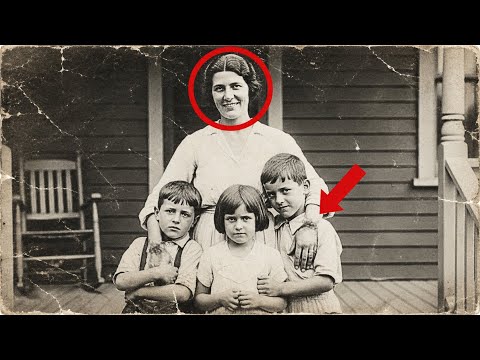
She turned the photo over. “Mother and us, Seattle, June 1926.” No names. No photographer’s mark. But when she flipped it back and held it under the window light, her breath caught in her throat.
The mother’s left wrist—visible where the sleeve had slipped—bore a dark, mottled bruise. Her right hand, resting on her daughter’s waist, showed the same shadowed mark. Elizabeth knew injuries. In her final years of work, she’d photographed domestic violence victims for court cases. These were not shadows.
They were bruises. Deliberately hidden under long sleeves on a warm June day.
Yet the woman’s face showed no pain. Only love. Only that bright, protective smile.
“Are you buying that box, ma’am?” The auction assistant’s voice startled her.
Elizabeth nodded, fingers still gripping the photograph. “Yes. I’m buying it.”
That night, in her home studio in Alameda, she placed the photo under her professional magnifying lamp. The details emerged with painful clarity. Both wrists—definite contusions, dark and extensive. The knuckles of the woman’s right hand—swollen. What Elizabeth had first taken for a shadow on her upper arm was another bruise, hidden beneath the fabric.
She pulled out her notebook and began documenting everything. The house behind the family was typical working-class Seattle. Wooden siding, plain porch. But the rose bush suggested care. The lace curtains—a touch of beauty within limited means. The children’s clothes were clean and neat, if not expensive. The eldest boy in knickers and a white shirt. The younger boy in overalls. The little girl’s dress carefully mended at the hem.
These were children raised with love.
But the mother—she was the one who held Elizabeth’s attention. Long sleeves, regardless of season. Posture straight, almost defiant, as if she were seizing this moment to leave proof of her love for her children. The smile never wavered. But her eyes, when Elizabeth examined them through the magnifier, held something else. Not sadness. Resolve. Purpose.
Elizabeth leaned back and rubbed her tired eyes. Outside her window, evening had deepened into night. She hadn’t eaten dinner. But she couldn’t stop staring at the photograph, couldn’t stop thinking about the story hidden within it.
She turned it over again, studying the faded pencil marks. The handwriting was careful, almost childlike—as if written by someone with little education, or perhaps by one of the children years later, preserving a memory.
Seattle, 1926. Thirty-one years ago. If the woman had been thirty then, she’d be sixty-one now—nearly Elizabeth’s own age. Were any of those children still alive? Did they remember that day? That photograph, their mother’s smile?
Elizabeth made a decision. Tomorrow, she would begin searching for answers. She knew people in Seattle—other photographers, historical societies, libraries with old city directories. Someone, somewhere, might remember this family. Might know what happened in that house with the roses and the lace curtains.
She owed it to the woman in the photograph. To those bruised hands that held her children with such fierce tenderness. To that smile that refused to fade, despite everything.
The next morning dawned cold and gray, typical for November in Portland. Elizabeth woke early, the photograph already occupying her thoughts before she opened her eyes. Over coffee, she made a list of potential sources: the Seattle Public Library’s historical archives, the Washington State Historical Society, old newspaper collections, and her colleague Thomas Chen, a retired photojournalist who’d worked in Seattle in the 1940s.
She called Thomas first.
His voice was warm and curious. “Elizabeth. It’s been months. What’s got you calling at eight in the morning?”
“I found something, Tom. A photograph from 1926, Seattle. I need your help tracking down the story behind it.”
A pause. “You know I can’t resist a mystery. What have you got?”
Elizabeth described the photograph in detail—the woman, the children, the house, and most importantly, the bruises hidden beneath the loving tableau.
Thomas listened without interruption, and when she finished, he was silent for a long moment.
“1926 was a hard year in Seattle,” he finally said. “The economy was struggling. Labor unrest, violence in the working-class neighborhoods, domestic troubles. People didn’t talk about those things then. Women had no recourse.”
“I know,” Elizabeth said quietly. “That’s why I need to find out what happened. This woman—she was trying to tell someone something. I can feel it.”
“Send me a copy of the photograph. I’ll make some calls at the historical society. I know a woman there, Sarah Bennett—she specializes in Seattle social history from that era. If anyone can help, it’s her.”
Elizabeth spent the morning in her darkroom, carefully printing copies of the photograph. She made enlargements of specific areas—the woman’s hands, the front of the house, the children’s faces. Every detail might hold a clue.
By noon, she had packaged everything and driven to the post office, sending the copies to Thomas in Seattle and keeping a set for herself.
Back home, she began searching through her collection of Seattle city directories. Elizabeth had accumulated dozens of volumes over the years—invaluable for tracing families and old photographs. She pulled out the 1926 edition and began the tedious work of searching street by street for houses that matched the one in the photograph.
The directories listed thousands of residents by name and address, but without a name or specific location, it was like searching for a single grain of sand on a beach. But Elizabeth had learned patience from years of darkroom work. She made notes of neighborhoods with similar houses—Ballard, Georgetown, parts of Capitol Hill.
In the late afternoon, the phone rang. It was Thomas, his voice excited.
“Sarah found something. There was a photographer working in Seattle in the twenties—a woman named Dorothy Hayes. She did family portraits for working-class clients, traveled to homes with a portable camera. Sarah says Hayes kept detailed logs of her work, now stored in the historical society’s collection.”
Elizabeth’s heart raced. “Can we see them?”
“Sarah’s pulling them now. She’ll check the entries for June 1926, see if any match. But Elizabeth—” Thomas paused. “She also said to prepare yourself. If this family went through what you suspect, the records might be difficult to read.”
“I understand,” Elizabeth said, though her hand trembled slightly as she hung up. She looked at the photograph on her desk, at the woman’s determined smile. At those hands that had endured so much yet held her children with such tenderness.
“I’ll find your story,” Elizabeth whispered to the image. “I promise.”
Three days later, a thick envelope arrived from Seattle. Elizabeth’s hands shook slightly as she opened it, pulling out photocopied pages from Dorothy Hayes’s ledger book. Sarah Bennett had included a note: Found 17 entries for June 1926. One of them might be your family. Call me after you’ve read them.
The ledger entries were meticulous. Hayes recorded not just names and addresses, but brief descriptions of each session, the payment received, and often personal observations. Elizabeth spread the pages across her dining table and read through each entry carefully.
Most were unremarkable. Families celebrating new babies, anniversary portraits, children’s birthday pictures. But entry number fourteen made Elizabeth’s breath catch.
June 18, 1926. Called to residence on Dawson Street, Georgetown. Client paid $3 in advance. Woman requested portrait with her three children. Observed numerous bruises on hands and wrists. Client insisted on long sleeves despite warm weather. Husband not present. Woman was very specific about quick copies. Took extra care with lighting to capture her smile. She wanted the children to remember her as happy. Left with deep unease. Delivered photographs June 20. Woman appeared relieved, almost peaceful.
Elizabeth read the entry three times, her chest tight. The address was there. 1247 Dawson Street, Georgetown. Hayes hadn’t recorded a name, but the description matched perfectly. The timing, the bruises, the urgent request for quick copies, the specific desire to be remembered as happy.
She called Thomas immediately.
“I found it. Georgetown, Dawson Street, June 18, 1926.”
“Sarah’s already on it,” Thomas replied. “She pulled property records. The house was rented by a family—a woman named Helen, husband Robert, three children: William, James, and Mary. But Elizabeth—there’s more.” His voice dropped. “Sarah found newspaper archives. Three days after the photograph was taken, there was an incident at that address.”
Elizabeth’s stomach clenched. “What kind of incident?”
“Robert was found dead inside the house. The official report said he fell down the basement stairs, hit his head. But there were questions. Neighbors reported hearing arguments, sounds of a struggle. Helen claimed he was drunk, lost his balance. The police investigated but couldn’t prove otherwise. The case was closed as an accidental death.”
Elizabeth sat down heavily. The photograph suddenly took on a new dimension. Three days before her husband’s death, Helen had posed with her children. She’d wanted her smile captured, wanted to be remembered as happy—those bruises, that resolve in her eyes.
This wasn’t just a family portrait. It was testimony. It was survival.
“What happened to Helen and the children?” Elizabeth asked.
“That’s where it gets difficult,” Thomas said. “The family left Seattle within weeks. Sarah’s trying to trace them through census records and directories from other Washington towns, but it’ll take time. People moved a lot back then, especially if they were starting over.”
Elizabeth thanked him and spent the rest of the evening studying the photograph with new understanding. Helen had known she was creating a record—something her children could keep, something that showed love instead of violence. Whatever had happened to Robert—whether truly an accident or something else—Helen had made sure her children would remember her not as a victim, but as their protector. Happy. Strong.
Now the question was: where had Helen and her children gone, and had they found the peace and safety she so clearly deserved?
Elizabeth found herself unable to let go. Over the next week, she immersed herself in research with an intensity that surprised her. She contacted census record offices, wrote letters to county clerks across Washington State, and spent hours at the Portland library, scrolling through microfilm of old newspapers from surrounding towns.
The breakthrough came with the 1930 census. Sarah Bennett called, her voice bright with excitement. “We found them. Helen and the three children—William, James, and Mary—were living in Tacoma in 1930. She’s listed as a widow, working as a seamstress. The children are in school.”
“An address?” Elizabeth asked, hope surging.
“Just a ward number, but it’s something. They were living in a working-class neighborhood near the waterfront. I’m checking Tacoma city directories now.”
While Sarah worked on Tacoma, Elizabeth pursued another angle. She’d noticed something in Dorothy Hayes’s ledger—the photographer had written that Helen seemed “relieved, almost peaceful” when she collected the prints. That specific language suggested Hayes had sensed something profound about Helen’s state of mind. Elizabeth wondered if Hayes had kept any personal diaries or letters. She called the historical society and spoke with Sarah about it.
“Actually, yes,” Sarah said. “Hayes donated her papers before she died in 1952. Most are business records, but there are some personal letters and a few diary entries. I can look through them.”
Two days later, Sarah called again. “Elizabeth, you need to come to Seattle. I found Hayes’s diary from June 1926. There’s an entry about your Helen, but it’s something you should read yourself.”
Elizabeth packed a bag that afternoon and drove north through the rain, arriving in Seattle late that night. She barely slept, the photograph, Helen’s determined smile, and those bruised hands haunting her dreams.
The next morning, Sarah met her in the society’s research room. She was a woman in her fifties with kind eyes and careful hands, the kind of person who understood the weight of historical documents. She placed a leather-bound journal on the table between them.
“June 21, 1926,” Sarah said, opening to a marked page. “Hayes wrote this the day after she delivered Helen’s photographs.”
Elizabeth leaned forward and read the elegant handwriting: I cannot stop thinking of the woman on Dawson Street. When I returned with her portraits, she had such relief in her eyes. She paid me the remainder, counted the coins carefully, and held the photographs as if they were precious jewels. She said, ‘Now my children will remember me as happy.’ Not happy—remember me happy. As if she were becoming a memory already. I asked if she was all right, if she needed help. She smiled that same bright smile from the portrait and said, ‘I will be fine. Very soon.’ Then she closed the door. I stood on the porch for a long moment, troubled by something I could not name. That woman has made a decision. Whatever happens in that house, she has chosen her path. I pray she and her children find safety.
Elizabeth’s eyes filled with tears. Helen had planned everything. She’d documented her injuries through the photograph, created a record of her love for her children, and then somehow freed herself from Robert. Whether his death was accident or self-defense, Helen had known she needed evidence—proof of what she’d endured.
“There’s more,” Sarah said gently, turning pages. “The 1940 census. Helen was still in Tacoma, working as a seamstress, but all three children are listed with occupations. William is a mechanic. James is in the Navy. Mary is a teacher. They made it, Elizabeth. They survived and built lives.”
Elizabeth wiped her eyes and looked at the photograph she’d brought, now protected in a plastic sleeve. Helen’s smile seemed different now. Not just loving, but victorious. Defiant. A declaration that she would not let her children remember her broken.
“I need to find them,” Elizabeth said. “The children—they’d be adults now. William would be about forty-one, James thirty-nine, Mary thirty-six. They might still be alive. They should know what their mother did. How brave she was.”
Sarah nodded. “Then we keep searching.”
The Tacoma Public Library’s local history room smelled of old paper and polished floors. Elizabeth and Sarah sat at a corner table surrounded by city directories from the 1930s and 1940s, searching for Helen’s family. It was painstaking work—cross-referencing names, addresses, occupations, trying to piece together lives from fragments.
“Here,” Sarah said, pointing to a 1938 directory. “Mary—listed as a student at the College of Puget Sound. That’s significant for a working-class girl in the thirties, especially with a widowed mother.”
“Helen made it possible,” Elizabeth finished. “She worked as a seamstress for years to give her children opportunities.” She felt a deep respect for this woman she’d never met, whose story she was slowly uncovering.
They found William’s announcement in a 1941 newspaper. He’d married a local girl named Patricia and settled in Tacoma, working at the shipyards. James’s Navy records showed he’d served in the Pacific during the war and returned to Washington in 1946. Mary had indeed become a teacher, working at Franklin Elementary School in Tacoma until the late forties.
But by the 1950s, the trail grew harder to follow. The post-war years scattered families. People moved for jobs, for better housing, for fresh starts. Their leads were growing cold.
Elizabeth refused to give up. She spent a week in Seattle and Tacoma, visiting churches, schools, and senior centers. She placed advertisements in local newspapers: Seeking information about Helen and her children William, James, and Mary, who lived in Tacoma in the 1930s and 1940s. For family history research, please contact Elizabeth Morgan. She left her Portland phone number.
Within days, calls began coming in. Most were false leads, people who knew other families with the same names. But on the sixth day, a woman named Ruth called.
“I think I knew Mary,” Ruth said, her elderly voice trembling slightly. “We taught together at Franklin Elementary in the late forties. She was in her late twenties then, dark hair, very dedicated to her students. Are you looking for that Mary?”
Elizabeth’s heart raced. “Yes, that could be her. Do you remember anything about her family or her past?”
Ruth was quiet for a moment, and Elizabeth could hear the sound of decades-old memories being sifted through. “She was very private about her past. But one day, we were talking about our mothers, and I remember—Mary said her mother was the strongest person she’d ever known, that she’d saved them from something terrible when they were children. She had a photograph of her mother that she kept on her desk. She’d look at it sometimes during breaks. Said it reminded her what love and courage looked like.”
Elizabeth’s eyes stung. “Did Mary ever say what happened to her mother?”
“She said Helen died in 1949. Heart failure. I think Mary took it very hard. She said her mother had worked herself into an early grave trying to give them a good life.” Ruth paused. “Mary left teaching around 1950, moved away. I lost touch with her after that, but I remember she was a remarkable teacher, especially with troubled children. She seemed to understand what it was like to be afraid, to need protection.”
After thanking Ruth, Elizabeth sat in her hotel room, holding the photograph, staring at little Mary’s face—six years old, pressed against her mother’s side, safe within Helen’s protective embrace. That little girl had grown up to be a teacher who helped frightened children, carrying forward her mother’s legacy of protection and love.
But where was Mary now? Where were William and James? They’d be in their early forties now, perhaps with children of their own, carrying Helen’s story without even knowing how remarkable it was.
Elizabeth returned to Portland, frustrated but not defeated. She’d left contact information with a dozen agencies across Washington, placed more advertisements, and asked everyone she met to spread the word. Somewhere, Helen’s children or their children had to exist. Someone had to remember.
Three weeks passed. Elizabeth returned to her normal life, printing photographs for local clients, teaching occasional photography workshops at the community center. But the photograph remained on her desk, and every evening she found herself studying it, thinking about Helen’s courage, wondering if she’d ever find the family and tell them what she’d learned.
Then, on a Tuesday morning in late December, a letter arrived. The envelope was postmarked Eugene, Oregon, and addressed to Elizabeth Morgan in careful handwriting. Inside was a single sheet of paper, written in the same careful hand.
Dear Mrs. Morgan, My name is William. I saw your advertisement in the Tacoma newspaper. My cousin sent it to me. You are looking for information about my mother, Helen, and my siblings and me. I don’t know why you’re searching or what you’ve found, but your advertisement mentioned family history research. My mother passed away in 1949. My brother James died in Korea in 1951. My sister Mary lives in Sacramento with her family. If you have found something about our mother, I would like to know. She was an extraordinary woman who gave everything to protect us and give us a good life. Whatever you’ve discovered, I’m ready to hear it. Please write back or call if you’d prefer to talk. Sincerely, William.
He’d included a phone number.
Elizabeth’s hands trembled as she read the letter three times. She’d found them. After weeks of searching, one of Helen’s children had found her. She looked at the clock—9:30 AM—and picked up the phone.
It rang three times before a man answered, his voice deep and cautious. “Hello?”
“Is this William?” Elizabeth asked. “I’m Elizabeth Morgan from Portland. I just received your letter.”
A pause. “That was fast. I only mailed it three days ago.”
“I’ve been waiting for this call since I found your mother’s photograph in November,” Elizabeth said softly. “I have so much to tell you about her. About what I’ve discovered. But first, let me ask—do you remember the photograph? June 1926, Seattle. You and your siblings with your mother on the porch.”
Another long pause. When William spoke again, his voice was thick with emotion. “I remember. I was nine years old. It was one of the few photographs we had of my mother. Mary has the original now. She always said it was her most treasured possession because it showed our mother looking so happy. Why? What have you found?”
Elizabeth took a deep breath. “This isn’t something to discuss over the phone. William, I’d like to meet you in person. There’s a story behind that photograph. A story of your mother’s courage that I think you need to hear. Can I drive down to Eugene? Would you be willing to meet with me?”
“Yes,” he said immediately. “Yes, I want to know. When can you come?”
They arranged to meet that Saturday at a café in downtown Eugene. Elizabeth spent the next three days preparing—printing the photograph carefully, including marked enlargements where the bruises were visible, copies of Dorothy Hayes’s ledger entry and diary, the newspaper clipping about Robert’s death, and the census records that showed how Helen had built a life for her children after Seattle. She wanted William to understand not just what had happened, but who his mother truly was. A woman who had endured unimaginable pain yet stood before a camera and smiled, documenting her love while quietly planning her freedom, and then worked herself to the bone to give her children opportunities she’d never had.
Saturday morning was clear and cold. Elizabeth drove south through the Willamette Valley, the winter landscape stark but beautiful, thinking about the conversation ahead. How do you tell a man that his mother’s love was stronger than he ever knew? How do you honor her pain while celebrating her strength?
She’d know when she saw his face.
When Elizabeth arrived, the café was quiet and warm, a few customers scattered at tables. She recognized William immediately. His eyes—they were Helen’s eyes, that same determined gaze from the photograph. He stood as she entered, a tall man in his forties with graying hair and the weathered hands of someone who worked hard.
“Mrs. Morgan?” he asked, extending his hand.
“Elizabeth, please.” She shook his hand firmly, feeling the calluses, the strength.
“Thank you for meeting me.”
They settled at a corner table with coffee, and Elizabeth carefully placed the photograph between them. Not the original—she’d made a high-quality print. William stared at it, his fingers tracing the edge gently. “I haven’t seen this in years,” he said quietly. “Mary keeps the original close. It’s framed by her bed. We always thought it showed how much our mother loved us.” He looked at Elizabeth. “But you found something else, didn’t you?”
Elizabeth nodded. She pulled out her folder and began to explain everything. Dorothy Hayes’s ledger, the diary entry, the dates, the newspaper report of Robert’s death. She showed him the enlarged images of Helen’s wrists, the visible bruises, the evidence of violence hidden beneath that loving smile.
William’s face shifted as Elizabeth spoke—confusion, then realization, then a deep, painful understanding. When she finished, he sat back heavily, his eyes fixed on the photograph.
“I remember him,” William said finally, his voice barely above a whisper. “My father. I remember being afraid of him. The sounds of arguments at night, trying to keep James and Mary quiet so we wouldn’t make him angry. But the specific details—I was so young, and my mother never spoke of those days. She always said we were going to have a better life, that the past was behind us.”
“She protected you,” Elizabeth said gently. “That’s what the photograph was for. She documented what she’d endured, but she made sure you would remember her as happy, not as a victim. Not as someone who was hurt.”
William’s eyes glistened. “She posed for this three days before he died. She must have been planning something.”
“I believe she was,” Elizabeth said carefully. “The police report said it was an accident. Your father fell down the basement stairs. Whether that’s exactly what happened or something else—your mother made sure there was a record. She was preserving evidence of her injuries while also showing you her love. She was incredibly brave, William.”
He wiped his eyes roughly with the back of his hand. “She worked so hard after we came to Tacoma. Sewing, washing clothes, feeding us, keeping house, and still finding ways to send us to school. I never understood where she got the strength. Why she pushed herself so hard. Now I know. She was making up for lost time, giving us the life she couldn’t give us in Seattle.”
Elizabeth showed him the census records, the timeline of Helen’s life in Tacoma—the years of hard work, the children’s educations, the opportunities she’d sacrificed her own health to provide. William read through everything, his expression a mixture of sorrow and pride.
“She died when I was thirty,” he said. “Heart failure. The doctor said it was overwork and stress, that her body simply gave out. I used to blame myself for not helping her more, for not realizing how tired she was. But she always said she was fine, that seeing us succeed was all she needed.”
“She gave you a gift you didn’t know you had,” Elizabeth said. “The knowledge that she suffered so you wouldn’t have to. That was deliberate. She wanted you to grow up without that burden, without knowing the full extent of what she endured and overcame.”
William looked at the photograph again, at his mother’s smile, at her hands holding him and his siblings close. “Can I—can I get copies of everything you’ve found? I need to show Mary. She should know this. And her voice cracked. She should know that every time she looks at this photograph, she’s seeing the most profound act of love our mother ever made—choosing to be remembered as happy instead of broken.”
“Of course,” Elizabeth said, sliding the folder toward him. “I made these copies for you. The photograph, the documents, everything. Your mother’s story deserves to be known and honored.”
They sat together for another hour. William shared memories of Helen—her smile, her fierce protectiveness, her insistence on kindness toward others, her pride when William learned a trade, when James joined the military, when Mary graduated from college. Each memory now carried new depth, new meaning, illuminated by the context of what Helen had overcome.
When they finally stood to leave, William embraced Elizabeth tightly. “Thank you,” he whispered. “Thank you for seeing what no one else saw. For caring enough to find us, to give us back a piece of our mother we didn’t even know we’d lost.”
Elizabeth drove back to Portland that evening with a lighter heart but also a deeper sorrow. She’d given William answers, but she’d also opened wounds that had never fully healed.
Two days later, her phone rang. A woman’s voice, thick with emotion. “Mrs. Morgan, this is Mary. William called me yesterday and told me everything you found. I’m driving up from Sacramento tomorrow. Can I meet you?”
They met at Elizabeth’s home in Portland. Mary was in her thirties, with Helen’s dark hair and that same intensity in her eyes. She carried a leather portfolio, and Elizabeth could see that Mary’s eyes were already red from crying.
“I’ve looked at that photograph every day for twenty-eight years,” Mary said as they settled in Elizabeth’s study. The original photograph was now on the table between them, carefully preserved under archival light. “Every day since my mother died, I thought I understood everything it meant. But after William told me about the bruises, about what you’d discovered—I realized I’d been looking at it wrong my whole life.”
Elizabeth handed her the magnifying lamp. “Look at her hands now. Knowing what you know.”
Mary leaned over the photograph, and when the bruises came into sharp focus under the glass, she let out a small sob. “How did I never see this? How did I miss it?”
“You weren’t meant to see it,” Elizabeth said softly. “Your mother made sure of that. She wanted you to see the smile, the love, the protection. The bruises were for someone else to find, for the future, for someone who might need to understand what she went through.”
Mary examined every detail—her mother’s wrists, her swollen knuckles, the way the sleeves were carefully positioned. Then she looked at Elizabeth, her eyes red. “I remember that day now. I was six years old. My mother woke us early, dressed us in our best clothes, and told us a nice lady was coming to take our picture. She said it was important that we all looked happy, that we remember how much we loved each other. I remember thinking she looked different that day—frightened, but also determined.”
Elizabeth said carefully, “Three days later, your father died.”
Mary nodded slowly. “I barely remember him. William has clearer memories. James too. But I remember the fear, the tension, the feeling that we always had to be very quiet and very careful. After we moved to Tacoma, my mother never spoke of him again. She never explained what happened. She just said we were going to have a better life, and we did. She worked herself to the bone to give us that life.”
Elizabeth showed Mary Dorothy Hayes’s diary entry, the census records, and Ruth’s memories of Mary as a young teacher. Mary read through everything, tears streaming down her face.
“That’s why I became a teacher,” Mary said. “She taught me that protecting children was the most important work in the world. I worked with troubled students, kids from difficult home situations. I always seemed to know which ones were afraid, which ones needed extra gentleness. Now I understand why. I was one of those children, and my mother taught me how to save them.”
They talked for hours. Mary shared memories of Helen that now took on heartbreaking clarity—her mother’s nightmares, her fierce insistence that Mary become independent, her warnings about choosing a partner carefully, her relief when Mary married a man who respected her. Mary understood now that her mother had been teaching her, guiding her, ensuring she would never become what Helen had been.
As evening approached, Mary took photographs of all the documents with a small camera she’d brought. “I want my children to know this story,” she said. “My daughter is fourteen now. She needs to understand where she comes from, what her grandmother overcame, what real strength looks like.”
Before leaving, Mary took Elizabeth’s hands in hers. And Elizabeth couldn’t help but notice how much Mary’s hands resembled Helen’s in the photograph. Strong and gentle at the same time.
“You gave me back my mother,” Mary said. “Not the saint I’d created in my memory, but the real woman. Flawed, hurt, terrified, but brave enough to save us. That’s worth more than you can imagine.”
Spring came to Portland with cherry blossoms and rain, washing the city clean. Elizabeth stood in her study, preparing for an exhibit at the local historical society. The exhibit was called “Hidden Stories: Women’s Lives in Photographs,” and Helen’s portrait was its centerpiece. Both William and Mary had given permission for the photograph to be displayed with the full story Elizabeth had uncovered. They’d even contributed their own memories and reflections, which would be displayed alongside the image. Mary had written a deeply moving piece about what the photograph meant to her now. This portrait is no longer just a picture of my mother as she was. It’s a farewell to the old version of her and a welcome to the new. It’s not just an image of love. It’s a declaration of survival.
The exhibit opened on a Saturday afternoon. Elizabeth was amazed by the turnout—hundreds of people came to see the photographs and hear the stories behind them. But the crowd around Helen’s portrait was the largest. People were drawn to that smile, to the story of hidden pain and extraordinary courage.
William came with his wife and two teenage sons. Mary drove up from Sacramento with her husband and daughter. They stood together before their mother’s photograph, seeing it now with full understanding—not just as a family portrait, but as evidence, as testimony, as a love letter to her children that had finally been delivered.
A young woman in her twenties approached them hesitantly. “Excuse me, are you the family in this photograph?”
“Our mother,” Mary said, gesturing to Helen’s image. The young woman’s eyes filled with tears. “I just wanted to tell you that I’m going through something similar to what your mother went through. I’m planning how to leave safely, how to protect my son. This photograph, this story—it’s giving me courage. If she could do it in 1926 with no resources, I can do it now with all the help available today.”
Mary took the young woman’s hand. “You can. And if you need help, there are people who will support you. My mother taught me that protecting your child is worth any risk, any sacrifice. You’re already doing the right thing by planning and being smart.”
They talked for several minutes. Mary wrote down phone numbers for women’s shelters and legal aid services. The young woman clutched the information like a lifeline.
Elizabeth watched from across the room, and in that moment, she understood why she’d been the one to find Helen’s photograph. The story wasn’t just about one woman’s courage in 1926. It was about every woman who had ever faced danger and chosen to risk everything for freedom. Helen’s decision to document her injuries while showing her love—a record that would one day reveal the truth—had echoed across decades because the struggle she faced hadn’t ended. It had simply changed forms.
Over the following weeks, more women came forward during the exhibit. Some were historians who’d found similar photographs in their research. Others were descendants of women who’d survived domestic violence in earlier eras. And some, like the young woman who’d approached Mary and Elizabeth, were living through the same reality Helen had escaped.
Elizabeth created a resource board at the exhibit, listing modern support services, legal rights, and emergency contacts. Helen’s photograph became more than a historical artifact—it became a living call to action, a reminder that courage and love could transcend the darkest circumstances.
Three months after the exhibit opened, Elizabeth received a letter from the young woman who’d spoken with Mary. She’d left her abusive partner, found safe housing through a women’s shelter, and was rebuilding her life with her son. She’d enclosed a photograph of herself and her little boy, both smiling on the porch of their new apartment. On the back, she’d written: So my son will remember that his mother was brave.
Elizabeth pinned the photograph to her study wall next to Helen’s portrait. Two women, separated by seventy-one years, connected by the same fierce love and determination to protect their children. Two photographs, each capturing not just a moment, but a transformation from victim to survivor, from fear to hope.
That evening, Elizabeth sat at her desk, looking at both photographs in the fading light. She thought about Dorothy Hayes, the photographer who’d recognized Helen’s situation and documented it with such care. She thought about Sarah and the archivists who’d preserved the records that made this story possible. She thought about William and Mary, who carried their mother’s legacy forward through their lives and choices. And she thought about Helen herself, that smiling woman with bruised hands who’d understood that a photograph could be more than a memory. It could be a witness, a testament, and ultimately, an inspiration.
Helen had created a portrait of love that was also a portrait of survival. And in doing so, she’d ensured that her courage would echo through generations.
The photograph remained on display at the historical society for six months. In that time, more than two thousand people saw it, according to Elizabeth’s estimate. Each one carried away Helen’s smile and the knowledge that sometimes, the most powerful act of love is refusing to let suffering have the final word.
When Helen posed for that photograph, she’d known it might be the last image her children would have of her. She’d chosen to show joy instead of pain, protection instead of vulnerability. And in that choice, she created something that transcended her own story—a testament for everyone who had ever loved someone enough to fight, to survive, to endure.
The photograph now rests in the historical society’s permanent collection, with a small brass plaque beneath it: Helen and her children, Seattle, 1926. Photograph by Dorothy Hayes. A portrait of love, courage, and survival.
Elizabeth likes to think Helen would have wanted it that way—remembered not for the pain she endured, but for what she overcame. And for that smile, which had protected her children across the decades.
What would you do if you found a photograph like Elizabeth’s—a hidden story of courage and love waiting to be discovered? Would you search for the truth, no matter how painful? Share your thoughts in the comments below.
Report this article
Select a reason for reporting:






