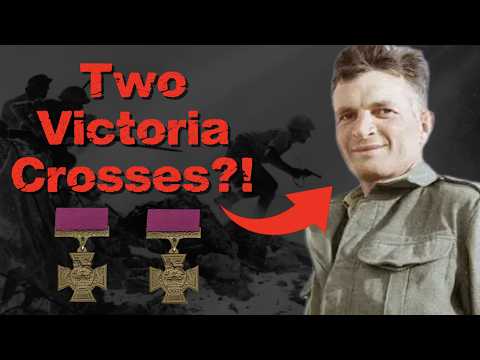
In the annals of military history, only three men have ever been awarded the Victoria Cross twice. One of them was a New Zealander named Charles Upham, a soldier whose extraordinary bravery on the battlefield became the stuff of legend. But when King George VI was asked to approve a second Victoria Cross for Upham, he reportedly wanted to know: “Does one man really deserve the award twice?” The answer from Major General Howard Kippenberger, who knew exactly what Upham had done, was simple: in his view, Charles Upham deserved to be awarded the Victoria Cross many times over.
It was an exceptional claim, but Charles Upham’s wartime record was equally exceptional. He became one of only three men in history to receive the Victoria Cross with a bar—the first for a series of operations on the island of Crete in 1941, and the second for his actions in North Africa the following year. Yet Upham himself never seemed comfortable with the attention. He spent most of his later life avoiding the spotlight, stating that many other men had done just as much and received no recognition at all.
Born in Christchurch, New Zealand, on September 21, 1909, Charles Upham was educated at Waiehi School, Christ’s College, and Canterbury Agricultural College—now Lincoln University—where he earned a diploma in agriculture. Before the war, his life revolved around working the land. He was a sheep musterer, a cattle driver, a farm manager, and a government valuer. He spent years moving across the New Zealand high country, often in harsh weather and over rugged terrain.
In 1935, he met Mary Eileen Tamney—known as Molly—who was working as a dietitian at Christchurch Hospital. They became engaged in 1938. However, the outbreak of World War II was looming, and in September 1939, Charles Upham enlisted. He entered Burnham Camp the following month.
Upham had already served in the Territorial Army and held the rank of sergeant, but when he joined the regular forces, he was asked to enlist as a private. He didn’t stay in that rank for long. The principal of Canterbury Agricultural College wrote to his commanding officer saying that if he wasn’t mistaken, Upham would make a distinguished soldier. And indeed, he wasn’t wrong—within months, Upham was promoted to corporal and then to sergeant.
In December 1939, he sailed from New Zealand with the first echelon of the Second New Zealand Expeditionary Force. He arrived in Egypt in February 1940. There he completed his training as an officer and became a second lieutenant. However, Upham was not suited to the ceremonial aspects of military life. He had no patience for military routine that he considered pointless. He was more interested in practical soldiering, and that was where he excelled.
In 1941, the New Zealand Division was sent to Greece. The campaign ended in withdrawal, and many Allied troops were evacuated to Crete. By the time Upham arrived there, he was sick—suffering from dysentery. On May 20, 1941, the Germans launched Operation Mercury, the airborne invasion of Crete. And in that fighting, Upham earned his first Victoria Cross—and just saying “first Victoria Cross” is remarkable.
Between May 22 and 30, Upham repeatedly found himself at the forefront of the battle around the retreating Allied positions in Crete. On May 22, his platoon took part in a counterattack toward Maleme airfield. The airfield was crucial because the German airborne forces had seized positions around it. If they could continue to land reinforcements there, the battle for Crete would become much harder. Upham’s squad advanced over 3,000 yards without any support. German machine guns constantly halted the advance, but Upham dealt with them personally. At the first machine-gun position, he advanced under heavy fire and silenced it with his pistol and grenades. Further on, another machine gun opened fire from inside a house. Upham advanced toward the house, threw a grenade inside, and killed the crew. They continued to advance until they were stopped again at a third machine-gun position; Upham crawled toward it and silenced it with another grenade.
“I remember when we encountered those machine guns that opened fire on us. And I think we set a record for the 50-yard dash until we reached that depression and could get some cover. But the thing that still sticks in my memory and made me laugh—the only time I laughed in Crete—was when you got there and your first words were a sharp reprimand for the Germans’ poor marksmanship.” “Well, I didn’t quite see it that way, because we had just come out of a hail of bullets whistling past my ear, and I considered them good shots.”
Upham cleared all the positions under heavy machine-gun fire, exposing himself to danger. Yet his men were forced to withdraw from the airfield, and as they retreated, Upham helped carry a wounded soldier. Then he helped gather more men so that other casualties could be recovered. Shortly afterward, they faced a problem: a nearby company had become completely isolated. “There’s a small group of our mates completely cut off, and they can’t be left there.” I then spoke to the forward platoon commander, Second Lieutenant Charles Upham, and told him I wanted him to send two of his best men with this message to that isolated group. Charles watched a corporal take charge of the rest of his platoon and set off himself with Corporal Dave Kirk on this mission, because he saw it as too dangerous to assign to anyone else. They set out on a mission that offered little hope of survival, let alone success. And how they succeeded is, of course, written in the Victoria Cross citation. Without that intervention, that company would likely have been surrounded and captured.
The fighting continued for days. Upham was hit by shrapnel in his back. He was blown into the air by a mortar shell. He was wounded in his foot. Yet he stayed with his men. At their new position at Galatas on May 25, German forces attacked again. Upham moved forward to reconnoiter their positions before bringing his men forward. His unit opened fire on the Germans, killing 40 and forcing them to retreat. When the order to withdraw finally came, he sent his men back but stayed in place. That was because other nearby troops were in danger of being cut off, and Upham wanted to warn them. However, while returning, he was spotted by two German soldiers who opened fire. Upham fell to the ground and pretended to be dead. The two Germans approached to check the body, allowing Upham to get up and hide behind a tree. One arm was still severely affected by his wounds, but he managed to rest his rifle on a branch and waited. When the two Germans came close enough, Upham shot them both. In fact, the second man fell so close to Upham that he knocked the rifle from the branch he was using.
By May 30, the Battle of Crete was nearly over. Allied forces were withdrawing to their final positions in the hope of evacuation. Upham was exhausted and wounded, still suffering from dysentery. He had barely eaten anything. But even then, there was another mission to be done. German forces were threatening the Allied headquarters near their final position. Upham took a Bren gun and two armed soldiers and climbed to high ground above a valley. From there, he opened fire. He was credited with killing 22 German soldiers and scattering the rest.
For over a week, he repeatedly attacked German positions, saved wounded men, gathered isolated troops, and continued fighting despite his many wounds and illness. For these actions, he was awarded the Victoria Cross. Brigadier Inglis read the citation. The Victoria Cross for Lieutenant Upham on the left. The Distinguished Service Order (DSO) for Major Kippenberger. Here Upham receives his medal and bar. But Upham did not consider the medal his alone. He later accepted it in recognition of his battalion and the men of the 20th Battalion. Because those of us who served with Charles also know that he was a very brilliant commander. The men had confidence in him because of the very high standards Charles set for himself and for the men under his command. They trusted him because they knew he always put their welfare and safety before his own. They trusted him above all because he would never ask them to do anything he wouldn’t do himself. And although Charles was a wonderful commander and above that, frankly, he was the gentlest and kindest character you could meet in a day’s journey. I always enjoy mixing with the mates who served with him to see the pride in their voices when they say, “I was in old Charlie Company.” And my God, they have every right to be proud.
However, there is still much more to his story. After all, his war was not over. In 1942, the New Zealand Division was fighting in North Africa. Upham had by then recovered from his illness and wounds and had become a captain and company commander. And here, his actions would lead to his second Victoria Cross.
On June 27 at Minqar Qaim, the New Zealand Division found itself completely surrounded by Axis forces. German troops were attacking New Zealand positions and trying to clear paths through minefields for their tanks. One of Upham’s forward platoons came under heavy machine-gun and artillery fire. Upham wanted to know if they could hold. And what would you do if you wanted to know that? Well, Upham walked across open ground to find out for himself. He reached the position under intense fire, checked that the men were all right and whether they could hold there. Once reassured, he walked back.
That night, the New Zealand Division broke through the Axis lines. The breakout was carried out under bright moonlight—there was little darkness to hide the movements, and most of the fighting was at very close range. At one point, Upham and a corporal saw a truck carrying German soldiers and ran toward it under heavy fire. They reached the vehicle and attacked it with grenades, destroying the truck. Shrapnel from Upham’s own grenades wounded both his arms. Yet he continued fighting and only received medical treatment the following night. As soon as his wounds were dressed, he returned to his company.
A few weeks later came the Battle of Ruweisat Ridge. On the nights of July 14 and 15, the New Zealanders attacked amid confused fighting in which communications began to break down. Upham was ordered to send an officer forward in a vehicle to find out what was happening and take control of the situation. Of course, he didn’t send anyone. He sent himself. Upham drove his vehicle forward under enemy fire, located the forward troops, and returned with the information. Once again, he was wounded in the arm; once again, his wound was dressed; once again, he returned to his unit.
His men captured an important position and repelled German counterattacks while Upham continued to direct them under artillery and mortar fire. Yet he was wounded again—this time more seriously. A mortar shell or fragment hit his leg. Upham lost a great deal of blood and could no longer move. His company was reduced to a handful of survivors, and the German counterattack eventually overran the position. Upham was captured.
For these actions in North Africa, he was awarded a bar to his Victoria Cross. However, this second VC was not announced until 1945. That was when King George VI raised his question about whether the award was truly justified. Kippenberger’s answer was that Upham deserved it several times over.
By then, Upham had spent nearly three years as a prisoner of war and had suffered many wounds. At one stage, Italian doctors wanted to amputate his arm. Upham refused, and a British doctor later treated it and managed to save the arm. Upham did not sit idle in captivity either. He attempted to escape several times. During one prisoner transfer, he jumped from a truck and fled despite German guards firing at him. He was recaptured, but many other attempts followed. Eventually, the Germans decided he was a difficult prisoner to handle and sent him to a place they believed he could not escape from: Colditz Castle.
“What the hell is this place?” he reportedly said. “It looks a pretty ghastly place to me.” One name you might know who was held at Colditz was David Stirling. My enduring memory of Charles Upham at Colditz is his defiant attitude toward the German soldiers, officers, and guards. He took pleasure in annoying them for good reason—he would turn out for roll call with either a cigarette or his old pipe in his mouth. Most of the time, the guards looked the other way. But sometimes they objected, and then there was trouble.
And of course, when the Americans liberated the castle in 1945, Upham wanted to return to the fight immediately, but his request was refused. Instead, he returned to Britain and was reunited with Molly. They married on June 20, 1945, in New Milton, Hampshire. Later that year, Upham returned to New Zealand, and in September, the award of the bar to his Victoria Cross was officially announced. He came home as one of the most famous and greatest soldiers the country had ever produced.
Charles and Molly settled at Lansdowne, their farm in Conway Flat in North Canterbury, where they raised their three daughters. Upham returned to working the land. He avoided the spotlight whenever possible and hated being treated as exceptional—which he did not believe he was. He believed many soldiers had performed deeds of bravery equal to anything he had done. The only difference was that no one had seen them.
The war left its mark on Upham too. Later accounts described his struggle with some of the effects of his experiences. He hated being confined indoors and reacted badly to loud noises. After his experiences in Greece, Crete, North Africa, and POW camps, it is not hard to understand why.
Charles Upham died on November 22, 1994, at the age of 86. His funeral was held at ChristChurch Cathedral. Thousands came to pay their respects, making it one of the largest military funerals in New Zealand since the death of Howard Kippenberger—the man who had always spoken of Upham with such high regard. After his death, there was actually a controversy over his medal group. The Imperial War Museum in London had bought the medals from Upham’s family in 2006. They were then loaned under a 999-year loan to the National Army Museum in New Zealand. On December 2, 2007, Upham’s Victoria Crosses were among nine medals stolen in a major museum robbery. Fortunately, they were recovered in February 2008. They remain at the National Army Museum in New Zealand to this day.
When I made my video about Willie Apiata, many of you suggested I do one on Charles Upham. And after telling you this story, perhaps you can understand why there were so many suggestions about him. This man’s story is astonishing, and I hope you enjoyed it. Because history sometimes doesn’t need to be rewritten. It only needs to be told correctly.
So here’s my question for you: In a world that so often celebrates loud self-promotion, what does Charles Upham’s quiet humility teach us about the true nature of heroism—and would you have had the courage to walk across that open ground?
Report this article
Select a reason for reporting:






