He sat on the edge of his bunker, legs dangling over the sandbags, and said it out loud like a prayer: “Three days, and then we’re up and gone.” He wasn’t talking to anyone in particular. It was 1967, or maybe 1969, or 1971—the hill changed, the battalion changed, the faces in the next foxhole changed. But the arithmetic never did. Every American in Vietnam carried a date in his head, and the Army had an acronym for it too: DEROS, Date Eligible for Return from Overseas. Twelve months for the Army, thirteen for the Marines. Men forgot their own birthdays in Vietnam. They forgot phone numbers, wedding anniversaries, the names of their old teachers. But no one ever forgot their DEROS.
What that grunt on the hill didn’t know yet was that leaving Vietnam wasn’t something that happened to you once, on a single morning at a single airport. It was a process, run by counters and clipboards and lines that never seemed to move. And in those last days—especially the last day—the Army would take things from him. Some he’d hand over gladly. Some he’d laugh about at reunions fifty years later. And at least one he would never forgive.
It starts with something much smaller. The seventh thing the Army took was the uniform he’d been living in, and almost no one mourned it. By the end of a tour, the jungle fatigues were barely useful as clothing. They’d started dark olive green, but twelve months of sweat and sun and monsoon rain and red highland dust had faded them to a washed-out rag, thin at the knees and elbows, frayed at every seam. The fabric was designed to dry fast and let air through in the heat, and it did—until it rotted. A man went through several sets a year, and his last set usually looked like it had been through everything he had.
A surprising number of soldiers stopped wearing underwear in their first month. They did it to protect their skin. Cotton trapped moisture against the body, and in that climate, wet skin turned into painful sores in places a man never wanted a medic to examine. The old-timers told the new guys that on day one. Most new guys learned the lesson themselves after a few weeks, walking funny. Then there were the boots. The jungle boot was one of the few things the Army got exactly right. The upper was canvas so it dried faster than leather, with two small drainage holes at the instep to let water out after crossing streams. The sole was designed to shed mud instead of collecting it. Inside the sole was a thin steel plate, because the enemy sharpened bamboo, smeared it with filth, and planted it in hidden pits. By month twelve, the black leather had worn away, the canvas was fraying, and the laces had been replaced with parachute cord.
When he reached the processing center at the end of his tour, he took off his jungle fatigues and boots, and the Army handed him a set of khakis. Starched stiff, smelling of the warehouse they came from. With them came a pair of tight dress shoes—after a year of boots that had molded to his feet—a shiny brass buckle, and a small garrison cap that didn’t seem to fit. The Army had its reasons. It wanted the men stepping off planes in California to look like soldiers returning from an organized war. It didn’t want them looking like men who had just crawled out of a swamp, which is exactly what many of them were. Anything living in the folds of year-old jungle fatigues—mud, fungus, tiny creatures—had no place in an American airport. Men remember wearing those khakis and feeling like actors in a play they had never rehearsed. The uniform was tailored for the man the Army thought was coming home. It didn’t fit the man who actually was.
Few men kept their boots. They wrapped them in a shirt and buried them at the bottom of a duffel bag. Some of those boots are still in closets, red highland dirt still stuck in the soles. Most men didn’t bother. Ask most veterans what happened to the uniform they wore for a full year, and they’ll tell you they have no idea and never wondered. That was the easy one.
The next thing was much harder to give up, because for twelve months he had never been more than an arm’s length away from it. The sixth thing the Army took was his rifle. For a full year, the M-16 went everywhere with him. It went on patrols, to the river when he filled his canteens, even to the latrine. At night it rested on his chest or his knees, safety on, though his thumb stayed on it anyway. He knew its weight with his eyes closed. He knew its sounds: the click of the magazine seating, the slam of the bolt going forward, and the terrifying silence when it didn’t fire. In the early years, it jammed so often that Congress held hearings. Men cleaned it with almost religious devotion, using toothbrushes and pipe cleaners and cleaning rags in the rain and in the dark. The rifle in enemy hands tolerated neglect. Theirs did not.
At some point in his last days—usually after a helicopter had lifted him from the field to a rear area—he walked to the arms room. The armorer took the rifle, locked the bolt back, glanced down the barrel, and read the serial number off the receiver. He matched it to the receipt, the scrap of paper that said this specific weapon had been this specific soldier’s responsibility. After the signature, the rifle was sent to Iraq with a row of others just like it. He turned in his ammunition, and his magazines were counted. He also handed over his grenades, smoke canisters, and the Claymore mine he had carried up and down hills for months without ever firing it. He walked out of that room with nothing in his hands.
It’s hard to describe what that does to a man, so better to let the men describe it themselves. Across hundreds of testimonies, the same small detail appears again and again. In the first nights after coming home—in the transit barracks, on the plane, in childhood bedrooms—they woke up with their hands already reaching for a rifle that wasn’t there. Some say it lasted weeks, others months. A few say it never entirely stopped. Think about carrying something for a full year that you sincerely believed was the only reason you were still alive. Now imagine a clerk taking it from you with a ballpoint pen.
The rifle wasn’t the only thing he signed away. Before a soldier could leave his unit, he had to clear it. That meant a form with a list of offices on one side and a blank space next to each. Supply, arms room, orderly room, finance, aid station. He walked the base collecting signatures to prove he didn’t owe the U.S. Army so much as a canteen cup. A man who had spent months at the tip of the spear in the jungle now spent a whole afternoon standing in line waiting for clerks to finish their coffee. Soldiers had many names for rear-echelon clerks, and none of them can be printed here. After that, his relationship with his unit was finished, on paper and in fact. Then he was sent to the place where the real stripping happened.
The fifth thing the Army took was everything he thought he could sneak past them. Most men leaving the southern half of the country passed through the 90th Replacement Battalion at Long Binh, a sprawling base northeast of Saigon. Further up the coast, many went through the 22nd Replacement Battalion at Cam Ranh Bay. Often these were the same places they had landed a year before, and many veterans remember that strange symmetry. When they arrived, pale and jumpy, the men leaving were shouting at them across the compound, announcing how few days they had left. A year later, some of those same nervous new guys found themselves shouting the same thing at the next batch.
Then came the waiting. Homebound seats were assigned by manifest, and the manifest was read aloud in the lines several times a day. A soldier stood in the heat and listened for his name. If it wasn’t called, he went back to his bunk to come back for the next reading. Some waited hours, some waited days, and no one strayed far. And somewhere along that final stretch, before he reached the inspectors, he passed a box. The box varied from place to place. It might be a wooden crate with a cracked lid, a painted oil drum, or a bin by the door. But the arrangement was the same everywhere. Men remember it almost word for word. Anything you put in here, nobody’s going to ask about. Anything we find after this point, it’s your problem.
What went into those amnesty boxes could have filled a small museum and a forensic evidence room at once. Men dropped in rifle rounds they’d forgotten were rattling in their pockets, grenades and pistols no one had ever issued them. Marijuana went in too—cheap, potent, and everywhere in Vietnam—along with switchblades and brass knuckles. Men also ditched small lucky charms they’d carried all year and suddenly decided weren’t worth missing their flight over. Then his bag went on the table, and everything in it was emptied out. The inspectors—some military police, some customs—unrolled socks, shook out boots, and ran their fingers along every seam. A man’s whole life lay spread out for strangers on a bare wooden table.
There were letters from his girl and photographs, some he’d rather his mother never saw. There was a Zippo lighter engraved with his unit’s name and his dates of service, and a dark joke about death that had seemed funny when he paid a street engraver to cut it. There were strict rules about souvenirs. Some things could legally go home on a form signed by an officer. But most of what a nineteen-year-old wanted to bring back wasn’t allowed. The rules were narrow, the enforcers were inconsistent, and arguing could cost a man his seat on the plane. Very few argued.
Even the money the Army had paid him was reclaimed. For a year, he’d been paid in military payment certificates, colored paper designed to keep real dollars out of the black market. They were worthless at home and not allowed to leave the country. At the exchange window, a clerk took them and counted out American bills instead. Some men stood there flipping the green paper between their fingers as if it were the foreign currency.
Now take that one table and repeat the scene. More than two and a half million Americans served in Vietnam. Every one who walked out passed through a version of that morning at some table, across more than a decade. No one photographed it, and no news crew set a camera beside the amnesty box. It happened the way most history happens—to ordinary men in a hot room who assumed no one would ever ask them about it.
Back at Long Binh, the line kept moving slowly. Since the summer of 1971, a man who had survived the inspection and had nothing left to declare had to give up one more thing before anyone let him near a plane. The Army collected it in a plastic cup. The fourth thing the Army took was a urine sample, and that sample decided whether he was going home.
By 1970, the war had a heroin problem, and it looked nothing like the one back in the States. Vietnamese heroin came out of the Golden Triangle, the mountains where Burma, Laos, and Thailand meet. It was refined to a purity far beyond anything sold on American street corners. It was so strong that men didn’t need to inject. They mixed it with ordinary cigarettes and smoked it. Or they sniffed it. It was sold in tiny vials from roadside stalls and by kids on bicycles for pocket change. Many men who used it convinced themselves they weren’t addicts, because addicts used needles and they never did.
In the spring of 1971, two congressmen returned from a fact-finding trip with a number that stunned Washington. They estimated that between 10 and 15 percent of American soldiers in Vietnam might be addicted to heroin. That June, President Nixon stood before the cameras and called drug abuse the number one enemy of the American people. The Army was ordered to test men before letting them leave the country, and within weeks the testing began. The men had a name for it immediately: Operation Golden Flow.
A soldier went to a collection point, was handed a cup, and produced a sample while an observer stood and watched. The observation wasn’t optional. Men had tried buying clean samples from buddies, and the Army had learned its lesson. The sample was sent for testing. If it came back negative, he continued toward his plane. If it came back positive and was confirmed, he wasn’t going anywhere. Imagine it from his point of view, standing there. You have finished 365 days, lived through things you will never talk about at a dinner table. You have cleared your unit, turned in your rifle, been searched down to your socks, and heard your name called in the line. And now a sergeant with a clipboard tells you the plane is leaving without you.
Instead of boarding, he went to a detox center for about a week, sometimes longer, to suffer withdrawal on a bed while his clothes soaked through with sweat. When his test finally came back clean, he flew home, sometimes transferred directly to a military hospital in the States for further treatment. Some men who had been using stopped abruptly in their last weeks to pass the test. They shook through withdrawal alone in the barracks without telling anyone. At home, people were afraid. There were fears that tens of thousands of addicted veterans were about to return to American cities. So the government funded a study. A researcher named Lee Robins at Washington University in St. Louis followed hundreds of men after they came home, including many who had failed their tests. What she found surprised almost everyone.
The vast majority of men who had been addicted over there were not addicted here. Most simply stopped. They left behind the fear and the boredom and the heat and the cheap, abundant drugs, and returned among people and places they knew. For most of them, the craving stayed over there with the war. Researchers still argue about what that means. For most of the men who stood in that line, the test revealed nothing at all. They handed over the cup to a stranger and went back to waiting for their names. What bothered many of them far more than the test was that they were doing all of this alone.
The third thing the Army took was the men who fought beside him. It did this deliberately, and it did it to everyone. In World War II, most men served for the duration, however long it lasted. In Vietnam, the Army promised a fixed tour, and to keep that promise it rotated individuals instead of whole units. A soldier arrived alone and was dropped into a squad of strangers. Then he left alone on his own date while the others stayed for theirs.
There was real logic to it. No one served indefinitely, and every man could see the end from the beginning. But it meant an infantry squad was always a mix of new guys who knew nothing and short-timers counting days. It also meant that almost no one came home alongside the men who had been with him on the worst days of his life. The countdown had its own vocabulary. Under 100 days, a man was a two-digit midget. Under 10, a one-digit midget. Men who were almost done became superstitious. Some wouldn’t say their date out loud, and some wouldn’t make plans for going home. Every unit seemed to have a story about a man killed in his last week, and no one wanted to be the next story.
Some commanders pulled their short-timers back in the last few days. Others needed every rifle they had, so a man patrolled almost to the last moment. Then came the last morning in the field. The supply helicopter came in low over the trees, loaded with water, C-ration boxes, a mailbag, and often a new guy. The new guy stepped off in dark green fatigues and boots that were still black, with a face that hadn’t learned anything yet. The short-timer climbed aboard. Goodbyes in the field were quick, partly because the helicopter wouldn’t wait, and partly because no one knew how to say it. There was a quick handshake and a slap on the back. Someone wrote an address on a torn piece of C-ration cardboard and stuffed it in a pocket. Write me. I will. Some did. Most meant to.
Then the helicopter rose, the hill shrank, and the faces became small shapes beside small holes. Twenty minutes later he stood on a helicopter pad at a rear base. The war was still going on there without him, while his friends were still stuck in it. This is the part veterans find hardest to talk about. Leaving was hard, but knowing what happened afterward was worse. A letter might arrive a month after he got home telling him who was hit in the weeks after he left. Sometimes no letter came, and he learned decades later or never. Many carried a quiet, lingering guilt for no reason other than having the right date on their orders.
Years later, units began holding reunions. Men in their sixties walked into hotel lobbies, looked across the room at faces they hadn’t seen since they were twenty, and knew some of them anyway. Some men had left behind a platoon, and others had left behind a friend. For thousands of them, that friend walked on four legs.
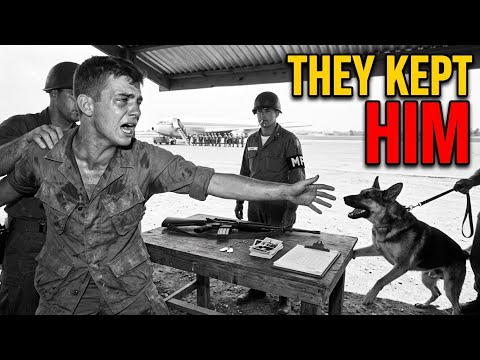
The second thing the Army took was his dog. Nearly 4,000 dogs served with U.S. forces in Vietnam. Most were German shepherds, along with Labrador retrievers trained to track. Some guarded air bases and supply depots through the night, and others searched for tunnels and booby traps. Scout dogs walked point ahead of an infantry patrol in the most dangerous position in the column, with one soldier holding the leash. The soldier and his dog trained together for weeks before they went out on any patrol. In the field, the soldier lived with his dog the way a rifleman lived with his rifle, only closer. He fed the dog and bathed him, pulled ticks from his ears and carried extra water on his back, because heat could kill a shepherd as surely as a bullet. He learned to read that dog the way you read a face you love. The ears coming up, the sudden freeze mid-step, the fur rising along the spine. That was an alert, and it could mean a tripwire, a bunker, or dozens of men waiting at the tree line. Handlers credit their dogs with saving thousands of American lives, and no one who walked behind them argues.
Every one of those dogs carried a serial number tattooed inside its ear. Officially, the dog was equipment, and that one word decided everything that followed. When a handler’s time came, the dog stayed. The tour belonged to the man, and the dog belonged to the Army. On his last morning, the handler went to the kennels and did whatever he could stand. Some men sat on the concrete floor with the dog’s head in their lap for an hour. Others couldn’t take it and walked away without looking back. The dog didn’t understand any of it. A few days later, there was a new man holding the leash, and the dog learned that man too. Some dogs worked with three or four handlers in a row. The men went home one by one, and the dog stayed.
Then the war ended, and the question every handler had pushed to the back of his mind finally got its answer. The dogs were not coming home. A tropical blood disease swept through the military kennels in the late sixties and killed hundreds of them, and officials cited the disease risk along with the cost of shipping the dogs back. As American units withdrew, most of the remaining dogs were handed over to the South Vietnamese army or disposed of. By most estimates, only about 200 dogs left Southeast Asia, and even those went to other military bases, not to a backyard. There were exceptions, and one is worth remembering.
In December 1966, an Air Force sentry dog named Nemo was on a night patrol with his handler at Tan Son Nhut Air Base when Viet Cong fighters attacked. Both were hit. Nemo took a bullet in the face and lost an eye. He crawled to his wounded handler and lay on top of him to protect him until help arrived. Nemo was flown to the United States and lived out his life at Lackland Air Force Base in Texas. Very few other dogs were that lucky.
For most handlers, there was no ending at all. Men wrote letters asking where their dogs went. They made phone calls and asked at veterans’ gatherings. Most never got an answer, because the records, where they existed, didn’t say. In 2000, Congress finally passed a law named for a military dog called Robby, allowing retired working dogs to be adopted by their handlers and others. It came about three decades too late for every dog in Vietnam. Today there are memorials to the war dogs of Vietnam. Many were paid for by the men who had to leave them behind. Ask an old handler about his dog, and the first thing you’ll get is a name. Then, often, a long silence.
The first thing the Army took, the greatest of them all, was the one no one signed for and no one ever counted. They took his long way home. When his name was finally called, a bus took him to the airport. A civilian passenger jet waited on the tarmac, chartered by the government from companies like Flying Tiger, World Airways, and Continental. The men called it the Freedom Bird. It had carpet and air conditioning. It had American stewardesses, and for many soldiers, these were the first American women they had spoken to in a year. Men who had walked point through enemy territory could barely thank one of them for handing them a soda. No one relaxed on the floor. The airports had been rocketed, and every man on that plane had heard of someone hit on his last day. They sat strapped in, staring at the cabin door, waiting for someone to close it. Some held their breath until the wheels left the runway. Others refused to believe anything until the pilot announced they had left Vietnamese airspace. And then, for many of them, came the first deep sleep in a year. They sat upright in airline seats with no one on guard duty, and no one needing to be.
About a day later, after a refueling stop in Japan or Alaska or Hawaii, the plane landed in America. Usually it came down at Travis Air Force Base in California or McChord in Washington. From Travis, buses took the men to the Oakland Army Base, where the Army had one last line waiting for them, and it ran all night. There was a medical check, then forms, then more forms. Back pay was paid in cash, and every man got a clean uniform for the trip home. Men who had been awake since they were on a hilltop in the highlands shuffled from office to office at three in the morning, signing whatever was put in front of them.
For men leaving the service, the most important paper in the file was the DD-214. It was supposed to compress a man’s entire military life onto one page. His units, his job, his dates of service, his medals, and his time overseas. A clerk typed it, often at midnight, for the hundredth time in his shift, so errors were common. Names were misspelled, dates were wrong, medals were left off entirely. Most men signed without reading it. They had been awake for two days, and all they wanted was to go home. A copy went in the soldier’s pocket. The official file ended up in a huge building outside St. Louis, the National Personnel Records Center, which holds the service records of tens of millions of Americans.
Shortly after midnight on July 12, 1973, a fire broke out on the upper floor of that building. The last American combat troops had left Vietnam less than four months earlier. The fire burned for days, and when it was finally out, between 16 and 18 million documents had vanished. Most Army records from the Vietnam era survived. But the losses hit the previous generation hardest. About eight in ten Army personnel files for men discharged between 1912 and 1960 were destroyed. Some files that survived still carry burn marks today. So if your grandfather was in the Army during World War II, there is a real chance his file no longer exists. Families who write to St. Louis often discover that exactly. What they have left is whatever was in the house when he died.
That’s why I put together a guide called Find Your Grandfather’s War. It shows you how to reconstruct an American soldier’s record from World War II when the family has only a name, a photograph, and a box of things no one can explain. Those things are evidence, and the guide teaches you how to read them one by one. You’ll find it in the notes below this video. Somewhere in a closet right now, there’s a box like that waiting for someone to open it. It might be your grandfather’s.
Our soldier’s copy of that paper was folded in his breast pocket when he walked through the gate at Oakland into a gray California morning. He took a cab to the airport and bought a ticket with cash from the money the Army had handed him an hour earlier. He found a pay phone, dropped in a handful of coins, and heard his mother’s voice crack on the other end of the line. Then he boarded a domestic flight full of businessmen who never looked up from their newspapers. Depending on his luck and his connections, a man could go from a military base to his parents’ kitchen in just two or three days. His father had come home from World War II on a ship, and the trip took weeks. He shared it with thousands of men who had seen what he had seen, slept where he had slept, and were all wondering what came next. They played cards. They talked, or they were silent. At night, they stood at the rail and stared at the water. No one designed that voyage as therapy, but for many of them, it worked like it. It gave them a long, quiet pause between the hell of war and the threshold of home.
The son got a seat on a plane next to a stranger, and a sleepless night in a processing line. The Army had found a faster way to get him home, and in doing so, it took that quiet pause away. His mother cooked everything he had asked for in his letters. His little brother wanted to know if he had killed anyone. His father asked him nothing at all, and maybe that was the kindest thing anyone did for him that week. On Saturday, there was a party. Someone put a beer in his hand and asked him how it was over there. He said it was fine, and the conversation turned to cars and baseball. By Monday, many of these men were back at their jobs or in their offices, working beside people who had spent the past year worrying about entirely different things.
Three days, and then one last waking morning. That’s how the story began. On a hilltop with a young man counting days on his fingers. In the end, the Army stripped the uniform off his back and the rifle from his hands. It emptied his pockets into a box and spread the contents of his bag on a table. It took a sample of his urine and, for some, took their seat on the plane. It pulled him off the hill and away from the men in the next foxholes. It kept the dog that had walked in front of him every day. They took the long ocean crossing his father had, and replaced it with a single day. But some things slipped through. A pair of boots came home wrapped in a shirt, and a Zippo came home with a dark joke engraved on its side. A torn piece of C-ration cardboard with an address written in pencil is still in somebody’s wallet fifty years later. And no form ever asked a handler to hand over the name of his dog.
If you were there, tell me what you handed across that counter and what you managed to pass behind them. And if you held a leash in Vietnam, tell me his name. Somebody should keep saying it.
Report this article
Select a reason for reporting:






