The sun was setting over the Buffalo River, casting long shadows across the tiny mission station of Rorke’s Drift. Inside the hospital, the moans of the wounded mixed with the distant rumble of gunfire from Isandlwana, ten miles away. No one yet knew that the British Army had just suffered its worst defeat at the hands of a native African force. But the men at Rorke’s Drift were about to find out—and face a onslaught of 4,000 Zulu warriors with only 130 defenders.
Lieutenant Gonville Bromhead, a deaf officer with little ambition, stood with Sergeant Frank Bourne, the 23-year-old prodigy known as ‘The Kid.’ Together, they commanded a ragtag group of British soldiers, colonial troops, and sick men. As the Zulu impi approached, their chanting and drumming echoed off the hills, a terrifying symphony of war. The defenders hastily stacked mealie bags and biscuit boxes, forming a crude barricade. They had 20,000 rounds of ammunition—and not a moment to lose.
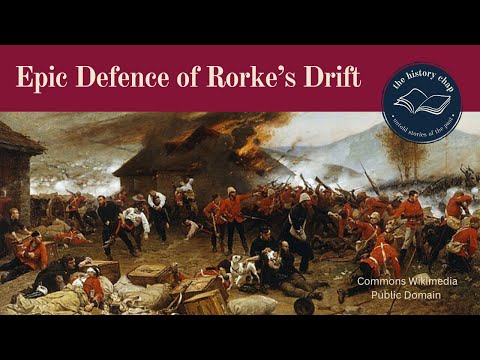
The first wave hit like a thunderstorm. Zulu warriors, many in their 30s and 40s, surged forward with shields and assegais, their feet stomping the ground in unison. British rifles cracked, felling dozens, but still they came. Private James Dunbar shot eight Zulu warriors with eight consecutive rounds. The air filled with smoke and the screams of the wounded. Inside the hospital, Surgeon James Reynolds worked frantically, amputating limbs as bullets pierced the walls.
As the battle raged, the hospital became a death trap. Zulu warriors set the thatched roof ablaze, and patients were trapped in tiny rooms. Private John Williams, a 23-year-old soldier using a pseudonym, grabbed a broken pickaxe and began hacking through walls to create an escape route. Room by room, he and Private Henry Hook evacuated the sick and wounded, while flames licked at their heels. The stench of blood and burning flesh filled the air.
Outside, the defenders fought with bayonets and rifle butts. Corporal Frederick Schiess of the Natal Native Horse made a daring solo charge, killing three Zulu hiding behind the barricade. The Reverend George Smith, a towering 6’6″ chaplain, roamed the line, distributing ammunition and shouting, “Don’t swear, boys! Don’t swear! But shoot them, boys! Shoot them!” His booming voice became a beacon of hope.
By midnight, the hospital was lost, but the defenders had retreated to a smaller perimeter around the storehouse. The Zulu attacks continued relentlessly, wave after wave, their war cries piercing the night. Private Henry Hook, who had fought tirelessly, later said, “It was like trying to stop a river with a fork.” Yet stop them they did, using the barricades to funnel the attackers into narrow kill zones.
As dawn approached, the Zulu withdrew, exhausted and demoralized. They had lost over 350 warriors, while the British had lost only 17. But the defenders were on their last legs—many had fired over 100 rounds each, their shoulders bruised and bleeding from the recoil. When Lord Chelmsford’s relief column finally arrived, the men of Rorke’s Drift could barely cheer. They had held the line, but the cost was immense.
The Battle of Rorke’s Drift became legendary, earning 11 Victoria Crosses—the most ever awarded for a single engagement in British military history. But as the survivors looked out over the carnage, they knew that courage alone hadn’t saved them. It was luck, preparation, and the sheer determination of ordinary men facing extraordinary odds.
But the story of Rorke’s Drift did not end with the relief column’s arrival. For the men who had survived, the battle left scars that no medal could heal. Private John Williams, whose hands were raw and bleeding from his night of frantic digging, would carry the scars for life. He returned to England a hero, but the memories of the burning hospital and the screams of the Zulu haunted him. He rarely spoke of that night, even to his family.
Sergeant Frank Bourne, the young ‘Kid’ who had helped hold the line, was offered a commission but turned it down. He remained a sergeant, preferring the company of ordinary soldiers. He later said, “I was no officer. I was just a soldier who did his duty.” Bourne served for another 20 years, fighting in Burma and India, but Rorke’s Drift remained the defining moment of his life.
Lieutenant Gonville Bromhead, the deaf officer who had been overlooked for promotion, finally received his Victoria Cross. But his health had been shattered by the campaign. He died in 1891, at the age of 45, never having risen above the rank of major. His gravestone in Ireland bears the simple inscription: “He fought at Rorke’s Drift.”
As for the Zulu, their defeat at Rorke’s Drift was a bitter pill. Dabulamanzi kaMpande, the king’s half-brother who had led the attack, was reprimanded by Cetshwayo for crossing into Natal without permission. The king was furious that his warriors had attacked a fortified position without orders, wasting lives that could have been used elsewhere. But Dabulamanzi argued that he had acted to restore the honor of the Zulu nation after the victory at Isandlwana.
In the end, the Zulu kingdom fell. The British invaded again later that year with overwhelming force, and Cetshwayo was captured. The proud warriors who had fought so bravely at Rorke’s Drift were forced to work in the gold and diamond mines of South Africa, their way of life destroyed forever. It was a tragic end for a people who had only sought to defend their homeland.
Yet the memory of Rorke’s Drift lived on. In 1964, the film Zulu brought the battle to a new generation, cementing its place in British military lore. But the film, like many Hollywood retellings, took liberties with the truth. It portrayed the 24th Regiment as Welsh, when in fact most of the defenders were English, with a significant number of Irish and Welsh soldiers as well.
And then there is the question of the Victoria Crosses. Eleven were awarded for Rorke’s Drift, the most for any single battle in British history. But some historians have argued that the awards were as much a propaganda tool as a recognition of bravery. After the disaster at Isandlwana, the British public needed heroes, and Rorke’s Drift provided them. The men who received the VC were brave, but so were many others who were not decorated.
One such man was Surgeon James Reynolds, who had performed 35 operations by firelight, removing pieces of bone from Private Hitch’s shoulder without anesthesia. He received the Victoria Cross, but he always said that the real heroes were the men who held the barricades. After the war, he returned to Ireland and lived a quiet life, rarely speaking of his experiences.
Another was the Reverend George Smith, the towering chaplain who had distributed ammunition under fire. He was not awarded a VC, but his courage was never forgotten by the men he served. He continued his ministry, serving in India and later in England, where he became a beloved parish priest. He died in 1918, just before the end of the Great War.
The Battle of Rorke’s Drift was a small engagement in a small war, but it has become a symbol of courage against overwhelming odds. It is a story of ordinary men—British soldiers, colonial troops, and Zulu warriors—who found themselves in an extraordinary situation and rose to the occasion. It is also a reminder of the cost of empire, and the tragedy of a proud people who lost their independence.
As the years passed, the survivors of Rorke’s Drift grew old and died, but their story lived on. In 1979, on the centenary of the battle, a memorial was unveiled at the site, honoring both the British and Zulu dead. It stands there today, a reminder of a time when two nations clashed on a remote hill in southern Africa, and ordinary men became legends.
But the story has one more layer—one that rarely makes it into the films or the parade grounds. Of the 130 men who stood behind the mealie bags that night, fewer than a dozen ever spoke publicly about what they saw. Most slipped back into obscurity, carrying the weight of the battle in silence.
Take Private William Jones, one of the VC recipients from the hospital. He returned to Birmingham and took a job at a railway yard, never mentioning his medal. His own neighbors did not learn he had won the Victoria Cross until a newspaper reporter tracked him down in 1890. Jones reportedly told the man, “I only did what any soldier would have done. The real heroes are still lying out there on that hill.”
And what of the men who were not decorated? Private Waters, the soldier who hid in the wardrobe and later slipped through the Zulu lines in Otto Witt’s black coat, survived the battle without a scratch—and without a medal. He was never officially recognized, though his story of escape became a favorite among the veterans themselves. Some said he simply had the luck of the devil. Others said he had more nerve than any man alive.
There is also the quieter, uglier aftermath—the one the newspapers never printed. After the relief column arrived, Chelmsford’s men combed the surrounding bush for Zulu survivors, killing wounded and hiding men where they found them. This was not a battle anymore; it was a hunt. The men of Rorke’s Drift, many still trembling from the night’s ordeal, watched it happen and said little.
One of the defenders, a young private from the 24th, wrote home to his mother a week later. “We have been called heroes,” he wrote, “but I do not feel like one. I feel like a man who has seen too much and cannot forget it.” He never wrote about the war again.
Meanwhile, across the river, the Zulu survivors made their way back to their homesteads. Many of them were never again able to fight; the wounds they carried were not only to their bodies. Some had lost brothers, sons, and cousins on that slope below the mission station. The victory at Isandlwana had been sweet, but Rorke’s Drift had shown them that the red-coated soldiers could hold their ground when they chose to.
King Cetshwayo, when he heard the full account of the battle, is said to have shaken his head. “You went to fight the British at their strongest point,” he told Dabulamanzi, “and you left your brothers to die against a wall of sacks and boxes.” The king was not wrong. The attack on Rorke’s Drift had been a gamble, and it had failed.
But the Zulu warriors who survived did not see it that way. To them, the men who charged the barricades had shown the highest form of courage—the kind that asks no reward and expects no mercy. In the years that followed, veterans of the battle would tell the story around evening fires, not of defeat, but of the day they stormed the red soldiers’ camp and nearly carried the day.
And so the story of Rorke’s Drift closes—not with a single triumphant note, but with a long, fading echo. The 11 Victoria Crosses still glitter in museums, yet the men who earned them mostly vanished into quiet lives. Bourne became a colonel in the end, though he never sought the spotlight. Bromhead died young, his health ruined. Williams carried his scarred hands to the grave.
On the other side of the river, Zulu families mourned their dead for generations. Dabulamanzi’s bold gamble cost his people dearly, but his warriors’ bravery was never forgotten by their own. The kingdom fell, yet the spirit of those who charged the barricades lived on in song and story.
Today, the mission station is a museum. Visitors stand where mealie bags once stacked, and they wonder: what would I have done?
So here is my question for you, dear reader—if you had been behind those biscuit boxes that night, would you have stayed and fought, or slipped away into the dark? Tell me in the comments below.
Report this article
Select a reason for reporting:






