The rain never stopped. It fell in sheets, turning the jungle into a swamp and the airstrip into a river of mud. For the young Australian pilots of 75 and 76 Squadrons, Milne Bay was a “muddy bloody hole” – a primitive hellhole at the eastern tip of New Guinea where they were sent to hold the line against an enemy that had never been beaten on land.
It was August 1942. The Japanese were advancing relentlessly across the Pacific, and their sights were set on Port Moresby. Milne Bay was the last obstacle. If it fell, the road to Australia would be wide open. The Australians knew they had to stop them here, on this godforsaken strip of steel matting laid over swamp, or risk losing everything.
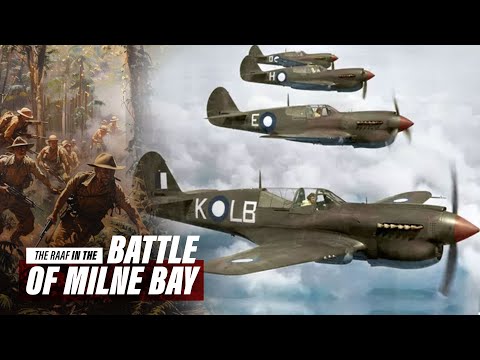
The first sign of the enemy came on August 4th, when Japanese reconnaissance aircraft appeared over the bay. “We were only there a short period of time and the first alarm went off,” recalled one pilot. “A Japanese reconnaissance aircraft being escorted by a couple of Zeros came in to see what was going on.” The Kittyhawks of 76 Squadron were airborne on patrol. They pounced, shooting down the reconnaissance plane and sending the Zeros fleeing. It was the first kill above Milne Bay, but it was only a taste of what was to come.
From that day on, the alert was constant. The pilots lived in tents, six to a hut, with mud floors and mosquito nets their only defense against malaria. “We had malaria and dysentery,” one veteran remembered. “I had both at one stage. You’d take your oxygen mask off and have a vomit all over the place, put it back on, and carry on.” The conditions were beyond brutal, but they had no choice. The Japanese were coming.
On August 11th, a second air raid did not take the Australians by surprise. A dozen Zeros met 22 Kittyhawks from both squadrons. The fight was fierce. By the end, three RAAF pilots were missing, and a fourth, Sergeant George Inger, crashed and died on Gurney Field. The toll was mounting, and the men were exhausted.
The Kittyhawk, or P-40E, was their weapon of choice. “It was a beautiful aircraft for strafing because it had six .5 calibre machine guns,” said one pilot. “Far more effective than the Spitfire.” But it had its quirks. In a high-speed dive, it wanted to roll one way and yaw the other. “If you were bounced by a Zero, you dived full bore, got up over the speed where these things happen, took your hands and feet off, and the airplane did manoeuvres that nobody could ever shoot down.” It was a wild ride, but it kept them alive.
Meanwhile, on the ground, the situation was deteriorating. Malaria was rampant. By September, there were 33 infections per 1,000 soldiers per week. “The malaria threat was well known, but preventative measures were pushed down the list of priorities,” a historian noted. The 55th Infantry Battalion was so badly afflicted that they had to be sent back to Port Moresby. The men who remained fought on, weakened by disease but determined to hold.
The Japanese invasion force left Rabaul on August 24th: two light cruisers, three destroyers, two transports, and two submarine chasers. They were heading straight for Milne Bay. At 8:30 a.m. on the 24th, headquarters was alerted by a Hudson bomber and coastwatchers. The convoy was coming.
The next day, two flights from 75 Squadron went out to investigate reports of barges landing troops on Goodenough Island. “We arrived just in time to see the barges getting ready to pull onto the island,” one pilot recalled. “We immediately went in and strafed and strafed and strafed. We used up all our ammunition.” The other four aircraft followed, and the result was devastating. “Nobody got off the island,” the pilot said. “They were marooned.” It was a decisive blow that dampened the Japanese invasion plans.
But the main force was still coming. That afternoon, Kittyhawks and a single Hudson bomber attacked the convoy near Rabi Island, but with limited success. “We went after the troop ships naturally, but we weren’t very successful,” said one pilot. “We got one near miss.” The weather was terrible, with huge clouds sitting on top of the convoy, making it hard to manoeuvre. “You could only go down and try and strafe the top of the boats and then disappear out, because one does not normally take on a cruiser – that’s fatal.”
At around 10:30 p.m., the Japanese main force of over 1,000 men and two Type 95 Ha-Go tanks made landfall near Waga Waga on the northern shore of the bay. But they had made a critical error. They landed 3 km further east than intended, giving the Australians precious time to prepare.
The next morning, the Japanese suffered another setback when a daylight RAAF raid hammered their base area. Kittyhawks and a Hudson, accompanied by US B-25s, B-26s, and B-17s, destroyed 12 barges, fuel dumps, and supplies in a 45-minute strafing spree. “We set fire to a lot of it and burned it up,” one pilot said.
But the Japanese pushed on. That night, they attacked Number Three Airstrip, which had been cleared but not yet made into a strip. The Australians were waiting. “The Japanese rushed to get across that strip, and they were all shot down – all killed,” a veteran remembered. The tanks got bogged in the mud and were abandoned. It was the turning point.
Over the next two days, the Australians began a slow and bloody counterattack, pushing the Japanese back east along the north shore. The Kittyhawks provided crucial close air support, strafing Japanese positions marked by smoke signals. “We would go in four aircraft abreast and strafe just the tops of the coconut trees,” one pilot explained. “The Army would release a smoke signal, and we wouldn’t fire till we’d flown past it. It was extremely effective.”
By September 6th, the battle was over. The Japanese evacuated 933 survivors by ship, leaving an unknown number dead on the battlefield. “The Australians have proven that the Japanese are not invincible,” General Slim later said. It was the first time a Japanese invasion force had been defeated on land, and it happened at Milne Bay.
The victory did not come without a final, bitter twist of the knife. Just after 10 p.m. on the night of the evacuation, the freighter Anshun, still unloading cargo at Gili Gili, was caught in the searchlights of the Japanese cruiser Tenyu and the destroyer Arashi. “She took about ten hits from the cruiser and rolled onto her side at the docks,” a witness recalled. The Anshun was lost, a smoking ruin in the shallows, but the men who had fought so hard to hold the bay could only watch and count themselves lucky it had not been worse.
The next night, two Japanese warships returned to bombard Australian positions, firing for fifteen minutes before slipping away into the darkness. Several casualties were suffered, but the Japanese never came ashore again. The battle for Milne Bay was, for all intents and purposes, finished.
For the pilots of 75 and 76 Squadrons, the cost had been steep. They had lost mates to Zeros, to the murderous weather, and to the strip itself. The memory of Bill Carrey, flying in alone at dusk after the evacuation, his Kittyhawk clipping the hills beside the runway at Port Moresby, would haunt the squadron for years. “It was a great tragedy,” one of his friends said quietly. “It upset a lot of people.”
And yet, out of that muddy, rain-soaked hell, something remarkable had emerged. The men who had arrived at Milne Bay as nervous young pilots, unsure whether the Japanese could be beaten, left as veterans who knew the answer. “They captured a Japanese Zero and worked at combat manoeuvres with our own aircraft,” one pilot remembered. “We found out that if you could get above them and trade off your height for speed, you could peck at them and climb up again. But whatever you do, don’t mix it with them.” The lessons had been written in blood, but they had been learned.
Back in Australia, the news travelled fast. Milne Bay was not a great set-piece battle like El Alamein or Stalingrad. It was a vicious, close-quarters slog in a swamp, fought by men who were sick, exhausted, and half-drowned. But the result was the same. “The Australians have proven that the Japanese are not invincible,” General Slim told his troops. It was the first time a Japanese invasion force had ever been defeated on land in the entire war, and it happened at a place most of the world had never heard of.
The myth of Japanese invincibility, which had hung over the Pacific like a dark cloud since the fall of Singapore, had been shattered. And it had been shattered by a handful of Kittyhawk pilots, a few thousand infantrymen, and a strip of steel matting laid over a swamp.
But the war was far from over. As the survivors of Milne Bay caught their breath and counted their dead, the fighting in New Guinea was already moving on. The Japanese were falling back along the Kokoda Track, and the Allies were preparing their next move. The men of 75 and 76 Squadrons would fly again, and the lessons of Milne Bay – the value of air superiority, the importance of close cooperation with the Army, and the terrible cost of disease – would shape every battle that followed.
For now, though, there was a moment to rest. The rain still fell on Milne Bay, turning the strip back into a river of mud. But the planes were still there, the men were still there, and the bay was still in Allied hands. “It was a muddy bloody hole,” one pilot said, looking back. “But it certainly saved the day.”
And so the men who had held the line drifted back to the routine of war – patrols, alerts, and the endless rain. But something had shifted in them. They had looked into the abyss and the abyss had blinked first.
Years later, long after the guns fell silent, the veterans of Milne Bay would gather and speak of that muddy strip not with bitterness, but with a strange, quiet pride. “We were just kids,” one of them said. “But we did something that mattered.”
The myth was broken. The Japanese had been beaten on land for the first time, and the world took notice. From that swampy corner of New Guinea, a message rippled out across the Pacific: the tide was turning.
For the pilots of 75 and 76 Squadrons, the Kittyhawks were more than machines. They were the bulldozers that carried them through hell and back. “She was hefty and strong, could take a real belting,” a pilot remembered fondly. “And thank goodness it could.”
Milne Bay was never meant to be a great victory. It was meant to be a delaying action, a desperate stand. Instead, it became a turning point. The rain still fell, the mud still swallowed boots, but the men who walked away from that bay carried with them the knowledge that they had done the impossible.
And the question that lingered, for them and for history, was simple: if a handful of sick, exhausted pilots and infantrymen could shatter the myth of invincibility in a muddy swamp, what else might be possible?
What do you think – was Milne Bay the true turning point of the Pacific War, or just a footnote in a much larger story? Share your thoughts below.
Report this article
Select a reason for reporting:






