In the autumn of 1881, deep beneath the silver-rich hills of Lake Valley, New Mexico, a miner’s pick shattered the silence—and broke through into a passage that appeared on no map. The air that rushed out was dry and cold, and a candle flame bent toward the hole, as if something inside was breathing. What lay at the end of that straight, dustless corridor would haunt everyone who saw it: a metal object fifty-four feet long, with a toothed wheel taller than a man and four curved blades folded shut like a flower that had never opened. The Apache had a name for it, and they said it had been left behind.
“Do not touch it. Do not wake it. And do not take the silver that grows around it.” That was the warning the Apache gave. The mining company ignored it. They took the silver—millions of ounces of it—and then they sealed the passage behind a locked door and wrote nothing in their reports but the word cavern.
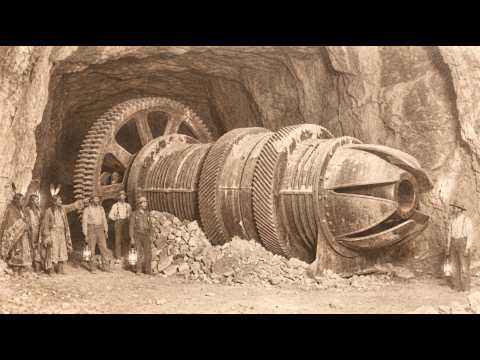
The story begins not with the object itself, but with the men who found it. Thomas Ellery Whitcomb, a 36-year-old assayer from Scranton, Pennsylvania, kept three field books bound in black oilcloth. He never wrote down a guess; he wrote down measurements. On October 11, 1881, he stepped into the passage and measured it: six feet wide, seven feet high, running due east for 190 feet without a single degree of drift. “No vein of ore runs this straight,” he wrote, “neither does any human hand.” He drew a question mark next to the observation that the floor was as clean as a swept hallway—the only question mark in all three of his books.
Two days later, he returned with twelve lanterns and a surveyor’s chain. He measured the hollow: 118 feet long, 52 feet wide, the roof estimated at 70 feet—as high as a church. The object lay on its side. At the back, a double wheel with teeth that locked together; Whitcomb counted 96 on one ring and stopped halfway on the second, writing only Same. The middle was five broad drums, each wrapped in grooves that curled like thumbprints. At the front, four fourteen-foot blades curved toward a dark opening three feet wide. He pushed a ten-foot rod into the opening and touched nothing. “No bottom—or deeper than the rod,” he wrote.
The object was sheathed in a pale mineral crust, four and a half inches thick on top—the kind of crust that takes centuries to form. But when young Pat Dunlevy scraped it away, the metal underneath was smooth and bright, without a trace of rust. Whitcomb scratched it with his knife and left no mark. He managed to lift a single flake and put it in a glass vial labeled Specimen 44. That evening, he put the flake in the assay furnace. It did not melt. Not at any temperature the furnace could reach. “This is not iron. It is not copper. It is not silver. And it is not any metal I have ever weighed,” he wrote, and then underlined: There is air going into the nose.
Before Whitcomb could write more, Bernard Macdonald, the mine superintendent, sent word: Write nothing to the Philadelphia people until Wright arrives. I have spoken to the men. The crew was paid a full day’s wages for a day they did no work. The passage was sealed with forty-two timbers, two barrels of lime mortar, and a pair of iron hinges. The company’s quarterly report mentioned only a natural limestone cavern of no commercial value. But a cave with no commercial value is not usually locked behind a door.
That winter, J. Whitaker Wright, the company’s promoter, wrote to a Philadelphia investor: “The less said about the East Gallery, the better for the stock.” He never mentioned it again. Twenty-two years later, convicted of fraud, he swallowed cyanide in a London courthouse. But he never exaggerated the East Gallery—he never spoke of it at all.
The Apache, however, had already spoken. In October 1881, a Chihenny man named Tamas, who hauled firewood for the miners, came to Whitcomb’s assay office. He asked one question: Was the flower open? Whitcomb said no, it was closed. Tamas nodded and gave four statements. It had been left behind. The Chihen do not camp at the foot of that hill. The white metal on the walls is its frost. And if you take the frost, the cold goes somewhere else. Whitcomb wrote not understood beside the fourth. He would understand it two years later, when the silver was gone and the passage had turned cold.
Fifty-two years later, in 1933, an anthropologist named Morris Opler recorded the testimony of an elderly Warm Springs Apache woman known only as S.K. She had ridden with Nana’s band as a girl. She said the hill had a name: The hill that holds the closed flower. She said the flower was waiting, but she would not say for what. That knowledge, she said, belonged to the Chihen. And she drew a shape in the dirt: a circle with four curved lines bending inward, their tips not meeting, a small space left open in the center. Opler copied it exactly. In a different archive, in a different state, Whitcomb’s pencil drawing from 1881 showed the same shape—the blades curling clockwise, the center open.
Two records, never meant to be read together. An assayer and a prisoner of war. One drew what he had seen; the other drew what her people had always known. And between them, a question hangs in the dark of that sealed passage, waiting for someone to measure the gap once more.
That question did not die with the records. It simply waited, the way the flower waited, in the dark behind a locked door that no one had opened since 1943.
But the hill at Lake Valley was not the only place where the shape appeared. And this is where the story turns outward, away from one mine and one assayer, toward something older and stranger and far more widespread.
Consider the Mimbres bowls. A thousand years ago, in the valley of the Mimbres River forty miles west of Lake Valley, a people painted black designs on white clay. When they buried their dead, they turned a bowl upside down over the face of the person being buried, and before they did, they punched a small hole through the very center. Archaeologists call it a kill hole. One bowl, one hole, one open center.
In 1932, in a report published by Harvard’s Peabody Museum, there is a photograph of one such bowl. Around its rim runs a toothed band of small, sharp triangles, evenly spaced, circling the mouth like the teeth of a gear. Inside that band, four black curved blades bend toward the center, clockwise, their tips not meeting. And in the one place the blades leave uncovered, the potter punched the kill hole through.
The report gives it two words. Geometric whirl.
Beneath the photograph, no further comment. The bowl is not displayed today. Since the Native American Graves Protection and Repatriation Act passed in 1990, objects taken from native graves are not shown or photographed without consultation with descendant communities. That is the right decision. But it means the bowl survives now only in a small gray photograph in a report more than ninety years old.
And there is more. Two hundred miles south, in what is now the Mexican state of Chihuahua, stand the ruins of a great adobe city called Paquimé. Between 1958 and 1961, the American archaeologist Charles Di Peso excavated it for the Amerind Foundation, and his reports filled eight volumes. In one of those volumes, there is an object taken from a storeroom: a disc carved from sandstone, about two feet across, with a toothed edge and four channels curving across its face toward a hole bored through the center. The report classes it as a ceremonial stone and dates it to between 1200 and 1450.
Four places. Four different centuries. The same toothed ring. The same closed blades. And every time, the same space left open at the center.
Each of these traces, on its own, could be dismissed. A bowl is a bowl. A disc is a disc. A cavern is a cavern. But they do not sit on their own. They sit in a line, spaced across a thousand years and a thousand miles, and every one of them points at the same hill.
Now return to Lake Valley, because the hill itself has not been silent. In the 2000s, New Mexico’s program for making abandoned mines safe closed dozens of old openings around the town with steel grates—grates that keep people out but let bats come and go. For every opening, the program kept a closure record.
One of those records belongs to an opening on the east side of the bridal chamber workings, numbered LV17. The record carries four notes. Timber bulkhead collapsed. Strong continuous inward airflow. Grating installed. No entry. And a fifth note, added in the margin by a bat biologist working with the program: every other opening on this hill holds a bat colony, but LV17 holds none at all. And from the signs outside, it never has. Nothing lives there.
The inspection record from one year later is even shorter. Grating intact. Thin gray film on the inner bars. Not sampled.
A thin gray film. What Whitcomb called frost. What Ruth Seely, standing in that same hollow in 1943, called the cold coming back. This time, on the inside of a gate.
So the frost is returning. The gap between the blades has widened by two and a half inches in sixty-two years. And no one has measured it since. The question is no longer whether the flower is closed. The question is how far open it has already become, and whether anyone will be there to measure it when it opens the rest of the way.
Because S.K. was asked what the flower was waiting for, and she was silent for a long time, and then she said that this knowledge belonged to the Chihen. She never said it belonged to no one. She said it was not something to be given to an outsider.
Which leaves the hill, and the lake, and the shadow that still falls across the water every morning. In the dry months, the lake still shrinks to a white crust of salt. After the rains, it still fills like a mirror. And inside that hill, at the end of a straight road, in a hollow as tall as the roof of a church, something fifty-four feet long is lying in the dark, with a toothed wheel at one end and four curved blades at the other, and the space between those blades is wider than it was.
So the question turns, quietly, from what is it to how long do we have. The frost returns on the inner bars of a gate no bat will roost behind. The gap widens by inches across decades, patient as mineral growth, indifferent to every reasonable explanation we have offered.
Maybe it was a cavern. Maybe it was calcite and lantern light and a copying error and a translator’s choice. But the Chihen did not call it a stone or a machine. They called it a flower, and they said it was waiting.
S.K. took that knowledge with her. Tamas took his fourth sentence. Whitcomb took his measurements to a grave in Socorro. And the hill kept its own counsel, counting centuries in crust, breathing inward through a nose no rod could find the bottom of.
If your family worked at Lake Valley, at Hillsboro, at Kingston, or at Chloride—if you carry a story, a letter, or a photograph that belongs to that hill, and it is yours to share—write it below. Every one of these records was once held by a single person.
And keep one question with you: if that flower opened two and a half inches in sixty-two years, how far open is it now—and what will you do when someone finally measures it?
Report this article
Select a reason for reporting:






