The microphone was a merciless judge. In the late 1920s, as Hollywood rushed to convert to sound, a single spoken line could shatter a career built over decades. For silent film stars, the arrival of talkies was not an evolution—it was a brutal audition they never asked for.
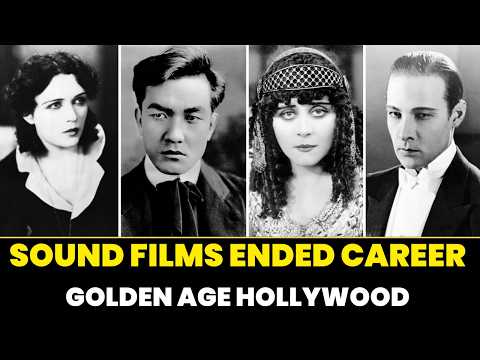
Some had voices that clashed with their on-screen image. Others had accents that early sound technology amplified into a liability. And a few simply belonged to a style of acting that the new medium made obsolete overnight. Seventeen silent film legends would discover that fame in the silent era meant nothing when the microphones turned on.
John Gilbert was the first to fall. He was one of Hollywood’s most popular leading men, known for romantic dramas and a smoldering intensity opposite Greta Garbo. His face could break hearts without a word. But when sound arrived, audiences heard his voice—clear and pleasant, yet somehow not the voice they had imagined. Combined with his grand, theatrical acting style, it felt exaggerated for the new naturalistic talkies.
Worse, Gilbert had made an enemy of studio head Louis B. Mayer. Rumors swirled that Mayer deliberately sabotaged Gilbert’s sound debut, giving him poor scripts and roles that accentuated every perceived weakness. His leading-man status evaporated. By the early 1930s, he had retired, a shadow of his former glory.
Clara Bow, the “It Girl,” was the spirit of the 1920s—carefree, magnetic, and larger than life. Her Brooklyn accent and distinctive voice didn’t fit the refined expectations of sound cinema. Early recording technology amplified every imperfection, and Bow struggled with the technical demands of dialogue. Off-screen, her personal life was unraveling: financial troubles, family pressures, and mental health challenges. The studio pressure to conform left her alienated. At just 28, she walked away from the industry that had adored her.
Vilma Bánky, the Hungarian-born beauty, faced a different barrier. Her thick accent made dialogue difficult for American audiences to follow. Unlike some stars who hired voice coaches, Bánky had little interest in changing her speech. She had married actor Rod La Rocque in 1927, and as her enthusiasm for Hollywood waned, she chose a private life over the fight for a sound career.
Norma Talmadge, a major dramatic star, saw her refined image crumble when her voice—too high-pitched for some—didn’t match her elegant screen presence. Critics were harsh, and Talmadge lost interest. By the early 1930s, she had retired, leaving behind a legacy that sound could not preserve.
Harold Lloyd, the daredevil comedian of Safety Last!, found that his physical gags and everyman charm didn’t translate to the sound era. Audiences now craved verbal wit. Though his voice worked, his style of comedy felt old-fashioned, and the industry shifted toward faster, cheaper films. By the 1930s, Lloyd stepped away from acting, turning to real estate.
Carl Dane, the lanky Danish comedian, saw his thick accent become an insurmountable barrier. Roles dried up almost overnight. Financial hardship and personal struggles followed, and he died in 1934, isolated and forgotten.
Colleen Moore, the quintessential flapper, found that her bubbly, youthful persona fell out of fashion as Hollywood turned to mature, dialogue-heavy dramas. She tried a few sound films but quickly realized the new direction didn’t suit her. Rather than adapt, she retired and focused on her intricate dollhouse creations.
Gloria Swanson, the epitome of silent glamour, had a good speaking voice—but her grand theatrical style clashed with the naturalism of talkies. Hollywood began favoring younger stars, and Swanson’s established persona felt out of step. She retired in the early 1930s, only to make a legendary comeback decades later in Sunset Boulevard.
The list continues—Douglas Fairbanks, Mary Pickford, Buster Keaton, Lillian Gish, Sessue Hayakawa, Pola Negri, Theda Bara—each a titan of the silent era, each undone by the microphone’s unforgiving truth. Their stories are not just about technology, but about the cruel, arbitrary nature of fame. And for some, the fall was only the beginning of a longer, stranger journey.
Douglas Fairbanks had been Hollywood’s ultimate action hero—swashbuckling through The Mark of Zorro and Robin Hood with boundless energy. But his acting relied on grand physical gestures, not dialogue. At fifty, he felt out of place in an industry suddenly obsessed with youth and conversation. Disillusioned, he retired in the early 1930s, spending his final years traveling.
Mary Pickford, “America’s Sweetheart,” actually won an Academy Award for her first sound film, Coquette. Yet the roles that had made her beloved—innocent, youthful characters—no longer suited her as she aged. She missed the artistry of silent films and felt the magic fading. Rather than continue in a direction she didn’t enjoy, she retired, leaving behind a legacy as a founder of United Artists.
Buster Keaton’s stone-faced physical comedy didn’t translate to dialogue-driven narratives. His distinctive voice and timing fell flat, and MGM’s creative restrictions stifled his genius. Combined with alcoholism and a crumbling marriage, his prominence waned through the 1930s.
Lillian Gish, the “First Lady of American Cinema,” found her ethereal, subtle style less in demand. Rather than adapt to Hollywood’s fast-paced talkies, she turned to the stage, where her skills were celebrated for decades.
Sessue Hayakawa had broken stereotypes in silent films, playing complex romantic leads. But talkies offered few roles for Asian actors beyond villainous or exotic parts. Frustrated by Hollywood’s narrow casting, he left for Europe, only to return years later and earn an Oscar nomination for The Bridge on the River Kwai.
Pola Negri’s thick Polish accent made leading roles nearly impossible. Hollywood’s tastes had shifted from the exotic vamp to the girl next door. She returned to Europe, where her style was still appreciated.
Theda Bara, cinema’s first vamp, saw her seductive persona become outdated as audiences craved realism. She chose not to attempt a comeback, living quietly away from the industry, remembered as one of the first true movie stars.
Rudolph Valentino never faced the microphone—his death in 1926 at thirty-one froze him forever in the silent era, an icon untouched by sound. Wallace Reid, the all-American hero, had already died in 1923 from morphine addiction following an on-set injury, another tragic figure claimed before talkies arrived.
But not every story ended in retreat. A handful of silent stars would prove that the microphone could be conquered—if you knew how to listen to it.
Charlie Chaplin was perhaps the most famous silent star of all, and he refused to bow to the microphone. He simply didn’t make a full talkie until 1940’s The Great Dictator, two decades after sound had conquered Hollywood. His Little Tramp character, with his pantomime and pathos, needed no voice. When he finally spoke on screen, audiences were stunned—but by then, his career had already weathered scandals and political storms.
Yet Chaplin’s stubbornness was the exception. For most silent stars, the microphone was a cliff edge. But a few found a bridge.
Ronald Colman, the British actor with the velvet voice, had been a silent romantic lead. When sound arrived, his rich, cultivated tones made him an even bigger star. He transitioned seamlessly, earning an Oscar nomination for Bulldog Drummond and later winning Best Actor for A Double Life. His secret? He had trained on the stage before Hollywood, and his voice was an asset, not a liability.
Janet Gaynor, the delicate beauty who won the first Best Actress Oscar for silent films, also made the leap. Her voice was soft and natural, and she adapted to the new medium with ease. She starred in the original A Star Is Born in 1937, proving that silent charm could survive the talkie revolution.
Norma Shearer, known for her sophisticated silent roles, reinvented herself as a talkie queen. She hired a voice coach and worked tirelessly on her diction. Her husband, MGM production chief Irving Thalberg, helped her secure strong roles, but it was her determination that won audiences over. She earned five Oscar nominations and won for The Divorcee in 1930.
But these success stories were rare. The microphone was not just a technical device—it was a cultural filter. It favored the stage-trained, the native speakers, the voices that matched the new ideal of American speech. Silent film had been a visual language, accessible to immigrants and international audiences. Talkies demanded a different kind of performance, one rooted in language and realism.
For every Colman or Shearer, there were dozens who fell through the cracks. The transition to sound was not just a technological shift; it was a purge. It swept away an entire generation of stars whose artistry had been built on gesture, not words. Some retired gracefully. Others fought and lost. A few, like Clara Bow, were destroyed by the pressure.
And then there were those who never had the chance. Rudolph Valentino died before the microphone arrived, forever frozen as the silent lover. Wallace Reid succumbed to addiction before sound could test him. Their early deaths preserved their legends, but robbed them of the chance to adapt—or to fail.
By the mid-1930s, the silent era was a memory. The stars who had defined it were scattered—some in Europe, some in retirement, some in the ground. The industry that had made them had moved on, indifferent to their fate.
Yet their images endure. In the flickering frames of silent films, they are still young, still radiant, still speaking without a voice. The microphone may have judged them, but the camera had already made them immortal.
But history has a way of rewriting its own verdicts. The silent stars who fell were not failures—they were pioneers caught in a revolution they never chose. Their faces had taught the world how to dream without words, and that gift could not be erased by a microphone.
When Gloria Swanson played Norma Desmond in Sunset Boulevard, she spoke for all of them: “I am big. It’s the pictures that got small.” The line stung because it was true. The talkies hadn’t made these actors obsolete—they had simply changed the rules of a game played on someone else’s terms.
Today, we watch their films and feel something modern audiences never could: the pure, unmediated power of a glance, a gesture, a tear. Sound gave cinema a voice, but silence gave it a soul.
So the next time you see a silent film flickering on a screen, remember the seventeen who were asked to speak and found the world no longer listening. Their silence still speaks louder than any dialogue ever could.
Which silent star’s story moved you the most—and do you think you could have survived the microphone’s judgment?
Report this article
Select a reason for reporting:






