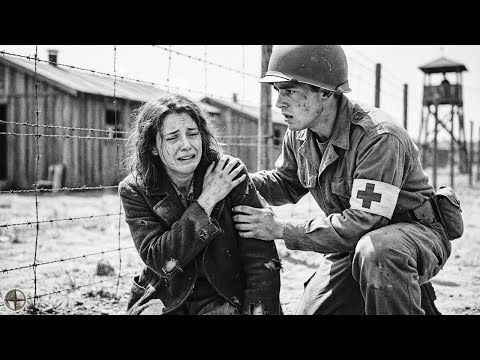
May 12th, 1945. Camp Swift, Texas. The air was so hot it seemed to shake above the sand, and the tin roofs flashed like knives in the sun. A line of captured German women stood silent in the dust, while a young American medic walked past them with a clipboard, bored, just ticking boxes—height, weight, scars.
Then he touched one woman’s shoulder gently, and she flinched like he had pressed a brand of fire into her skin. Her voice was calm, but her words were not.
“It burns when you touch it.”
Under that scar was a secret she had carried across a continent and an ocean—a hidden piece of war that would shock the US soldier who found it and destroy everything they both thought they knew about the enemy.
Germany, early 1945. The Third Reich was falling apart. Town after town shook with artillery. Roads were full of soldiers and civilians moving west, trying to escape the front. In a small village near the Ludendorff Bridge at Remagen, a 23-year-old German woman named Margarite Hoffman worked in a signals unit. She was a chemist’s daughter from Heidelberg, trained to handle radio messages, not weapons. Her work was supposed to be safe behind the lines.
That was the lie.
One cold day in January, American guns began to fire on the area. The air shook with the deep thump of shells. Windows rattled. Dust fell from rafters. Margarite and other staff ran for a cellar. She felt a hard blow across her back like someone had hit her with a hot hammer. She stumbled but did not fall. She did not know it yet, but a small fragment from an 88 mm shell had punched into her right shoulder blade and stopped near her ribs.
Her uniform smoldered. The air smelled of smoke, lime dust, and burned cloth.
Later, she would say, “At first, I thought it was only a bruise. Only when I lay down at night, it burned.”
In the chaos of retreat, there was no time for careful treatment. Field hospitals were overflowing. Infections spread easily where bandages and medicine were short. Margaret had seen these places. She had heard rumors that badly wounded women were sent away and never came back. So she made a choice.
She hid her wound.
As her unit fell back toward the Rhine, she kept her right arm close to her body. The spot under her shoulder blade felt hot, as if a coal was trapped under the skin. Each bump in the road made fire shoot down her side. Still, when someone asked, “Margarite, are you hurt?” she always answered, “No.”
In March, American infantry reached their village. Tanks clanked in the streets, boots pounded overhead, while Margaret and six other women hid in a farmhouse cellar. They had been told all their lives that Americans were monsters. One Nazi leaflet said the Yankees will shoot prisoners like dogs. A captured clerk later recalled, “We expected to be lined up and killed. Instead, when they came up with their hands raised, the Americans looked almost uncomfortable. One soldier offered water. Another asked in broken German if anyone was wounded.”
Margaret shook her head. She remembered. “They said the injured would be taken away to other places. I did not want to vanish.”
The paradox was sharp. She trusted enemy horror stories more than the man holding out a canteen.
From that point, her world turned into numbers and lists. The women were sent to a temporary camp, then another. Names were recorded, heights and weights written down. Photographs were taken. They were sorted by jobs—nurses, clerks, farm workers—like items on a shelf. By 1945, around 425,000 German prisoners of war would be shipped to camps in the United States. To move them, the Allies used trains, then Liberty ships. Each Liberty ship could carry more than 2,000 troops or prisoners across the Atlantic at once.
Margaret and 14 other women were loaded into a cattle car—straw on the floor, a bucket in the corner. Through the wooden slats, they saw Germany slide away, then France, then the ports.
At the harbor, the smell of tar, salt, and diesel filled the air. Chains rattled as cranes lifted crates and vehicles. When the prisoners were marched up the gangplank, some stared at the gray hull of the ship and thought they might never see land again. One POW later wrote, “We did not know if we were going to work or to disappear.”
The crossing took nearly two weeks. The sea was rough. Many were seasick. The holds smelled of vomit, sweat, and fuel oil. Margaret lay on her bunk, cradling her right arm. The skin over the fragment was red and tight. At night, the pain woke her like a burn. She pressed her hand against it and felt heat. Still, she stayed silent.
When the ship reached New York, the prisoners caught glimpses of the harbor through small openings—tugs hooting, gulls crying, the distant shape of tall buildings. Some saw the Statue of Liberty and laughed bitterly. Freedom for them meant barbed wire.
Soon they were moved again into trains heading inland. Guards tried to explain in simple words. Many of the prisoners heard one name repeated: Texas. They had seen pictures of cowboys and deserts in magazines, but nothing more. To them, Texas was as strange as the moon.
By that summer, tens of thousands of German POWs would be scattered across camps in that state, working on farms and roads that were not their own. As Margaret’s train rolled south, the air grew warmer. Dust came in through the cracks. Her shoulder throbbed with each mile. She pressed it harder against the wooden wall, trying to hide the way she winced.
Somewhere ahead waited a camp called Swift—and a young American medic who would not accept her quiet lie.
Camp Swift lay on flat land about twenty miles east of Austin. Low scrub trees, red dirt, and long rows of white barracks stretched under a hard blue sky. In summer, the heat pressed down like a hand. Dust got into everything—boots, beds, food.
By mid-1945, Texas held about 80,000 German prisoners across more than seventy camps, and Camp Swift alone could hold more than 10,000 soldiers and POWs at one time. In the mornings, the camp woke to the clang of the mess bell and the smell of coffee and bacon fat drifting from the kitchens.
On the American side of the wire, men complained about paperwork and drills. On the German side, many prisoners were surprised to find three hot meals a day and real mattresses. One POW later said, “We ate better there than in the last winter at home. It was confusing.”
Corporal Thomas Reed felt confused in another way. He was twenty-six, from Chicago, the son of a pharmacist. He had trained for combat—learned how to fire a rifle, how to move under machine-gun fire. Then a training accident shattered his leg. Now a steel rod held the bone together. Instead of Europe, he got sent to Camp Swift to work in medical administration.
His days were mostly forms and numbers—height, weight, scars, vaccinations. He checked German men who went to road crews, sawmill details, cotton fields. The paradox stung him. He had prepared to fight Germans with a gun, and now he handed them soap and recorded their blood pressure.
The arrival of women changed the pattern.
One hot May afternoon, two trucks rolled up with fifteen German women in faded gray uniforms. Dust swirled around their boots as they climbed down. They stood straight, eyes forward, faces closed. Female US Army personnel, WACs, took charge of them, separate from the men. The women were sent to their own fenced area, their own barracks, their own work in laundry and kitchens.
Word spread quickly through the camp. “Frauen—women prisoners,” some guards said with surprise. Most POWs were young men. Whole groups of women were rare.
Reed watched from the doorway of the medical hut as the new arrivals passed. One of them—slim, with hair tied back and a tired face—held her right arm close to her side. Even in the heat, she seemed to shiver when the truck jolted.
The next morning, Reed was told to perform medical checks on the new group. The exam room was a converted barracks—bare floorboards, a few chairs, a metal table, a cabinet of supplies that smelled faintly of alcohol and carbolic. A fan turned slowly overhead, pushing warm air around. Outside, boots thumped and someone shouted orders in English.
The women came in one by one. A WAC stood near the door, arms folded, watching. Reed worked through the first few quickly—names, ages, lungs listened to through a cold stethoscope, backs checked for scars or rashes. His pen scratched across the forms. Most women were thin but healthy enough.
The woman with the guarded arm was seventh in line.
When her turn came, she stepped forward quietly. Up close, Reed saw she was younger than he first thought—early twenties. Lines of dry dust on her cheeks. Her gray jacket hung unevenly. The right sleeve hardly moved.
“Name?” he asked.
“Margarite Hoffman,” she answered in careful English.
He raised his eyebrows. “You speak English well.”
“I learned in school. My father is a chemist in Heidelberg,” she said, then fell silent.
“Any illness? Any wounds or pain?” Reed asked the usual question.
She paused just a second too long, then shook her head. “No, I am well.”
Reed frowned slightly. He had seen prisoners fake sickness to avoid work, but this felt different. She was hiding something. Still, procedure was procedure.
“Please take off your jacket,” he said.
She unbuttoned it with her left hand only. The right stayed close to her side as if pinned there. When she slid the jacket off, Reed noticed how stiffly her shoulder moved. Under it, her cotton shirt was thin and yellowed. He listened to her heart and lungs. They sounded steady.
Then he said, “Raise both arms, please.”
Her left arm went up without trouble. Her right lifted only a few inches before she gasped and stopped. Her face went pale. Muscles in her jaw tightened as she clenched her teeth. Reed saw the skin over her shoulder twitch under the cloth like something was pulling from inside.
“You are hurt,” he said softly.
“It is nothing,” she whispered. “It will pass.”
He reached out and placed his fingers lightly on the back of her shoulder through the shirt.
At that small touch, she flinched as if burned. Heat came through the fabric—hotter than the air in the room. She sucked in a sharp breath and closed her eyes.
Near the door, the WAC supervisor shifted impatiently. “Corporal, we need to finish this group,” she reminded him.
Reed let his hand drop, but his mind was now fixed on this puzzle. The camp rule book said to note injuries and send serious cases to higher care. The prisoner rule book—unwritten but strong—told Margaret to stay silent. She stood there breathing carefully, her right arm back against her chest.
“I can’t help you if you don’t tell me the truth,” Reed said quietly.
Her eyes met his for a brief moment. There was fear there, but also something like refusal.
“Please,” she said, “no hospital, no separation.”
He finished the form with neutral words, but he did not forget her face—or the strange heat under his fingers.
Later that day, a German prisoner who spoke good English told him, “You must understand, Corporal. We were told, ‘Your kindness is the first trick. If we accept it, we begin to doubt everything.’”
That evening, Reed looked again at Margarite’s file. Age 23. Captured near Remagen. Occupation: communications. All facts, no feeling. The paper did not mention the way she had trembled when he touched her shoulder.
The next time he spoke with her, another woman translating, Margarite finally gave him a few more words about the hidden wound. “It burns,” she said, her voice low. “It burns when you touch it.”
But to find out why, he would have to win something rare in a prison camp. Her trust.
What would you have done in Reed’s place—push for the truth, or respect her silence?
Report this article
Select a reason for reporting:






