The Atlantic Ocean, winter 1942. A lone destroyer cuts through towering waves, its crew tense and silent. Sonar pings echo through the hull. Somewhere beneath the black water, a German U-boat stalks its prey. This is the world of Greyhound, Tom Hanks’ gripping naval thriller—but how much of it actually happened?
The film follows Commander Ernest Krause, a career Navy officer finally given his first command: the destroyer USS Keeling, call sign “Greyhound.” But here’s the twist: Krause and his ship are entirely fictional. They spring from the pages of C.S. Forester’s 1955 novel The Good Shepherd, where the commander was named George Krause. The film changes his first name to Ernest but keeps the core of the story intact.
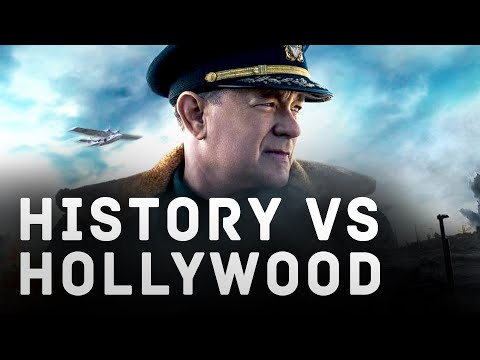
Yet Greyhound is far from pure fantasy. Forester was a meticulous researcher, and his novel is grounded in the brutal reality of the Battle of the Atlantic—the longest continuous campaign of World War II. This was a fight for survival, not just for ships, but for the entire Allied war effort. If Germany had managed to sever the supply lines between North America and Europe, the consequences would have been catastrophic. Tanks, planes, fuel, food—all of it flowed across the Atlantic, and all of it was vulnerable.
The film captures this tension with visceral intensity. German U-boats, operating in coordinated “wolf packs,” hunted Allied convoys relentlessly. In the movie, the unseen enemy taunts the crew over the radio—a dramatic touch that never actually happened. While U-boats did occasionally intercept Allied transmissions, they never managed to hack into a convoy’s internal communication system to broadcast threats. That bit is pure Hollywood, designed to give a human voice to an invisible foe.
What about the ship itself? The USS Keeling may be fictional, but the vessel used for filming was very real. The production shot aboard the USS Kidd, the only surviving World War II destroyer that still retains its wartime configuration. Today, it rests in Baton Rouge, Louisiana, as a museum ship. While close-ups were filmed on the actual Kidd, many wide shots of the Greyhound are computer-generated images of the same ship—a detail that’s noticeable on screen.
One of the film’s most memorable scenes involves a U-boat surfacing so close that the destroyer’s main guns can’t depress low enough to hit it. Sailors resort to rifles and machine guns—a desperate, close-quarters brawl on the open sea. It seems like a Hollywood invention, but something remarkably similar happened on November 1, 1943. The destroyer USS Borie attempted to ram U-405, and a massive wave lifted the Borie’s bow, dropping it onto the U-boat. The two vessels became locked together, so close that the American crew indeed used small arms to fire at the Germans. The U-boat eventually sank, but the Borie was so badly damaged that it had to be scuttled the next day.
The Battle of the Atlantic exacted a terrible toll. The Allies lost nearly 3,500 merchant ships and 175 warships. Germany lost 783 of its 1,100 U-boats. Almost 80,000 Allied sailors and airmen perished over six long years. These numbers are the stark backdrop against which Greyhound unfolds—a fictional story set against a very real, very deadly conflict.
But the film raises another question: how did the real commanders handle the pressure? The weight of responsibility, the constant fear of torpedoes, the sleepless nights—these are the elements that make Greyhound more than just an action movie. They are the human heart of a war fought on a vast, unforgiving ocean.
To understand that pressure, you have to look at what a convoy commander actually faced. In the mid-Atlantic, beyond the reach of land-based aircraft, there was a stretch of ocean known as the “Black Pit.” Convoys entering this gap lost their air cover entirely, and the U-boats knew it. This is precisely where Forester placed his fictional Greyhound, and precisely where the real battle was most desperate.
The tactics shown in the film—depth charges, evasive zigzagging, the agonizing wait for sonar contact—were all drawn from real accounts. Depth charges had to be dropped with terrifying precision, and even then, kills were rare. A destroyer might spend hours hunting a single U-boat, expending dozens of charges, only for the submarine to slip away and strike the convoy from another angle.
What the movie captures brilliantly is the isolation of command. Krause stands alone on the bridge, making split-second decisions that could doom hundreds of men. In reality, convoy commanders often collapsed from exhaustion after days of continuous action. Some suffered nervous breakdowns. The psychological toll was as deadly as any torpedo.
And yet, the film compresses a campaign into a single crossing. In truth, the Battle of the Atlantic was not one battle but hundreds of running fights spread across six years. The turning point came in May 1943, when Allied escort tactics, improved radar, and long-range aircraft finally broke the wolf packs. The hunters became the hunted. U-boat losses soared so high that Germany’s Admiral Dönitz was forced to withdraw his submarines from the North Atlantic entirely.
Still, the question remains: why does Greyhound resonate so deeply with audiences? Perhaps because it strips war down to its essence—duty, fear, and the quiet courage of ordinary men doing an extraordinary job. Tom Hanks has said he wanted to honor the sailors who fought a war no one could see, on an ocean no one could tame.
The film may be fiction, but its heart is true. The USS Keeling never existed, yet thousands of real destroyers just like it steamed into the Black Pit, knowing they might never come back. Their stories are the ones that truly deserve to be told.
And those stories reveal something the film can only hint at: the sheer technological arms race that defined the Atlantic war. Every time the Allies developed a new weapon—improved radar, high-frequency direction finding, the Leigh Light for night attacks—the Germans answered with their own innovations. Snorkels let U-boats run submerged longer. Acoustic torpedoes homed in on the sound of a propeller. The cat-and-mouse game never stopped evolving.
One of the most important tools in that game was Huff-Duff—High-Frequency Direction Finding. When a U-boat transmitted a radio message, even a brief one, Allied stations could triangulate its position within minutes. In the film, the crew of the Greyhound rely heavily on radio intercepts to track their unseen enemy, and this is one of the most accurate details in the entire story. Real commanders did exactly that, though the process was often slower and far less precise than Hollywood suggests.
Then there was the escort itself. A convoy crossing the Black Pit was guarded by a thin screen of warships—sometimes only four or five destroyers and corvettes protecting forty or fifty merchant vessels. The math was brutal: one escort could not be everywhere at once. When a U-boat attacked one flank, the commander had to decide whether to chase it or hold position and protect the convoy. Chase too far, and another wolf would slip through the gap behind you.
This is the dilemma at the heart of Greyhound. Krause faces it again and again, and each choice costs him something. In real life, commanders lived with those choices for years, not hours. Some never forgave themselves for the ships they lost. Others simply stopped sleeping, haunted by the sound of torpedoes striking hulls in the dark.
There is also a quieter truth the film touches on: the men themselves. Most sailors in the Battle of the Atlantic were not career officers like Krause. They were teenagers from Kansas and farmers from Nova Scotia, cooks and coal-stokers and signalmen who had never seen the ocean before the war. They endured freezing spray, rotten food, and the constant gnawing fear that the next explosion might be the last thing they ever heard.
The merchant marine crews were even more exposed. Unlike Navy sailors, they had no weapons, no depth charges, no way to fight back. Their ships carried the fuel and food and ammunition that kept Britain alive, yet they were often the last to be remembered. By the war’s end, one in seven merchant sailors who crossed the Atlantic had been killed—a casualty rate higher than almost any branch of the military.
So when Greyhound shows a torpedo striking a tanker and the sea erupting in flame, it is not exaggerating. Real convoy crews watched helplessly as ships ahead of them vanished in seconds, then steered their own vessels straight through the burning oil and floating wreckage. There was no time to stop. There was no time to grieve. The convoy had to keep moving.
What the film does best, perhaps, is capture the loneliness of the ocean. No landmarks, no horizon, no sense of progress—just grey water in every direction and the knowledge that help was hundreds of miles away. For the men who fought there, the Atlantic was not a backdrop. It was an enemy in its own right.
That loneliness is the film’s true subject. Krause never sees his enemy, never trades a word with the men he fights, never gets to celebrate a decisive victory. He simply endures, hour after hour, until the convoy slips into the safety of air cover. It is a portrait of leadership stripped of glory—only responsibility remains.
And that, more than any battle scene, is what connects Greyhound to the real men of the Atlantic. They did not win the war in a single dramatic moment. They won it by showing up, crossing again and again, and refusing to let the line break. Forester understood this when he wrote his novel, and Hanks understood it when he brought it to the screen.
So the final verdict is a satisfying one: the ship is invented, the commander is invented, and the taunting radio broadcasts are pure fiction. But the fear, the exhaustion, the impossible choices, and the black, indifferent sea—those are as real as history gets. Greyhound is not a documentary, but it is a worthy tribute.
Which brings us back to you. When you watch a film like Greyhound, does knowing what really happened make the story richer—or does it spoil the drama? Let us know in the comments below.
Report this article
Select a reason for reporting:






