They sprang from their chairs and cried with joy. The officer from the Luftwaffe had just announced that they would become soldiers—anti-aircraft assistants—and the classroom erupted in ear-splitting cheers. “Suddenly, we had become soldiers, exactly as we’d hoped,” one recalled. “It was sheer joy.”
These were the children of the Hitler Youth, indoctrinated from birth to worship the Führer and eager to prove their worth on the battlefield. For them, war was an adventure, a chance to live dangerously and handle real weapons. They had no idea what awaited them.
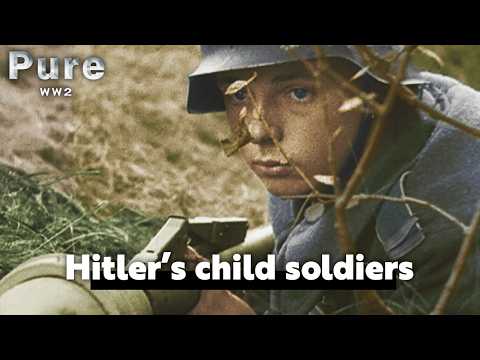
Among the 200,000 Flakhelfer were boys like Günter Grass, the future Nobel laureate, and Joseph Ratzinger, the future Pope Benedict XVI. They manned searchlights and cannons, aiming at Allied bombers that darkened the skies over German cities. “We were convinced that Germany was conducting a defensive war,” another recalled. “So we fulfilled our service with extreme zeal.”
But the thrill of combat soon gave way to horror. One afternoon, a boy shot down two fighter bombers in half an hour. “There was a sense of triumph,” he said. “I’d received the insignia for fighters of the anti-aircraft unit—something you only get when you have participated in destroying eight airplanes mid-flight.” Then he did the math: he had participated in the deaths of around fifty people. “We were obviously dancing with joy, but once we got closer and saw the pilot all shriveled up like a ragdoll in the fire, well, that really upset us terribly.”
Between air raids, they went back to being almost normal children. But the Allies’ aerial superiority left little hope. Exhausted, deafened by unprotected ears, they were cannon fodder. “There was an air raid siren,” one remembered. “We all left our buildings and went into the little woods nearby.” He was with his friend Hans Gruber when fighter bombers strafed a train full of goods. “He’s afraid,” Hans said. “That was a close one again, but I got a stone in my back.” Then Hans turned slightly, and the boy saw his back—nothing left but a gaping hole. A 3/4-inch bullet had torn through him. “Nothing could save him.”
That was the first lesson that made many start to think about the true meaning of war. “From then on it was hard all of the time and ugly and pathetic,” one said. The Allies bombarded Germany heavily, and the young people experienced a waking nightmare. They helped recover corpses—or bits of corpses—and load them onto trucks. “It was a massacre beyond compare.”
In a burning building, a woman’s forearm was trapped under a steel beam. They tried to lift it, but it was impossible. The man in charge ordered a handsaw. “He placed a tourniquet on the top of this woman’s arm and I had to hold on to this tourniquet,” a boy recalled. “Then he sawed off the arm. We were able to get her out and just after that the building completely collapsed. She would have died. But that sound of a saw sawing into a human arm, that is unforgettable.”
Most of these images were not broadcast. It was important not to lower morale. Defeat didn’t stop the propaganda—it made it worse. In the autumn of 1943, 16,000 Hitler Youth of the class of 1926 joined the ranks of a new armored division of the Waffen-SS. Created by Heinrich Himmler, the 12th SS Panzer Division was baptized Hitlerjugend. They were sixteen and seventeen years old—teenagers who didn’t have the right to smoke or drink, but they had the right to kill. “The regime was counting on their audacity and lack of awareness in the face of danger,” a historian noted. Joseph Goebbels proclaimed, “The enemy must know that even for our children, there is no other choice than to fight until the last.”
Leaving Belgium, where it had been training, the 12th SS Panzer Hitler Youth Division headed for Normandy. In May 1944, the region was not considered strategic by the Wehrmacht leadership—the Allied invasion was expected in Pas-de-Calais instead. On June 6, 1944, Operation Overlord was launched. The Allies landed in Normandy. “When the information concerning the landing arrived, we had a big party in our unit,” one veteran recalled. “We thought finally they will stop attacking us only from the sky. They’re also attacking on land and so we’ll be able to beat them. We were convinced that we were going to beat them.”
The day after D-Day, the Hitlerjugend division was sent to the city of Caen, a major Allied objective. The city was meant to fall within 24 hours. For these teenagers, it was a baptism by fire. Their aggressiveness transformed those 24 hours into six weeks of hell for the Allied troops. The division stopped the British and Canadian offensive in front of the city gates. The Hitler Youth took many prisoners. German cameras filmed the last moments of the men doomed to die as the young soldiers under the command of Kurt Meyer executed their prisoners of war by the dozen. At Ardenne Abbey, west of Caen, 18 Allied soldiers were assassinated. In the courtyard of the Château d’Audrieu, 45 Canadian soldiers were executed. In total, the SS division Hitlerjugend killed over 150 prisoners of war. The children of the Third Reich had become war criminals.
The young people were such fanatics. “They were more fanatical than their elders,” one observer recalled. “They were ready to die for Hitler. They would have run and jumped out of the window. You had to watch out for them more so than with the adults.” They were caught up in madness, entirely submissive to the Führer. They would have done anything at all—war crimes, massacres, acts of violence. The years of indoctrination had paid off.
The Allies quickly identified the 12th SS Hitlerjugend, which they nicknamed the Baby Division. Their recklessness and barbarism made them a formidable foe. The young people within its ranks were merciless machines of war, and they did not hesitate to sacrifice their lives. Despite the barbarism they demonstrated, the regime honored them.
The showcase of the Reich remained as rose-tinted as ever, but the reality was very different. The landings had succeeded. The Wehrmacht had lost the Battle of Normandy. Hundreds of thousands of soldiers were captured—among them, thousands of young people. Once they had saluted with outstretched arm, but now they surrendered with both hands.
These defeats did not prevent the Hitler Youth from going on to fight on other fronts. “I can still recall very clearly a discussion with my friend Hans Keller,” one veteran said. “We were saying, so apparently it’s not only collapsing in the east but also in the west. But from there to losing the war—that was out of the question. It was impossible.”
Convinced that they were the last resort of the Reich, young volunteers flooded into the combat units, willingly or otherwise. “It was an order like in the army,” one recalled. “You couldn’t say, ‘I’m not going.’ My father would have been put in a camp or my mother would have been punished. That’s how it was at the time. We were forced to volunteer, and those who didn’t volunteer had their heads shaved.”
The arrival at the front of these young recruits did not boost the morale of the soldiers. They were very skeptical about their aptitude for fighting. “They said we were mad,” a boy remembered. “At first, they laughed when we arrived. Most of them had been at war for so long already, they were all wounded in some way or another. And they really lectured us and asked us what we thought we could achieve. They said to us, ‘Can’t you see that everything is going down the drain? And anyway, why did you volunteer to come here?'”
The myth of a heroic and victorious war gave way to reality. The young soldiers were unable to block the Allies’ progress. “I went there with four friends,” one said. “They were real friends, not just soldiers. And of those friends, in the space of two or three weeks, three of them fell. So it was quite tough at that point. Of course, we felt like we were cannon fodder. We’d been taught to fight for the country until death and we took that very seriously and that’s what we wanted to do.” They were steeped in madness as though drugged, blinded, blended.
Whether at the Battle of the Bulge or on the Eastern Front, the Hitler Youth marched into battle—they had no choice. Surrender was forbidden. Firing squads shot down deserters. On March 20, 1945, Adolf Hitler made his final appearance on the news and congratulated the Hitler Youth that he’d sent to the slaughter. “Your fight is now a vital experience,” he told them. “To be or not to be. Such is the choice of the German people. I’m sure that beyond our difficult ordeals, victory shall be ours since it is to our young—to you—that it is owed above all.”
Among these last fighters were very young children like Alfred Czech, twelve years old, or Helmut Hubner, just turned sixteen but who looked much younger. Interviewed for the occasion, Hitler was no longer capable of controlling his gestures and suffered from what looked like Parkinson’s disease. At fifty-six, he looked like an old man and expressed no remorse. Hitler and his entourage had completely lost all sense of reality. He couldn’t care less what would happen to the German people. Hitler even said, “If the German people die out, they alone are responsible.” It was really a gang of criminals. There’s no other way to put it.
Even in April 1945, a month before the capitulation, the machine was still in operation. Young child soldiers were still being sent into battle. In the streets, posters called on the population to defend their cities. Even children as young as ten were being called up. “We had been examined on the 4th of April 1945,” one recalled. “Some of my class were deemed apt. We had received camouflage fatigues from the Waffen-SS. The sleeves and the legs of the pants had to be taken up for me.”
On April 16, the heaviest artillery barrage of the war began. 1,236,000 shells were fired by the Soviet armies. 100,000 tons of steel rained down on the Germans. On April 25, the Red Army entered Berlin. Wherever they fought, some of the Hitler Youth suddenly realized that they might die. “It was a question of survival,” one said. “We shot in the direction we thought the enemy would be coming from. Like when we threw stones as kids, except that for us they were grenades. So I threw grenades and tried to make it out alive.”
Nine of his classmates lost their lives. “People were dropping like flies,” he said. “For us, it was clear that now we just wanted to save our lives.” Equipped with light weapons, the Hitler Youth harried the tanks of eighteen Soviet armies. The soldiers of the Red Army had to flush them out like rats. While the young people were being decimated, Adolf Hitler was sheltered in his bunker twenty-three feet below the ground.
On April 30, the Soviets launched the attack on the Reichstag. The dictator who had chosen to stay in Berlin committed suicide with a bullet to the head. The Hitler Youth who once considered themselves the Führer’s children were suddenly orphaned. “I’ll say it more or less as I thought of it at the time,” one remembered. “A hero is dead. Nothing more. A hero in inverted commas. At midday, we would still have obeyed any order from the Führer, but by one o’clock in the afternoon, it was all over. It was like an awakening, like waking up with a hangover.”
In May 1945, unconditional surrender was signed by the last high dignitaries of the Third Reich. The Hitler Youth, lured by the prospect of power and glory, had reaped nothing but the horror of war and defeat. “I informed the captain and I said, ‘But captain, that’s impossible. Germany can’t possibly surrender,'” one recalled. “With that, the captain put his arm on my shoulder and said, ‘You know, lad, truth sometimes requires more courage than lies.’ So then I understood that it was over. I cried like a baby.”
Many of the soldiers, particularly the older ones, said, “What luck! This mayhem is over and done with.” Europe was bled dry by the war. While the Allies shared Germany, millions of displaced refugees sought to return to their own countries.
For the Hitler Youth, the fall of the Reich did not necessarily constitute a liberation. Thousands were detained by the Allies in huge prisoner-of-war camps. The victors knew they were harboring a generation born, educated, and fanaticized under Hitler. Thus began a long period of re-education, both in the classroom and in the camps. The children of Hitler discovered a new world and a new word: democracy.
To denazify them, the victors held screenings. The cinema, once used to indoctrinate, was used to confront the German people with Nazi crimes. “We had to watch films about Auschwitz,” one said. “Horrors upon horrors. I couldn’t get over it because there were these mountains of corpses lying there. It was terrifying.” At first, many didn’t believe it. They thought it was propaganda. But then came the first testimonies. “How could a people who had Goethe and Schiller and so many others do this kind of thing?” one asked. “At that point, we felt ashamed. It will weigh on our history forever.”
As Germany put itself back together, the Hitler Youth who had been prisoners of war returned home, sometimes after long years of imprisonment. Wilhelm Kuiper found his family after several years in Belgian mines. “My mother couldn’t speak,” he said. “She couldn’t stop holding my hand. She said nothing. She just touched me.”
Solomon Perel, a young German Jew who had hidden his identity among the Hitler Youth for four years, nearly forgot his own name. After the war, he returned to Braunschweig and saw a man in striped prisoner’s clothing with a yellow star. “I asked him, ‘Excuse me, are you Jewish?’ He completely ignored me because to him I was surely not Jewish,” Perel recalled. “I was really hurt. And then I went back to him, faced him. And in that moment, quite miraculously, I remembered two words with which the most sacred Jewish prayers begin. And then I got the feeling that he believed me. And I hugged him almost suffocating. And that’s when I said my real name for the first time. And that’s when I started the process of becoming Sally the Jew again.”
In their twilight years, some of the Hitler Youth feel they have a mission. Their survival must have meaning. They want to tell their story. “It’s my duty,” one said. “It is the only thing that I can still do to contribute to it not happening ever again. If we can make young people in Germany passionate about peace the way we were made passionate about war back then, well then we will live in peace in Europe forever.”
And yet, even after all these years, a question still haunts them: How is it possible that we could have run around after such a leader? “Today all that clamoring is simply repulsive,” one admitted. “When I was ten years old, the Third Reich had existed for eight years. We had known nothing other than the Third Reich. We didn’t know anything else. That’s how it was.”
Their testimony stands as a warning. A troubled democracy, they insist, is still preferable to a totalitarian state. “People are always complaining about democracy,” one said. “And I say to them, look at this and this. Think of the Third Reich.”
So now, with the last witnesses growing old, the question passes to us: what will we do with their story—and will we recognize the same seduction of certainty, belonging, and glory when it comes for our own children?
Report this article
Select a reason for reporting:






