Dr. Emma Richardson had spent three months in the basement archive of the Boston Historical Society, cataloging Victorian photographs. The air was thick with the smell of old paper and dust, and most days blurred into an endless stream of stern faces and faded sepia tones. But on this particular afternoon, a mislabeled box marked “Agricultural Equipment 1880s” caught her eye. Inside, instead of farm tools, she found a collection of family portraits. One photograph, dated 1871, stood out—not because of its subjects, but because of the haunting look in the eyes of a young girl.
As Emma examined the portrait more closely, she noticed something odd. The girl’s eyes seemed to hold a secret, a depth that was unusual for the stiff, formal portraits of the era. “It was as if she was looking right through me,” Emma later recalled. She decided to scan the image at high resolution, hoping to uncover what made it so captivating.
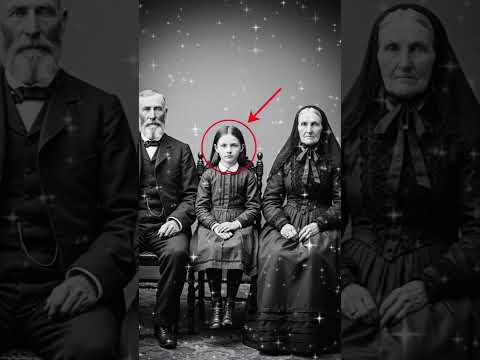
Under the magnifying glass, the details emerged. The girl’s eyes were not just expressive—they were filled with tears, barely visible but unmistakable. This was no ordinary family portrait; it was a farewell. The girl’s father, standing beside her, had his hand on her shoulder, but his face was turned slightly away, as if hiding his own emotions. Emma’s heart raced as she realized the photograph might be the last memory of a family torn apart by the turmoil of the 19th century.
Determined to learn more, Emma delved into the society’s records. The portrait was part of a collection donated by a descendant of the family, but the accompanying documents were sparse. A name surfaced: “The Holloway Family, 1871.” A quick search revealed that the Holloways had been prominent in Boston’s abolitionist movement. Could this photograph be connected to the Underground Railroad? The girl’s tears suggested a goodbye to someone leaving on a dangerous journey.
Emma’s curiosity burned. She spent the next week cross-referencing the Holloway name with historical newspapers and letters. A breakthrough came when she found a diary entry from a neighbor, mentioning that the Holloway’s eldest son had fled to Canada to avoid capture. The date matched the photograph. “The girl’s tears were for her brother,” Emma whispered, piecing together the story. The portrait was taken just before his departure, a silent testament to a family’s sacrifice.
But why had the photograph been mislabeled and forgotten? Emma suspected it was intentional—a way to protect the family’s secret. As she prepared to share her findings with the historical society, she couldn’t shake the feeling that there was more to uncover. The girl’s eyes seemed to plead with her, urging her to dig deeper.
Little did Emma know, this discovery was just the beginning. The Holloway family’s story was far more complex than she imagined, and the photograph held clues to a mystery that had been buried for over a century.
Emma returned to the archive the next morning before the heating had even kicked in, her breath fogging the air as she unlocked the basement door. She had barely slept, her mind circling the same question: if the photograph was a farewell to the eldest son, why did the girl’s eyes seem to follow her? She pulled the Holloway file again and spread its contents across the table—a single donation letter, three brittle receipts, and a photograph of a family that looked almost ordinary until you looked too long.
The donation letter was signed by a woman named Margaret Holloway, dated 1942. Her handwriting was careful, almost reluctant, as if each word cost her something. “These items are given in memory of my grandmother, who never spoke of the war years,” she had written. Emma read the line three times. The war years—but which war? 1871 sat awkwardly between the Civil War and the first World War, a gap in the timeline that made the phrase strange.
She checked the receipts. Two were for coal deliveries, unremarkable. But the third made her sit up straight: a payment to a Boston photography studio, Whitmore & Sons, for “one portrait, cabinet size, rush order.” The date was April 14, 1871. Rush order. Someone had needed that photograph taken quickly, before time ran out.
Emma pulled up the studio’s records on the society’s microfilm machine, cranking the reel with a squeal that echoed through the empty basement. Whitmore & Sons had been prolific, their ledgers dense with names and dates. She found the April entries and traced her finger down the page until she reached the fourteenth. There it was, in faded copperplate: “Holloway family, 6 persons, paid in full. Note: father requested no copies.”
No copies. A portrait taken in haste and then deliberately kept singular—never reproduced, never distributed. That was not the behavior of a family preserving a memory. That was the behavior of a family hiding something.
Emma leaned back in her chair, the microfilm machine humming its low, mechanical drone. She thought about the father’s face in the photograph, turned slightly away, and the hand on his daughter’s shoulder that looked less like comfort and more like restraint. What if the girl was not crying because her brother was leaving? What if she was crying because she was the one being left behind—or worse, because she was the one being sent away?
She pulled up the census records for 1870, the year before the portrait. The Holloway household listed seven names: the father, Elias; the mother, Cordelia; four sons—and a daughter named Prudence, age eleven. Emma counted the figures in the photograph again. Six persons. One was missing. The eldest son, the one the neighbor’s diary claimed had fled to Canada, was not in the picture at all.
So the farewell was not for him. The photograph had been taken after he was already gone. Which meant the tears in Prudence Holloway’s eyes were for something else entirely—something the family had gathered to mark on April 14, 1871, in a rush, with no copies to spare.
Emma reached for her phone and dialed the number of the society’s head archivist, her hand trembling slightly. “I need to request the restricted Holloway collection,” she said when he answered. “The materials Margaret Holloway donated in 1942—the ones that were sealed.” There was a pause on the other end of the line, long enough that Emma checked to see if the call had dropped.
Then the archivist spoke, his voice quieter than before. “How did you know about the sealed materials, Dr. Richardson?”
Emma’s grip tightened on the phone. “The donation letter mentioned items given in memory of her grandmother,” she said, choosing her words carefully. “But there’s no inventory of what those items were. I assumed there was more.” The archivist exhaled slowly, the sound crackling through the speaker.
“There is more,” he admitted. “A diary, some letters, and a small packet wrapped in oilcloth. Margaret Holloway’s will stipulated they remain sealed until 2022. That was thirty years ago. The seal expired, but no one’s ever requested them.” Emma’s pulse quickened. “I’m requesting them now.”
The archivist hesitated. “They’re in the climate-controlled vault, not the general collection. I can have them brought up tomorrow morning. But Dr. Richardson—the packet has a note attached. It says, ‘For the one who asks about Prudence.'” The line went silent. Emma felt the hair on her arms rise. “Someone knew a researcher would come looking,” she murmured.
The next morning, Emma arrived before dawn. A gray archival box sat waiting on her table, its lid stamped with the Holloway name in faded ink. She opened it with gloved hands. On top lay a leather diary, its spine cracked with age, and beneath it, a bundle wrapped in oilcloth tied with twine. The note was pinned to the cloth with a rusted straight pin: For the one who asks about Prudence.
She opened the diary first. The handwriting was cramped and hurried, the ink smudged in places as if written in haste or tears. The first entry was dated April 15, 1871—the day after the photograph. “They took her this morning,” the writer had scrawled. “Elias would not speak. Cordelia has not left her room. We told the neighbors she has gone to her aunt in Vermont. There is no aunt in Vermont.”
Emma’s breath caught. Prudence Holloway had not been crying for a departing brother. She had been crying because she was the one being sent away—and the family had lied about where she went. Emma turned the page, her fingers trembling.
The next entry was shorter, the handwriting more unsteady. “The doctor came again. He says the asylum in Worcester is the only place that will take her. Elias signed the papers last night. May God forgive us all.” Emma set the diary down, her throat tight. The girl in the photograph—the one with tears in her eyes—had been committed to an asylum. The portrait was not a farewell to a son fleeing to Canada. It was a farewell to a daughter the family was surrendering to a place from which few returned.
She reached for the oilcloth bundle and untied the twine. Inside was a small stack of letters, their edges worn soft, and a single object wrapped in tissue: a child’s locket, its chain broken, the silver tarnished almost black. Emma opened it carefully. Inside, on one side, was a tiny photograph of Prudence herself, unsmiling. On the other side, a lock of pale hair.
She unfolded the first letter. It was addressed to Cordelia Holloway and dated months after the photograph. The handwriting was not the diarist’s. It was formal, clinical, and utterly cold. “We regret to inform you that your daughter Prudence has been transferred to the chronic ward. Her condition has not improved. We advise against further visits, as they agitate her.”
Emma turned to the next letter, then the next. Each one was a variation on the same theme: no improvement, no visits, no hope. The final letter, dated 1874, was brief. “We must inform you of the death of your daughter. She passed in her sleep. Her belongings are enclosed.” The belongings, Emma realized, were the locket and the letters themselves—returned to a family that had already lost her.
She sat back, the basement silent except for the hum of the microfilm machine. The photograph had been mislabeled, forgotten, buried in a box of agricultural equipment. But someone—Margaret Holloway, or perhaps Cordelia herself—had made sure the truth survived. “For the one who asks about Prudence,” Emma whispered. She had asked. And now she understood.
But as she reached for the final letter in the stack, she noticed something odd. The envelope was still sealed, its wax intact, and the name on the front was not Cordelia Holloway’s. It was addressed to Elias Holloway, and in the corner, in small, careful letters, someone had written: Do not open until the girl is found.
Emma stared at the sealed envelope, her heart hammering. “Do not open until the girl is found”—but Prudence had died in 1874. Unless the note meant someone else. She checked the postmark: 1876, two years after the asylum’s final letter. Her hands shook as she broke the wax.
Inside was a single sheet in a stranger’s hand. “I have taken the child from Worcester. She is safe and does not remember. Do not look for her. Let her live.” Emma’s breath caught. Prudence had not died. Someone had smuggled her out, and the family had been told a lie to keep her hidden.
She turned the page over. A final line, scrawled in a different ink: “If you have found this, then the truth has waited long enough. My name was Prudence Holloway. I lived.”
Emma closed her eyes. The girl in the photograph had not been buried in an unmarked grave. She had grown up somewhere else, under another name, and left this letter as her only proof. The archive’s silence had not been an erasure—it had been a promise.
What would you have done, if you were the one who found her?
Report this article
Select a reason for reporting:






