In the summer of 1914, the world stood on the brink of a war unlike any other. The assassination of Archduke Franz Ferdinand had set off a chain reaction, and soon three German armies under Kaiser Wilhelm II marched into Belgium, their sights set on Paris. Britain, bound by treaty to protect Belgium’s neutrality, issued an ultimatum: withdraw or face war. When the ultimatum expired, Britain declared war on Germany. The British Expeditionary Force set sail for France, and public confidence was high. After all, Britain was a world power, its Royal Navy the envy of the world, and the British Empire spanned a quarter of the globe. Young men, raised on tales of military glory, rushed to join up, eager to defend king and country.
But behind the patriotic fervor, there were those who sensed the coming storm. Lord Kitchener, the new Secretary of State for War, predicted a long and drawn-out conflict. He appealed for 100,000 new recruits, and thousands answered the call. Among them was 18-year-old Robbie Burns, an insurance clerk from Glasgow. “Everywhere you went in Glasgow, the great big posters up of Kitchener, his finger pointing at you. No matter where you were, this finger seemed to be pointing at you – ‘Your King and Country Need You.’” Burns, like many others, was eager for adventure. “I never thought of being killed, never thought of that. I thought it’d be good fun killing somebody.”
Such was the success of Kitchener’s campaign that recruiting stations were swamped with volunteers. Men from all walks of life joined up, many encouraged to enlist alongside friends and work colleagues in so-called Pals battalions. Entire towns and cities competed to raise the most recruits, and new battalions were formed of men from the same street, factory, or football team. 18-year-old Ted Francis left his job at a paper factory in Birmingham to join the 16th Warwickshire Regiment, known as the Birmingham Pals. “You’d have thought an extra bank holiday had been told in Birmingham because people were excited, laughing, joking. Young people like myself saying, ‘We’ll show those Germans, we’ll push them back home. How dare they walk over little Belgium?’”
But not everyone was caught up in the fervor. In County Durham, 18-year-old farm worker George Littlefair’s mother pleaded with him on her deathbed not to join the army. “She says, ‘There’s a war on now, do not join the army.’ That was her last words to me. And what did I do? Joined the damn army.” Littlefair, like many others, saw the war as a novelty, a chance to escape the drudgery of rural life. “We were raw country lads, never seen anything. We felt we were going to have a bit of fun.”
By the winter of 1914, almost a million men had joined Kitchener’s Army. But across the Channel, it was becoming clear that there would be no swift victory. Both sides had begun to dig defensive positions in the frozen fields of France and Belgium, and a system of fortified trenches emerged that would eventually stretch from the Belgian coast to the Swiss Alps. The age of trench warfare had arrived.
At home, recruits were so plentiful that the Army could afford to be selective, accepting only those in A1 physical condition. They were desperate to join the action but would first have to endure rigorous training to turn them from civilians into soldiers. For many volunteers, this period was a welcome relief from the daily grind. Outdoor activities replaced the factories, mines, and shipyards they had left behind. But they quickly learned that army discipline could be harsh and punitive. Robbie Burns, now 19, did his best to stay out of trouble. “If you did things wrong, you’d lose your pay – a lot of money, sixpence a day, don’t forget that. You’d lose your leave, have to do extra drill, and keep reporting to the guardroom at certain times. So it paid to do what you were told.”
For the youngest volunteers, this was often their first time away from home and their mothers – something the sergeant major didn’t let them forget. “He wasn’t very old himself, but he was a big tall young fellow with a nasty wagging tongue. He used to call us all ‘you flipping little mother’s boys’ and used language we never liked. We absolutely disliked this fellow when he came into view. I suppose in a sense it did you good – you got to know what discipline meant.”
This volatile mixture of men from different social classes could on occasion turn nasty. Farm laborer George Littlefair took great offense at a comment made by a young corporal. “I was 19, 12 stone, a strong country lad. There was one little bugger who turned up, yelling and shouting, and he used to call me ‘Littlefair’ because it was short and he couldn’t get ‘Littlefair’ out. I was in one of them good humors, I never answered him. So he came up to me, looked at me, and said, ‘Do you think you are?’ I just stood. He said, ‘I think you’re a bastard.’ As soon as he said that, I had him in the mouth with that. I said, ‘Don’t prove it.’” George was fortunate – for striking a corporal he could have faced a court-martial, but he was spared punishment when he revealed his mother had recently died.
Taking command of an overenthusiastic bunch of new recruits could be a daunting prospect for an inexperienced young officer. After first enlisting as an infantryman, 19-year-old Richard Hawkins was granted a commission into the Royal Fusiliers and responsibility for his first platoon. “Why the hell they did as they were told by a young man probably younger than they were, I don’t quite know – except that they were told I was in charge and they had to do as I said, and they did, no question. The morale was tremendous. We were anxious to get on with the job, we wanted to go to France and stop the Hun. We were all very proud to be in the Army defending our country.”
With vast numbers taking up arms, there were often shortages of equipment, and many volunteers learned to drill with makeshift weapons – broomsticks and shovels. Finally getting to use a rifle was a great thrill. “Came the great day when we were issued with rifles. We were all waiting for that. Some of them rubbed that rifle and cleaned it and worshipped it. Even more thrilling was when we had real bullets to fire at a target. That was really something we all looked forward to.”
Kitchener had expected his new recruits to undergo a year of training before being sent into action, but two major factors meant this period was cut short. Firstly, during the spring of 1915, the Allies suffered enormous casualties on the Western Front. In just two days of fighting, 11,000 men were lost for a gain of just two kilometers when British and Empire troops launched their first major offensive near the French town of Neuve Chapelle. Worse was to follow as a further 70,000 men were killed or wounded fighting to defend the Belgian town of Ypres, where the Germans used poison gas for the first time to devastating effect. Then in April, the Allies attempted to open up a new front with the launch of the Gallipoli campaign in Turkey. In the months that followed, over 140,000 British and Empire troops would be lost on Turkish soil in one of the most infamous battles of the war.
But for now, this deployment of fighting men to the east combined with heavy losses in the west meant that the new recruits were needed in France urgently. In May 1915, the first divisions of Kitchener’s Army began their journeys to the front line. One of those preparing to go to France was 18-year-old George Lath from Hampshire. He had lied about his age when he enlisted and was given one last chance to avoid the fighting. “My captain sent a sergeant out to me. He said, ‘Lath, the captain wants to know how old you are.’ I said, ‘Why?’ He said, ‘Because he don’t believe you. We’re going to France, and we don’t want you crying when you get over there. Say you’re not old enough, because it won’t happen – you won’t come back. So say it now.’ I said, ‘I’m going with the lads.’ And from then on we went on.”
By the time the new recruits began to arrive in France, an uneasy peace had settled over the Western Front. Attack and counterattack had done little to gain either side an advantage, and the dangers of shellfire and machine-gun bullets kept both sides confined to their trenches. As they marched towards the front, Kitchener’s men knew little of the horrors that awaited them and remained confident that victory would soon be theirs. “You could see some of them swelling absolutely fist to busts with pride, and I too, being cheered by French girls – thought it was great to be a soldier then. We’ll show them, we’ll push these Huns back where they belong. It was just the thoughts of really young men who didn’t know any better.”
But as they neared the front line, the reality began to sink in. “You could probably hear a very, very faint noise of gunfire, very faint. And then the nearer we got, of course, then we realized what we were in for. Oh, then you began to shake. The nearer we got to the front line, the more it was pouring with rain. We were just on foot, walking up, marching with all our equipment, everything you could carry, bedded up with your guns. And suddenly you begin to see the sky lighting up, flashing, flashing, flashing, and you begin to hear the noise of the guns. You know you’re getting nearer. You can’t help feeling butterflies in your tummy – whether you’re going to shoot Germans or whether they’re going to shoot you. You never knew what the future held. That was a terrible thought, really. Going into war is not a very pleasant experience – terrible.”
And in the weeks and months that followed, the men of Kitchener’s Army would learn the dreadful realities of trench warfare, where the possibility of death or serious injury was only a gunshot away.
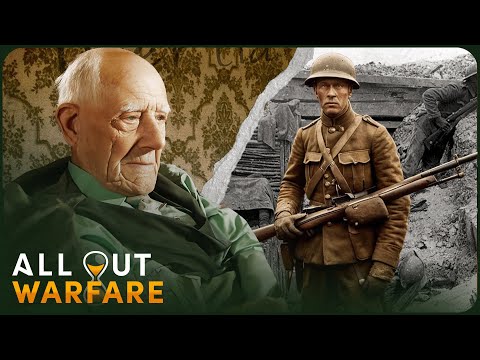
In the decades that followed, these men carried the war home in silence. Many never spoke of the mud, the shells, or the faces of friends frozen in no man’s land. “You don’t talk about it,” one veteran admitted. “You couldn’t. Who would understand?” Yet in their final years, they opened their hearts to the cameras, determined that the world should remember.
Their stories were not of glory, but of endurance. Of rats and rum, of letters never sent, of promises broken by shrapnel. “We were ordinary men,” said one, “who did what had to be done.” They spoke of fallen pals with a tenderness that time had not dimmed, and of the youth they left behind in the Flanders mud.
When the last of them passed, a century of living memory fell silent. But their voices remain, captured on film – a warning and a witness. As one survivor put it, “If we don’t tell it, who will?”
Now, more than a hundred years on, their words still echo. Do we truly listen – or have we already forgotten?
Report this article
Select a reason for reporting:






