In the winter of 2001, deep inside the barren reaches of southern Afghanistan, a small Australian patrol rolled through a landscape that the world’s most powerful air force could not see. They were hundreds of kilometers from any friendly base, far beyond the reach of quick reinforcement, and entirely dependent on a radio link that connected them to an American command system they barely understood. What the US air controllers saw on their maps that season was a tiny flag—almost invisible among the larger American positions—but it marked something extraordinary: a handful of men who had driven themselves into the void.
This is the story of that flag, and of the night it turned into a desperate race against time.
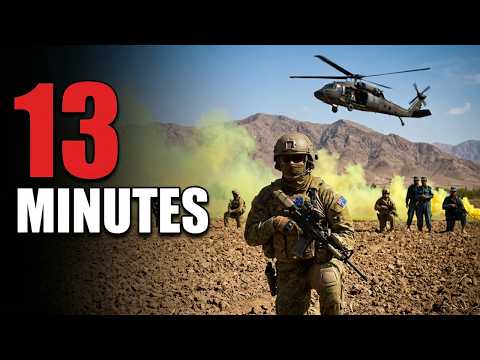
The war in Afghanistan had begun as a clean air campaign against fixed targets, but by late October 2001, the easy strikes were gone. Taliban and al-Qaeda fighters had dispersed into villages and caves, moving only at night. “Airplanes can’t crawl around on the ground and find people,” Secretary of Defense Donald Rumsfeld famously said. So the Americans sent in ground teams—Special Forces soldiers with Air Force combat controllers, the first eyes on target.
Each team carried an Inmarsat satellite phone, and the system became brutally simple: bombs from the sky, eyes on the ground. Without those eyes, the world’s most powerful air force was dropping ordnance on empty dirt.
But there were never enough eyes. The US carriers in the North Arabian Sea could only keep aircraft over Afghanistan for about ten hours a day each, leaving daily gaps. Land-based F-15E Strike Eagles had to fly around Iran to fill them. Everything the Americans did there depended on extraordinary skill—and on a few allies who could operate far from the flagpole.
Into this gap stepped the Australian Special Air Service Regiment. In November 2001, the first SAS squadron left Perth and entered Afghanistan through a dusty forward base called Rhino, a former drug-smuggling hub in the desert southwest of Kandahar. The man who had fought hardest to get them there was Major Dan McDaniel, the squadron’s commander. He later wrote that Australia had no base in the Middle East, no ready way into Afghanistan, and no American formation waiting to receive them. “There were no facilities,” he recalled. Nothing was offered. Nothing was easy.
The American who finally agreed to sponsor them was Marine General James Mattis, commanding Task Force 58 at Rhino. And the Australians brought something almost no other coalition special forces unit had: their own vehicles.
Those vehicles were six-wheeled Land Rovers—long-range patrol vehicles modified specifically for the SAS to carry a patrol, its weapons, water, fuel, and radios across country for days without paved roads. In the 1990s, the regiment had seriously discussed selling the fleet and giving up the capability entirely. Afghanistan ended that debate. On the ground, the difference was immediate. Other coalition special forces arrived and waited, competing for a limited pool of American helicopters. If no helicopter was available, they didn’t move. The Australians got in their trucks and drove.
“The squadron’s vehicles, its communications system, and its simple but effective logistics chain gave it a flexibility that attracted the Americans,” McDaniel wrote. The Americans were supporting a growing number of coalition partners who needed transportation. Here was a vehicle that transported itself.
The squadron’s mission was broad: long-range, long-duration patrols, shorter direct-action tasks, and reconnaissance stretching over thousands of kilometers. During the peak of that winter, Australia was one of the few nations running sustained special reconnaissance in eastern and southern Afghanistan, reporting on al-Qaeda presence and on the mood of the Afghan people.
But the work was dangerous in ways that had nothing to do with firefights. Afghanistan in 2002 was one of the most landmine-contaminated countries on earth, and the abandoned Taliban weapons caches were the worst places of all. Clearing those caches was part of the mission. About a month before the February patrol, an Australian soldier was wounded in a mine incident in the area. McDaniel separately describes a soldier from that first rotation who lost part of his foot and much of the use of his leg to an anti-personnel mine.
Then came 16 February 2002. A long-range patrol vehicle was moving through southern Afghanistan with five Australians aboard. The ground looked like the rest of the country. The vehicle found a mine—described by the Army as a suspected anti-vehicle device. Four of the five men were uninjured. The fifth was hit: Sergeant Andrew Russell, 33 years old.
He had joined the Army in 1986, trained at Kapooka, became a combat engineer, and passed SAS selection in 1991. He had served in the Gulf in 1997 and 1998 and twice in East Timor. His awards included the Australian Active Service Medal and the Infantry Combat Badge. At home, his wife Kylie had just given birth to their first child, Leisa.
The countdown began. The patrol sent the call. Two minutes before midnight Australian Eastern Summer Time, the task force headquarters was notified. In Kandahar, it was about 5:30 p.m., and daylight was fading.
The American response was fast. Thirteen minutes after the headquarters was alerted, combat search-and-rescue helicopters lifted off from Kandahar. No official source records the distance they covered. Whatever it was, the first help was expected to come from the air.
Then the Americans went further. A three-man US military rescue team parachuted into the incident site. Three men left an aircraft over a desert that turned out to be mined at the end of the day, to reach an Australian soldier they had never met. The US military offers only one sentence: “They parachuted in to stabilize his condition for helicopter evacuation.”
That is the heart of this story. There is no statement from an air controller. There are American rescuers who looked at an Australian patrol far beyond any support, and then they jumped.
The patrol’s own men fought for him too. Defense Minister Robert Hill later acknowledged their efforts to save his life under those difficult conditions. But it was not enough. Andrew Russell was flown to Kandahar and pronounced dead after arriving at an American medical facility there. He was the first Australian soldier killed in combat since the Vietnam War, more than 30 years earlier. He never came home to meet his daughter.
In Canberra, the reaction came the next day, 17 February. Chief of Army Peter Cosgrove announced the death: “It is a very sad day. We all mourn the loss of a brave and loyal soldier.” Opposition leader Simon Crean spoke of the great debt owed to the men and women who serve in the armed forces. John Howard said it showed how dangerous the mission was. Robert Hill added a phrase few remember—that the Australian government also appreciated the efforts of the American medical team who assisted our forces. It is one of the very few places in the official record where the American side of this story is mentioned: a single sentence of thanks from a minister for men whose names were not recorded.
At Kandahar airfield, the squadron carried Russell to the aircraft that would take him home. The pipes that played his farewell belonged to a Canadian unit, the Princess Patricia’s Canadian Light Infantry, which had arrived in Kandahar with the Americans. His mates from the operational squadron stood and watched him go.
There is one side of this that should trouble you. The record gives you the date, the time, and the 13 minutes—but it omits the place. No public source specifies the distance. The Army says southern Afghanistan. Reports from that time point to the Helmand side of the south. McDaniel says only that the squadron’s tactical operations remain classified. There is no official number for how far Andrew Russell’s patrol was from support. The same applies to the figure in the title of this video. The Registan, the sand sea where the patrols worked, is 200 kilometers wide. It is not a measured distance from Russell’s vehicle to help, because that distance has never been published. But what is documented is the shape of the help. It lifted off from Kandahar 13 minutes after the call reached headquarters, and part of it had to arrive by parachute. On the ground that winter, no support meant help required a helicopter or men willing to jump.
What the Americans concluded about these men showed up in policy. The flags in Tampa became more than silent admiration. By early 2002, McDaniel wrote, the Australian government was considering just one squadron with no rotation—go once, show commitment, then go home. McDaniel says that when the first commander rotated out, his successor was widely described as the man sent to dismantle the task force and bring it home. But things did not go that way.
In March, the task force moved north to Bagram to support Operation Anaconda, the coalition’s major offensive into the Shahi Kot valley. This channel covered that operation separately—it is its own story. But one detail matters here. McDaniel writes that the Australian task force had independently detected a dense al-Qaeda presence in Shahi Kot months before the operation, and had been reporting on it from manned observation posts. US command ordered those patrols withdrawn for fear of compromise, replacing them with manned and unmanned reconnaissance flights. Those flights, McDaniel writes, failed to identify all the fortified enemy positions that did most of the damage to coalition forces in the first hours and days. That assessment is McDaniel’s alone, and no American evidence supports it. Yet it fits everything else in this story. Aircraft could not crawl on the ground, and someone had to.
By then, something had changed in the patrols themselves. The gap the squadron had admitted—the lack of joint terminal attack control—was being closed the practical way. In his book Anaconda, McDaniel writes: “Australian patrols directed their aircraft onto al-Qaeda targets, day and night, for more than a week.” One of those patrols carried an American airman who was later awarded the Silver Star, the third-highest US decoration for valor in combat.
So an American controller accompanied an Australian patrol as it called in airstrikes on al-Qaeda for over a week, while winter closed in on the southern desert. McDaniel adds that Australian performance in that operation convinced senior American commanders that Australian forces were worth pressing to stay. At every rotation decision, high-level calls between the two governments took place, and at every call, he says, the United States pressed Australia to remain.
Australia sent a second squadron in March and April, and a third in September. Australian special forces did not leave Afghanistan until December 2002. The American decision about those patrols came as a request, repeated at the highest levels, to keep them. Nobody needed to say it aloud. The rotation plan itself pointed to the nature of the work. McDaniel explained that one year suited the regiment because it divided into three rotations of four months each—the period over which the intensity could be managed before a squadron needed to come out. Four months of long-range patrols, then home, and the next squadron in.
The honors followed. Lieutenant Colonel Peter Gilmore, commander of the regiment and the first task group, was awarded the Distinguished Service Cross for his leadership. The Americans gave him the Bronze Star. The squadron itself received a Unit Citation for Gallantry for distinguished and continuous service in warlike operations in Afghanistan.
None of that answers the question the way one American voice on the radio would. So it is clear, after searching American air power history, Australian Army records, and the first squadron commander’s account, that no published quote from an American air controller describes an Australian patrol in the southern desert that winter. If one exists, it has not been published. That silence is not an accident. It deserves to be taken seriously. Special reconnaissance is designed to leave no trace. The patrol that does its job best is the one nobody sees. Its reports go up the chain under a classified heading. The aircraft it directs onto a target are logged as American sorties. When it succeeds, the credit goes to the air war, because the bomb and the plane and the pilot all belong to it.
So a whole squadron can be tracked flag by flag in Tampa, and still appear only in a footnote of the best American history of that campaign. The Americans who saw it were looking at a map and listening to a radio, while the men they were watching were doing their best to disappear. Lambeth’s description of Australia—fighters and tankers guarding an island in the Indian Ocean thousands of kilometers from Kandahar—is accurate enough. His book is air power history written from the air power point of view, and on that side of the record, Australian ground patrols barely register.
The same gap sits behind a warning McDaniel wrote after watching a surveillance aircraft fail to see what his patrols had seen. He argued the coalition had become too dependent on technology. Australia needed new technology too, he said, but the soldier remains the decisive element. In other words, the answer lies in more capable soldiers, not soldiers enabled by technology.
The cost did not end when the squadron came home. The soldier wounded in the foot returned to Australia and was punished for failing some aspect of the Army’s basic fitness assessment. In 2002, the Army was still applying peacetime personnel rules to its wounded. In the end, he was medically discharged. McDaniel sees the defense policies of that time as far too slow to adapt to what its soldiers had achieved.
This story has its limits, and they should be stated. The first squadron did not win the war in the south. The Marines, US Special Forces teams, and the air campaign carried that burden. McDaniel himself says the patrols never found Osama bin Laden. The squadron was small, giving the Americans greater reach rather than greater firepower. A group of soldiers with eyes on the ground, able to reach places the air war could not see.
McDaniel’s lesson about alliance was the harshest. The problems of getting a base, a sponsor, and a road into Afghanistan taught the squadron that Australia was not as close to the Americans as it had assumed. At the time, he wrote: “The United States did not really know us, did not understand us, and did not necessarily trust us.” The Americans did not trust these men at first. By the end of the first rotation, they were asking them to stay.
There, everything hung on communication with people able to help. Once, a dead battery cut one Afghan’s connection to the Americans for more than a decade. Another time, a replacement battery caused an American bomb to fall on an American team. Years later, McDaniel returned to Kandahar on his third tour. It was 2009, and the temperature was still 30 degrees Celsius at midnight. He was standing outside in the dark with three American officers when he met Charlie Wilson, the former US congressman who had helped arm the Afghan resistance against the Soviets in the 1980s. Wilson told them: “You guys are finishing what we started, but you’re doing it a lot better than we did.” McDaniel wrote that he did not agree in silence. By 2009, the coalition did not look to him like it was winning.
Yet in the winter of 2001, the mission was simpler, and the first squadron completed it. It penetrated farther than almost any other squadron, and reported what it saw to a headquarters on the far side of the world. When one of its vehicles struck a mine at the end of an afternoon in February, the Americans had helicopters airborne within 13 minutes. Three men dropped from an aircraft at dusk to reach an Australian sergeant. What the Americans saw was a flag on a map in Tampa. Then, when they jumped, they saw the ground beneath it.
Sergeant Andrew Russell’s name still heads a list that stretched across the next twenty years. If someone in your family served in Afghanistan—with the SAS, any other unit, or earlier in Vietnam or East Timor—tell me about them in the comments. Their names deserve more than a passing mention.
And if a single flag on a map was enough to bring three men out of the sky for a stranger, what does that tell us about the alliances we build—and the ones we quietly let fade?
Report this article
Select a reason for reporting:






