The F-111 was supposed to be the ultimate warplane—fast, versatile, and deadly. But a hidden flaw lurking deep within its wings would bring it to the brink of disaster, killing crew and grounding the fleet. This is the story of how a tiny crack in a steel component nearly destroyed one of the most iconic aircraft of the Cold War.
In the early 1960s, the U.S. military faced a daunting challenge: Soviet air defenses were becoming increasingly sophisticated. The shootdown of a U-2 spy plane at over 60,000 feet in 1960 sent shockwaves through the Pentagon. Aging bombers like the B-52 were vulnerable, and even newer aircraft like the F-105 were already showing weaknesses. The Air Force needed a new breed of aircraft—one that could fly fast and low, beneath enemy radar, deliver a massive payload, and return safely.
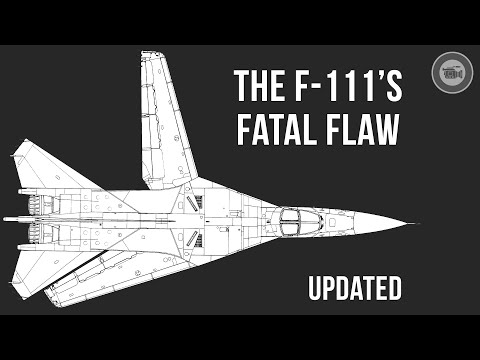
At the same time, the Navy was seeking a fleet defense interceptor with long range and heavy missile capability. Under pressure from Secretary of Defense Robert McNamara, the two services were forced to collaborate on a single aircraft: the Tactical Fighter Experimental, or TFX. The result was the General Dynamics F-111, a revolutionary design with variable-sweep wings that promised to revolutionize aerial warfare.
But the F-111 was plagued by problems from the start. The variable-geometry wings, while innovative, introduced complex mechanical systems that were prone to failure. In 1968, a fatigue test revealed serious manufacturing defects in the wing box, and the following year, a catastrophic accident shocked the world.
On December 22, 1969, an F-111A was conducting a simulated rocket attack run at Nellis Air Force Base. As the pilot pulled up, the left wing suddenly detached from the aircraft. The crew had no chance to eject—the aircraft rolled too quickly. Both men were killed. The investigation traced the failure to a crack in the wing pivot fitting, caused by a sharp-edged forging defect. The crack had grown rapidly during flight, leading to a critical failure. With only 100 hours on the airframe, the F-111 should never have suffered such a catastrophic breakdown.
The accident had far-reaching consequences. Australia, which had ordered 24 F-111Cs, immediately grounded its fleet and refused to accept delivery until the flaw was fixed. The Royal Australian Air Force leased F-4E Phantoms as a stopgap while American engineers scrambled to solve the problem.
The root cause was identified as inconsistent heat treatment of the D6AC steel used in the wing pivot fitting. Variations in fracture toughness meant that even tiny defects could propagate into catastrophic cracks. The U.S. Air Force launched an extensive recovery program, redesigning the component and improving manufacturing processes. It would take until March 1973 for the first redesigned F-111C to be accepted by the RAAF.
Despite its troubled beginnings, the F-111 would go on to prove its worth. It had longer range and faster top speed than any other aircraft in Southeast Asia, giving Australia a significant defensive edge. And remarkably, it would establish the best safety record of any Century Series fighter, with only 77 losses after a million flying hours.
But the road to redemption was far from smooth. The F-111’s story is a testament to the dangers of pushing the boundaries of technology—and the high cost of failure.
By the time the first six F-111Cs touched down at Amberley on July 1st, 1973, the RAAF’s patience had been tested to its limits. Six long years had passed since Australian crews first began training on the aircraft in 1967. What they received was not merely a bomber, but a machine that had been torn apart, inspected, and rebuilt from the inside out.
The recovery program had been brutal in its thoroughness. Every wing pivot fitting was removed, X-rayed, and replaced with components machined to far tighter tolerances. The D6AC steel was subjected to rigorous heat-treatment verification, ensuring that fracture toughness fell within strict parameters. No longer would a hidden flaw slip through the cracks—literally or figuratively.
For the Australian crews, the wait had been frustrating but necessary. They had watched from the sidelines as the Americans wrestled with the F-111’s demons. They had flown leased Phantoms while their own aircraft sat in Fort Worth, stripped down and scrutinized. Now, finally, the aircraft was theirs.
The F-111C that arrived at Amberley was a different beast from the one that had first flown in 1968. It retained the same sleek, menacing profile—the long nose, the distinctive cockpit pod, the variable-sweep wings that could angle back for high-speed dashes or spread wide for slow, stable approaches. But beneath the skin, it was stronger. Safer. Ready.
Australian pilots quickly discovered what their American counterparts already knew: the F-111 was a remarkable flying machine. Its terrain-following radar allowed it to scream through valleys at treetop height, hugging the earth while enemy radar struggled to pick it out from the clutter. Its range was unmatched in the region—over 4,000 kilometers without refueling—giving the RAAF the ability to strike deep into Southeast Asia and return home.
The aircraft’s weapons bay could carry a staggering array of ordnance. Laser-guided bombs, conventional iron bombs, mines, even nuclear weapons if the need ever arose. The F-111 could do it all. And with a top speed of Mach 2.5, it could outrun nearly anything that threatened it.
But the F-111’s integration into Australian service was not without its own challenges. The RAAF had to build an entirely new support infrastructure around the aircraft. Maintenance crews trained for years on the complex variable-geometry wing mechanisms, learning to inspect and repair systems that had no equivalent in any other aircraft in the Australian inventory.
The F-111’s arrival also coincided with a shifting strategic landscape. The Vietnam War was winding down, and Australia was reassessing its defense priorities. The F-111C, with its long legs and heavy payload, offered a deterrent capability that no other aircraft in the region could match. It was a strategic asset, not just a tactical bomber.
By the mid-1970s, the F-111 had become a familiar sight in Australian skies. Its distinctive shape—the long, pointed nose, the broad wings that seemed to shift and morph in flight—was instantly recognizable. Children looked up in awe as it thundered overhead. Aviation enthusiasts traveled from across the country to watch it perform at air shows.
Yet the shadow of its troubled past lingered. Every pilot who strapped into the F-111C knew the history. Knew about the Nellis accident. Knew about the crack that had killed two men and nearly doomed the entire program. That knowledge bred a healthy respect for the aircraft’s limits—and a deep appreciation for the engineers who had made it safe.
As the 1970s gave way to the 1980s, the F-111C proved itself time and again. It participated in major exercises, often outperforming newer aircraft from allied nations. Its ability to fly fast and low, to strike targets with precision, and to return home on a single tank of fuel made it a favorite among planners and pilots alike.
But the story of the F-111 was far from over. The aircraft would continue to evolve, receiving upgrades to its avionics, weapons systems, and electronic warfare capabilities. And in the decades to come, it would face new challenges—and new dangers—that no one could have predicted when those first six aircraft touched down at Amberley.
The 1980s brought a new set of demands. The RAAF’s F-111Cs were aging, and while the airframes remained sound, their avionics were rapidly falling behind. In 1982, the Australian government approved a major upgrade program that would transform the F-111C into a truly modern strike platform.
The upgrade, known as the Pave Tack program, fitted the aircraft with a sophisticated infrared targeting pod. Mounted in the weapons bay, the Pave Tack allowed the F-111 to detect, track, and designate targets at night and through smoke or haze. For the first time, the RAAF had a genuine all-weather precision strike capability.
Pilots who flew with the new system described it as a revelation. Where once they had relied on radar alone, now they could see the battlefield in crisp thermal imagery, picking out vehicles, bunkers, and bridges with startling clarity. The F-111 was no longer just a fast bomber—it was a hunter-killer.
But the upgrades came at a cost. The Pave Tack pod was heavy and complex, requiring extensive modifications to the aircraft’s wiring and cooling systems. Maintenance crews, already stretched thin, had to learn an entirely new set of skills. The F-111 was becoming a maintenance nightmare—but a necessary one.
By the late 1980s, the strategic environment had shifted again. The Cold War was winding down, and Australia’s defense focus turned increasingly toward its own region. The F-111C, with its unmatched range and payload, remained the centerpiece of the RAAF’s strike capability. But questions were being asked about its future.
In 1990, the RAAF began upgrading the fleet again, this time with digital avionics, improved navigation systems, and a new defensive countermeasures suite. The aircraft that emerged from these modifications was designated the F-111C AUP—Avionics Upgrade Program. It was, in many ways, a brand-new aircraft wearing an old skin.
The AUP aircraft featured a glass cockpit, multifunction displays, and a digital mission computer that could process data at speeds unimaginable to the pilots who first flew the F-111 in the 1970s. The variable-sweep wings, once the source of so much grief, were now managed by sophisticated software that adjusted their angle automatically for optimal performance.
Pilots loved it. One RAAF squadron leader remarked that the F-111 had gone from a brute to a ballet dancer—still powerful, but now graceful and precise.
But the upgrades could not mask the fundamental reality: the F-111 was getting old. Airframe fatigue was becoming a concern, and spare parts were increasingly hard to source. The RAAF began studying options for a replacement, even as it continued to fly the F-111 on operational missions.
In 1999, the F-111C was called upon to prove its worth in a real-world contingency. During the East Timor crisis, Australian forces deployed to restore stability in the newly independent nation. The F-111C flew deterrent patrols over the island, its presence a clear signal that Australia was prepared to defend its interests.
The aircraft’s mere appearance over Dili was enough to send a message. No one doubted that the F-111 could deliver devastating firepower if called upon. Fortunately, the show of force was sufficient, and the F-111 returned to its bases without dropping a single bomb.
The East Timor deployment was a turning point in the public’s perception of the F-111. No longer was it seen as a relic of the Cold War—it was a vital tool of Australian foreign policy, a symbol of national resolve. The aircraft that had once been grounded by a tiny crack was now the spearhead of the nation’s defense.
By the 2000s, the F-111C’s days were numbered. The RAAF began transitioning to the F/A-18F Super Hornet, and in 2010, the last F-111s were retired. At the farewell ceremony, veteran pilots and maintainers gathered to watch the final flight—a low, fast pass over Amberley that shook the ground and left tears in many eyes.
The aircraft that had once been grounded by a tiny crack had flown for nearly four decades. It had survived its own demons and emerged as one of the most beloved machines in Australian aviation history. Its safety record—77 losses per million flight hours—was the best of any Century Series fighter.
The F-111 was more than a warplane. It was a symbol of Australian ingenuity and perseverance. From the brink of disaster to the pinnacle of capability, the F-111 earned its place in history.
What do you think—was the F-111 the greatest strike aircraft of its era, or did its troubled beginnings forever taint its legacy? Share your thoughts in the comments below.
Report this article
Select a reason for reporting:






