In the early hours of September 1st, 1939, the world held its breath as German forces unleashed a devastating assault on Poland. This was not just another border skirmish—it was the opening salvo of a conflict that would engulf the globe in flames. But how did Germany, a nation crushed by defeat just two decades earlier, rise to become a military juggernaut capable of such audacity? The answer lies in a story of secret rearmament, ruthless ambition, and a revolutionary doctrine that would change warfare forever.
When Adolf Hitler became Chancellor in January 1933, Germany was still shackled by the Treaty of Versailles. The army was limited to 100,000 men, with no tanks, no heavy artillery, and no combat aviation. Yet beneath the surface, a determined military leadership and nationalist factions were already plotting to break free from these constraints. What changed with Hitler’s rise was not the desire, but the speed, scale, and political will to turn these aspirations into reality.
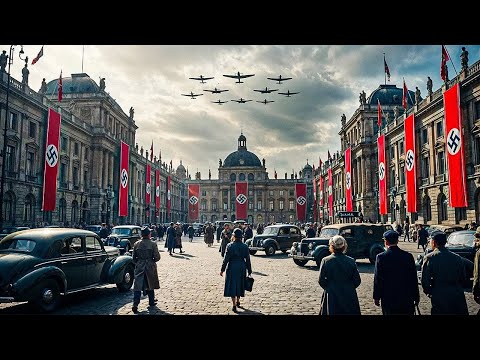
In the first months of his reign, Hitler presented himself as the leader of a new era. Propaganda insisted that Germany had regained strong leadership and must free itself from the humiliation of the Great War. While officially respecting Versailles, the regime discreetly began rearmament under the guise of public works programs and administrative cover. Clandestine links with the Soviet Union, maintained since the Weimar Republic, allowed weapons testing on Russian soil far from international oversight. Under Hitler, these practices expanded and were integrated into a coherent plan linking economic reconstruction with war preparation.
Job creation in arms factories was presented as social policy, but in practice, it built an industrial infrastructure ready to support military production. A turning point came in 1935 when Hitler openly announced compulsory military service, transforming the Reichswehr into the Wehrmacht. The army was reorganized into larger divisions, and armored and motorized units began to form. That same year, the Luftwaffe—already secretly developing—was officially established, with massive resources invested in modern military aviation.
The Kriegsmarine, though more limited, also began expanding with new submarines and plans for a stronger surface fleet. The Heer, as the land army was called, was the first to grow. From 100,000 men, it swelled to several million in just a few years. Infantry, panzer, and motorized divisions were organized, giving the army greater flexibility and mobility than in the previous war. Officer schools were reactivated, and doctrines were developed to avoid the positional warfare that had characterized 1914–1918. Instead, the idea of a quick war—where armored vehicles and aircraft played a central role—was promoted.
The Luftwaffe, under Hermann Göring, became one of the most visible symbols of Germany’s new military power. From its earliest years, it focused on producing fighters like the Messerschmitt Bf 109, dive bombers like the Junkers Ju 87 Stuka, and medium bombers like the Heinkel He 111. These models were designed not only to match other powers but to shape a style of warfare in which aviation directly supported ground forces, striking enemy concentrations and disrupting defenses. The Luftwaffe was not born as an independent strategic weapon, but as an integral part of a Blitzkrieg plan.
The Kriegsmarine faced greater limitations. Germany could not compete with the British Royal Navy in ship numbers, so it opted for a development centered on U-boats. In 1935, a naval agreement with Great Britain theoretically set limits on the German fleet, but in practice, it justified expansion. The ambitious Plan Z called for large battleships and aircraft carriers, though only a portion was completed by the war’s outbreak. Meanwhile, U-boats offered an asymmetric tool capable of threatening enemy supply routes.
The development of this military machine was accompanied by a doctrinal framework that sought to avoid the mistakes of the previous war. The experience of the trenches left German officers convinced that the next conflict must be resolved quickly and with coordinated use of all means. Thus was born the idea of Blitzkrieg—lightning war—not a single codified plan, but a set of principles prioritizing surprise, speed, and coordination between forces. The army would penetrate enemy lines with tanks and motorized troops while the air force destroyed key points and disrupted the rear. The infantry would advance behind to consolidate gains. This combination aimed to destabilize the enemy from the outset and prevent reorganization.
Blitzkrieg represented a break with attrition warfare. Instead of slowly wearing down the enemy, it aimed for a rapid collapse of their capacity to resist. This required meticulous planning, efficient logistics, and coordination between branches on an unprecedented scale.
Politically, Hitler combined these measures with a public discourse that continued to speak of peace and a just revision of the international order, while in practice directing all state resources toward rearmament. Financial mechanisms such as the so-called Mefo bills—promissory notes issued by a fictitious company—allowed arms production to be financed without appearing in official budgets. This financial engineering concealed the real pace of rearmament, avoiding an immediate economic collapse while permitting massive military expansion.
The economy was adjusted to military needs. Heavy industry, steel production, and research into synthetic fuels and materials were placed under state control. Agriculture was adapted to the expectations of self-sufficiency, seeking to ensure food supplies in the event of war. The Four-Year Plan, launched in 1936, was the clearest expression of this policy. Its objective was to prepare Germany for war in the short term, reducing dependence on imports and ensuring the capacity to sustain a prolonged conflict.
The German military command, though occasionally reticent about the pace imposed by Hitler, gradually aligned with these objectives. Generals who had experienced the First World War understood the risks of a premature conflict. But the regime’s authority and initial foreign policy successes reinforced confidence that Germany could once again confront Europe. The army, which during the Weimar years had sought to maintain a low profile, became the central pillar of a state that conceived of itself as a militarized community.
Internationally, these measures generated concern among neighboring powers. But the policy of appeasement and the desire to avoid a new war allowed Germany to continue expanding its capabilities without immediate opposition. Thus, by 1939, the Wehrmacht had become a force of several million men equipped with modern divisions, a large air force, and an expanding navy. What had begun as rearmament disguised as a social program had transformed into a war machine ready to be deployed.
The Reich’s big lie—the pretext for invading Poland and starting the war—had been carefully constructed. Since the spring of 1939, the German high command no longer discussed whether to attack Poland, but when. Planning began to take concrete shape in April when Hitler issued instructions for swift and decisive action against the eastern neighbor. The objective was not solely military. It was about imposing a definitive solution to the Polish problem, which for the regime was both territorial and ideological.
The guidelines were clear: eliminate Poland’s defensive capacity from day one, destroy its administrative structures, and make it unmistakable that this was neither a temporary campaign nor a partial occupation. To achieve this, the German army needed meticulous organization. By mid-year, plans were finalized for what would be the fastest campaign Europe had yet seen. Forces were concentrated at several strategic border points. The Wehrmacht had overwhelming forces at its disposal—around 1.5 million men, almost 2,500 tanks, and more than 2,000 aircraft were ready to participate in the offensive.
Tactical preparations included strong coordination between ground and air forces. The concept of Blitzkrieg found its first practical application in this operation. Although not yet a formally established doctrine, the idea of combining rapid, deep, and well-synchronized attacks with intensive use of aviation was key. The Panzer divisions, supported by tactical aviation, would seek to penetrate the interior of the country as quickly as possible, avoiding conventional defensive lines and sowing confusion in the enemy rear.
The regime not only prepared the military aspect. Weeks before the attack, a propaganda apparatus was deployed to justify the action. Messages were crafted that portrayed Poland as a potential aggressor, and border incidents were exaggerated to generate an atmosphere of imminent threat. One of the most notorious fabrications was the Gleiwitz incident—a covert operation carried out by German forces disguised as Poles, simulating an attack on a German radio station. This event was presented to the world as a Polish provocation and served as an immediate pretext for launching the offensive.
At 4:45 a.m. on September 1st, 1939, the attack began. The Luftwaffe bombed strategic positions in the Polish interior, including airfields, communication centers, and military warehouses. Almost simultaneously, ground units crossed the border on multiple fronts with encircling movements that sought to disorganize the enemy from the first minutes. The Panzer divisions advanced at high speed, flanked by motorized infantry that secured the conquered areas.
The attack was devastating. Within days, the Polish defenses began to collapse. German forces did not pause at points of resistance, but instead surrounded them and continued inland, leaving mopping-up and consolidation tasks to the rear guard. This strategy allowed for a continuous advance without exhausting forces in protracted engagements. Polish units, though they offered resistance at various points, were unable to coordinate effectively or establish a coherent defensive line. Furthermore, German air supremacy hampered any attempt at reorganization or counterattack.
Meanwhile, propaganda within Germany spread the idea of a preemptive, necessary, and just operation. Alleged abuses committed by Poland against German minorities were highlighted, and the Reich was portrayed as a victim forced to defend itself. Hitler’s speeches constantly repeated this narrative, asserting that all diplomatic avenues had been exhausted. The newsreels featured carefully selected images of smiling soldiers, columns advancing unopposed, and towns supposedly welcoming the German troops.
Coordination between the various branches of the military was fine-tuned in real time. Mobile divisions communicated their progress and requested air support when they encountered resistance. The Luftwaffe responded swiftly, removing obstacles and allowing the advance to continue unabated. This breakneck pace surprised not only the Poles but also international observers. Within a few days, German forces were deep inside enemy territory, surrounding Warsaw and other key cities.
On the diplomatic front, Germany had previously assured that the Soviet Union would not intervene on behalf of Poland. This was made possible by the pact signed in August between the two powers—officially a non-aggression pact, but including secret clauses on the partition of Polish territory. With this agreement, Hitler eliminated the risk of a two-front war and could concentrate exclusively on the Eastern campaign. Furthermore, he was confident that France and Great Britain would not react strongly, as had happened in previous episodes.
However, the diplomatic calculation was not entirely correct. On September 3rd, France and the United Kingdom declared war on Germany, fulfilling their commitments to Poland. Despite this, no immediate military action was taken by these powers. For weeks, the so-called Phoney War reigned in the West, with minimal defensive movements and no significant fighting. This allowed Germany to continue its offensive without worrying about a second front.
Within German territory, news of the war was received with a mixture of enthusiasm and resignation. Propaganda had prepared the ground, presenting the conflict as a just and necessary cause. Many citizens supported the action, convinced that it was the only way to resolve the outstanding problems with Poland. At the same time, censorship and information control measures were activated to ensure a single narrative and prevent dissenting voices. Values such as sacrifice, discipline, and national pride were promoted, while casualties were minimized and the harshest aspects of the conflict were hidden.
The campaign was brief but intense. On September 17th, the Soviet Union invaded Eastern Poland, fulfilling its agreement with Germany. This further accelerated the disintegration of the Polish army, which was already in retreat. Warsaw held out until the end of the month, but finally capitulated after a siege accompanied by constant bombardment. The Polish resistance was valiant in many instances but completely overwhelmed by the enemy’s technical and organizational superiority.
By the end of September, the map of Europe had changed. Poland was divided between Germany and the Soviet Union, and the world had formally entered the war. For the Nazi regime, the campaign was a demonstration of military effectiveness, strategic planning, and political control. It confirmed that the rapid war model worked, and this reinforced the high command’s confidence in future operations. Blitzkrieg was not yet a familiar word to the public, but its essence had been put into practice with brutal efficiency.
The experience in Poland became a model to follow. Generals studied every detail of the operation to fine-tune the mechanisms for future campaigns. Political authorities highlighted the results as proof of the superiority of the German system. Parades were organized, victory bulletins were distributed, and the figure of the German soldier was glorified. The initial success reinforced the idea that the Reich had an inevitable and justified expansionist destiny and that obstacles would be overcome with the same speed and determination as in this first campaign.
Thus began—from the German perspective—a conflict that had not yet revealed its true colors, but which already demonstrated the determination of a regime willing to use all its resources to achieve its ends. The invasion of Poland not only marked the beginning of the World War but also the starting point of a way of waging war where speed, surprise, and propaganda were as important as weapons.
By April 1945, the Thousand-Year Reich had shrunk to a few square kilometers of rubble. In the Führerbunker, Hitler married Eva Braun, dictated a political testament blaming everyone but himself, and swallowed a cyanide capsule before his officers burned the bodies. “The war is lost,” a radio operator whispered, and no one contradicted him.
Seven days later, General Alfred Jodl signed the unconditional surrender at Reims. The guns fell silent across Europe on May 8th. In the streets of Berlin, survivors emerged from cellars blinking at a sun that seemed almost obscene. “Is it really over?” a woman asked a Soviet soldier, who simply nodded and handed her a piece of bread.
What remained was a continent in ashes: fifty million dead, cities erased, and a moral reckoning no treaty could contain. The Nuremberg trials would expose the regime’s crimes to a horrified world, while the Cold War began dividing the very ground the Wehrmacht once marched across.
From the secret rearmament of 1933 to the bunker of 1945, the Blitzkrieg had promised lightning victory—yet it delivered only a twelve-year storm that consumed its makers. Was it ambition, fear, or blind obedience that carried a nation to such ruin?
Report this article
Select a reason for reporting:






