Wildlife researchers in southern Florida faced an unexplained problem in the early 2000s: adult American crocodiles were disappearing from the mangrove channels where they had lived for years. These were not young or marginal animals. They were dominant individuals that occupied the best territories in the region, and boat captains who had worked the same waters for two decades could identify them by sight and location. Crocodiles that hold a territory for a decade do not typically abandon it. The animals in the Everglades had simply vanished, and for a long time, no one could explain where they had gone.
The American crocodile was listed as an endangered species in 1967. By the mid-20th century, coastal development, hunting, and habitat loss had reduced the Florida population to a few hundred animals concentrated at the southern tip of the state. Decades of federal protection and careful management brought the population back to roughly 4,000 animals by 2007, when the species was reclassified from endangered to threatened. Conservation officials pointed to the recovery as evidence that early legal intervention could reverse a species’ decline. Then the counts in the strongest areas began to move in the opposite direction.
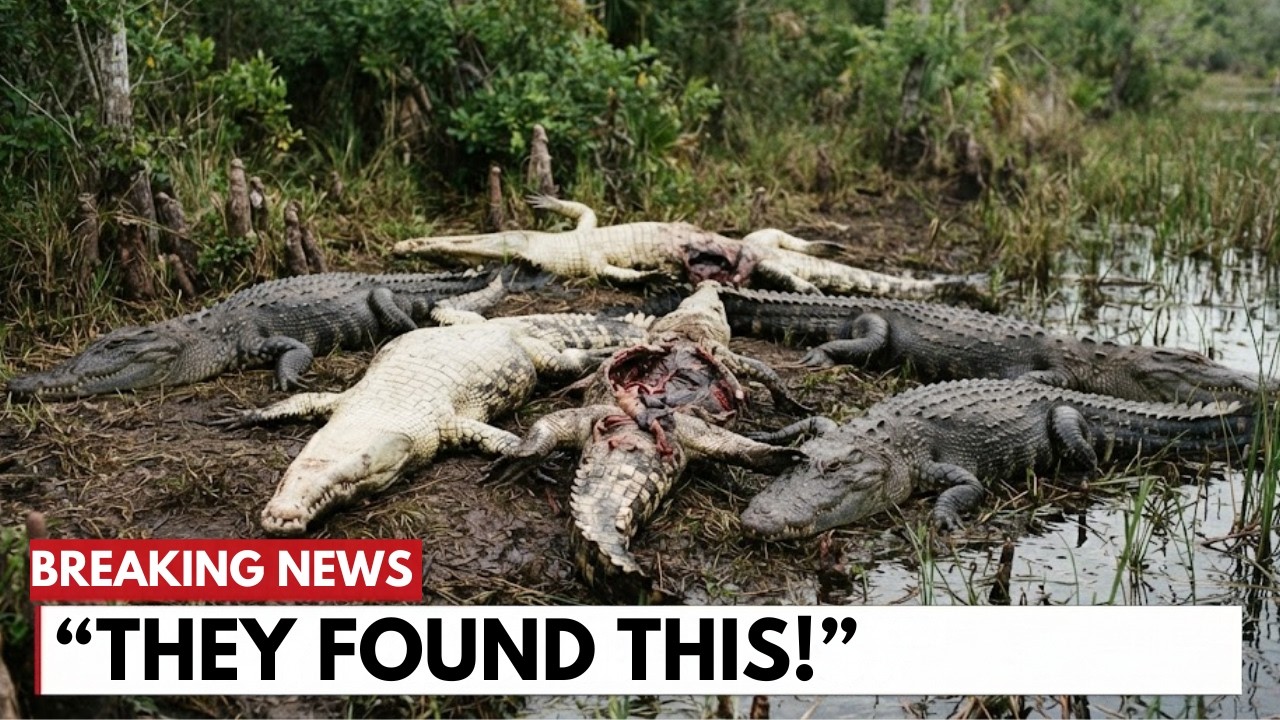
The American crocodile is not the same animal as the more familiar alligator that lives in freshwater canals across Florida. The crocodile is a saltwater and brackish-water specialist that sticks to coastal mangroves and estuaries and generally avoids contact with people. In the entire recorded history of the United States, a wild American crocodile has never killed a human being. That is not a biological accident. It reflects a temperament shaped over millions of years, and the species has followed that path consistently.
When the strongest animals in the best habitat stopped appearing in state and federal surveys, the obvious suspect was the Burmese python. By 2009, the python invasion of the Everglades was already one of the most documented environmental disasters in American conservation history. The snakes had reduced raccoon populations by 99 percent in some parts of the park and caused sharp declines in opossums, marsh rabbits, and foxes. The question of whether a large python could take on a native crocodile was not theoretical. In 2005, park researchers photographed a Burmese python that had attempted to swallow a six-foot alligator and died in the attempt. The image spread widely and fixed in the public mind the idea that these snakes would confront any animal regardless of size.
That theory did not hold up when biologists examined the dead crocodiles recovered from the channels. Pythons kill by constriction, which leaves specific patterns of trauma on the body. The dead crocodiles showed no such patterns. The wounds described an animal that bit and tore, not one that crushed. The kills also showed a level of efficiency that did not match the defensive struggle a dominant territory-holding crocodile would normally put up. Whatever killed these animals did so quickly and without meeting effective resistance.
The breakthrough came from an unexpected location. A University of Florida team captured a small crocodile in a Miami canal, miles from any known American crocodile habitat. Native crocodiles do not appear in those waterways, but the animal itself was what stopped the field team. At first glance it looked like a normal crocodile. Closer inspection showed a broader, heavier snout than an American crocodile’s, and a darker olive color that did not match the local animal’s grayish-green. The behavior was the strangest part. This was a young crocodile, and it moved toward the researchers rather than away from them. American crocodiles do not approach people at any age.
The team suspected a hybrid and sent tissue samples to a genetics lab. The result was unambiguous: the animal was a Nile crocodile, an African species that had reproduced in Florida.
The contrast between the two species is significant. The American crocodile has no recorded human fatalities in U.S. history. The Nile crocodile is responsible for more human deaths than any other crocodilian, with estimates of several hundred per year across sub-Saharan Africa. Some researchers believe the true number is higher because attacks in remote areas go unrecorded. Nile crocodiles are built to hunt large mammals at the water’s edge, do not share the local species’ avoidance of humans, and can reach lengths beyond 18 feet and weights approaching 2,000 pounds.
Genetic testing of the captured Nile crocodiles showed near-identical sequences among individuals. That pattern points to a single founding event: a small group from one source released into the same waterway at roughly the same time. It does not match the profile of scattered, independent escapes from different facilities over many years.
The most plausible explanation for how Nile crocodiles reached a U.S. national park is the exotic pet trade. South Florida is one of the largest markets for illegal and semi-legal exotic animals in the world. Nile crocodiles can be purchased as hatchlings, and they are manageable at two feet long. They become unmanageable at eight feet, and they do not stop there. An owner who decides the animal no longer works as a pet faces a choice between the cost and difficulty of surrendering it to a licensed facility or simply releasing it into the nearest body of water. At least one group of owners made the wrong choice years before the disappearances were first noticed. Because juvenile Nile crocodiles resemble juvenile American crocodiles closely enough to pass a casual inspection, they moved through the mangroves without triggering the alarm that should have been raised.
Florida Fish and Wildlife Conservation Commission efforts, coordinated with the University of Florida, removed three confirmed Nile crocodiles from the wild. In a less adaptable species, removing three individuals might represent meaningful progress. In a species capable of establishing a self-sustaining population from a small founding group, with no natural predators to limit its growth, three tells you where the effort began, not where the problem ended. Nile crocodiles grow faster than native American crocodiles. The individuals captured in Florida were already outperforming local animals of the same age and size. They also tolerate colder conditions better than the American crocodile, meaning there is no natural temperature barrier at the latitude where the native species’ suitable habitat ends.
It is also worth noting the condition of the ecosystem the Nile crocodile entered. The coastal mangroves the American crocodile depends on for nesting and shelter had been removed for decades to make way for development. Water flow through the Everglades had been diverted and re-engineered for agriculture and municipal use in ways that damaged the estuary habitats at the edge of the crocodile’s range. Runoff from farms, roads, and parking lots flows into the same waters the native crocodile needs for successful nesting. Decades of recovery work on the species took place alongside the gradual dismantling of the environmental conditions the recovery program depends on.
The pattern in the Everglades is consistent with many other Florida invasions. The Burmese python followed the same path. So did the green iguana, the Argentine tegu, the lionfish, and the cane toad in other contexts. Each arrived through a pathway created by human activity and settled into a landscape already altered in ways that removed the resistance a healthy ecosystem would have offered. The Everglades is not a natural experiment in what happens when invasive species meet native ones. It is a case study in what happens when an ecosystem already fragmented, chemically damaged, and developmentally constrained meets a new species at the same moment its borders are opened by human choices.
The American crocodile’s clean safety record in the United States is a biological fact that would not necessarily hold up under continued contact with a species that does not share its calm temperament. If Nile crocodiles become established and expand, the warning infrastructure around the waterways bordering Florida’s southern coast would change permanently. That change points toward conditions that the ecotourism economy, the backcountry fishing industry, and the kayak operations in the Ten Thousand Islands have no framework for managing. The predator at the end of this story is not the one in the water. It is the decision that put the water in its current condition in the first place.






