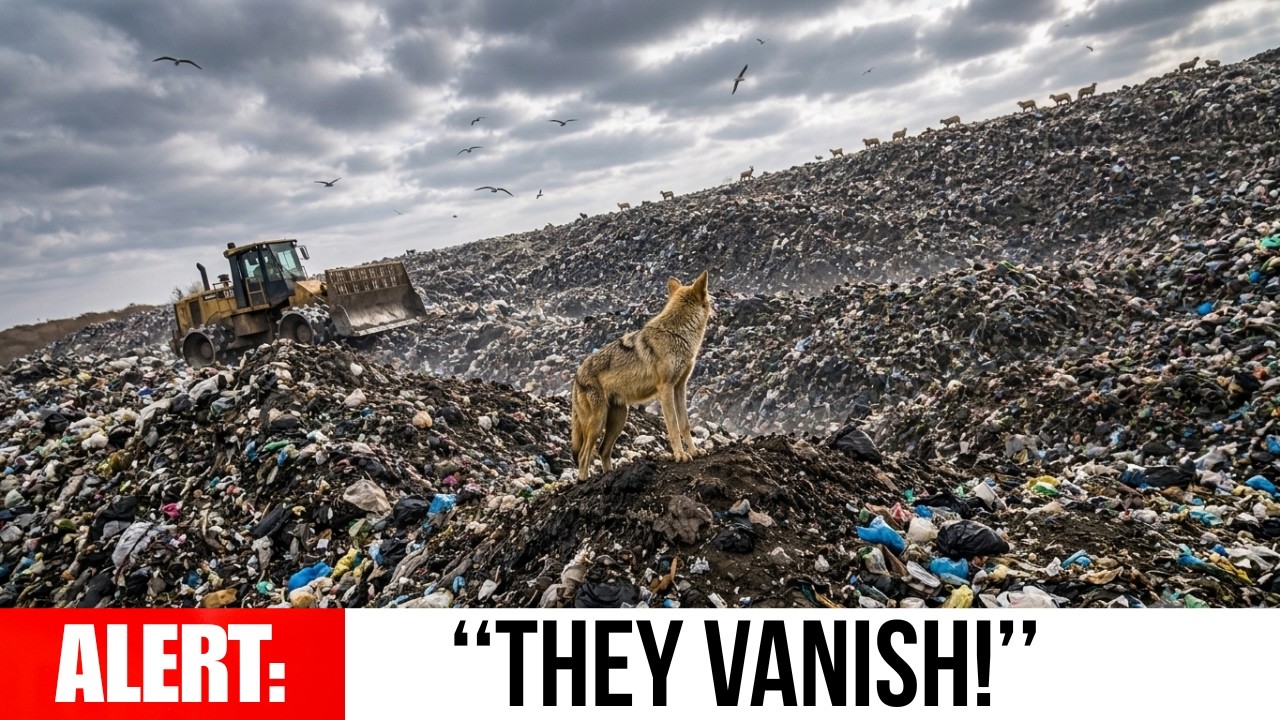
In early 2024, technicians reviewing night camera footage at the Puente Hills landfill, the largest waste site in North America, noticed something unusual. The infrared cameras, which had recorded nightly activity at the site for years, were suddenly capturing empty frames. The rats and stray cats that had dominated the footage had vanished. Researchers soon identified the cause: coyotes had moved into the landfill and established themselves as the dominant predators in the area.
Puente Hills is not a typical landfill. At its peak, the artificial mound of waste reached 152 meters in height, roughly the size of a 50-story building. It received between 3,000 and 7,000 tons of waste daily from the Los Angeles metropolitan area, which generates an estimated two to two and a half kilograms of trash per person per day. The organic material in the waste created a consistent food source for rodents, and the landfill attracted a dense rat population. Estimates suggest that rat density around such facilities is four to six times higher than in typical urban neighborhoods.
The rat population attracted stray cats. An estimated 2,500 to 3,000 feral cats settled around Puente Hills, drawn by the warmth of the decomposing waste and the reliable food supply. The cats hunted birds and rodents, creating a simplified food chain that centered entirely on the landfill.
The coyotes that entered this environment arrived after a long history of conflict with humans. From the 1930s through the 1970s, the federal government spent over one billion dollars in today’s currency on programs aimed at eliminating coyotes across the American West. Methods included poisoned bait, aerial shooting, and den gassing. At the height of these campaigns, an estimated 100,000 to 150,000 coyotes were killed each year.
The eradication efforts failed. Coyote populations responded to the pressure through a biological mechanism known as compensatory reproduction. When population density dropped and food became more available, surviving females produced larger litters, and pups matured faster. The result was that coyotes expanded their range rather than shrinking it. By the end of the twentieth century, coyotes had established populations in over 500 cities and in every U.S. state except Hawaii.
Urban coyotes also adapted behaviorally. Researchers who tracked urban populations found that they became less reactive to human noise and activity. Their digestive systems changed to process starch and processed foods more efficiently. Some coyotes in transitional zones showed genetic traces of interbreeding with domestic dogs.
These adaptations made coyotes well-suited to the landfill environment. Studies at a similar facility outside Denver found that a single coyote could kill between 200 and 300 rats per month. In Alberta, motion cameras recorded coyotes present on 78 percent of nights at a landfill site. Around Puente Hills, coyotes established densities three to five times higher than in adjacent natural areas.
The effect on the rat population was rapid. Rat sightings in the landfill footage dropped from appearing in 30 to 40 percent of frames to just 3 to 10 percent. Much of this decline resulted not from predation alone but from changes in rat behavior. The presence of coyotes caused rats to reduce their foraging activity by 50 to 70 percent and to limit feeding to shorter periods. Studies on rats exposed to coyote scent found elevated cortisol levels in the 200 to 300 percent range, which reduced reproductive success by 30 to 50 percent.
The feral cat population around the landfill also declined sharply. Camera footage that previously recorded four to nine cats per night began showing no cats at all within months. Some cats were killed, but most left the area. Research on cat behavior in coyote territory shows that cats avoid areas marked by coyote scent within a radius of 300 to 500 meters. Stomach analysis of coyotes found in landfill areas showed cat fur in 28 to 42 percent of specimens, with the proportion rising to 55 percent during winter in Canadian sites.
The departure of the cats had measurable effects on bird populations. Ground-nesting birds, which had been heavily predated by cats for over a decade, began to recover. From 2012 to 2020, in areas where coyotes settled and cats left, ground-nesting bird populations increased by up to 210 percent. California quail, which had nearly disappeared from parts of the Los Angeles basin, increased by 300 to 380 percent in some locations. An estimated 85 percent of successful nests were located in cat-free zones patrolled by coyotes.
The wildlife shift extended to the Los Angeles River, a mostly concrete flood control channel. Black phoebes and yellowthroats, species that avoid areas with heavy cat presence, returned to the river corridor once the cats were gone. In Griffith Park, a mountain lion established itself at the center of the park, while coyotes occupied the surrounding edges, creating a layered predator structure that allowed smaller birds to nest in the protected middle zone.
Serious coyote attacks on humans remain rare, averaging about three per year nationally, a fraction of the number of dog bites. However, public pressure to remove coyotes remains significant in many areas. Data from a coyote removal in a Toronto area in 2021 showed that the ecological balance shifted quickly once the predators were gone: rats returned, cats moved back in, and recovering bird populations declined again.
The situation at Puente Hills represents an unintended experiment in predator-mediated ecosystem management. A coyote population that established itself naturally resolved three intersecting problems: the rat population was suppressed, the feral cat population was displaced or reduced, and ground-nesting bird populations recovered. No agency budget funded the change, and no management plan directed it. The coyotes simply occupied an ecological niche that human activity had created, and the system adjusted to accommodate them.






