In 1918, a group of professional lobster fishermen working off Port Stephens on the coast of New South Wales, Australia, reported an encounter with an unusually large white shark. According to their accounts, the animal was estimated at between 115 and 300 feet long, a size range that has made the story a subject of debate for over a century.
The fishermen were experienced professionals supplying seafood to the growing Sydney market. Many came from Italian and Greek immigrant families who had settled along the coast since the 1890s. They worked from open Mediterranean-style boats suited to lobster fishing on the reefs, and their knowledge of the local waters had been built up over generations.
The reports were documented by David George Stead, a marine biologist who served as the first fisheries commissioner for the New South Wales government from 1906. Stead later founded the Wildlife Preservation Society of Australia in 1929. His account noted that the fishermen were sufficiently alarmed to refuse to return to sea for several days, even though the interruption meant financial losses for their families.
Stead recorded that separate crews working in different areas independently described the same animal, a pale white creature of enormous size. The descriptions did not match any known species, living or extinct.
The central question raised by the story is whether the animal could have been a megalodon, the prehistoric shark believed to have gone extinct around 3.6 million years ago. Modern paleontological research offers a more conservative picture of megalodon’s size than older estimates. A widely cited 2022 study led by paleontologist Jack Cooper at Swansea University used a three-dimensional scan of a megalodon vertebral column to estimate the animal’s length at roughly 50 to 65 feet. That figure is well below even the lowest estimates reported at Port Stephens.
The report of a white-colored shark also presents a biological issue. Great white sharks have countershading, gray on top and white below, which aids in hunting. An entirely white shark would lose that camouflage advantage. Marine biologists note that aging or leucism, a genetic condition causing partial loss of pigmentation, can lighten the coloring of some sharks. Leucism has been documented in sharks, including a tiger shark photographed off Hawaii in 2019 and an oceanic whitetip shark photographed near the Bahamas in 2016.
The fossil record shows that megalodon teeth have been found on every continent except Antarctica, indicating the species occupied most ocean basins during its time. Australia has a particularly rich megalodon fossil record, including a 2019 discovery in Victoria of fossilized teeth believed to represent a nursery site. This suggests Australian coastal waters were once breeding grounds for the species.
The scientific consensus on megalodon extinction is supported by a 2019 study led by paleontologist Robert Boessenecker, which linked the extinction to climate cooling in the Pliocene epoch, the loss of warm shallow seas, and competition with great white sharks and killer whales for marine mammal prey.
Proponents of the idea that large ocean creatures remain undiscovered point to several examples. The coelacanth, thought to have gone extinct 66 million years ago, was found alive off South Africa in 1938. The giant squid was not photographed in its natural habitat until 2004. The megamouth shark, now a known but rare species, was only discovered in 1976 when one became entangled in a research vessel anchor near Hawaii.
In 2020, researchers aboard the research vessel Falkor documented a siphonophore, a gelatinous organism, measuring 150 feet long off the coast of Western Australia. It became the longest animal ever documented. The same survey program has since classified dozens of species new to science along the Australian continental slope.
Skeptics offer several counterarguments. They note that a storm had passed through the region shortly before the 1918 incident. Fishermen who had lost equipment in the storm, working within vulnerable immigrant communities without formal insurance, may have found it easier to attribute their losses to a sea monster than to storm damage.
There are also biological objections. A population of sharks over 50 feet in length would require consuming multiple tons of prey daily. Sharks lose teeth throughout their lives, and megalodon teeth fossilize readily due to their density. If a living population existed, fresh teeth would be expected to wash ashore periodically. None have been found.
Optical effects in water can distort the apparent size of submerged objects, and psychologists who study eyewitness testimony have documented how fear can enlarge memory through repeated retelling. These effects differ from deliberate dishonesty, but they complicate the interpretation of witness accounts.
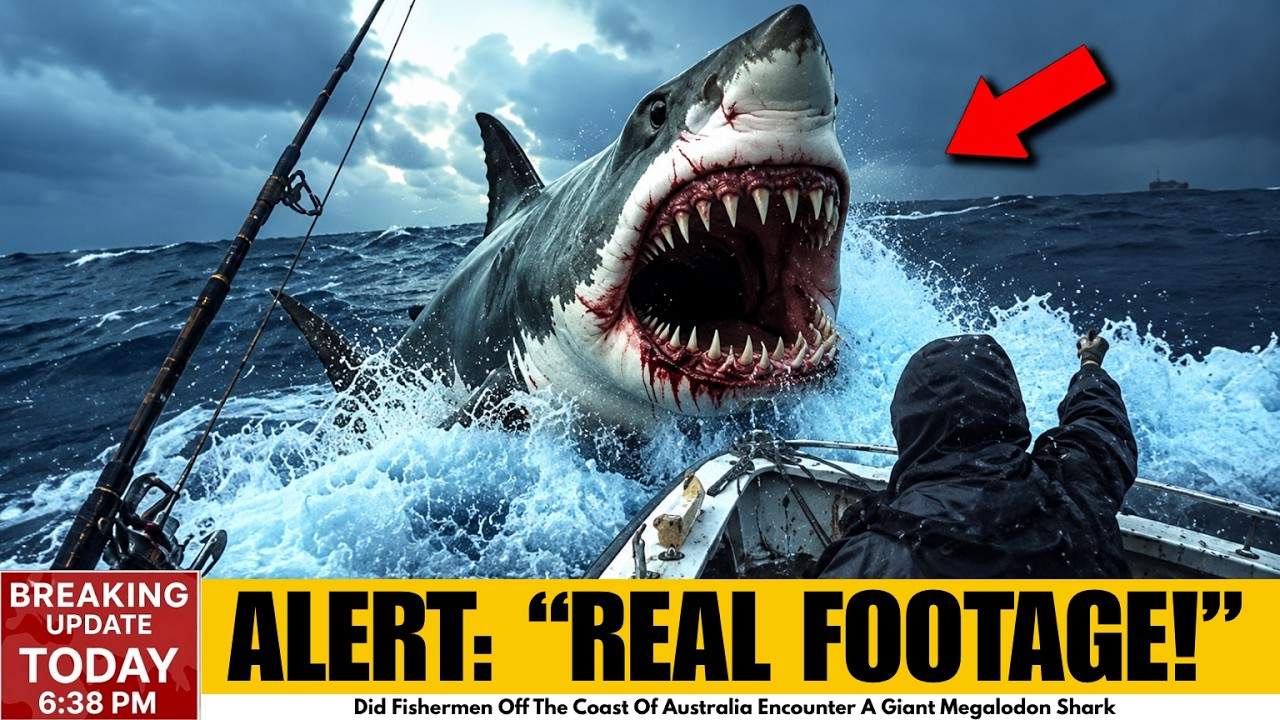
Modern technology has also changed the landscape of such claims. In May 2021, widely shared video of a basking shark in the Atlantic Ocean was frequently misidentified as a megalodon. In 2023, researchers traced several viral videos of giant sharks to AI-generated or digitally composited footage.
Environmental DNA sampling, a technique that detects trace genetic material in seawater, has been used in broad surveys of Australian coastal waters. These surveys have not produced genetic signatures consistent with megalodon survival. The technique has limitations related to depth and degradation rates, but it represents a more rigorous form of evidence than was available in 1918.
Australia continues to report encounters with large sharks in the modern era. In 2024, a fisherman near the same stretch of coast described seeing a great white shark so large that his mind initially struggled to process what he was looking at. The Great Australian Bight has been informally called the “Australian shark triangle” by some researchers, tracing the continental shelf edge where shallow waters give way to deep ocean conditions.
Australia has also hosted some of the largest great white sharks ever recorded. Deep Blue, one of the largest documented great white sharks, was estimated at over 20 feet long and weighed approximately 2.5 tons when photographed off Guadalupe Island in 2013. Great white sharks continue to grow throughout their lives and can live for more than 70 years, according to 2014 age studies.
The Port Stephens case remains unresolved. The consistency of independent witness statements and the credibility of the naturalist who documented them prevent the story from being dismissed outright. However, the biological evidence against a surviving megalodon population, including the lack of fresh teeth, the absence of environmental DNA traces, and the enormous dietary requirements such a population would demand, is difficult to reconcile with the account.
The ocean continues to produce discoveries, from the 150-foot siphonophore documented off Western Australia to new species classified along the Australian continental slope. Whether the Port Stephens fishermen encountered an unknown creature or an exaggerated account remains unclear, but the story occupies a space between what science has ruled out and what it cannot yet confirm.






