In 1918, off the wild coast of Australia, a crew of hardened crayfish fishermen working near Brotton Island encountered something that ended their careers on the spot. They were hauling heavy wooden traps from the deep waters of Port Stevens, a region in New South Wales known for its rich marine life and treacherous currents. These were not amateur anglers. They were rugged, weather-beaten mariners who knew every reef and predator in the South Pacific.
That morning, the routine haul turned into a nightmare. As the crew pulled up one of their heaviest lines, the tension spiked violently, nearly pulling the vessel off balance. The water around the boat began to churn as a massive shadow moved upward from the abyss with terrifying speed. A creature of unthinkable scale broke the surface beside their boat.
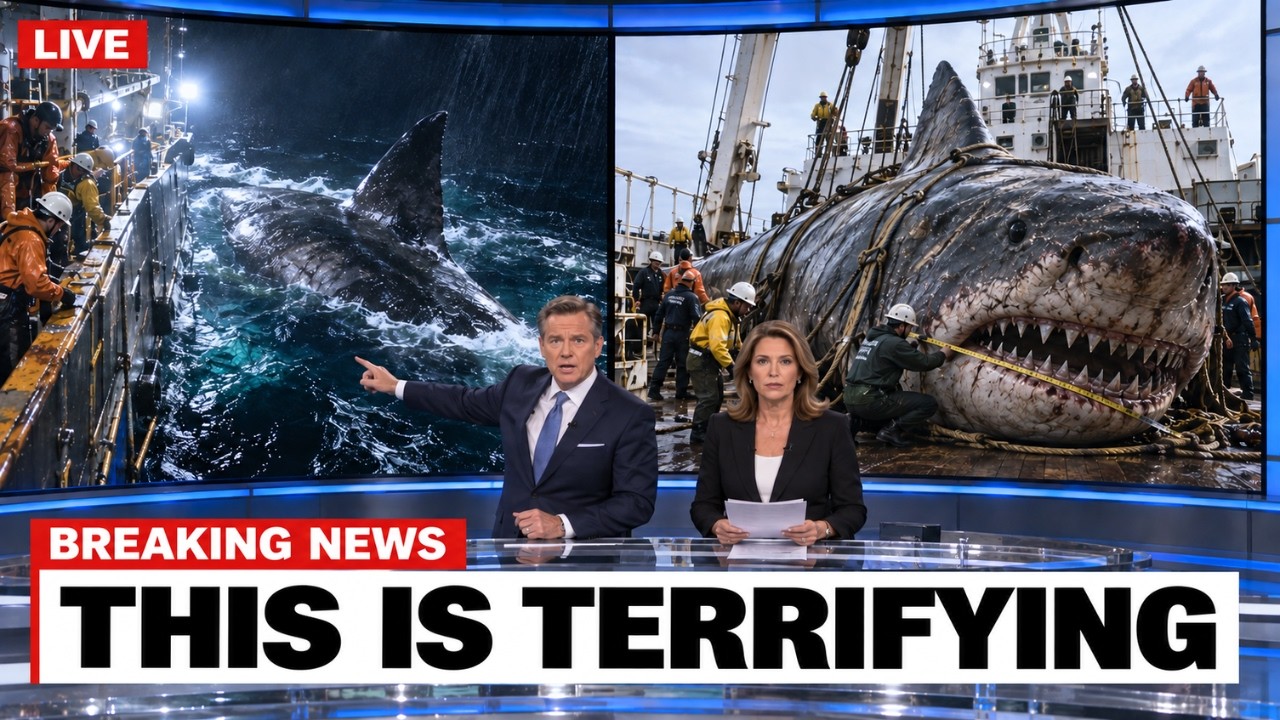
The fishermen watched in horror as a ghostly pale white head, described as being as wide as a wharf shed, emerged from the froth. In a single effortless motion, the titan clamped its jaws around the heavy wooden crayfish pots and snapped the thick hemp mooring lines like cheap string. It swallowed the entire rig, iron weights and all, before sinking back into the dark depths. The displaced water nearly swamped the fishing vessel.
The crew did not attempt to salvage their remaining lines. In a state of pure panic, they fired up the engine, abandoned thousands of dollars worth of equipment, and made a desperate run for the safety of Nelson Bay Harbor. When they hit the docks, they sat in absolute shock, visibly shaking, and refused to step back onto a boat. These were men whose livelihoods depended on daily trips to sea, yet they openly declared that something out there made the open ocean unnavigable.
Word of the incident spread quickly through the coastal communities and reached government authorities. The state’s fisheries department sent David George Stead, a prominent Australian naturalist, oceanographer, and senior official with the New South Wales State Fisheries, to conduct a formal investigation. Stead was a seasoned scientist and strict rationalist who had spent his career cataloging the marine fauna of the South Pacific.
Accompanied by a fisheries inspector, Stead traveled to Port Stevens expecting to find a group of embarrassed sailors covering up lost equipment. Instead, he found the fishermen utterly broken on the docks at Nelson Bay, sitting in a state of quiet, lingering trauma. These were tough, practical men who knew the difference between a humpback whale, a basking shark, and a great white.
When Stead interviewed each crew member separately to check for inconsistencies, their core story remained unsettlingly uniform. All of the men independently described a predator of unbelievable proportions, a ghostly pale white shark-like entity with a head as broad as a local wharf shed. When asked to estimate the creature’s total length, the panic-stricken crew compared it to the length of the Nelson Bay Pier itself, claiming it stretched anywhere from 115 feet to an almost incomprehensible 300 feet long.
Stead recognized that human perception under extreme terror is unreliable and often magnifies objects in the water. However, he could not dismiss the cold, hard physical evidence. Thousands of dollars worth of commercial crayfish gear was gone. Thick, heavy-duty hemp mooring lines had not snapped from rot or friction. They had been sheared clean or dragged down by an immense sudden downward force. The heavy wooden traps, reinforced with iron and built to withstand the punishing ocean floor, had vanished in a single moment.
Stead documented the entire encounter and eventually published the account in his 1963 book, “Sharks and Rays of Australian Seas.” In his writings, he openly struggled with the data. As a man of science, he knew that a 115-foot shark defied modern biological limits. On the other hand, he acknowledged that these hardened mariners had undeniably encountered a massive, highly aggressive marine predator that science had not properly documented. His written logs turned a local ghost story into a permanent documented mystery in Australian maritime history.
To understand what could have terrified those fishermen so deeply, you have to rewind millions of years to an era when the oceans belonged to absolute monsters. Emerging during the early Miocene epoch roughly 23 million years ago, Otodus megalodon was not just another large shark. It was the ultimate evolutionary masterpiece of oceanic apex predators. Belonging to an entirely separate extinct lineage known as the megatoothed sharks, this evolutionary line scaled up in size over tens of millions of years until it sat at the very top of the global food chain.
The validated scientific reality of megalodon is staggering. Fossilized tooth specimens measuring over seven inches along their diagonal edge allow paleontologists to estimate that fully grown adults reached lengths of 50 to 60 feet, weighing anywhere between 50 to 70 metric tons. A single adult megalodon weighed as much as a fully loaded commercial airliner, with a body mass roughly 30 times larger than the biggest great white shark ever recorded.
The key to megalodon’s dominance was its sheer unmatched destructive power. The creature possessed a gaping mouth measuring up to nearly 10 feet wide and 8 feet tall, lined with five rows of thick serrated teeth designed specifically to crush bone rather than just cut flesh. Modern computer biomechanical modeling estimates that a full-grown megalodon could exert a bite force of over 18 tons per square inch, roughly 180,000 newtons. For comparison, a modern great white tops out at around 1.8 tons of bite force, and a Tyrannosaurus Rex generated about 6 tons. Megalodon possessed enough raw crushing force to flatten a small car.
Anatomically, megalodon was built like a living biological submarine. Its skeleton was composed of dense, flexible cartilage rather than bone, allowing it to maintain dynamic agility despite its massive bulk. Unlike most cold-blooded fish, fossil evidence suggests megalodon possessed regional endothermy, the ability to keep its body temperature warmer than the surrounding water. This high-octane metabolic engine allowed it to swim faster, digest heavy meals rapidly, and hunt in both lukewarm tropical zones and cooler temperate waters across the globe.
The fossilized remains of prehistoric whales regularly show clear megalodon bite marks directly on rib cages, shoulder blades, and spinal columns. This proves megalodon actively rammed its prey at high speeds and bit directly through thick bone to crush vital organs. For nearly 20 million years, nothing in the global ocean could challenge this sovereign apex predator. Its presence dictated how marine mammals evolved, where they migrated, and how deep they dared to swim.
Fueling a 70-ton metabolic furnace required an absurd amount of daily calories. To keep its heart pumping and its core temperature elevated, an adult megalodon needed to consume thousands of pounds of blubber and meat every single day. Its primary targets were ancient baleen whales, prehistoric sperm whales, massive sea turtles, sirenians, and large pinnipeds.
Paleontologists reading the fossilized crime scenes of the prehistoric deep have unlocked the horrifying mechanics of a megalodon attack. When targeting smaller whales, megalodon would often charge directly from below, ramming the underside of the victim at full speed. The sheer kinetic impact alone was enough to shatter the whale’s skeleton or hurl it clear out of the water. Against massive adult baleen whales, megalodon played a far more brutal game of tactical disablement, deliberately biting off pectoral fins, flippers, and tails to completely immobilize them before delivering a crushing strike to the chest cavity.
Megalodon was a global nomad, patrolling vast oceanic highways spanning what is now the Atlantic, Pacific, Indian, and Mediterranean basins. Fossilized teeth have been unearthed on nearly every continent except Antarctica. However, fossil discoveries reveal that megalodon also utilized warm, shallow coastal bays as dedicated nursery grounds. Female megalodons would travel into sheltered, food-rich shallow waters to give birth to live young. Even at birth, a megalodon pup was roughly 6 to 10 feet long, larger than an adult human.
Despite millions of years ruling the marine food chain unchallenged, the king of the ocean vanished from the rock strata roughly 3.6 million years ago at the boundary between the Pliocene and Pleistocene epochs. Its downfall was not caused by a single dramatic asteroid impact. Instead, megalodon was slowly brought down by shifting planetary systems, disappearing food sources, and new evolutionary competitors.
During the late Pliocene, tectonic plate movements caused the Isthmus of Panama to rise, closing off the ancient Central American seaway and severing warm water circulation between the Atlantic and Pacific oceans. This triggered a dramatic drop in seawater temperatures and widespread global cooling. Ice caps expanded, and huge swaths of warm, shallow coastal waters that megalodon relied on for breeding grounds dried up or turned freezing cold.
Megalodon’s main food source, ancient baleen whales, adapted by evolving thick layers of blubber and migrating toward the cold, plankton-rich polar waters near the Arctic and Antarctic. Even with regional endothermy, maintaining a warm core temperature in a 70-ton body required a crushing amount of energy. Swimming into frigid polar waters to chase migrating whale pods burned far more calories than megalodon could regain from a single kill.
To make matters worse, the Pliocene saw the rapid evolutionary rise of smaller, faster, and far more adaptable marine predators. The ancestors of modern great whites were spreading rapidly, targeting the smaller marine mammals that juvenile megalodons depended on for survival. Early forms of predatory odontocetes, ancestral killer whales, and raptorial sperm whales began patrolling the seas, hunting in coordinated packs and driving juvenile megalodons to total starvation. Megalodon’s massive size, which had served as its ultimate weapon for millions of years, turned into a fatal evolutionary trap.
Science insists the book closed on megalodon millions of years ago. But the ocean’s sheer vastness keeps the door open. Over 70% of the Earth’s surface is covered by ocean, and more than 80% of the global ocean remains unmapped, unobserved, and completely unexplored by human eyes. We have better topological maps of the surface of Mars than we do of our own planet’s abyssal ocean floors.
This brings us to the concept of deep sea gigantism, a phenomenon where deep sea species grow to significantly larger physical proportions than their shallow water relatives. The giant isopod looks like a massive terrestrial pill bug scaled up to the size of an armchair. The colossal squid, which lives thousands of feet down in dark crushing depths, reaches lengths of over 40 feet with eyes as big as dinner plates.
For decades, naval operators and research vessels have picked up acoustic anomalies echoing through the ocean floor that defy easy classification. During the Cold War, underwater hydrophone networks recorded low-frequency, massive underwater sound signatures propagating across thousands of miles of deep water. Dozens of unidentified bioacoustic tracks remain unexplained in hydrographic archives.
Consider that a creature as massive as the megamouth shark, a 16-foot plankton-eating giant, was completely undiscovered by modern science until it accidentally got tangled in a US Navy vessel’s anchor chain in 1976. The idea that the ocean still hides massive secrets stops sounding so crazy.
Revisiting the Australian coast reveals that the 1918 encounter was not the only time sailors reported something massive moving below. During World War II, sonar operators recorded submerged moving contacts that generated massive echo returns. These targets moved at incredible speeds, displaying the dynamic maneuverability of a living creature. Deck lookouts on destroyers reported seeing massive dark dorsal fins cutting through the surface spray, described as standing 6 to 8 feet high.
In the 1960s, the captain of a 55-foot commercial cutter working near the Tuamotu archipelago documented a harrowing encounter in broad daylight. The crew watched a massive pale white shark glide directly alongside their vessel, nearly equal in length to the vessel itself, with a head spanning almost 12 feet across. The shark lazily circled the boat, inspected the anchor chain, and melted back down into the deep, leaving the crew too unnerved to deploy their dive gear.
Under intense physical stress, an unfamiliar 25-foot great white shark or a massive whale shark, which can reach lengths over 40 feet, can easily morph in the human mind into a 115-foot sea monster. Yet, a standard whale shark is a filter-feeding giant that glides harmlessly near the surface. It does not violently attack heavy gear or swallow iron-weighted crayfish pots whole. An albino or abnormally large great white shark could explain the aggression, but the sheer physical power required to instantly drag down thousands of pounds of commercial gear remains a massive biological question mark.
More than a century has passed since those traumatized Australian fishermen scrambled onto the docks at Nelson Bay. The ghost of the 1918 Port Stevens incident continues to cast a long shadow over modern maritime culture. The story survived because it tapped directly into a primal human fear: the realization that the deep sea holds monsters capable of turning our most advanced tools into matchsticks.
When you strip away Hollywood’s dramatic CGI and look back at the actual historical record, the core human drama of Brotton Island remains uniquely chilling. These men did not gain fame or fortune from their story. They lost their gear, forfeited their income, and faced ridicule from the press, all because they were too terrified to ever step foot on a fishing boat again. When experienced seamen choose financial ruin over returning to open water, whatever they saw was powerful enough to shatter their reality.
Whether the fishermen at Brotton Island encountered an impossibly huge genetic anomaly of a great white, a prehistoric survivor slipping through a deep water trench, or something science has yet to explain, one truth stands clear. The ocean belongs to the ocean, and we are merely temporary visitors standing at the shore’s edge.






