In 2012, while a large wildfire still burned above them, biologists entered a smoky canyon in southwestern New Mexico carrying plastic buckets and an electric fish-stunning rod. The fire, known as the Whitewater-Baldy Complex, burned roughly 300,000 acres and was the largest in state history at the time. According to New Mexico wildlife officials, it destroyed nearly half of the Gila trout population, a species found nowhere else.
Some criticized the rescue effort. Wilderness Watch, a conservation group, accused agencies of turning the first protected wilderness area in America into a fish farm for hikers. One New Mexico county banned the use of fish toxicants entirely.
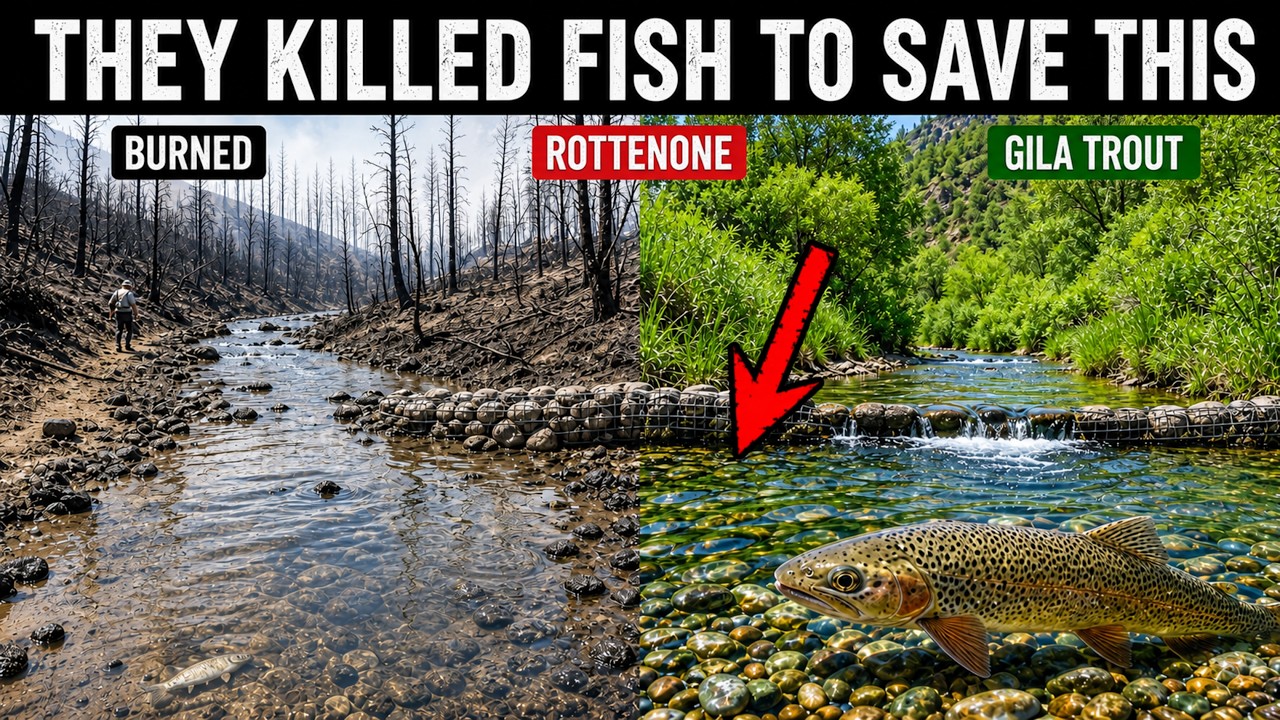
A century earlier, the Gila trout occupied about 620 miles of streams. By the 1950s, it had been reduced to four streams, and scientists had not yet given it a formal name. The 2012 rescue succeeded, barely. Biologists removed 96 fish from one lineage. Then the monsoon season arrived, and the streams they had emptied dried up anyway. A second fire destroyed two more streams. Eight of 17 populations were lost, along with 47 miles of habitat.
The program could have ended there. It did not. In the most recent official count, Gila trout occupy more streams than at any point since surveys began. The species remains listed as threatened. In July 2026, when the same mountain burned again, crews resumed recovery work within a month.
The root of the problem predates the fires. Nearly every stream in this story originates in the Gila National Forest, a three-million-acre area in southwestern New Mexico along the Arizona border. The fish survived partly because of a 1924 decision by forest service official Aldo Leopold, who persuaded his agency to leave half a million acres untouched, four decades before Congress formally endorsed the wilderness concept. Leopold’s arguments at the time concerned deer ranges and travel areas, not fish. Nothing suggests he knew those headwaters held a species science would not name for another 26 years.
The Gila trout is a relative of Pacific salmon. Genetic reconstruction suggests its ancestors moved inland from the Gulf of California and became isolated in the coldest waters available as the Southwest dried. It is a small fish, olive-green fading to gold with fine black spots, typically reaching five to nine inches. Adults live about four years, occasionally six. Females do not reproduce until age three, lay roughly 150 eggs, and may only see two spawning seasons. A single population is never more than a few years from disappearing entirely.
Three factors nearly eliminated the species. The first was land use. From the late 1800s, grazing, logging, and mining eroded slopes above the streams, sending soil into the water, widening and warming channels. People also overfished. The second factor was the stocking of non-native trout within Gila trout range, which continued from 1907 until the late 1960s. The third was what those introduced fish did once they arrived. Brown and brook trout spawn in the fall, so their young appear earlier and claim the best feeding spots before Gila trout hatch. Large brown trout eat young Gila trout directly, while rainbow trout interbreed with them. The resulting hybrids are fertile, and each generation dilutes the pure strain.
The problem extended beyond New Mexico. The range once included headwaters of Arizona’s Verde and Agua Fria Rivers. Arizona lost all its populations by the 1950s. Robert Rush Miller formally named the species in 1950. By then, only four or five streams remained. The government listed it as endangered 17 years later. Protecting the fish on paper proved to be the easy part.
Modern river management usually emphasizes reconnection: removing barriers, dropping old dams, and letting fish move again. In the Gila headwaters, recovery teams did the opposite, deliberately building barriers. Sometimes they constructed concrete walls across canyons. More often, they modified existing waterfalls to make them impassable. Biologist Dustin Myers repaired falls on the West Fork by blasting rocks at their base and turning them into a slope. One afternoon of explosives preserved 21 miles of clean habitat. The result is an island above the falls, isolated from the rest of the watershed. Everything living there must be placed there intentionally.
Before closing the barrier, teams must empty the stream of non-native fish. They use a piscicide called rotenone, derived from tropical plant roots. It prevents gills from extracting oxygen, killing anything that breathes through them. The logic is harsh but not irrational. It depends on the chemical working as intended, and in 2007 it did not. David Propst, then a native fish biologist with the New Mexico Department of Game and Fish, reported that brown trout had reappeared in the upper West Fork after treatment. A batch of antimycin, another fish toxicant, had lost potency while stored on a shelf. Some fish survived and spread back into the system. Years of work were lost because of expired chemical.
The program continued anyway because in those same years, population numbers began to move. Whitewater Creek, a 23-mile stream in a roadless area, provides a clear example. Teams of 25 to 30 workers dripped rotenone into the creek at low concentrations, and poured a sand-and-rotenone mixture into springs and seepage areas, because fish often survive treatment in groundwater. The process repeated each fall for three years; a single treatment was never enough. A second chemical added at the lower end breaks down the toxin within 20 to 30 minutes. What flows downstream is potassium, manganese, and water, all neutral substances, the same kind of chemical used in municipal drinking water treatment. Rotenone also breaks down naturally, within a day in warm water and a week in cold water.
After killing insects in a treated stream, invertebrates return within about a year, and fish are reintroduced after them. Research by Hamilton and colleagues found rotenone reduced insect diversity more than antimycin, including mayflies and caddisflies that trout eat. It also kills native dace and suckers, which teams restock manually.
The controversy was not only technical. Madeleine Carey of Wild Earth Guardians opposed the approach on principle, arguing it represented excessive management in an area specifically designated to remain wild. Jason Amaro of Trout Unlimited, based in Silver City, said he wanted the native fish back as much as anyone but described the situation as a predicament, since everyone lives downstream. Michael Ruhl, who ran the state’s native fish program, responded that rotenone had been standard practice for decades and had federal approval. The program continued.
All fish come from a single facility: Mora National Fish Hatchery, roughly 400 miles away in the Sangre de Cristo Mountains. It is the only place in the world that raises this species. Five lineages survived there. A fire eliminated two of them in the wild, and for six years the Spruce Creek lineage existed only in the hatchery tanks. It returned to a stream in 2018.
By 2006, the species covered 67 miles of water, and the U.S. Fish and Wildlife Service downlisted it from endangered to threatened. Among more than a thousand listed species, only about 56 have been moved to a lower category. By April 2022, the count reached 23 populations.
The fragility persists after the smoke clears. A burned slope stops acting like a sponge and starts acting like a roof. More runoff means more ash in the stream. More ash means less oxygen in the water, which can leave a streambed that looks healthy from the trail but holds no life beneath it.
Mineral Creek offered an unusual opportunity. A fire had burned the highlands above the stream, and rains washed the same ash mixture downstream, killing all non-native trout in the water. No permits, no detoxification stations, no public meetings were needed. The fire did the removal work for free. It took four years for the water to become clean enough for fish. In November 2016, 1,033 Gila trout were trucked eight hours from Mora, suspended under a helicopter in an aerated tank, and lowered into a stream emptied by wildfire. Andy Dean, the agency’s lead biologist for the species, called it a significant step forward.
Then came developments nobody had planned. Gila trout reproduced on their own in manually restocked streams. Anglers began fishing with free permits, 50 years after touching the fish was a federal crime. Meanwhile, the hatchery that anchored the species was quietly struggling. In 2022, only 16% of eggs reached the eyed stage, and of those that hatched, one in ten survived the year.
Daniel Gallegos returned to his hometown of Mora in 2023 to run the program. He placed fish in round tanks with a fast current that made them swim the length of their bodies per second, all day. He painted the tanks brown to mimic streambed stones, since fish raised in dark tanks grow darker. When the hatchery sent a batch to Arizona, biologists there asked about the change; earlier batches had entered the stream looking, as Gallegos put it, like a flashlight. After two adjustments, egg survival rose from 16% to 70%, and yearly survival from 10% to 91%.
The hatchery fixes the fish problem, but not the stream problem. For that work, consider Little Turkey Creek, a small stream inside the Gila Wilderness. Machinery is illegal in wilderness areas, so everything moves by mule. Jim Brooks, a retired federal fish biologist and veteran mule handler, jokes that there is a reason men like him walk with a limp. He watched 25 years of his career go up in smoke. Trout Unlimited began planning the Little Turkey Creek project in 2017. Five years passed before the first rock was moved.
Teams go twice a year. Students from New Mexico and Western New Mexico universities work with Jeff Arterburn, a professor and local chapter president. They drive a steel rod into the bank, plant a willow cutting, and move on three feet. Trout Unlimited counts about 2,600 plantings, with a survival rate around 83%. Project director Eric Head says losses came from elk and cattle eating them. No one can say when the willows will begin cooling the stream, though earlier plantings have added two feet of new growth.
On June 21, 2026, lightning struck Saguache Mountain, about 12 miles southeast of Glenwood. The resulting fire moved up through Iron Creek, through dead timber left by a 2012 fire, the same ground once again. Iron Creek was not just any stream. Between 2002 and 2013, every surviving lineage of Gila trout quietly lost genetic diversity except Iron Creek.
On July 14, biologists from the state and the Forest Service, assisted by firefighters, removed 78 Gila trout from Iron Creek and flew them to Mora. Dan Trujillo, the state’s species biologist, called it an ancient lineage, a remnant of what was once a much larger population. All fish survived the trip. The rescue reflects a pattern that began with the Divide Fire in 1989, when Main Diamond Creek became the first wild population moved to the hatchery. That arrangement ceased in 2022, when the Black Fire burned 325,000 acres, including more than 90% of the adjacent Aldo Leopold Wilderness, where scientists told reporters as few as nine populations may remain. No surveys have been published since.
A study by Williams and colleagues concluded that fire and flooding may matter more to these populations than rising water temperatures over the next 50 years. In the Gila, fires are the primary threat, arriving on a schedule no one controls.
The recovery plan defines success in specific terms: 20 populations in the Gila unit across 93 miles, 15 in the San Francisco unit across 50 miles, and four more mixed-lineage populations across an additional 25 miles. That totals 39 populations and 168 miles. Currently the species has 23 populations in 131 miles, with a target date of 2032. That goal represents only about a quarter of the 620 miles the fish once occupied. The full historical range was never the objective.
A related species offers a comparison. In 1967, Gila trout and Apache trout were listed as a single species. Five years later, scientists determined they were distinct. In September 2024, Apache trout was removed from the endangered species list entirely, the first sport fish delisted due to recovery, an effort led by the White Mountain Apache Tribe. One of the two species has reached the end of its recovery process. The other is still transported in buckets, and delisting, when it comes, will mean less than it appears. Removal from the list triggers a five-year monitoring period, and barriers will still need maintenance indefinitely. Robin Silver of the Center for Biological Diversity called the Apache delisting premature.
At a waterfall on the West Fork, the entire argument is captured in about 30 feet of river. Below the falls, brown trout and rainbow trout swim in water resembling most Western rivers. Above it lives a fish that occupied these streams before the Southwest dried. A single waterfall, two versions of the same river.
Nearly a century ago, Leopold drew boundaries inside the wilderness. Someone had to decide which side was considered wild. Certain things remain preserved only as long as someone keeps showing up with buckets. The question of when protection becomes captivity rather than rescue has no settled answer.






