A near-perfect circular sinkhole sits in the Caribbean Sea about 60 miles off the coast of Belize City. Known as the Great Blue Hole, it measures roughly 300 meters across and drops to a depth of about 125 meters. The formation lies within the Lighthouse Reef Atoll and is part of the Belize Barrier Reef Reserve System, which received UNESCO World Heritage status in 1996.
The hole is visible from orbit because of the sharp contrast between its deep blue center and the pale turquoise shallows surrounding it. It has been photographed from the International Space Station. In 2012, the Discovery Channel ranked it among the most remarkable natural sites on the planet.
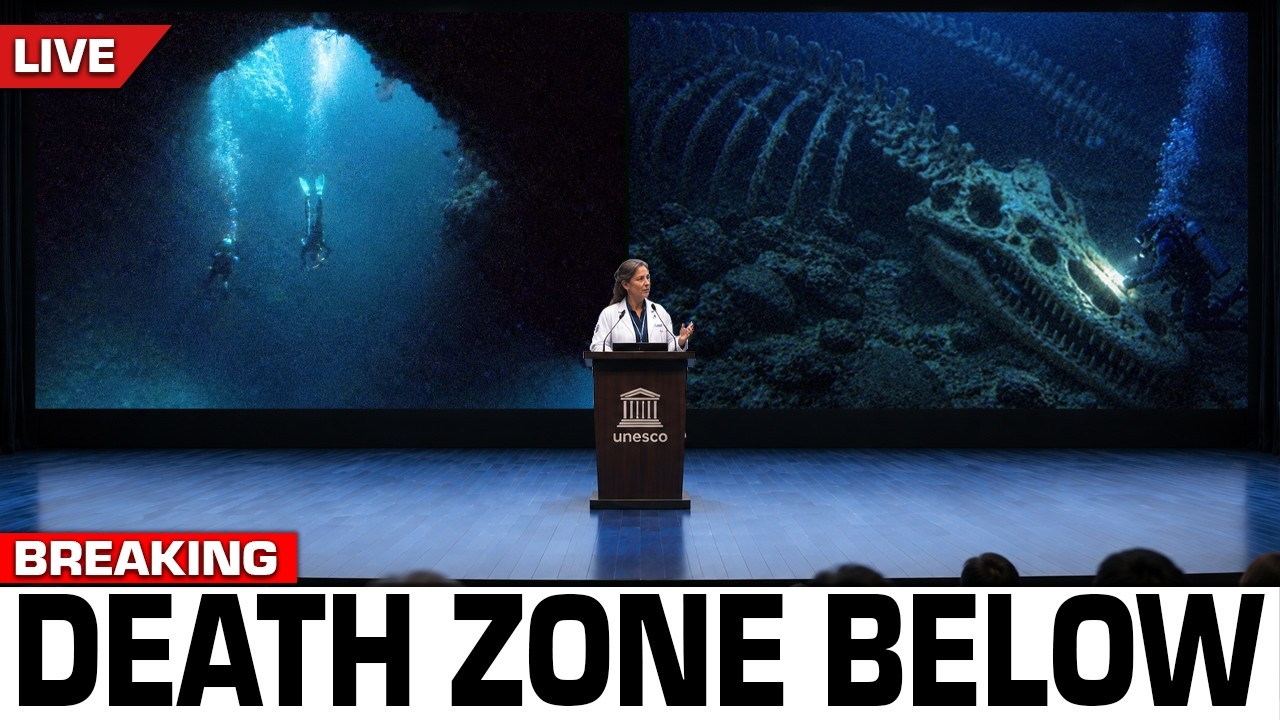
Recreational divers typically stay within the upper 130 feet of the hole, where coral formations, reef sharks, sea turtles, and tropical fish are common. The site has become one of the most popular diving destinations in the Caribbean.
The Great Blue Hole did not form underwater. Geologists have determined that it began as a dry limestone cave, shaped by slightly acidic rainwater dissolving the stone over thousands of years in a process called karstification. The same process created the cenote networks found across Mexico’s Yucatan Peninsula.
Rock and stalactite samples indicate that the cave system formed in at least four stages, tied to periods when global sea levels dropped during past ice ages. Major formation episodes occurred roughly 153,000, 66,000, 60,000, and 15,000 years ago. When each ice age ended and sea levels rose, the cave flooded from below. Eventually, the ceiling of the deepest chamber collapsed, leaving the vertical shaft visible today.
Distinct ledges at depths of about 21, 49, and 91 meters mark stages where water levels paused long enough to carve shelves into the rock. Some stalactites tilt consistently off vertical by about 5 degrees, which suggests the underlying limestone plateau shifted slightly after they formed.
Jacques Cousteau brought his research vessel Calypso to Belize in 1971 to study the Great Blue Hole for his television series. His expedition filmed submerged stalactites and retrieved physical samples, providing evidence for the cave origin theory. Cousteau reportedly ranked the site among the top ten scuba diving locations on Earth, which helped make it an internationally known destination. His team also established the commonly cited depth measurement of 410 feet.
Cousteau’s expedition did not reach the bottom of the hole. No one would attempt that for nearly five decades. The deeper sections of the hole had already become known as dangerous, and several divers had gone missing there over the years.
Below roughly 100 feet, divers breathing compressed air face a physiological condition called nitrogen narcosis. The nitrogen in the air supply becomes absorbed into the bloodstream at increasing pressure and acts like a sedative, clouding judgment and slowing reaction times. Divers experiencing narcosis may feel overly confident and continue descending past safe limits. This condition is widely considered the cause of several disappearances in the deeper parts of the hole. No centralized public count of deaths at the site has been maintained, though people involved with a later scientific expedition said they believed at least three divers had gone missing before their trip.
Scientific dives had also identified an invisible barrier at around 90 meters, roughly 295 feet down. A dense layer of hydrogen sulfide gas blankets the water at that depth. It forms when bacteria break down organic material in an environment without oxygen. Beneath this layer, dissolved oxygen levels drop to essentially zero. Almost nothing capable of active movement can survive there, and the bottom portion of the hole is considered a dead zone. The seafloor beneath the barrier contains the shells of conch and hermit crabs that wandered too far from the oxygen-rich rim.
In November and December 2018, an expedition organized by Aquatica Submarines conducted 22 dives into the Great Blue Hole. Richard Branson and Fabien Cousteau, grandson of Jacques Cousteau, joined the effort. The team used two manned submersibles and sonar equipment to build the first complete three-dimensional map of the hole’s interior. One dive was broadcast live on the Discovery Channel in December 2018, and a documentary covering all 22 dives followed in spring 2019.
The expedition documented stalactite formations near the bottom, at around 407 feet, further confirming the cave’s dry origins. The team also recorded unusual tracks along the seafloor that have not received a definitive published explanation. Branson later wrote about seeing plastic bottles resting on the floor of the hole and cited ocean plastic pollution as a concern highlighted by the dive.
At the bottom of the anoxic zone, near a field of long-dead conch shells, the submersible pilots found the remains of two human divers. The team believed these remains belonged to two people who had previously gone missing in the hole’s deeper sections. The expedition documented the locations and reported their findings to the government of Belize. The remains were left undisturbed. Erika Bergman, the chief pilot, described the discovery as finding the resting place of two people and choosing to handle it with respect. The finding provided confirmation that at least some of the missing divers had succumbed in the deep, oxygen-free environment.
Four years later, a separate research effort produced a different kind of discovery. In the summer of 2022, a team led by Professor Eberhard Gischler of Goethe University Frankfurt extracted a sediment core from the floor of the hole. The core measured 30 meters and represented roughly 20,000 years of accumulated sediment. Because of the oxygen-free conditions at the bottom, the sediment had settled in undisturbed annual layers resembling tree rings.
Researchers identified distinct bands of coarser sediment formed when storm waves carried debris from the surrounding reef into the hole. Analysis of these layers revealed 574 individual storm events preserved over a documented period of 5,700 years. This is considered the longest continuous storm record ever recovered in the Atlantic basin.
The data indicated that the frequency of tropical storms and hurricanes in the southwestern Caribbean has increased over several thousand years, tied in part to a southward shift in the equatorial low pressure zone that drives hurricane formation. The research team suggested that storm frequency in the region could rise further during the 21st century due to climate change.
The Great Blue Hole is not the deepest known blue hole. That distinction belongs to the Taam Ja’ Blue Hole in Chetumal Bay along the southeastern coast of Mexico’s Yucatan Peninsula, just across the border from Belize. Its name translates roughly to deep water. A local fisherman named Jesús Artemio Poot Villa connected researchers to the site.
A September 2021 survey measured the hole at approximately 274 meters deep. A follow-up expedition in December 2023, published in Frontiers in Marine Science in 2024, used a conductivity, temperature, and depth profiling instrument and found the hole extends to a minimum depth of 420 meters, making it the deepest confirmed blue hole anywhere in the world. Researchers have not yet located its true bottom, and some speculate it may connect to a wider network of underwater caves.
Several aspects of the Great Blue Hole remain only partially understood. The seafloor tracks recorded in 2018 have no definitive explanation. Whether the hole hosts unique microbial communities capable of surviving without oxygen remains unclear, although studies of similar blue holes in the South China Sea and the Gulf of Mexico have documented specialized bacteria that generate energy without oxygen. The exact total number of people who have died diving in the hole also remains unconfirmed.
The Great Blue Hole formed through four stages tied to past ice ages, gained international attention after Cousteau’s 1971 expedition, and contains a chemically isolated layer that prevents most life from reaching its deepest sections. The 2018 expedition mapped the hole and found the remains of two missing divers. The 2022 sediment core provided a detailed record of Caribbean storm activity over more than five millennia. The hole is not the deepest formation of its kind, and parts of its environment remain only partly documented.






