The SS Edmund Fitzgerald, a 729-foot ore carrier, sank in Lake Superior on November 10, 1975, with the loss of all 29 crew members. For nearly five decades, the exact sequence of events leading to the sinking remained a subject of debate. A 2023 expedition using an artificial intelligence-guided underwater robot has provided the most detailed examination of the wreck to date, offering evidence that points to a catastrophic failure of the ship’s watertight integrity.
The Fitzgerald was built in 1958 at River Rouge, Michigan, and was the largest vessel on the Great Lakes at the time. Designed to transport taconite iron ore from Minnesota mines to steel mills, the ship quickly became a respected and familiar sight on the lakes. Over its 17 years of service, the vessel had a strong safety record and a loyal crew, many of whom served aboard for long periods. Captain Ernest McSorley had commanded the ship with confidence in its reliability.
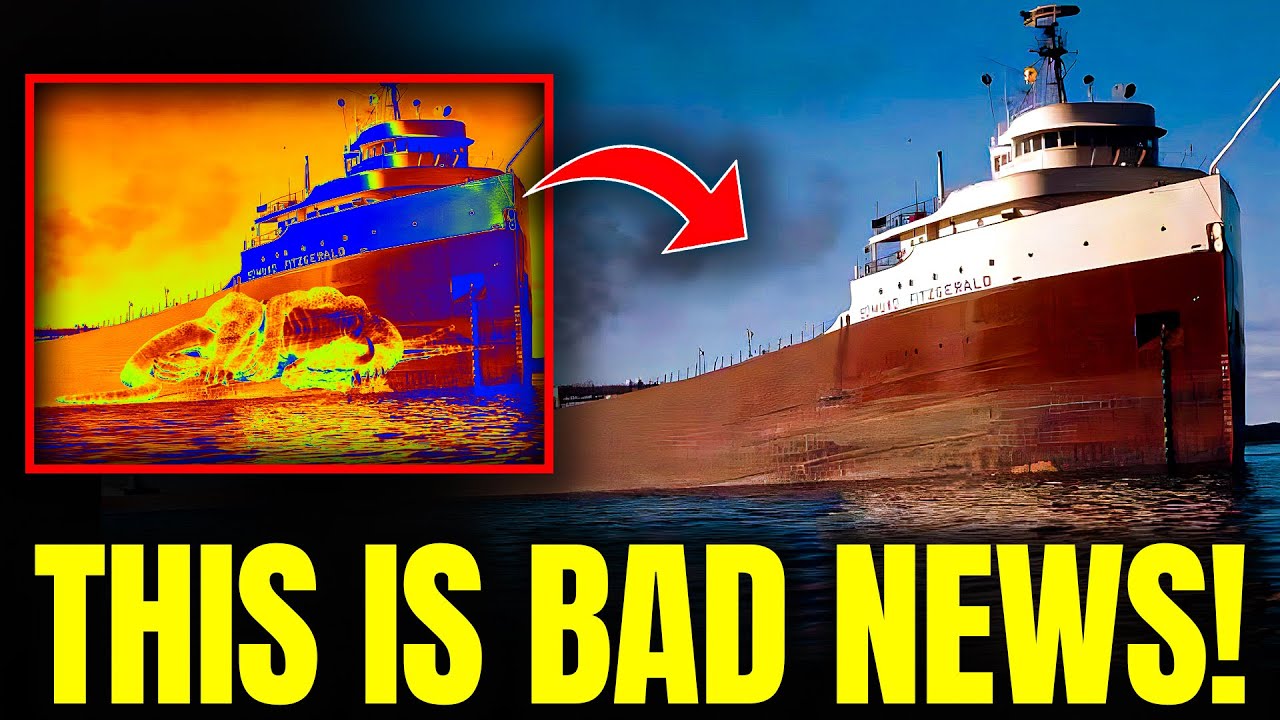
On November 9, 1975, the Fitzgerald departed Superior, Wisconsin, carrying more than 26,000 tons of taconite pellets for Detroit. Weather forecasts had warned of a powerful storm, and the ship sailed into conditions that soon became severe. Winds exceeded 70 mph, and waves climbed above 25 feet. The Fitzgerald was accompanied by another freighter, the Arthur M. Anderson, which remained in radio contact during the storm.
As conditions worsened, Captain McSorley reported that the ship was listing, had lost a vent, and that at least one hatch had been damaged. At approximately 7:10 p.m. on November 10, the Fitzgerald made its final radio transmission, stating that the crew was holding its own. Shortly afterward, the ship disappeared from the Anderson’s radar. No distress call was sent, and no flares were sighted. When the storm passed, rescue teams found debris but no survivors. The wreck was later located at a depth of 530 feet, broken into two large pieces. The bow was upright and partially buried in the lake floor, while the stern was upside down and twisted nearby, indicating a very rapid sinking.
Official investigations into the sinking produced differing conclusions. In 1977, the Coast Guard attributed the disaster to hatch cover failure, allowing water to flood the cargo hold. The crew’s families rejected this finding, feeling it unfairly suggested negligence. The National Transportation Safety Board later proposed that the ship may have broken apart on the surface. Other theories included collision with a shoal, the impact of an unusually large rogue wave, or structural weakening from years of service. For decades, the available technology limited the ability to examine the wreck in sufficient detail to resolve the question.
The 2023 expedition represented a major advance in that effort. The underwater robot was equipped with high-resolution 4K cameras, bright floodlights, multi-beam sonar, and an AI navigation system. It produced detailed three-dimensional models and enhanced imagery of the wreck, making it possible to study the ship in ways earlier submersibles could not.
The scans documented several significant findings. The ship had 462 hatch clamps, with 22 per hatch, and many of these were bent, rusted, or missing entirely. The pattern of failure was present across all hatches, suggesting a systemic breakdown rather than an isolated problem. The scans also showed that a four-inch vent pipe had broken off completely, leaving a direct opening into the cargo hold. Computer simulations indicated that water could have entered the hold at more than 4,000 gallons per minute under those conditions, which would have made the ship incapable of staying afloat for more than roughly half an hour. This would explain the absence of a distress signal and the speed of the sinking. The images also revealed signs of long-term maintenance issues, including replacement clamps and other hardware, suggesting the vessel had accumulated weaknesses over its service life.
The findings have implications beyond the Fitzgerald itself. Many Great Lakes freighters built in the same era shared similar design features, including a reliance on hatch and vent systems without robust backup seals. A single failure in those systems could create a rapid, catastrophic loss of buoyancy. Maritime experts have noted that such flooding could occur without detection by the crew until it was too late. The revelations have led to renewed scrutiny of older vessels and questions about whether regulatory oversight at the time adequately addressed these risks.
The delayed resolution of the mystery has also prompted reflection on the investigation process. The Coast Guard’s 1977 conclusion regarding hatch failure was broadly consistent with the new evidence, but it was disputed at the time, and decades passed before technology could confirm the physical details. The case has raised questions about how quickly institutions act on warnings and whether other ships of the era were ever evaluated for similar vulnerabilities.
The sinking of the Fitzgerald has long held a prominent place in Great Lakes history, remembered in part through Gordon Lightfoot’s 1976 ballad. The new evidence does not change the fundamental tragedy, but it reframes the cause. The disaster was not the result of a single dramatic event like a rogue wave, but of accumulated structural and mechanical failures that made the ship unable to withstand the storm. The crew’s families now have a clearer understanding that the crew did not make a fatal error, though the knowledge that the sinking might have been prevented has added to their grief.
The legacy of the Fitzgerald now includes a practical lesson for the shipping industry. The wreck’s condition illustrates the importance of regular inspections, rigorous maintenance, and the need to act on early signs of wear. The use of AI and modern imaging technology has also demonstrated a method for investigating historical maritime disasters with greater precision than was previously possible. The story of the Edmund Fitzgerald remains one of loss and courage, but the findings from the 2023 expedition have moved the discussion from speculation to a more grounded understanding of what happened on November 10, 1975.






