Scientists have confirmed that a four-story-high wave recorded off the west coast of Canada was the most extreme rogue wave ever officially documented. The wave, which occurred near Ucluelet, British

Scientists have confirmed that a four-story-high wave recorded off the west coast of Canada was the most extreme rogue wave ever officially documented. The wave, which occurred near Ucluelet, British Columbia, was roughly three times the height of the waves surrounding it. It did not cause any injuries or damage. Researchers at the University of Victoria analyzed the data and confirmed it was not a technical error.

Rogue waves have been part of maritime lore for centuries, but scientists only officially recognized them in 1995. That year, the Draupner wave, measuring 84 feet, struck a Norwegian gas platform in the North Sea. The platform was designed to withstand waves up to 64 feet. Since the wave did not match any known wave model, researchers formally defined a rogue wave as one that is more than twice the height of the waves around it.
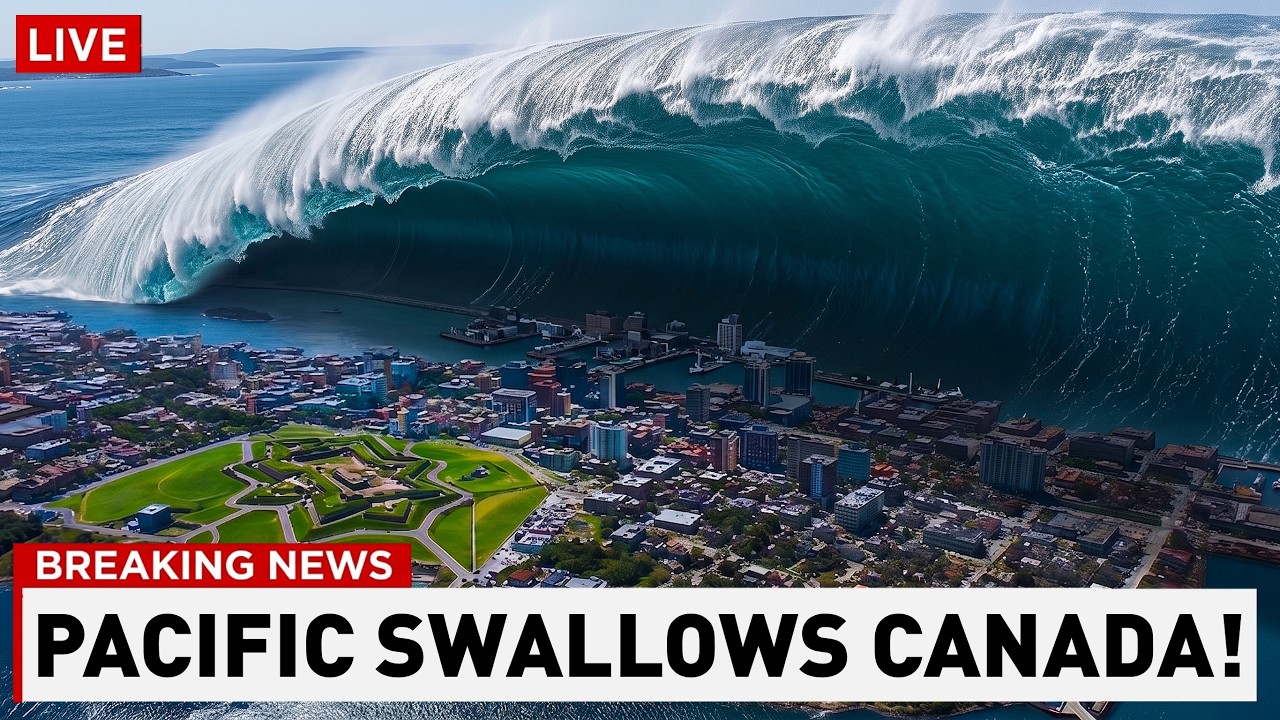
Scientists have confirmed that a four-story-high wave recorded off the west coast of Canada was the most extreme rogue wave ever officially documented. The wave, which occurred near Ucluelet, British

Rogue waves can form in stormy seas or appear in calm water without warning. They have steep sides, deep troughs, and can reach heights that pose serious risks to ships and offshore structures. In 2007, the National Oceanic and Atmospheric Administration compiled a list of 50 historical maritime disasters that were likely caused by rogue waves. One example is the 1975 sinking of the freighter Edmund Fitzgerald on Lake Superior, which some experts attribute to a phenomenon known as the Three Sisters, a sequence of three large waves.

Scientists have proposed two main explanations for how rogue waves form. The linear addition theory suggests that waves traveling at different speeds can cross paths and combine their energy into a single larger wave. The nonlinear focusing theory proposes that waves moving in groups can exchange energy, and that transfer can produce a rogue wave. A 2024 expedition to Antarctica by researchers from the University of Melbourne provided new evidence that strong winds over young waves play a significant role. The scientists used 3D cameras to track wave behavior and found that rogue waves occurred roughly once every six hours in windy conditions and did not appear in calmer seas.

In 2018, researchers recreated the Draupner wave in a laboratory for the first time. Their work showed how waves approaching from different directions can push water upward and form what is called a crosswave. Unlike ordinary waves that stop growing when they break, crosswaves can continue to grow even after breaking. The study found that waves meeting at large angles can become up to four times steeper than previously thought possible. This finding has implications for the design of offshore structures, such as wind turbines and oil platforms, which may not currently account for multidirectional wave forces.

Rogue waves are distinct from tsunamis. Tsunamis are caused by large-scale disturbances such as earthquakes, volcanic eruptions, or landslides that displace the entire water column. They are barely noticeable in the open ocean but can become destructive near shorelines. Rogue waves, by contrast, form at the surface and can appear without any seismic trigger.

Researchers have also identified a separate phenomenon called internal rogue waves, which form deep below the ocean surface. While the exact frequency of future rogue waves remains uncertain, scientists note that increased energy in the atmosphere and ocean could lead to more powerful waves in the coming years.


Related Posts

Florida’s ocean floor just collapsed, with sudden oceanic sinkholes emerging off the coast. Massive craters have opened beneath the water, swallowing sandbars and reshaping the seafloor in hours.

In late 2024, a NOAA research vessel mapping the continental shelf near the Florida Straits identified large circular depressions on the seafloor. Some of these sinkholes measured over 300 feet across and descended deeper than a 30-story building. Underwater drone footage showed sediment columns spiraling downward and water currents flowing into the voids. Researchers determined that these feature…

Deep beneath Colorado’s Mesa Verde, scientists have confirmed something startling—a sprawling network of hidden chambers and tunnels carved into the rock, untouched for centuries. For decades, researchers believed the ancient cliff dwellings were the region’s only marvel, but new scans have revealed a far larger subterranean world lurking below the surface.

In the summer of 2023, a survey team used ground-penetrating radar beneath Mesa Verde National Park in Colorado. The equipment detected something unexpected below the surface. The data suggested a network of chambers and passages under part of the mesa. The findings raised questions about the history of a site that has been studied for over a century.Mesa Verde is located in the southwestern corne…

Scientists reopened an underwater cave sealed for 40,000 years and immediately knew something was off. The ancient chamber, hidden beneath the depths, had remained untouched since the Ice Age.

In 2007, cave divers mapping underwater tunnels near Tulum, Mexico, found a large submerged chamber they named Hoyo Negro. The room, about 100 feet deep, contained scattered animal bones and a nearly complete human skeleton. The discovery led to years of research by the Mexican National Institute of Anthropology and History (INAH) and a team of international scientists.The human remains belonged t…

A 12-billion-gallon Florida lake vanished overnight, leaving stunned residents staring at a giant muddy hole. The massive Lake Jackson basin suddenly drained completely as its natural plumbing gave way.

Lake Jackson, a 4,000-acre lake just outside Tallahassee, Florida, drained into underground caves through a sinkhole in its floor over the course of several months. The lake, which once held about 12 billion gallons of water, is now largely exposed mud and sediment. The drain began in late November 2025, after months of drought in the region, and continued into early 2026. By March, vegetation was…

The Oregon coast has just been shut down by federal authorities, but they won’t say why. Divers reportedly surfaced with something from the deep that triggered an immediate, unprecedented closure.

Axial Seamount, an underwater volcano located roughly 300 miles off the Oregon coast, is showing signs that it may erupt before the end of 2025. Scientists have been monitoring the volcano closely since it last erupted in 2015, and recent data indicates the seafloor around it is inflating at a faster rate than it did before its previous eruptions in 1998, 2011, and 2015. The volcano sits along the…

Beneath Tennessee, a fault line stirs with a threat geologists call more terrifying than the legendary New Madrid zone. Scientists have long mapped the region’s seismic history, but new research reveals a hidden danger capable of producing catastrophic ground shaking across the mid-South.

A magnitude 4.1 earthquake centered near Greenback, Tennessee, rattled homes and woke residents in the region this morning. The tremor was felt as far away as Charlotte and Atlanta.The event drew renewed attention to a seismic zone beneath the Appalachian region that scientists monitor for larger potential earthquakes. The East Tennessee Seismic Zone stretches roughly 300 miles from Alabama throug…

Leave a Reply

Your email address will not be published. Required fields are marked *




