Mexico City is sinking fast, and the ground beneath 22 million people is collapsing. The metropolis extracts so much groundwater from the soft clay lakebed underneath that parts of the city are dropping about 20 inches a year.

In 2003, a fisherman in Chetumal Bay, Mexico, noticed a grouper disappear beneath the surface and later found a hidden opening in the water. More than a decade later, his son guided researchers back to the site. Initial measurements found no bottom at 425 feet, and instruments recorded warm, salty water and rising currents where they were not expected. The hole, known as Taam Ja’, has since been measured to at least 1,372 feet deep, making it the deepest known blue hole on Earth.

Blue holes are essentially ancient sinkholes that filled with water as sea levels rose. They appear as dark circular shadows from above because of their depth. Taam Ja’ is unusual because it is difficult to spot from the surface, unlike more famous examples such as the Great Blue Hole in Belize.
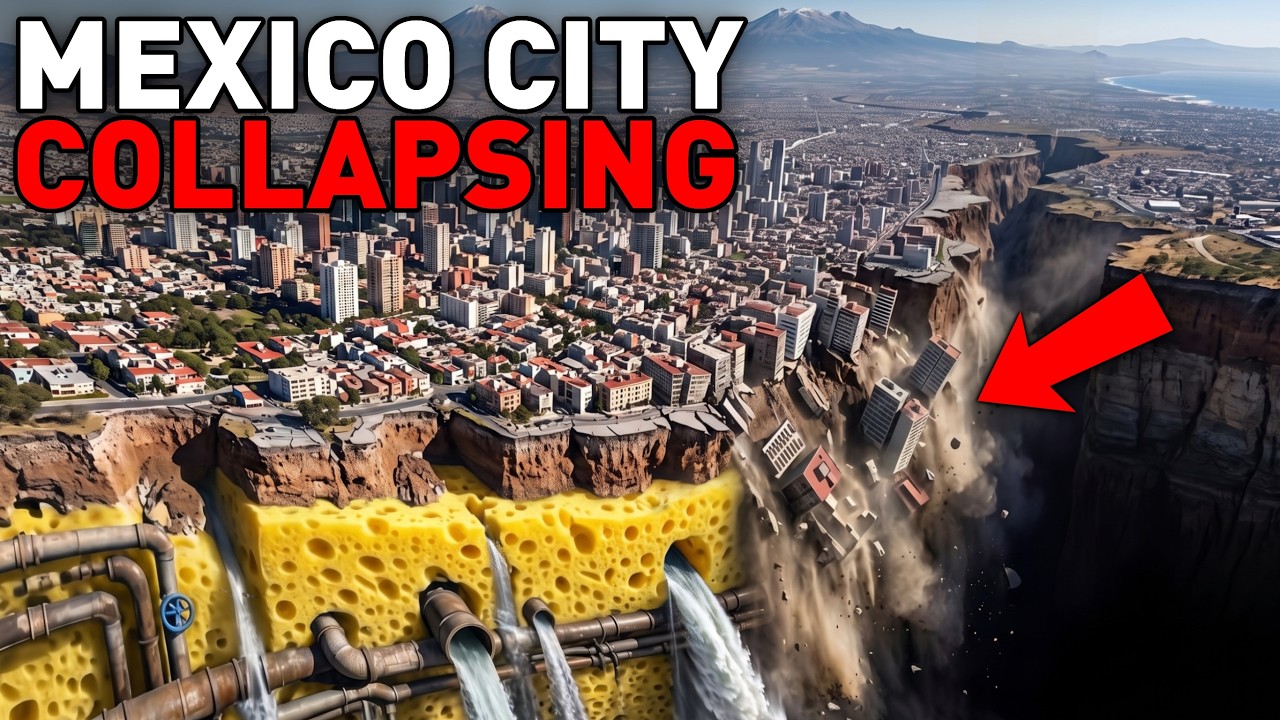
Mexico City is sinking fast, and the ground beneath 22 million people is collapsing. The metropolis extracts so much groundwater from the soft clay lakebed underneath that parts of the city are dropping about 20 inches a year.

In December 2023, researchers lowered a conductivity, temperature, and depth profiler into the hole. At around 1,312 feet, the water became warmer and saltier, with readings matching the open Caribbean Sea. This was surprising because the hole is located far inside the bay and appears horizontally isolated from the open ocean. The finding suggests the existence of subterranean tunnels or fractures connecting the hole to open seawater beneath the rock.

The region’s geology may explain this. Taam Ja’ is near the Chicxulub crater, the site of the asteroid impact about 66 million years ago that is widely linked to the extinction of the dinosaurs. The impact may have fractured the underlying rock, potentially making it easier for caves, tunnels, and blue holes to form in the area.

During an early expedition, researchers observed that the water above Taam Ja’ was calm while the rest of the bay had waves. From the center of the hole, water slowly rose upward, like a gentle spring. This occurred only once, and the behavior made diving conditions intimidating for those involved.

The deep, dark, and isolated environment raises questions about what might live there. Scientists consider it unlikely that large creatures could survive in such conditions, but microscopic life may exist. Any organisms found would likely be ancient and adapted to extreme environments. Their presence could have implications for understanding how life might survive on other worlds, such as the moons Europa or Enceladus.

Recreational divers cannot explore Taam Ja’. Standard scuba equipment only allows for depths of about 130 feet, and even professional divers rarely exceed 1,000 feet. The pressure at such depths requires specialized equipment and training. The next step is likely to send a remotely operated vehicle, or ROV, equipped with cameras and sensors.

The interior of the hole may contain side tunnels, ledges, or other features that make depth readings difficult. Scientists note that more of the ocean floor has been mapped than the interior of the Earth. Still, Taam Ja’ holds the record as the world’s deepest known blue hole for now.

Separately, a recent study from Virginia Tech examined a different kind of ground movement in the United States. The research found that land subsidence, the gradual sinking of the ground, is affecting 28 major US cities. This sinking is caused largely by the removal of groundwater, which leaves underground reserves depleted and the land above them unsupported.

New York, Dallas, Seattle, and other cities are sinking at rates of a few millimeters per year. This may sound small, but the ground sinks unevenly. If one part of a building or road sinks faster than another, the structure can become damaged. More than 29,000 buildings are located in zones considered at high or very high risk of damage.

Houston is sinking at about 5 millimeters per year, roughly twice as fast as New York. Parts of California have seen the ground drop by nearly 30 feet in some areas, causing large depressions and infrastructure problems. The problem is most severe where groundwater is heavily extracted, such as in agricultural regions of California.

Authorities have proposed solutions such as wastewater recycling and rainwater harvesting. Treating and reusing wastewater could reduce the need for groundwater, while creating green zones in cities could help absorb rainwater and return it to underground sources. These approaches would not stop the process overnight, but they could slow it down.


Related Posts

Florida’s ocean floor just collapsed, with sudden oceanic sinkholes emerging off the coast. Massive craters have opened beneath the water, swallowing sandbars and reshaping the seafloor in hours.

In late 2024, a NOAA research vessel mapping the continental shelf near the Florida Straits identified large circular depressions on the seafloor. Some of these sinkholes measured over 300 feet across and descended deeper than a 30-story building. Underwater drone footage showed sediment columns spiraling downward and water currents flowing into the voids. Researchers determined that these feature…

Deep beneath Colorado’s Mesa Verde, scientists have confirmed something startling—a sprawling network of hidden chambers and tunnels carved into the rock, untouched for centuries. For decades, researchers believed the ancient cliff dwellings were the region’s only marvel, but new scans have revealed a far larger subterranean world lurking below the surface.

In the summer of 2023, a survey team used ground-penetrating radar beneath Mesa Verde National Park in Colorado. The equipment detected something unexpected below the surface. The data suggested a network of chambers and passages under part of the mesa. The findings raised questions about the history of a site that has been studied for over a century.Mesa Verde is located in the southwestern corne…

Scientists reopened an underwater cave sealed for 40,000 years and immediately knew something was off. The ancient chamber, hidden beneath the depths, had remained untouched since the Ice Age.

In 2007, cave divers mapping underwater tunnels near Tulum, Mexico, found a large submerged chamber they named Hoyo Negro. The room, about 100 feet deep, contained scattered animal bones and a nearly complete human skeleton. The discovery led to years of research by the Mexican National Institute of Anthropology and History (INAH) and a team of international scientists.The human remains belonged t…

A 12-billion-gallon Florida lake vanished overnight, leaving stunned residents staring at a giant muddy hole. The massive Lake Jackson basin suddenly drained completely as its natural plumbing gave way.

Lake Jackson, a 4,000-acre lake just outside Tallahassee, Florida, drained into underground caves through a sinkhole in its floor over the course of several months. The lake, which once held about 12 billion gallons of water, is now largely exposed mud and sediment. The drain began in late November 2025, after months of drought in the region, and continued into early 2026. By March, vegetation was…

The Oregon coast has just been shut down by federal authorities, but they won’t say why. Divers reportedly surfaced with something from the deep that triggered an immediate, unprecedented closure.

Axial Seamount, an underwater volcano located roughly 300 miles off the Oregon coast, is showing signs that it may erupt before the end of 2025. Scientists have been monitoring the volcano closely since it last erupted in 2015, and recent data indicates the seafloor around it is inflating at a faster rate than it did before its previous eruptions in 1998, 2011, and 2015. The volcano sits along the…

Beneath Tennessee, a fault line stirs with a threat geologists call more terrifying than the legendary New Madrid zone. Scientists have long mapped the region’s seismic history, but new research reveals a hidden danger capable of producing catastrophic ground shaking across the mid-South.

A magnitude 4.1 earthquake centered near Greenback, Tennessee, rattled homes and woke residents in the region this morning. The tremor was felt as far away as Charlotte and Atlanta.The event drew renewed attention to a seismic zone beneath the Appalachian region that scientists monitor for larger potential earthquakes. The East Tennessee Seismic Zone stretches roughly 300 miles from Alabama throug…

Leave a Reply

Your email address will not be published. Required fields are marked *




