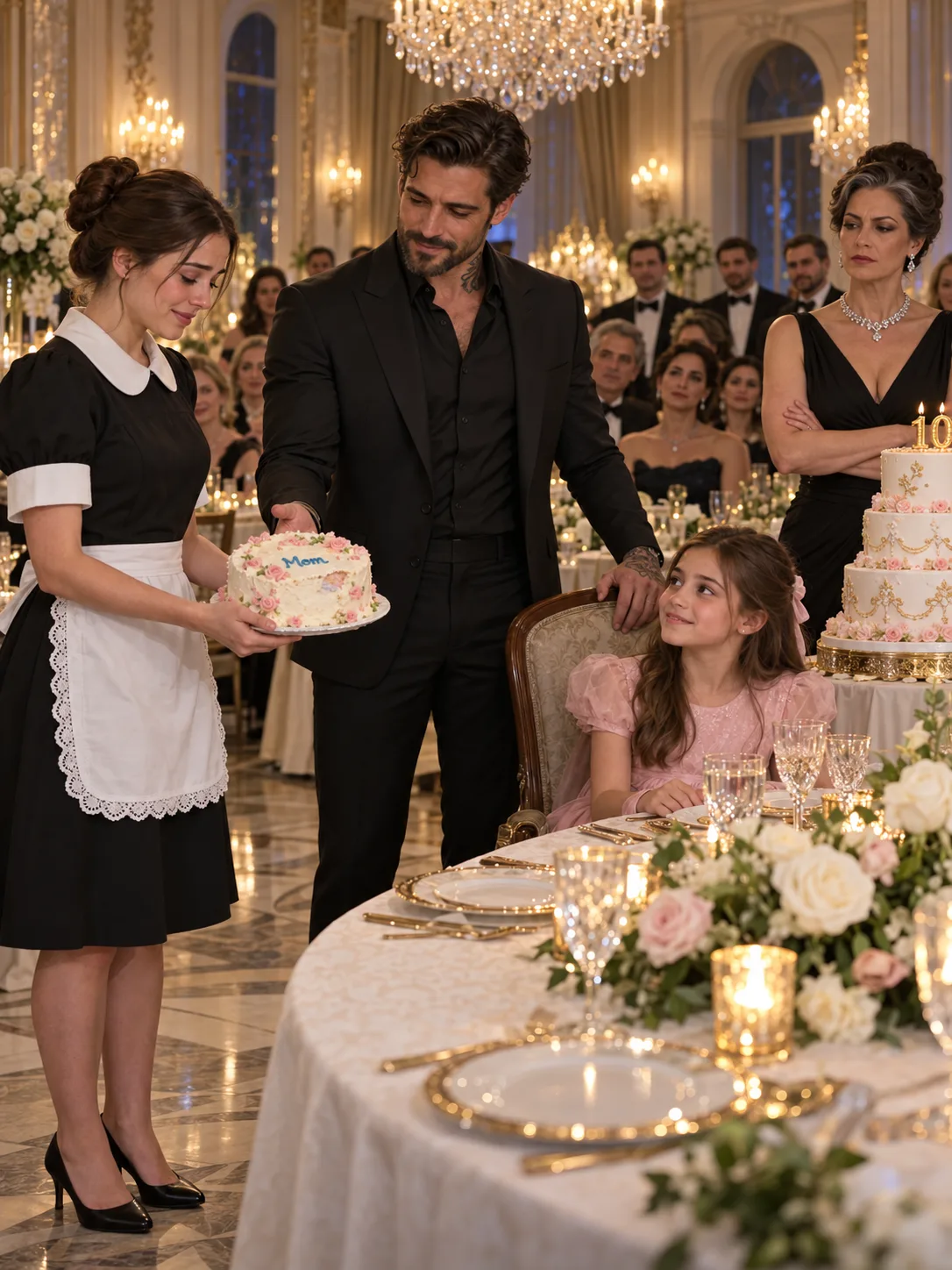
Chapter 11 – A PLACE AT HER OWN TABLE
“Then that’s exactly what you’ll do.”
Luca said it without hesitation.
I looked at him.
“You haven’t heard my conditions.”
“I heard the important one.”
He leaned back in his chair.
“You want a life that belongs to you.”
Diane smiled beside me.
I hadn’t seen her smile so openly in weeks.
But I wasn’t finished.
“I’d like to work three days a week,” I said.
Luca nodded.
“Three days.”
“I’d like my weekends.”
“Of course.”
“And I want to spend Christmas morning with my daughter.”
He looked genuinely surprised.
“Margaret, you could always spend Christmas with Diane.”
I gave him a look.
“Luca Moretti, who do you suppose has been making your Christmas breakfast since you were six?”
He thought about that.
Then he laughed.
A real laugh.
The kind I remembered from when he was a boy.
“All right,” he said. “Christmas breakfast is my responsibility.”
Diane raised an eyebrow.
“Can you cook?”
“Grilled cheese.”
“That’s not breakfast.”
“It is if you get up late enough.”
For the first time since that terrible dinner, I laughed without feeling guilty.
We spent the afternoon reviewing the new agreement.
Not because I distrusted Luca.
Because I’d learned that affection and accountability weren’t the same thing.
The agreement protected my original service date and benefits.
My duties would be limited to three days each week, focused on training, household coordination, and mentoring the younger employees.
An independent administrator would oversee compensation and service benefits.
Employees would receive copies of their records annually.
And decisions affecting their employment would require a written explanation and a fair opportunity to respond.
Luca signed the agreement.
Then he slid it across the desk.
I read it once more.
Diane waited patiently beside me.
Finally, I picked up the pen.
For a moment, I thought about the paper Vanessa had pressured me to sign.
The one I’d been told was necessary to collect money I’d already earned.
I’d signed that document because I was afraid.
This time, I wasn’t afraid.
I wrote my name carefully.
Margaret Sullivan.
No false identity.
No borrowed signature.
No promise that required me to disappear.
Luca examined it.
Then he held out his hand.
“Welcome back, Margaret.”
I shook it.
“Thank you, Mr. Moretti.”
He groaned.
“Please don’t start that again.”
“Old habits.”
“Apparently we’re changing those too.”
Over the following weeks, the household gradually found its rhythm.
Mrs. Carter’s benefits were formally restored.
John was able to continue his physical therapy without interruption.
Mr. Evans received a new agreement protecting his right to remain in the grounds cottage after retirement.
Rosa and Angela were credited for every year they’d worked.
Their retirement funds were independently verified.
They eventually signed the lease on the little apartment with the balcony.
Rosa showed me the floor plan three times.
I pretended not to notice that she cried every time.
The other employees received the same protections.
Not because Luca wanted people praising him for his generosity.
Because the family had made promises.
And promises, once made, needed to be kept.
Bellini House found a different kind of future.
After reviewing its finances, the nonprofit organization agreed to take over operations through a supervised restructuring.
The arrangement required new financial oversight, a sustainable operating budget, and an end to Vanessa’s control of the residence’s money.
Several local donors contributed to a temporary fund that helped keep the elderly residents in place during the transition.
Luca made a disclosed contribution through a separate charitable account.
No household retirement funds were involved.
The residents remained in their rooms.
Vanessa’s father remained in the room he knew.
I was told that he still asked about his wife some mornings.
Vanessa sat with him when he did.
She didn’t try to convince him that everything was fine.
She simply stayed.
I thought about that more than once.
Vanessa had done something terribly wrong.
Her fear of losing her father’s home had nearly taken away the security of people who had spent their lives working for another family.
What happened to her legally would take time to resolve.
Luca didn’t attempt to make the investigation disappear.
And he didn’t pretend their engagement could be repaired with an apology.
But he did allow one thing.
When Vanessa asked whether she could send personal letters to the affected employees, he told her the choice belonged to them.
Mrs. Carter declined.
Mr. Evans accepted his but didn’t answer.
I received mine on a Thursday afternoon.
It was four pages long.
Vanessa didn’t blame the bank.
She didn’t blame the consultant.
She didn’t blame being frightened.
She acknowledged what she’d done to me.
At the end, she wrote:
I treated your years of service as something to erase because they reminded me of what I couldn’t control. You deserved respect. I hope one day I can become someone who gives it without being asked.
I folded the letter.
I didn’t write back immediately.
Forgiveness wasn’t something I wanted to offer simply to make everyone comfortable.
But I kept the letter.
Sometimes that was enough for a beginning.
A month after the postponed wedding, Luca invited the household employees and their families to dinner.
Nothing extravagant.
No two hundred guests.
No society photographers.
Just the people who had shared the family’s ordinary days.
There were flowers on the tables, candles in the windows, and a large lemon cake waiting on the sideboard.
I arrived with Diane.
I wore my navy dress.
The little pearl buttons shone beneath the chandeliers.
For a moment, standing in the doorway, I remembered Vanessa ordering me to change.
I remembered the heat in my cheeks.
The forty people pretending not to hear.
The feeling that thirty-one years of my life had suddenly become something shameful.
Then Luca saw me.
He smiled.
“Margaret.”
“Hello, sweetheart.”
He walked toward us.
“You look beautiful.”
“It’s just a dress from Macy’s.”
“Then Macy’s did a wonderful job.”
He offered Diane his arm and walked us toward the table.
Mrs. Carter was already seated beside her husband.
Rosa and Angela were arguing cheerfully about which of them would get the larger piece of cake.
Mr. Evans was telling a story about Luca getting his bicycle stuck in the rose bushes when he was eight.
Luca protested that the story had been exaggerated.
Mr. Evans insisted it hadn’t.
I laughed.
Then I noticed the place cards.
Mine was beside Luca’s.
But there was something underneath it.
A small envelope.
I opened it.
Inside was a handwritten note.
Margaret,
When my mother died, I thought the best way to honor her was to keep everything exactly as she’d left it.
I was wrong.
She didn’t want a house preserved like a museum. She wanted the people inside it to have good lives.
Thank you for helping me understand the difference.
Love, Luca.
I looked up.
He was watching me.
For a moment, I couldn’t speak.
Then I reached into my handbag.
I’d brought something for him too.
His mother’s brass kitchen watch.
He looked startled.
“Margaret, I can’t take that.”
“Yes, you can.”
“She gave it to you.”
“And I’ve worn it for nearly fifteen years.”
I turned it over so he could read the inscription.
For all the hours given.
“Your mother gave me this because she wanted me to remember that my time mattered,” I said.
I closed his fingers around it.
“I think you understand that now.”
His eyes filled.
“Margaret—”
“You keep it, sweetheart.”
He nodded.
Then he hugged me.
Not the careful, formal embrace he’d given me at public celebrations.
The way he’d hugged me when he was little and came home frightened after his first day of school.
I held him for a moment.
Then Diane came beside us.
“Mom,” she said gently, “your chair is waiting.”
I looked at my daughter.
She’d been patient with me.
Even when she felt I gave too much of myself to another family.
Now we had Sunday dinners planned.
A weekend trip to the coast.
And a small garden behind her house where I’d promised to help her grow roses.
I still loved the Moretti family.
I always would.
But I no longer needed to prove it by giving them every hour of my life.
Luca pulled out my chair.
I sat down.
My daughter took the seat beside me.
Around us, the people who had spent years caring for this family were laughing, eating, and talking about their own futures.
Nobody was wearing a uniform.
Nobody was waiting to be dismissed.
Luca raised his glass.
“To my mother,” he said.
A few people murmured her name.
“And to the people who made this house a home.”
I looked around the table.
At the faces I’d known for decades.
At the younger ones who would carry on when we retired.
At my daughter, who reached beneath the table and squeezed my hand.
For thirty-one years, I’d believed belonging meant being needed.
I’d confused devotion with duty, and duty with the fear of disappointing someone.
But I knew better now.
A home wasn’t a place where you had to earn your chair every day.
It was a place where you could sit down without asking permission.
Luca looked at me.
“Margaret, would you like to say something?”
I glanced at the lemon cake.
Then at the people waiting around the table.
“Yes,” I said, smiling.
“First, somebody please cut that cake before Mr. Evans tells another embarrassing story.”
Everyone laughed.
“And second—”
My voice softened.
“Thank you for saving me a seat.”
Luca shook his head.
“No, Margaret.”
He took my hand.
“Thank you for finally letting us understand that you always deserved one.”
And when dinner was over, I didn’t clear the plates.
I didn’t fold the napkins.
I didn’t check the kitchen or count the silverware.
I put on my coat, took my daughter’s arm, and went home with her.
On Sunday morning, we would have breakfast together.
For once, there was nowhere else I needed to be.
THE END.
Share