In the skies over Vietnam, American pilots faced a deadly dilemma: how to hit a target without risking their lives in the process. The year was 1972, and the AGM-65 Maverick had just arrived—a weapon that promised to change everything. But would it live up to the hype?
Before the Maverick, there was the AGM-12 Bullpup. “It was an admirable weapon, but its flaws were glaring,” one pilot recalled. The Bullpup required pilots to fly straight at the target, guiding it via a joystick while exposed to enemy fire. The 250-pound warhead was limited, and the time spent guiding it was a death sentence. “You had to stay on course, and that made you a sitting duck,” another veteran explained.
The Pentagon knew they needed something better. By the late 1960s, the U.S. Air Force and Navy were pouring money into precision-guided munitions. Laser guidance was one path, but another—electro-optical guidance—promised even greater potential. “The idea was simple: lock onto a target, fire, and forget,” an engineer involved in the project said. Two systems emerged: the Navy’s Walleye and the Air Force’s GBU-8. Both were effective but limited by their need for direct overhead attack.
Then, in 1965, the Air Force funded a competition for a new missile. Hughes and Rockwell submitted designs, and by 1966, Hughes won with its ZAGM-65A. “The contract was worth $95 million, with plans for 17,000 units,” a defense official noted. The missile was small—less than 2.5 meters long—and carried a 126-pound warhead. Its electro-optical camera fed a TV screen in the cockpit, allowing the pilot to lock onto a target and fire.
On September 19, 1969, the first unguided launch from an F-4 Phantom took place. Just three months later, a guided test scored a direct hit on a tank in the New Mexico desert. “The accuracy was astonishing—a circular error of just 1.5 meters,” a test engineer recalled. By 1972, the Maverick was in service, and it was rushed to Vietnam.
In the heat of combat, the Maverick proved its worth. “We fired about 30 of them before the ceasefire,” a Phantom pilot remembered. “The hit rate was incredible—80 to 90 percent.” But it wasn’t perfect. Smoke, fog, and low light degraded the TV image, and the missile’s single focal length made targeting difficult unless the pilot got dangerously close.
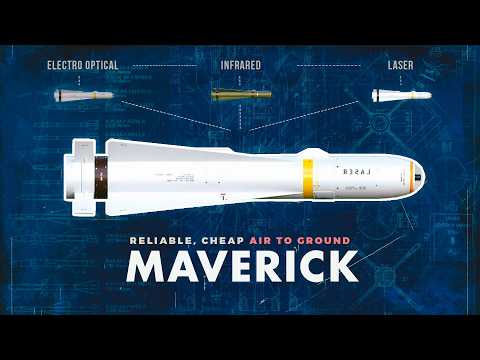
The lessons from Vietnam and the Middle East would lead to a series of upgrades—the 65B with magnification, the 65D with infrared imaging, and the 65E with laser guidance. Each variant addressed a weakness, and each would prove its mettle in conflicts to come. But the story of the Maverick was just beginning.
By the mid-1970s, the Maverick had already seen limited combat in Vietnam and the Yom Kippur War, where Israeli Phantoms fired roughly 100 missiles with surprisingly high hit rates. “In favorable conditions, it performed brilliantly—80 to 90 percent hits,” an Israeli pilot later recalled. But those same conditions exposed the weapon’s Achilles’ heel: the TV seeker struggled in smoke, haze, and low light, and the 65A’s single focal length forced pilots to get dangerously close before locking on.
The answer came in 1975 with the AGM-65B. “We added a magnification mode—what we called the ‘zoom’—and it changed everything,” a Hughes engineer explained. The B model kept the same warhead, fuze, and most internal components, but the narrow field of view let pilots acquire targets from farther away, reducing their exposure to enemy fire.
Still, the Air Force wanted more. In 1977, they ordered a seeker that could see through bad weather and darkness. The result was the AGM-65D, which swapped the TV camera for an imaging infrared sensor. “It nearly doubled the detection range and worked at night,” a program officer noted. The D model also introduced the smaller SR-114 smokeless motor, which became standard on all later variants.
Meanwhile, the Marine Corps had their own requirement: a missile to crack hardened targets. Their answer was the AGM-65E, fitted with a 300-pound blast-fragmentation warhead and a laser seeker. “It was a completely different beast, but it did exactly what the Marines wanted,” a Pentagon source said. Delivered in 1985, the E model used the sturdier LAU-117 rail and would soon prove itself in Desert Storm.
The success of the E variant spawned two more: the Navy’s 65F, combining the heavy warhead with infrared guidance for maritime and land targets, and the Air Force’s 65G, which paired a refined IR tracker with the same penetrating warhead. “We were taking proven pieces and mixing them into new configurations,” an engineer recalled. “It was modular warfare.”
Then came 1991. During Operation Desert Storm, more than 5,000 Mavericks were fired—from F-16s, A-10s, and Marine Harriers. “The Warthog alone launched thousands,” a maintenance chief remembered. In the clear desert skies, the old TV-guided models performed superbly, with hit rates between 80 and 90 percent. The IR versions excelled at night but proved less effective in daylight.
The Air Force responded with the AGM-65H, returning to a daytime optical seeker but replacing the old analog TV camera with a digital CCD sensor. “The image clarity was night and day,” a test pilot said. The H model kept the 125-pound shaped-charge warhead and impact fuze but benefited from the improved electronics of later variants.
The final major variants—the 65K and 65L—arrived later. The K was essentially an upgraded G with a CCD sensor, while the L combined the laser seeker of the E with a new tracker optimized for fast-moving targets. “The L was the last of the line,” a Raytheon official confirmed. By 1999, full-scale production had effectively ended, though limited batches continued.
In the decades since, the Maverick has remained in service with more than 35 air forces, including Australia’s. “Over 75,000 have been built—more than any other U.S. precision-guided missile,” a defense analyst noted. It is no longer a frontline weapon in high-threat environments, but in permissive skies, it remains a cheap, reliable, and devastatingly accurate tool.
What made the Maverick great was never raw sophistication. “It was versatile, affordable, easy to employ, and accurate enough,” one of its original designers reflected. The engineers of the 1960s took a promising but unproven technology and refined it with ruthless practicality. Few modern weapons can boast such a combat record from their very first day.
As the 1990s drew to a close, the Maverick’s production lines fell quiet, but its story was far from over. The weapon that had once been rushed to Vietnam as a technological marvel had become a staple of Western air power—a reliable tool in an era of increasingly complex precision munitions. “It was the workhorse that never got the glory,” a retired Air Force planner reflected. “The F-117 got the headlines, but the Maverick did the dirty work.”
That dirty work would come again. In the Balkans, NATO aircraft employed Mavericks against Serbian armor and bunkers, often in conditions that would have defeated the original 65A. The infrared seekers of the D and G models cut through the smoke and haze, while the laser-guided E proved devastating against hardened targets. “We trusted it because we knew what it could do,” a Marine Harrier pilot said. “It wasn’t flashy—it just worked.”
By the early 2000s, the Maverick had entered its fifth decade of service. Newer weapons like the Joint Direct Attack Munition and the AGM-158 JASSM offered longer range and greater flexibility, but they came with a price. “A JDAM costs tens of thousands of dollars and needs a GPS signal,” a defense analyst explained. “A Maverick costs a fraction of that and doesn’t care if the satellites are jammed.”
That affordability and independence made the Maverick indispensable in the low-intensity conflicts that defined the post-9/11 era. In Iraq and Afghanistan, F-16s and A-10s used it to destroy insurgent hideouts, vehicles, and weapons caches. “When you need to put a warhead through a specific window, the Maverick is still one of the best options,” an A-10 pilot noted. “It’s precise, it’s proven, and it’s already on the rail.”
But the battlefield was changing. The rise of sophisticated air defense systems—from Russian-made S-400s to improvised drone swarms—made the Maverick’s short range a liability. “You can’t fire a Maverick from 20 miles away,” a Pentagon strategist admitted. “You have to get close, and that’s a problem in contested airspace.”
Raytheon, which had absorbed Hughes’ missile division, proposed upgrades. A new datalink would allow in-flight retargeting. An improved seeker could see through camouflage and decoys. But the funding never materialized. “The Air Force had moved on,” a Raytheon engineer said. “They wanted stealth and standoff, not a 1960s design with a new coat of paint.”
Yet the Maverick refused to fade quietly. In 2011, during Operation Odyssey Dawn, Norwegian F-16s fired Mavericks against Libyan government forces. In 2014, Iraqi F-16s used them against ISIS convoys. In 2022, Ukrainian forces reportedly received AGM-65s—though which variants and in what numbers remained a closely guarded secret. “It’s the perfect weapon for a desperate fight,” a NATO advisor observed. “Cheap, available, and easy to use.”
That ease of use had always been the Maverick’s quiet genius. Unlike more complex systems, it required minimal training. A pilot could lock on, fire, and break away in seconds. “We called it the ‘fire-and-forget’ missile for a reason,” a former instructor said. “You didn’t need a PhD to use it. You just needed to know which button to press.”
As the 2020s unfolded, the Maverick’s future grew uncertain. The U.S. military had long since stopped buying new ones, and the remaining stockpiles were aging. “We’re cannibalizing old rounds to keep others flying,” a maintenance officer admitted. “Eventually, we’ll run out.”
But for now, the Maverick endures. It remains in the arsenals of more than 30 nations, from Australia to South Korea to Poland. It has been integrated onto drones, helicopters, and even ground launchers. “It’s the AK-47 of precision missiles,” a defense journalist wrote. “Not the best, not the newest, but always there when you need it.”
And perhaps that is the Maverick’s true legacy. It was never the most advanced weapon in the sky. It was never the fastest or the longest-ranged. But it was the first—the first to let a single pilot lock onto a tank, fire, and turn away. The first to prove that precision-guided munitions could be affordable and reliable. “The engineers in the 1960s didn’t set out to build a legend,” one historian concluded. “They set out to build a tool. And they built one that lasted.”
Today, the Maverick’s story is one of quiet endurance. It outlasted the Cold War, adapted to the deserts of Iraq, and even found its way into the hands of Ukrainian pilots defending their skies. “It’s not a miracle weapon,” a veteran pilot said. “It’s just a good one that refuses to die.”
Its legacy is written in the numbers: over 75,000 built, more than any other U.S. precision-guided missile. But its true impact is measured in lives saved—pilots who fired and turned away instead of flying into a hail of flak. “The Maverick gave us a chance to come home,” one recalled.
As newer weapons take to the skies, the old AGM-65 still sits on the rails of A-10s and F-16s, waiting for its next call. It may not be the star of the show, but it remains the reliable workhorse that never asks for glory. “You don’t retire a tool that still works,” a maintenance chief said with a shrug.
So the Maverick flies on—a 1960s idea that refused to grow obsolete. And as long as there are targets to hit and pilots to protect, it likely will. What’s your favorite underappreciated weapon of the Cold War? Let us know in the comments below.
Report this article
Select a reason for reporting:






