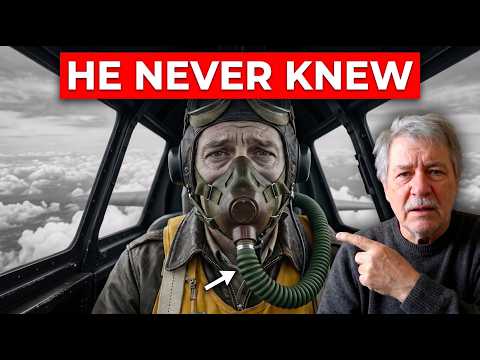
The B-17 crossed the English coast with both right wing engines sputtering, flak damage peppering the fuselage, and the pilot dead in his seat. No blood. No burns. No penetrating wound. Just a frozen oxygen hose connector at the mask fitting—the third such incident in two weeks.
The flight surgeon who climbed into that cockpit knew something was terribly wrong. The aircraft was airworthy. The equipment was certified. The pilot had been healthy at briefing. Whatever killed him hadn’t started over Germany—it had been waiting in the thin, freezing air at 28,000 feet.
This was the autumn of 1943, and across the scattered bomber groups of East Anglia, men were dying in intact aircraft without a visible mark on them. The Eighth Air Force’s daylight precision bombing campaign required crews to cruise at altitudes where the atmosphere holds only a third of the oxygen at sea level. Every crew position carried an oxygen mask connected to a central supply. The system existed. Whether it reliably functioned under the brutal conditions over Germany was the question forcing itself onto Colonel Malcolm Grow’s desk.
The standard A-12 continuous-flow mask delivered oxygen at a constant rate, depleting supply faster than a system calibrated to actual breathing. On a 9- or 10-hour mission, the margin at high-demand positions could become genuinely uncertain. That concern drove the transition to the A-14 diluter-demand mask, which released oxygen in proportion to each breath. The Aero Medical Laboratory at Wright Field tested it thoroughly—in a pressure chamber at room temperature. Those conditions did not include the -40°F to -50°F temperatures operational crews encountered at altitude.
At those temperatures, rubber stiffens. The A-14’s demand valve relied on a thin rubber diaphragm sensitive enough to detect the pressure differential of a single inhalation. In the lab, it performed perfectly. Over Germany in November, that same rubber lost its sensitivity. The mask looked intact. The hose appeared undamaged. Every check available to a man inside the aircraft said the system was functioning. But the demand valve had silently stopped responding to breath with sufficient flow—and the man at that position was breathing against a mechanism that was no longer providing what he needed, with no indication that this was occurring.
There was a second failure mode, simpler to explain. Every exhalation carries moisture. At altitude, that moisture freezes on contact with the first cold metal surface it reaches—the fitting connecting the rubber hose to the face mask. Ice formed where no external inspection could detect it. A partial blockage was sufficient. It reduced oxygen delivery below the crew member’s actual physiological need. The mask remained sealed. The hose stayed connected. The fitting appeared intact from any angle available for visual check. The ice had been building incrementally since before the aircraft reached the enemy coast, consolidating while the aircraft held altitude over Germany, reaching critical restriction with hours of flight remaining.
The problem was invisible at the command level because of how the Eighth Air Force was organized. Each bombardment group had its own flight surgeon who investigated unexplained medical incidents and filed reports into that group’s medical records—independently maintained, with no aggregation mechanism connecting them to records at other groups. From inside a single group, three unexplained deaths across several weeks was troubling. Across dozens of groups over a year, it was a pattern. But the pattern required someone positioned above the group level with access to all the records and a mandate to look across all of them simultaneously. That analytical function did not exist through most of 1943.
The classification system added another layer. Every air crew death required formal attribution: enemy action, accident, other causes, or undetermined. A pilot found dead in an intact cockpit after a mission with no direct combat hit presented a genuine classification problem. Undetermined was the honest designation. In other cases, combat stress appeared as the most medically defensible category. The deaths accumulated in the category built to absorb what the system could not otherwise explain—and the system had not yet been constructed to look for what was actually producing them.
Those cases had a specific character that the people who encountered them remembered. A tail gunner who failed to respond on intercom as the aircraft descended through 15,000 feet on the return leg. A ball turret operator found unresponsive when a crew member attempted physical contact after crossing back over the channel. A pilot on autopilot whose responses to crew intercom grew slower in ways no one could identify as anything other than fatigue. The correlating factors—the altitude, the mission duration, the specific position in the airframe, the crew station temperature, the season—were not available to any flight surgeon looking only at his own group’s incident record. What each surgeon saw was individual, unexplained, and medically frustrating. What existed across all of the records together was unmistakable. Nobody was looking at all of them together.
The Germans, watching American formations from their fighter cockpits, were drawing their own conclusions from behavior they could not fully explain. Luftwaffe after-action reports from 1943 noted what several characterized as abnormal formation discipline on certain long-range missions—aircraft lagging behind assigned positions, drifting laterally, or failing to reconsolidate after fighter attacks with the crispness those crews had shown on shorter operations at lower altitudes.
The attribution in these assessments was crew inexperience and insufficient operational maturity at sustained high-altitude formation flying. Captured airmen processed through interrogation facilities occasionally mentioned oxygen trouble, and interrogators filed those references under routine equipment complaints—a category that generated no analytical follow-up. The German observations were grounded in real behavior. Their interpretation, training deficiency, was the most logical explanation available given what they could see. That the actual mechanism was a rubber diaphragm stiffening in an unheated gun position was information no German intelligence file could contain. It barely existed in organized form on the American side until the investigation was conducted.
The physics of the failure explained why the deaths were so difficult to attribute correctly, and why the pattern required more than a year of accumulation before it generated a formal investigation. Oxygen deprivation at altitude does not announce itself to the person experiencing it. The subjective sensation accompanying the early stages of hypoxia is not distress or alarm. It is characteristically a mild euphoria—a diffuse sense of physical warmth and comfort that most people, including air crew briefed on the symptoms, did not reliably recognize in themselves as a medical emergency.
As arterial oxygen saturation continued to fall over subsequent minutes, motor coordination degraded progressively. Reaction times lengthened. Mental processes requiring sequential reasoning—reading an altimeter correctly, interpreting a course correction, responding to an interphone call from another crew station—became progressively unreliable in ways the affected person had diminishing capacity to detect. What made this specifically lethal in the cockpit was a physiological paradox. The cognitive function required to recognize one’s own progressive impairment was the first cognitive function impaired. A man losing oxygen at altitude felt capable and comfortable, and felt that with increasing certainty as his actual capacity declined.
On a B-17 with ten crew members, each managing a separate sector and equipment set in a combat environment demanding simultaneous attention to instruments, formation position, interphone traffic, and one’s own oxygen status, detecting that the pilot was responding with unusual delay was not straightforward. The autopilot held the aircraft on heading. The formation maintained its track. The pilot deteriorated in stages that produced nothing visible until the responses stopped.
The Eighth Air Force’s institutional response to individual incidents as they were reported was neither negligent nor adequate. Colonel Grow, as chief flight surgeon, had documented authority to investigate individual cases and recommend groundings for specific crew members. He did not have authority to suspend use of a certified oxygen system pending independent evaluation. Requesting a command-level review required both the medical evidence to justify the question and the institutional leverage to force it into a command environment under severe concurrent pressure.
October 1943—the month of the second Schweinfurt raid, sixty bombers and six hundred men in a single day—was not a moment when the Eighth Air Force’s command structure could absorb an additional request to restrict operations pending medical review of certified equipment without extraordinary justification. Grow accumulated the documentation to provide that justification. The moment when it became sufficient arrived after the incidents had been accumulating for more than a year.
By late 1943, Grow formally requested the involvement of the Aero Medical Laboratory at Wright Field and a team from the Mayo Clinic’s wartime Aero Medical Unit, which had been working with the military on high-altitude physiological research since before American entry into the war. The request was authorized. The combined team undertook the first systematic cross-group analysis the Eighth Air Force’s oxygen incident record had ever received—the first time anyone was positioned, tasked, and given access to examine the full scope of what the independent group medical records had been recording one incident at a time since 1942.
The investigators cross-referenced incident logs across multiple groups, controlling for mission altitude, duration, route, season, and crew position. What those fragmented records revealed once assembled and examined together was not ambiguous. Incidents clustered unmistakably on long-duration, high-altitude missions during cold-weather months. They were substantially rarer during summer operations and on missions not requiring sustained crews above 25,000 feet for multiple hours. They concentrated at specific crew positions—waist gunners and tail gunners, stationed in the least heated airframe sections, appeared in the incident record at markedly higher rates than pilots and co-pilots on the heated flight deck. When investigators mapped the documented temperature conditions at different crew stations against the incident distribution across aircraft positions, the correlation held consistently across groups and across the full operational period examined.
Pressure-chamber testing of actual front-line oxygen equipment—masks and hoses recovered from aircraft that had flown operational combat missions, not laboratory production samples stored under controlled conditions—confirmed the degradation mechanism. The A-14 demand valve response slowed measurably at -40°F. Hose fittings recovered from aircraft after winter missions showed internal ice formation at the mask connection point when disassembled and examined. The tests replicated the specific failure mode under conditions the original certification testing had not produced.
The Wright Field documentation raising cold-weather performance concerns before operational deployment had described the correct mechanism. The certification process had not been thorough enough to catch the operational consequence before the equipment reached the men flying out of East Anglia.
The harder implication was one the investigation could identify but not precisely quantify. Some fraction of losses attributed to enemy action had likely involved crews already physiologically impaired before the lethal engagement. A bomber crew flying with reduced oxygen saturation into a fighter intercept was not operating at full capability. Scan intervals were longer. Responses to interphone warnings were slower. The disciplined collective maneuvering that gave the bomber stream its defensive protection was degraded in ways that would never appear in any after-action report—because no one on either side had reason to look for it.
The aircraft still flew. The autopilot still held it level. The men inside it were progressively less able to do the things that determined whether they came home.
The reforms that emerged were not technologically dramatic. A mandatory oxygen status check required every crew member to report his condition via interphone at intervals of no more than thirty minutes—meaning a man going hypoxic would be identified while intervention was still possible. Heated mask hoses replaced the standard rubber connections at the coldest crew positions, addressing the ice formation directly. A preflight valve seal test was added to the A-14 checklist, conducted on the ground where the diaphragm was still flexible. And flight surgeons formally received authority to refer oxygen equipment to the maintenance chain—closing the gap that had existed when medical officers had no standing to initiate equipment review.
These were a thirty-minute radio call, a different hose, a revised checklist item, and a memo redefining interdepartmental authority. The Eighth Air Force’s post-war medical records document a measurable decline in oxygen system incidents following full implementation. The number that could not be recovered was the count of men lost before those protocols were standard.
The classification system used through 1943 had not been built to capture oxygen system failure as a distinct category, and no retrospective analysis has extracted from the undetermined and combat-attributed columns a precise figure for the pre-reform period. But the pattern was meaningful—not a handful of isolated incidents, but a documented phenomenon spanning multiple groups over more than a year.
After that, the thirty-minute oxygen status call went out across the aircraft of the Eighth Air Force before every mission. It was a short transmission, easily managed, simple to execute, obvious enough in retrospect to have been standard procedure from the first mission over Germany. For the men whose crew positions would have recorded only silence, it arrived alongside everything else that came too late.
What other silent failures in history might we only recognize once someone finally stands above the scattered records and asks what connects them?
Report this article
Select a reason for reporting: