They were Hitler’s worst nightmare—and he never saw them coming. A squad of German Jews who had escaped the Holocaust, lost everything, and then returned to Europe with one burning mission: vengeance. They were the X Troop, an elite unit of commandos so secret, so ruthless, that even the Nazis had no idea they existed. And their story begins with a single, impossible choice: to fight for the country that had once locked them up, or to let the darkness win.
In the chaos of World War II, as Hitler’s war machine crushed Europe, thousands of Jewish refugees fled to Britain, hoping for safety. Instead, they were met with suspicion and fear. Branded as potential spies, many were rounded up and sent to internment camps, their suffering compounded by the very nation they had hoped would save them. “Every German is an agent,” one newspaper declared, fueling a hysteria that turned victims into enemies.
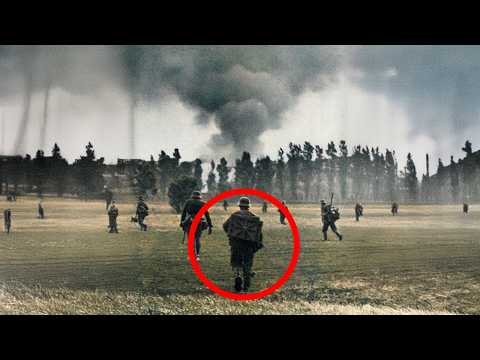
But these were not ordinary refugees. They were fighters, scholars, and patriots—men who had seen their families torn apart and their homes destroyed. They begged for a chance to fight back, to use their German accents and intimate knowledge of the enemy against the Third Reich. And after thousands of letters and desperate pleas, the British High Command finally listened.
From the shadows of internment camps emerged the X Troop: 130 men, handpicked for their skill, their fluency in German, and their burning hatred of the Nazi regime. They adopted British names, fabricated backstories, and transformed themselves into the ultimate weapon—commandos who could slip behind enemy lines, interrogate prisoners, and unleash hell.
Their training was brutal, their missions suicidal. “Where some soldiers were drawing straws to see who got to stay back from the most dangerous missions, the X Troopers were drawing straws to see who got to do the most dangerous missions.” From the beaches of Normandy to the forests of Belgium, they fought with a ferocity that stunned even their allies.
One of them, Manfred Gans, landed on D-Day and single-handedly captured 25 German officers, demanding in perfect German the location of mines that could have doomed the invasion. Another, Peter Masters, cycled into the chaos of Sword Beach and secured Pegasus Bridge, saving countless lives. And Ian Harris, a Vienna-born Jew, charged through German trenches, killing and capturing enemy soldiers with a fury born of years of persecution.
But their most personal battle was yet to come. As the war neared its end, these men embarked on a desperate race to find their families before the Nazis could execute them. Their stories of reunion—and heartbreak—would become the stuff of legend.
This is the story of the X Troop: the sneakiest, most savage payback tactic Hitler never saw coming.
But the X Troop’s war was far from over. As the Allies pushed deeper into Germany, the commandos faced a new kind of horror: the concentration camps. For many, this was the moment they had both dreaded and longed for—the chance to see with their own eyes the nightmare that had consumed their families.
Fred Jackson, the man who had interrogated Rudolf Höss, was not the only one shattered by the experience. For Jackson, the confrontation with Höss was a descent into a personal hell. After the interrogation, he locked himself away, haunted by the ghost of his mother and the monstrous banality of the man who had ordered her death.
Others found a different kind of closure. Colin Anson, who had searched for his mother in the ruins of Frankfurt, was one of the lucky few. His reunion with her, though scarred by trauma, gave him a reason to believe in a future. But for every happy ending, there were countless stories of loss that would never be avenged.
As the war in Europe finally ended, the men of X Troop faced a question that had haunted them since the day they fled their homeland: what now? Some returned to Britain, trying to rebuild lives in a country that had once treated them as enemies. Others stayed in Germany, helping to track down Nazi war criminals and bring them to justice.
Their legacy, however, was already cemented. The X Troop had proven that loyalty was not a matter of birth but of choice. They had fought not for glory, not for recognition, but for the simple, powerful need to strike back at the evil that had taken everything from them.
And as the world began to learn the full extent of the Holocaust, the story of these German Jewish commandos became a symbol of defiance. They were the ghosts of Hitler’s victims, returned to haunt him.
But the scars of war were not so easily healed. Many X Troopers struggled with the memories of what they had seen and done. Some found solace in family, others in silence. Yet they all shared a bond that could never be broken: they had been there, at the heart of the darkness, and they had emerged with their humanity intact.
Their story, however, remained largely unknown for decades. It was only in the 21st century that historians began to uncover the full extent of their contribution. Books were written, documentaries made, and finally, the men of X Troop received the recognition they had so long deserved.
But for the survivors, the greatest reward was not medals or praise. It was the knowledge that they had made a difference. They had saved lives, liberated camps, and brought Nazis to justice. They had done what they set out to do: they had gotten their own back.
And as the last of them passed away, their stories remained—a testament to the courage of those who refused to be victims, who chose to fight back against the darkness, and who, in doing so, became legends.
Yet the story of X Troop does not end with the guns falling silent. In the rubble of a defeated Germany, a quieter but no less dangerous mission began. The men who had stormed beaches and crossed rivers now found themselves hunting something far more elusive: the architects of the Holocaust themselves.
Some X Troopers were attached to the war crimes investigation teams, using their fluent German and intimate knowledge of Nazi structures to track down men who had vanished into the chaos of defeat. They walked through displaced persons camps, scanning faces, listening for familiar accents, following whispers. For these commandos, justice was not an abstraction—it was a list of names, each one tied to a family member who would never return.
One such hunter was a young sergeant from Berlin who had watched his father beaten to death in the street during Kristallnacht. Now he sat across from captured SS officers in makeshift interrogation rooms, speaking to them in the soft, familiar cadence of their shared mother tongue. He never raised his voice. He never needed to. The prisoners, expecting British brutality, found instead a mirror of their own past—and many of them broke under the weight of it.
But the hunt for war criminals was only part of the reckoning. Across Europe, millions of displaced persons wandered the roads, and among them were the surviving Jews—ghosts who had somehow crawled out of the camps. X Troopers who had enlisted to save their families now found themselves responsible for strangers who had no one left.
Peter Masters, the man who had cycled across Sword Beach and bluffed an entire garrison into surrender, spent the months after the war organizing food distribution and medical care for survivors. He wrote letters for those too weak to write, helped them find relatives, and stood guard over makeshift shelters where the traumatized slept. He had come to Europe to kill Nazis. He stayed to heal what they had broken.
Others could not stay. Some X Troopers returned to Britain and never spoke of the war again, burying their memories so deep that even their children knew nothing of their past. They had done what they set out to do—and now they wanted only silence.
But history, as it always does, refused to stay buried. Decades later, when researchers began piecing together the story of the X Troop, they found a trail of documents, letters, and half-remembered anecdotes that painted a picture of extraordinary courage. The men who had been deemed untrustworthy, who had been interned as enemies, had become some of the most decorated and feared soldiers of the entire war.
And yet, the greatest testament to their legacy was not in the medals or the citations. It was in the families they saved, the lives they rebuilt, and the simple fact that when the world had turned its back on them, they had refused to turn their backs on the world.
In 2019, a small ceremony took place at the National Memorial Arboretum in Staffordshire. A stone was unveiled, inscribed with the names of the 130 men of X Troop. Only two of them were still alive to see it. One was too frail to travel, but the other—a man in his late nineties—stood with the help of a cane and saluted as the Last Post played.
After the ceremony, a young historian asked him what he wanted people to remember. The old man was silent for a long moment. Then he said, “We were not heroes. We were just men who refused to be victims. There is a difference.”
He died three months later. His obituary in The Times was brief, mentioning his service in the Pioneer Corps and then in a ‘special unit.’ It did not mention the night he had slipped across enemy lines, or the German officer he had interrogated, or the family he had found—and lost—in the ruins of Berlin.
But that was the way of X Troop. They had come from the ashes of one world and fought to build another, and when it was done, they asked for nothing but the chance to live in it quietly.
Today, the stone at the Arboretum is often overlooked. Visitors pass it on their way to grander monuments. But if you stop and read the names—the British names they chose, the German names they buried—you can still hear their answer to the question that haunted them: What do you do when the world calls you an enemy?
You become the weapon it never saw coming.
And you win.
What would you have done, in their place—fled, hidden, or fought?
Report this article
Select a reason for reporting:






