Adolf Hitler was a man who never stood alone. For decades, the world believed he was a solitary figure, a dictator without a private life. But behind the closed doors of the Berghof, his alpine retreat, a different story unfolded—one of friendship, loyalty, and complicity in unimaginable crimes. This is the inside story of Hitler’s inner circle, a group of men and women who were not just followers, but willing participants in the darkest chapter of history.
They were the patrons, the friends, the confidants—people like Wilhelm Brückner, Hitler’s loyal adjutant; Martin Bormann, the ruthless organizer; and Albert Speer, the ambitious architect. They didn’t just serve Hitler; they were his equals, his companions, his family. And in return, they were granted power, wealth, and protection. But their loyalty came at a price—a price that would be paid in blood.
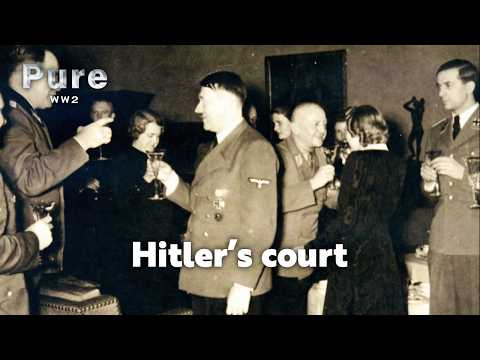
In the summer of 1939, private photographs from Eva Braun’s collection captured the carefree moments at the Berghof. Hitler laughed, posed with children, and played the gracious host. But behind the smiles, a sinister truth lurked. The same men who joked and drank with the Führer were also architects of genocide. There was no separation between political and private life in Hitler’s court; everyone was involved, everyone was a believer.
Take Wilhelm Brückner, for instance. He was Hitler’s chief adjutant, a man Hitler trusted implicitly. But Brückner harbored a dark secret. In 1934, the body of a young woman, Geda Zmer, was found in his apartment. She had been his lover, and her death was never solved. Brückner covered it up, and the Nazis, eager to avoid scandal, buried the case. It was a clear sign: in Hitler’s inner circle, loyalty meant protecting your own, no matter the crime.
Then there was Ernst Röhm, the SA leader and one of Hitler’s oldest friends. Röhm’s growing power threatened Hitler, and in the Night of the Long Knives, Hitler personally arrested him and had him shot. Loyalty, it seemed, was a one-way street. After Röhm’s murder, Hitler surrounded himself with a new circle—men like Martin Bormann, who owed everything to him.
Bormann was the gatekeeper, the man who controlled access to the Führer. “No one comes to the Führer except through me,” he famously said. He was ruthless, industrious, and utterly devoted. He managed Hitler’s finances, organized his schedule, and ensured that the inner circle remained pure. He was the perfect Nazi, and his wife, Gerda, was just as fanatical. Together, they embodied the regime’s twisted ideals.
But the inner circle was not just about politics; it was also about personal relationships. Hitler was the best man at many of their weddings, including Bormann’s and Goebbels’. These were not just alliances; they were bonds of family. And when those bonds were threatened, Hitler intervened. When Joseph Goebbels’ marriage to Magda was on the brink of collapse due to his affair with a Czech actress, Hitler stepped in and demanded he end it. Magda’s loyalty to Hitler, in return, would lead her to murder her own children and then take her own life in the bunker.
The court was a place of contradictions—a world of luxury and brutality, of camaraderie and betrayal. And at its center was a man who, despite his power, was never alone. He needed his circle, and they needed him. For better or worse, they had linked their fate to his. And as the war turned against them, they would all face the consequences.
The euthanasia program was one of the inner circle’s darkest secrets. Carl Brandt, Hitler’s personal physician, and Philipp Bouhler, the head of the Chancellery, organized the systematic murder of tens of thousands of disabled people. Hitler signed the order reluctantly, but his conviction was clear: the weak must be eliminated. Brandt shared that belief completely. After the war, he showed no remorse. “He could not distinguish between a human cell and a human being,” a Nuremberg psychologist later said of him.
Brandt was sentenced to death and executed in 1948. But others in the circle were more fortunate—or more cunning. Albert Speer, the architect who became Armaments Minister, managed to escape the gallows. He presented himself at Nuremberg as an apolitical technocrat who had known nothing of the Holocaust. It was a lie. Speer had been present when Hitler outlined his war plans in August 1939, and he had used slave labor from concentration camps to keep his factories running.
Yet the legend of the “good Nazi” stuck. Speer’s memoirs became bestsellers, and for decades he shaped a distorted image of the Third Reich. He claimed he had tried to assassinate Hitler, that he had been horrified by the crimes. None of it was true. He had been a devout disciple from the very beginning, a man who basked in the Führer’s glow.
As the war progressed, the inner circle shrank. Hitler withdrew from public life after the defeat at Stalingrad, surrounding himself with secretaries, aides, and doctors. The atmosphere at the Berghof grew strange—a mix of denial and panic. “We have to protect him,” one aide wrote in his notebook. “He is unresponsive at the moment, understandably depressed because of the war situation.”
But while Hitler deteriorated, Speer was at the top of his game. “Speer gets us all drunk with his figures,” Goebbels wrote enviously in his diary. Speer’s ruthless drive to increase armaments production prolonged the war by years. He was, in a way, the greatest criminal after Hitler himself.
After the failed assassination attempt of July 20, 1944, the circle rallied around the wounded Führer. Their reaction was not relief that the war might end, but fear of what would become of them without Hitler. They were bound to him for better or worse, and they knew it. So they kept fighting, even when victory was impossible.
In December 1944, Speer traveled to the Ardennes to support the last major offensive. He visited Hitler repeatedly at the Reich Chancellery to reaffirm his loyalty. The dictator was determined to die in Berlin, and his court stayed with him. Eva Braun, who had waited years for recognition, was rewarded shortly before their suicide: Hitler married her in the bunker.
When the end came, the inner circle faced it in different ways. Goebbels and his wife Magda murdered their six children and then killed themselves. Bormann died trying to escape the Red Army. Others, like Speer, survived to rewrite history.
After 1945, the survivors became a conspiratorial community. They needed to distance themselves from Hitler and the Nazi system, to seem credible. And so the legend of the unapproachable leader emerged—a Hitler no one had really known personally. The man who had been surrounded by friends, who had been best man at their weddings, who had laughed and joked with them, was transformed into a solitary figure who only delivered monologues.
It was a lie, but a convenient one. The truth was far more disturbing: Hitler was a product of his environment, a man who needed his circle as much as they needed him. They were not just followers; they were accomplices. And in the end, they all shared the same fate—whether on the gallows, in prison, or in the shadow of their own lies.
Heinrich Hoffmann, the photographer who had introduced Hitler to Eva Braun, was one of the few who dared to test the boundaries of the Führer’s patience. In the summer of 1943, his daughter Henriette—married to Baldur von Schirach, the Gauleiter of Vienna—confronted Hitler at the Berghof about the mistreatment of Jewish women in Holland. She had witnessed deportations with her own eyes, and she demanded answers.
It was a moment of extraordinary recklessness. The Schirachs had benefited enormously from the regime—Baldur had personally signed deportation lists in Vienna—and yet here was Henriette, pleading for the Jews. Hitler’s response was cold and final: the deportations would continue, and no one in his court had the right to question them.
The episode revealed something crucial about the inner circle. They were not ignorant of the crimes; they were complicit in them. When Himmler and his SS henchmen came to the Berghof in August 1939 to discuss the extermination plans for the Polish campaign, Speer and Brandt were present. The genocide of European Jews was discussed openly at the Berghof, and no one objected.
After the war, the survivors claimed they had known nothing. It was a lie that defied belief. How could Speer, who organized an army of millions of slave laborers, claim ignorance of the Holocaust? How could Brandt, who signed the euthanasia order, pretend he had been a mere bystander? They had all been part of a murder machinery, and they had all known.
The court around Hitler and Eva Braun was not a collection of naive idealists. They were convinced National Socialists who believed in the cause. They believed that Jews had no place in Germany, that the disabled were a burden on the nation, that the weak must be eliminated. Their loyalty to Hitler was not blind; it was ideological.
When the war turned against them, they did not waver. After Stalingrad, as Hitler withdrew from public life, the inner circle became his only connection to the world. They protected him, lied for him, and died for him. And when the end came, they faced it with the same fanaticism they had shown throughout their lives.
But the story of Hitler’s inner circle did not end in the bunker. It continued in the courtrooms of Nuremberg, where the survivors tried to rewrite history. Speer, the master of deception, presented himself as the penitent Nazi who had tried to kill Hitler. It was a performance worthy of an Oscar. He was sentenced to twenty years, but he emerged from Spandau prison in 1966 as a celebrity, his memoirs a bestseller.
Hoffmann, the photographer, was tried and acquitted. He lived to see his photographs become historical documents, his role in Hitler’s court reduced to that of a mere observer. And so the legend grew: the Führer as a solitary genius, surrounded by sycophants who knew nothing of his crimes.
It was a narrative that suited everyone—the perpetrators, the German people, and the world that wanted to believe that evil could be contained in a single man. But the truth was far more disturbing. Hitler was not a solitary figure; he was a product of his environment. His crimes were made possible by the men and women who surrounded him, who encouraged him, who carried out his orders.
The inner circle was not a collection of innocent bystanders. They were the architects of the Holocaust, the euthanasia program, and the war of annihilation. They shared Hitler’s beliefs, his ambitions, and his guilt. And when they claimed ignorance, they were lying—to the world and to themselves.
In the end, the Berghof was destroyed, its files burned, its secrets buried. But the evil that had emanated from it lived on in the hearts of those who had been there. They remained convinced Hitler followers until their deaths, their loyalty unbroken, their consciences silent. The inner circle was not just a group of friends; it was a conspiracy of murderers.
And the world, eager for simple answers, accepted the lie. The Führer was responsible for everything, and his companions were merely his tools. But the truth was more complicated—and more terrifying. They were not just tools; they were willing executioners.
Yet the lie could not hold forever. Historians sifted through surviving letters, diaries, and the private films Eva Braun had so carefully preserved. Each fragment pointed to the same conclusion: the circle knew, the circle approved, the circle participated.
Speer died in 1981, still insisting he had been the exception. “I should have known,” he wrote—words that rang hollow to those who had watched him thrive in Hitler’s shadow. Brandt, Bormann, Goebbels, Brückner: all gone, all silent, all complicit.
What remains is the uncomfortable question history keeps asking us: when evil gathers a circle of friends, who among them dares to say no? And if none do—what does that say about the company we keep?
Was Hitler truly a lone monster, or was he simply the face of a collective guilt that refuses to fade? We want to hear your thoughts—share them in the comments below.
Report this article
Select a reason for reporting:






