December 1943, the Western Front. The German Tiger tank crews burst into laughter when they first saw American soldiers carrying what looked like primitive metal tubes. A new rocket launcher—the bazooka—seemed like a child’s toy compared to their 54-ton armored beast. Within weeks, those same crews would scream in terror as these ‘toys’ punched through their impregnable armor, turning their steel fortresses into blazing coffins.
But how could a simple tube weapon, costing just $18 to manufacture, destroy tanks worth $100,000—the very machines that had the entire Allied forces trembling?
Winter 1943 had gripped Europe with brutal ferocity. Snow blanketed the battlefields where American and German forces faced each other across frozen ground. The war had raged for over four years, and both sides were exhausted.
German factories worked day and night to build their massive war machines. Their engineers believed they had created the perfect weapon: the Tiger tank. These steel beasts weighed 54 tons and stood eight feet tall. Their thick armor could deflect almost any shell fired at them. And their famous 88mm gun, mounted on top, could destroy enemy tanks from over a mile away.
German tank crews felt like kings of the battlefield when they climbed into these monsters. And they had every reason to feel confident. For months, Tiger tanks had crushed everything in their path.
The men who operated these machines came from all walks of life. Hans Müller, a country boy from Bavaria, served as a gunner. He had joined the army believing his country was fighting for survival. Werner Schmidt, a factory worker from Berlin, drove the massive tank with steady hands. Their commander, Sergeant Klaus Weber, was a veteran who had fought since the war’s beginning. These men trusted their steel fortress completely.
American forces faced a serious problem. Sherman tanks were lighter and far weaker than the German Tigers. A direct confrontation between a Sherman and a Tiger usually ended in disaster for the Americans. Soldiers often felt helpless when they heard the deep roar of Tiger engines in the distance. The sound heralded coming death, and there was little they could do to stop it.
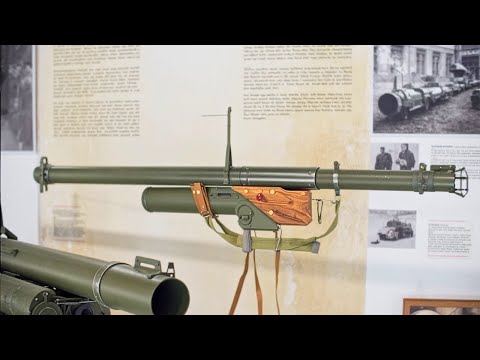
Then something new arrived in American supply depots. Long wooden crates contained a strange weapon that looked more like a piece of plumbing than a military tool. Soldiers pulled out metal tubes about 1.2 meters long, weighing only 6 kilograms. They called it the ‘bazooka,’ after a musical instrument used by a famous comedian. The weapon fired small rockets that seemed tiny compared to the massive shells used by tank guns.
American officers tried to train their soldiers on this new device. Many soldiers looked at the simple tube and shook their heads. How could this lightweight pipe damage a tank weighing 25.5 tons? A single rocket weighed no more than 1.4 kilograms. Some soldiers joked they might as well throw stones at the German beasts.
But orders were orders. Infantry units received their bazookas and trained on loading the small rockets. The weapon was easy to use, but many soldiers wondered if it would work when the time came. They were about to find out.
German tank crews were about to face the first American infantry team armed with this strange new weapon. This encounter would change everything both sides believed about modern warfare.
The first meeting occurred on a foggy morning near the Belgian border. The Tiger tank commanded by Sergeant Weber crossed a small village, its tracks crushing the frozen mud beneath. The engine roared like a caged beast as the 54-ton machine surged forward. Weber felt safe inside his steel castle, watching the world through thick glass periscopes.
Two American soldiers crouched behind a crumbling stone wall. Private Johnson held the bazooka, while his partner, Private Martinez, carried the rockets. Their hands trembled from cold and fear as they watched the massive tank approach. The Tiger looked like a moving building. Its gun barrel was longer than a telephone pole.
When Weber spotted the Americans, he laughed out loud. He called over the radio to his crew and nearby tanks. The Americans were carrying what looked like a piece of pipe. Weber had heard rumors of this new American weapon, but seeing it made him laugh. How could such a thin tube harm his mighty Tiger? The rocket it fired was smaller than the shells his own gun used for training.
Other German tank crews joined the laughter over the radio. They had spent months destroying American Sherman tanks with ease. Now the Americans thought they could fight back with toys?
Müller, the gunner, wiped tears of laughter from his eyes. Schmidt, the driver, shook his head in disbelief. These Americans must be desperate to try such foolish weapons. The Tiger continued its advance, not even trying to take cover. Why hide from such a weak weapon?
Weber decided to let the Americans fire first, just to see what their little tube could do. Then he would show them the power of German engineering with his massive 88mm gun.
Johnson aimed carefully at the side armor of the Tiger. His heart pounded like a drum in his chest. He felt the bazooka’s lightness in his hands, almost fragile compared to the monster charging toward them. Martinez loaded a rocket and patted Johnson’s shoulder. The rocket looked so small next to the Tiger’s thick steel plates.
The moment stretched like a rubber band about to snap. German laughter crackled over the radio waves. The American soldiers held their breath as they watched their comrades prepare to face the giant with what seemed like a slingshot.
The Tiger’s engine roar grew louder as it approached. Its commanders were still laughing at the sight of the primitive American weapon. What happened next would change everything both sides believed about the balance of power on the battlefield.
The laughter was still echoing in their headsets when Johnson squeezed the trigger. The bazooka kicked his shoulder like an angry mule. A bright flash lit the morning fog as the tiny rocket streaked toward the Tiger.
The projectile moved so fast it looked like a burning arrow splitting the cold air. Inside the Tiger, Weber stopped laughing. The small rocket struck the side armor of his tank with a sharp screech that echoed across the battlefield.
Then came the explosion.
The rocket, weighing just three pounds, carried an explosive charge that worked like concentrated lightning. The blast sent a stream of molten metal through the Tiger’s thick steel with terrifying ease. The armor that had protected German crews for months was suddenly worthless.
Weber felt his massive tank shudder as if struck by a giant hammer. The German laughter over the radio died instantly. Weber’s voice cracked as he screamed into the microphone. What he thought was a toy had pierced his invincible fortress.
Smoke poured through the hole in the tank’s side, filling the fighting compartment with choking fumes. Müller, the gunner who had been wiping tears of laughter from his eyes moments before, now screamed in terror as flames licked at his feet. The Tiger’s ammunition began to ignite from the heat. Small explosions popped like fireworks inside the tank—but these were deadly fireworks packed with high explosives.
Schmidt tried desperately to steer the burning tank away from the American position, but the controls were dead. The beast that had dominated the battlefield was now a death trap for its crew. Weber’s world turned upside down in seconds. Everything he believed about German superiority crumbled like a house of cards.
The Tiger was supposed to be the ultimate weapon, proof that German engineering was invincible. Now his crew was leaping from their burning fortress, running across the frozen ground like frightened rabbits.
Other German tank commanders watched in horror as Weber’s Tiger became a funeral pyre. Thick black smoke rose like a signal flag, announcing the end of an era. Radio chatter filled with panic as crews realized their steel castles were no longer safe. The Americans had found a way to kill giants with a weapon that cost less than a month’s pay.
Hans Müller crawled out of the burning tank, his clothes on fire. The country boy who had trusted German engineering with blind faith now rolled in the snow to put out the flames. His face was burned, and his belief in his country’s weapons was shattered. The simple American rocket had done what no enemy tank had managed in months. It had turned the mighty Tiger into scrap metal.
More American soldiers appeared with bazookas. The German tank crews who had felt like kings were now easy prey. The psychological impact spread like wildfire through German ranks. If the mighty Tiger could be destroyed by infantry with simple weapons, what did that mean for the entire war?
Werner Schmidt helped drag his wounded commander from the wreckage. The factory worker who had been so proud to serve in a Tiger tank now realized a bitter truth. All those months of feeling superior, all that confidence in German technology, had been built on a lie. The Americans weren’t weak or foolish. They were smart enough to find a simple solution to a complex problem.
Bazooka teams advanced, hunting for more German tanks. Each rocket they fired was another nail in the coffin of German armored superiority. The weapon that had seemed like a joke proved to be a deadly equalizer.
German radio operators reported the impossible again and again: Tigers burning, crews running, Americans advancing with their terrifying tube weapons. That moment changed everything in both sides’ view of the war. German soldiers realized their technology wasn’t magic, and their weapons weren’t invincible. American forces discovered that courage and smart engineering could defeat any enemy, no matter how large or frightening.
The balance of power on the battlefield shifted with the pull of a trigger.
The news spread through both armies like fire through dry forest. Within days, every German tank crew had heard the impossible story: mighty Tigers could be killed by American infantry carrying simple tube weapons. The tale moved from trench to trench, from command post to command post, reshaping how everyone thought about the war.
German tank tactics had to change overnight. Crews that had boldly advanced across open ground now crawled forward like frightened mice. They kept their distance from buildings where American soldiers with bazookas might hide. The psychological weapon proved as powerful as the physical one. Fear spread through German ranks faster than any bullet or shell.
Hans Müller lay in a field hospital, his burns wrapped in white bandages. The young farm boy stared at the ceiling, thinking about everything he had believed before that terrible morning. The Tiger had been his pride, a symbol of German power. Now it was just twisted metal cooling in a Belgian field. He whispered to the soldier in the next bed about how wrong they had all been. The Americans weren’t weak. They were clever in ways the Germans never imagined.
In Germany, tank factories worked harder than ever to build new Tigers. But the workers didn’t know what Müller knew. They still believed their steel beasts were invincible. The truth would reach them slowly, carried by wounded soldiers and whispered in letters that somehow slipped past the censors. German engineering was good, but it wasn’t magic. American ingenuity had found its weakness.
On the American side, bazooka production surged in factories across the United States. Workers who had never seen combat realized they were building deadly weapons. Every simple metal tube rolling off the assembly line carried the hopes of American soldiers facing impossible odds. The weapon that had seemed like a toy was now a decisive factor in the war.
Private Johnson became a legend in his unit. Soldiers wanted to hear his story again and again. How did it feel to fire that first shot? How did it feel to watch the mighty Tiger burn? Johnson always gave the same answer: it felt like David striking Goliath between the eyes. The bigger the tanks, the harder they fell. German tanks fell like anything else when hit in the right place.
The impact reached far beyond the battlefield. German High Command had to reconsider their entire strategy. If Tigers could be destroyed by cheap American weapons, what other advantages might they lose? Meanwhile, American generals realized they had found something bigger than a tank killer. They had found a way to turn industrial might into battlefield advantage. Simple weapons, produced in massive quantities, could defeat complex, expensive weapons.
Werner Schmidt returned to his factory job in Berlin after the war ended. He walked past the Tiger assembly line where he had once worked with pride. Now the sight brought back memories of that burning morning in Belgium. He had learned something about American thinking that stayed with him forever. Sometimes the best solution to a big problem wasn’t a bigger weapon—it was a smarter one. The Americans hadn’t tried to build better tanks than the Germans. They had found better ways to destroy them.
Years later, military historians studied the bazooka’s effect on World War II, writing about how a simple tube weapon changed the course of battles and perhaps the war itself. But the real story was simpler than all their complex analyses. It was about the moment laughter turned to screams, confidence to fear, and the moment everyone realized that no weapon is stronger than being outsmarted. That lesson echoed through military thinking for decades. Size and complexity don’t guarantee victory. Sometimes a country boy with a simple idea can change everything. The Americans hadn’t just built a tank killer—they had built a giant killer, and the giants of war learned to fear small things carried by determined people who refused to give up.
What would you have done if you were in that Tiger tank when the ‘toy’ weapon struck?
Report this article
Select a reason for reporting:






