The First World War was supposed to be the war to end all wars. Instead, it became a meat grinder that consumed a generation. Young men charged into machine-gun fire, shivered in waterlogged trenches, and died in numbers that defy comprehension. It was industrial slaughter on an unprecedented scale, a conflict so pointless that its very name became a bitter irony.
And yet, amid the mud and the madness, something else emerged. Not hope, exactly—more like a stubborn, shining courage that refused to be extinguished. These are the stories of ordinary people who, staring into the abyss, chose to act with extraordinary bravery.
Albert Jacka was a 22-year-old Australian lance corporal when he found himself in a trench at Gallipoli, facing a relentless Turkish assault. It was 3:30 a.m. on May 19, 1915. A party of Turks hurled eight bombs into his position. Three men were killed instantly; the rest were wounded. Most of the surviving Australians fled.
But not Jacka. He stayed, firing relentlessly into the enemy, preventing their advance. Then he did something even more remarkable. With just three young privates, he launched a counter-attack. “I’ll go first, follow me,” he told them. When one man was shot, Jacka didn’t stop. He crossed no man’s land alone, flanked the Turks from behind, and in a blur of violence shot five and bayoneted two more. The stunned enemy broke and fled, and Jacka captured three prisoners. He then held that trench alone for an entire night, refusing to leave.
For this, he received the Victoria Cross—the first Australian of the war to do so. But his bravery didn’t end there. At Pozières in 1916, he again displayed almost suicidal courage. Wounded seven times, with one bullet passing clean through his body, he refused to fall. He led a charge that freed 40 captured Australians and took 50 Germans prisoner. One stretcher-bearer called him “the bravest man in the Aussie army.”
Otto von der Linde was a young lieutenant in the German army, and on August 23, 1914, he faced a seemingly impossible task. The Belgian fort of Namur blocked the German advance, and its thick walls and machine guns made a frontal assault suicide. There was no time to wait for artillery. The senior officers were stumped.
Then Otto spoke up. He claimed he could take the fort without artillery, with just a handful of men. An officer laughed in his face. “How many men’s mothers do you intend to leave heartbroken?” he sneered. Otto’s answer: “About four.” The room fell silent. Against their better judgment, they gave him a chance.
Otto asked for volunteers. Forty stepped forward. He chose four. Then, in plain sight of the Belgian defenders, he and his small party marched across the open plain toward the fort’s moat. They shouted up that they were surrounded by artillery and demanded surrender. For agonizing minutes, silence. Then the drawbridge lowered. Otto’s bluff had worked. The fort surrendered without a single shot fired. He signaled success by hoisting a makeshift German flag made from a black coat, a white shirt, and a red shirt. A key position was taken, and countless lives were spared—all because one young man dared to think differently and risk everything.
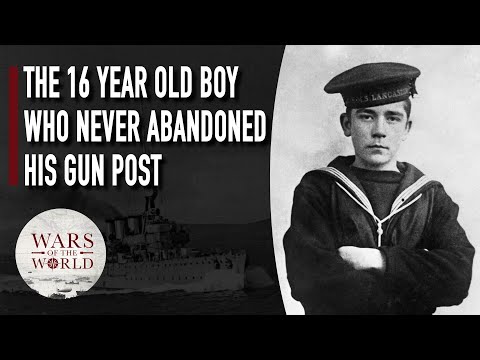
Jack Cornwell was just 16 years old when he stood on the deck of HMS Chester at the Battle of Jutland. He was a sight setter for a forward gun, a role that required him to stand outside the protective shield, exposed to enemy fire. When German cruisers opened fire, the scene became a nightmare. Three of Chester’s guns were destroyed in minutes. Jack’s entire gun crew was killed, and he was horribly wounded—metal shards ripped through his legs and stomach.
But Jack didn’t flee. He didn’t scream for help. He stayed at his post, awaiting orders, for nearly 20 minutes as shells rained down. The ship was hit 17 times and suffered over 70 casualties. Jack was taken to hospital, where he died two days later. His devotion to duty earned him a posthumous Victoria Cross. His mother received the medal from King George V himself. A special badge for courage was created in his name for the Boy Scouts. He was a boy who, in the face of unimaginable horror, simply did his duty.
These three stories—of a fearless Australian, a clever German, and a brave British boy—show that heroism belongs to no single nation. It shines through the darkness of war, a reminder that even in the worst of times, the human spirit can rise.
But the story of courage in the First World War does not end with these three. There were thousands more—men and women whose names never made the newspapers, whose deeds were witnessed only by their comrades and the dead. Their bravery was no less real for being unrecorded.
Consider the stretcher-bearers, who crawled into no man’s land under fire to retrieve the wounded. They carried no weapons, only bandages and morphine, and yet they faced the same artillery and machine guns as the fighting men. Many died with a wounded man on their back, refusing to leave him behind. Their courage was quiet, unassuming, and utterly essential.
Then there were the nurses, stationed just behind the front lines. They worked eighteen-hour shifts in makeshift hospitals, amputating limbs and dressing wounds that defied description. They saw the worst of the war—the shattered bodies, the gas-blinded eyes, the men who begged to die—and they kept going. Some were killed when shells hit the hospitals. Others worked on until they collapsed from exhaustion.
And what of the ordinary soldiers who never won a medal? The ones who held the line, day after day, in the mud and the cold? Their heroism was a different kind: the heroism of endurance. They did not charge machine guns or capture forts with bluff and bravado. They simply stayed. They wrote letters home that lied about the conditions. They shared their last cigarette with a dying friend. They laughed at jokes that weren’t funny, because laughter was the only thing that kept the darkness at bay.
One such man was a British private named Harry Patch, who would live to be 111 years old—the last surviving soldier of the trenches. He never spoke of the war for eighty years. When he finally did, he said simply: “I didn’t fight for king or country. I fought for my mates.” That sentiment, echoed by soldiers on every side, cuts through the nationalist myths. The war was fought by young men who cared less about flags and more about the person in the trench beside them.
This is perhaps the truest form of bravery: not the dramatic gesture, but the daily choice to endure, to protect, to care. It is the bravery of the human heart, which refuses to be hardened even by hell.
The stories of Jacka, von der Linde, and Cornwell are the ones that get told—the ones that win medals and make headlines. But for every Victoria Cross, there were a thousand acts of courage that went unseen. The war was full of quiet heroes whose names we will never know.
Take the tunnellers, for instance. Beneath the trenches of the Western Front, men dug miles of tunnels under enemy lines, planting explosives that would tear the earth apart. They worked in absolute darkness, often in silence, listening for the enemy’s pickaxes. Sometimes they broke through into a German tunnel and fought hand-to-hand in the cramped dark, with mud and blood up to their knees. If a tunnel collapsed, they were buried alive. Their bravery was claustrophobic, unseen, and utterly terrifying.
Then there were the runners, who carried messages between headquarters and the front lines. With telephone wires constantly cut by shellfire, these men had to sprint across open ground, exposed to snipers and artillery. Many were killed within minutes of setting out. They knew the odds. They went anyway.
And what of the animals? Thousands of horses, dogs, and pigeons served alongside the soldiers. Dogs carried messages through gunfire, pigeons flew home with vital intelligence, and horses hauled guns and supplies through the mud. They had no choice in the matter, no understanding of the war, and yet they suffered alongside their human comrades. Their courage, too, deserves to be remembered.
But perhaps the most overlooked heroes were the conscientious objectors—the men who refused to fight. They were branded cowards, imprisoned, and sometimes tortured. Some were sent to the front lines anyway, forced to carry stretchers and risk their lives without a weapon. Many died rescuing wounded men under fire, their bravery no less real for being born of conviction rather than obedience.
The war did not discriminate in its cruelty. It killed the brave and the cowardly alike, the clever and the foolish, the young and the old. But it also revealed something profound: that courage is not the absence of fear, but the triumph over it. Every man and woman who faced that horror and did their duty, however small, was a hero.
As we remember these stories, we must also remember the cost. The First World War shattered empires, redrew borders, and left scars that would take generations to heal. The bravery of those who fought should never be used to glorify the war itself. Instead, it should remind us of the preciousness of peace and the folly of conflict.
So let us honor the fallen—not by celebrating war, but by striving for a world where such sacrifices are no longer necessary. That is the truest tribute we can pay to their memory.
The war that was supposed to end all wars did not, of course, end anything. It merely planted the seeds of a darker harvest. Yet the courage of those who endured it remains a light we can still see by. Albert Jacka, Otto von der Linde, Jack Cornwell—their names live on, but they stand for a countless multitude whose stories were never told.
Walk through any village in Europe today and you will find the same silent stones: lists of names, often several from one family, carved into cold granite. Each name was a person who loved, feared, hoped, and chose to stand firm. The stones do not distinguish between the decorated and the forgotten. They simply remember.
Perhaps that is the lesson these stories leave us with. Heroism is not the exclusive property of the famous or the victorious. It belongs to the stretcher-bearer, the tunneller, the runner, the nurse, the conscientious objector, and the private who simply stayed. Courage is measured not by medals but by the quiet decision to do right when doing wrong would be easier.
And so we close this account—not with glory, but with gratitude. The soldiers of the First World War saw the abyss and walked toward it anyway, for mates, for duty, for reasons they themselves could barely name. We owe them our memory, and we owe the future our resolve to seek peace.
What stories of quiet courage in your own family or community deserve to be remembered? Share them below—because every act of bravery, however small, is worth passing on.
Report this article
Select a reason for reporting:






