They were the faces that defined our childhoods, the voices that lulled us to sleep, the characters we trusted with our hearts. But behind the cameras, the halos slipped. From punched walls to backstage feuds, from diva demands to shocking firings, the stories your favorite TV stars never wanted you to hear are finally coming to light.
These are the untold tales of the actors who played saints but lived as sinners—and the co-stars, producers, and crews who lived to tell the tale.
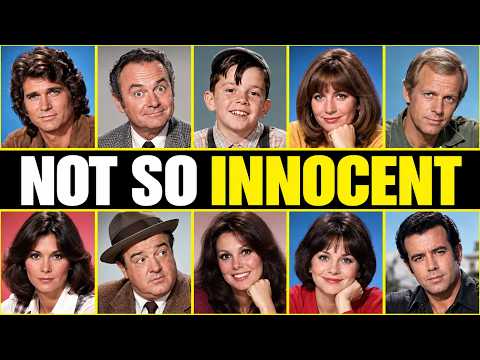
Take Andy Griffith, the beloved Sheriff Andy Taylor of Mayberry. On screen, he was the calm, widowed father who solved problems with a slow smile and a talk on the front porch. Off screen, he was a man with what those closest to him called an explosive temper. He once punched a car window and put his fists through doors. In fact, during the second season, he hit a wall in a fit of anger and hurt his hand so badly it had to be wrapped—and the writers covered it by having Sheriff Andy appear with a bandaged hand in two episodes, claiming he’d been hurt while bringing in troublemakers.
But Griffith’s anger wasn’t the only skeleton in his closet. He drank heavily, and his relationship with co-star Frances Bavier, who played Aunt Bee, was frosty at best. Bavier wasn’t even his first choice for the role. Yet, years later, she called him to apologize for being difficult during the series—just four months before she died.
Then there’s Valerie Harper, who played the lovable Rhoda Morgenstern. America adored her, and when she got her own spin-off, it was a hit. But in 1987, after asking for a raise and a bigger share of the profits, she was fired from her own show. The producers killed off her character in an off-screen accident and renamed the series. Harper sued and won $1.4 million plus a share of the profits, proving that sometimes the ‘brat’ label is just a smear.
And who could forget Kirk Cameron, the charming Mike Seaver on Growing Pains? At 17, he became a born-again Christian and, according to reports, began insisting that storylines be altered to remove anything he found inappropriate. He allegedly objected to a scene where his character was to be shown in bed with a girl—though he ultimately played it as written. He also reportedly went to producers and demanded the firing of actress Julie McCullough, who had posed for Playboy, claiming they were promoting pornography. McCullough said he wouldn’t speak to her afterward, and the friction cut him off from the rest of the cast—he didn’t even invite them to his wedding.
The list goes on: Pernell Roberts, who called Bonanza ‘junk television’; Cindy Williams, whose pregnancy dispute led to a $20 million lawsuit; Marlo Thomas, whose former household manager claimed she had a fierce temper; Lou Costello, who demanded top billing and a bigger cut; Kate Jackson, who clashed with producers over scripts; McLean Stevenson, who resented being one of six; Penny Marshall, who admitted she and Cindy Williams cursed at the writers; Carl Switzer, the Little Rascals’ Alfalfa, who was remembered as a terror; Harvey Korman, who was fired—for a day—by Carol Burnett; and Michael Landon, the angel of Highway to Heaven, who was accused of cutting co-star Karen Grassle’s scenes and making crude jokes at her expense.
These are the stories behind the smiles, the secrets behind the scripts. And this is only the beginning.
But the story doesn’t end with the names you already know. Beyond the marquee stars, there were quieter scandals, buried deeper, involving the actors who played the sidekicks, the neighbors, the best friends—the ones whose faces you’d recognize before you ever learned their names.
Take Amanda Blake, Miss Kitty on Gunsmoke. For twenty years she poured drinks and offered wisdom in Dodge City, the warm center of television’s longest-running Western. Off camera, she was a chain-smoker who kept a menagerie of exotic animals and, by several accounts, a temper that could curdle milk. When the show finally ended in 1975, she learned of its cancellation not from the network but from a newspaper.
And then there was Dennis Weaver, Chester Goode, the limping deputy who idolized Matt Dillon. He won an Emmy for the role, then walked away after nine seasons because he was tired of playing second fiddle to James Arness. He told interviewers he wanted to be a leading man, not a sidekick. He got his wish with McCloud, but he never escaped Chester’s shadow.
Perhaps the most startling case belongs to Frances Bavier herself. The woman who played Aunt Bee was, by nearly every account, the polar opposite of her character. She was a classically trained actress who found the role beneath her, and she clashed with everyone from Griffith to the crew. She reportedly refused to speak to some cast members for years and once described Mayberry as ‘a place I’d rather forget.’ Yet in her final months, she called Griffith to apologize—a moment he recounted with genuine emotion on Larry King Live.
Then there’s Danny Thomas, the beloved patriarch of Make Room for Daddy and founder of St. Jude. His daughter Marlo became a star in her own right, but the family’s public warmth hid a complicated truth. Danny was a relentless perfectionist who drove his writers to exhaustion and, by some accounts, his daughter to prove herself twice as hard.
These are the names that never made the tabloids, the scandals that stayed locked in studio files. They remind us that the line between saint and sinner is thinner than any script could suggest—and that the brightest halos often cast the longest shadows.
But if you think these stories are shocking, wait until you hear what happened on the set of television’s most wholesome family drama—a story so dark it was buried for decades.
It was Little House on the Prairie, and the story begins not with Michael Landon but with the man he pushed aside. Ed Friendly had bought the rights to Laura Ingalls Wilder’s books and brought the project to Landon, hoping to stay faithful to what she wrote. Friendly was gone after the pilot. Landon wanted his own version, and he got it.
The fullest account came in 2021, when Karen Grassle, who played Caroline Ingalls, published her memoir Bright Lights, Prairie Dust. She wrote that when the show became a hit, she asked for a raise before the second season. Landon refused, arguing that her salary should match what the child actors were paid. After that, she said, he began cutting her scenes and making crude jokes at her expense in front of the cast and crew—who laughed along.
She described it in an interview as a campaign on the set to break her down and diminish her value to the show. Landon himself admitted to being a heavy drinker and a chain smoker in those years.
When NBC ended the series, he wrote a final television film in 1984 in which the people of Walnut Grove blow up their own town. The standing sets in Simi Valley were dynamited on camera rather than left for any other production to use. Several of the actors stood and cried as the buildings they had worked in for nine years went up.
Grassle was careful to tell the other half as well. She wrote about her own drinking in the same book, and she said that she and Landon mended fences before the end. When he was ill, he let her know he would welcome a call, and she said they had a very nice conversation.
He was born Eugene Orowitz in Forest Hills, New York, on October 31st, 1936. He was diagnosed with pancreatic cancer in April of 1991 and died at his ranch in Malibu on July 1st, 1991, at 54.
But the prairie wasn’t the only wholesome set with a shadow. There was another show—one about a blended family in a big white house—where the man America called the perfect father was fighting his own battles off camera.
Robert Reed played Mike Brady on The Brady Bunch, the calm architect who solved every problem with a heart-to-heart in the living room. Off screen, he was a classically trained actor who considered the scripts beneath him. He clashed constantly with the producers, complained about the dialogue, and at one point refused to appear in an episode because he found the script too silly. The producers wrote him out of the final episode of the series entirely.
He kept his private life hidden for decades, and when he died in 1992, the world learned what his co-stars had known all along. Florence Henderson later said she wished he had felt free to tell them sooner. He was, by every account, a kind and generous man—and a difficult one to work with.
And then there was the set where the laughter was loudest but the wounds ran deepest: The Carol Burnett Show. Harvey Korman, the elegant second banana, was adored by America. But Burnett herself wrote in her memoir that during the seventh season, he arrived at rehearsal in a foul temper and was rude to guest star Petula Clark and the cast. When Burnett confronted him in his dressing room, he told her to mind her own business and backed her into the hall, shutting the door in her face.
Burnett called his agent and told him his client was done. By her account, Korman later asked what he could do to fix it. Her answer: “Be cheerful. Never be nasty to a guest or anyone on the crew.” He came in whistling the next week, and she had a plaque made for his door: Mr. Happy Go Lucky. He stayed three more years, and they remained close until he died in 2008.
These are the stories that never made the fan magazines—the slammed doors, the lawsuits, the apologies made too late. The halos were real, but so were the shadows. And perhaps that’s the lesson: the saints we grew up watching were never saints at all. They were people, flawed and fierce, who gave us something beautiful anyway.
So the next time you settle in for a nostalgic rerun, remember: the smile on the screen might have cost someone off camera dearly. Which of these backstage revelations shocked you the most—and which star’s halo do you think deserves a second look? Tell us in the comments below.
Report this article
Select a reason for reporting:






