They weren’t just generals. They were nightmares in uniform. To the Nazis, these 25 men weren’t names on a map—they were stormfronts, ghost stories, and unsolvable problems. From the freezing steps of the east to the burning skies over Germany, each one rewrote the rules of war and made the Third Reich bleed.
Some fought with tanks, others with silence. All of them were feared deeply, viscerally—and not always for the reasons you’d expect. This isn’t a story of heroes. It’s a story of who the Nazis hated to fight, and why they never forgot them.
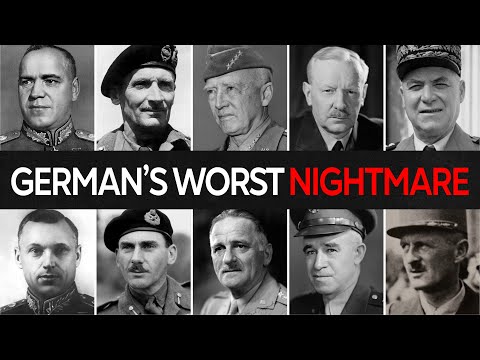
One name that haunted German war rooms was George S. Patton. The Germans didn’t just fear him—they studied him obsessively, tracking his movements like a gambler watching loaded dice. They were convinced that wherever Patton showed up, disaster followed. And they weren’t entirely wrong.
From the German perspective, Patton was their mirror: flamboyant, ruthless, a believer in momentum over caution. They didn’t just fear his army—they feared the idea of him. Even when he wasn’t leading a force, they assumed he was.
The entire German 15th Army waited anxiously in the Pas-de-Calais for a D-Day landing that never came, paralyzed by a phantom army the Allies crafted from cardboard tanks and fake radio signals—because they believed Patton was in charge of it. That wasn’t deception. That was weaponized reputation.
But it wasn’t just theater. When the Allies broke out from Normandy in Operation Cobra, it was Patton’s Third Army that tore through the hedgerows like a pack of wolves. French roads clogged with retreating Germans. Panzer divisions were rolled up before they could reposition. Patton was what happened when a blunt instrument learned to think in spirals.
And yet, for all his fire and fury, Patton wasn’t the most methodical killer of the Reich. That honor belonged to a very different kind of field marshal—one who never moved until he had mathematically guaranteed the outcome.
Bernard Law Montgomery wasn’t exciting. He was inevitable. If Patton was fire, Monty was gravity. You didn’t see the fall until you were already on the ground wondering how it happened.
Rommel once dismissed Montgomery as a plotting bureaucrat. That changed after El Alamein. There, Montgomery unleashed a slow-motion demolition of the Afrika Korps—a crushing logistical steamroll where every shell, every fuel truck, every spare tank had already been arranged in rows behind him like dominoes waiting to fall.
The Germans called it Materialschlacht—a battle of material, not maneuver. And they hated it because it meant their tactical genius, the very soul of Blitzkrieg, no longer mattered. Montgomery didn’t fight battles. He built inevitabilities.
But the Germans weren’t just afraid of what came after Montgomery. They remembered the man who came before him—a reserved, cerebral general who preferred results over rhetoric.
Claude Auchinleck was one of the few enemy commanders Rommel genuinely respected. Before the polished mythos of Montgomery, there was ‘The Auk’—a general who imposed steel on chaos. When Rommel’s Afrika Korps rampaged through North Africa in 1942, it was Auchinleck who stood in the way at the First Battle of El Alamein and held—barely, but he held.
What shook the Germans wasn’t the size of his forces or the brilliance of his maneuvers. It was the improvisation. The British Eighth Army was fractured, retreating, outgunned. But Auchinleck rotated divisions with clockwork precision, patched holes with Indian and Australian troops who’d been mauled weeks earlier, and did it without waiting for reinforcements from London.
Rommel, who thrived on disorder, suddenly found himself in a deadlock—and he hated it. He called Auchinleck a ‘clever and tough opponent,’ which in Rommel-speak was basically an admission of defeat.
But even Auchinleck, with his quiet grit, wasn’t prepared for what came next. A shift in the war that would move from the sand-blasted deserts to the blackened skies of the Reich—where fear didn’t arrive on tanks. It fell from above.
To the Nazi propaganda machine, Arthur ‘Bomber’ Harris was a monster. To Albert Speer and the German industrial elite, he was a mathematical extinction event. And to the average Luftwaffe officer, he was a logistical apocalypse in a tweed coat.
He didn’t fight battles in the conventional sense. He didn’t capture cities. He erased them.
As commander of RAF Bomber Command, Harris didn’t just believe in air superiority—he believed in air inevitability. And he made that belief felt nightly. Hamburg, Dresden, Cologne. Each city became a morbid equation: population density multiplied by flammable architecture, divided by the number of bombers the RAF could send in waves.
To the German high command, he was an unpredictable kind of terror because he didn’t care about tactical value or military targets. He cared about breaking morale, industry, infrastructure. The German war effort wasn’t defeated in the forests of the Ardennes—it was starved in the wreckage of synthetic oil plants and shattered railway junctions.
But as the Reich looked skyward for answers, it missed what was happening at ground level. Because while Harris shattered cities from above, someone else had begun dismantling the German war machine at its most vulnerable joint: its fuel supply.
Carl Spaatz didn’t drop bombs to make a point. He dropped bombs to make the enemy immobile. While Arthur Harris turned the air war into a nightmare, Spaatz turned it into a chessboard. With every refinery and fuel depot, another pawn taken off the table.
The Germans were slow to realize what was happening. At first, the American bombing campaign looked like a copy of the British one—loud, dramatic, and erratic. But then came the oil campaign, the real one, spearheaded by Spaatz and his methodical brain trust.
It wasn’t about terror. It was about precision. Ploiești, Leuna, Böhlen—synthetic fuel plants deep inside the Reich, plants the Germans had staked their armored future on. Spaatz went for them all.
Adolf Galland, the Luftwaffe’s chief of fighters, admitted after the war that it was this campaign—not D-Day, not the Eastern Front—that truly grounded the German air force. No fuel meant no planes, no tanks, no retreat, no counterattack, and worst of all, no illusion of control.
It was quiet devastation. But it wasn’t quiet for long. Because as the Luftwaffe crumbled, the German generals braced for something more primitive, more American, and far more brutal: the thunder of artillery, steel, and raw momentum.
Omar Bradley didn’t shout. He didn’t wear ivory-handled pistols or issue threats into cameras. What he did instead was bury entire German divisions under synchronized bombardment—quietly, methodically, and without blinking.
To the Wehrmacht, Bradley wasn’t colorful. He was unavoidable. The Germans called Patton a slasher. They called Bradley an architect of annihilation. And when Operation Cobra opened with a rolling wave of carpet bombing that turned the elite Panzer Lehr Division into wreckage and craters, even the most jaded German officers understood: tactics no longer mattered. Firepower did.
Bradley was the engineer behind that shift. He didn’t invent the tools—bombers, tanks, artillery barrages—but he stacked them like bricks into walls the Germans couldn’t climb. He turned mobility into math. He didn’t maneuver around German lines. He erased them.
And when he advanced, it wasn’t with flourish. It was with saturation. Panzer commanders in Normandy reported a chilling new feeling: irrelevance. Their training, their experience, their doctrine—it no longer worked. The enemy had stopped playing the same game.
And yet, amidst the deafening crescendo of mechanized firepower, a quieter threat was taking shape. A new kind of mind—subtle, innovative, and utterly unpredictable—was about to take the battlefield. One that wouldn’t fight the way anyone expected.
Guy Simonds didn’t inspire fear because he was loud. He inspired it because he was weird. Not eccentric weird—doctrine weird. The kind of commander who looked at established rules of war, nodded politely, and then quietly dismantled them in the dark.
In Normandy, German SS officers like Kurt Meyer began noticing something unsettling. Canadian formations under Simonds didn’t behave like British units or American ones. They attacked at night. They moved infantry inside armored hulls. They advanced under artificial moonlight—giant searchlights bouncing light off cloud cover to create an eerie, ghostly glow that robbed defenders of shadows and certainty.
German after-action reports described the sensation as fighting an enemy that had rewritten the timetable. Simonds understood something crucial: German defenses were built on prediction, on knowing how the enemy should behave. So he made sure they didn’t.
His invention of the Kangaroo—armored personnel carriers converted from tanks—solved one of the Allies’ deadliest problems: how to keep infantry alive while crossing open ground under machine-gun fire. The Germans had no counter ready. Their doctrines assumed exposed infantry. Simonds removed exposure entirely.
At the Scheldt, his operations dismantled fortress defenses the Germans believed would hold indefinitely—not through brute force, but through controlled chaos. His attacks felt asymmetric, unbalanced, and deeply uncomfortable to defend against.
And while Simonds unsettled German tacticians in the Lowlands, a very different kind of fear was growing farther south, among mountains the Germans had declared impassable—and an enemy who simply refused to accept that label.
Alphonse Juin didn’t trust maps. The Germans did. In Italy, German commanders fortified the Gustav Line with absolute confidence: rivers, cliffs, ridges, natural barriers layered with concrete and artillery. The terrain itself was supposed to be the defense.
Juin looked at it and saw pathways. Commanding the French Expeditionary Corps, he unleashed troops the Germans deeply misunderstood: Moroccan Goumiers. Lightly equipped, fast-moving, and utterly comfortable in mountains the Wehrmacht had written off as militarily irrelevant.
While American and British units stalled in frontal assaults, Juin’s forces slipped through ravines, goat paths, and ridgelines that didn’t exist on German operational maps. Field Marshal Kesselring noticed immediately. His reports described a new danger—not from tanks or bombers, but from men appearing where no enemy was supposed to be.
Defensive positions were outflanked not by force, but by geography itself turning traitor. The psychological impact was severe. German soldiers weren’t just fighting an enemy—they were fighting the collapse of certainty. Positions once considered safe were suddenly vulnerable. Retreats turned chaotic. Carefully prepared lines dissolved into improvised withdrawals.
Juin didn’t defeat the Gustav Line alone, but he cracked its logic. And once that logic broke, the entire Italian defense became a slow-motion unraveling.
Still, someone had to coordinate the chaos that followed—someone who could hold together Americans, British, French, Poles, and others without letting the alliance fracture under pressure. The Germans knew him well and feared what he represented.
Harold Alexander didn’t look dangerous, and to the Germans, that was the most dangerous thing about him. Polite, soft-spoken, impeccably calm. He gave no fiery speeches, no dramatic ultimatums. Yet Kesselring considered him one of the most threatening Allied commanders of the war—not because of his tactics, but because of his control.
Alexander commanded coalitions, and coalitions are supposed to fail. Different languages, different egos, different priorities. The German high command counted on that friction the way gamblers count on gravity. Alexander denied them the payoff.
In North Africa, then Italy, he orchestrated multinational forces with unsettling smoothness. Disagreements were absorbed. Rivalries diffused. When others clashed, Alexander mediated. When others hesitated, he delegated. To the Germans, it felt like fighting not an army, but a machine that refused to jam.
Kesselring’s nightmare wasn’t Alexander’s attacks. It was Alexander’s patience. German counteroffensives found no weak seams, no political fractures to exploit, no sudden Allied collapse—just pressure. Constant, polite, suffocating pressure.
Alexander didn’t need brilliance in every subordinate. He needed cohesion. And he got it again and again—which left the Germans with a grim realization. Even if they survived the desert, the mountains, and the beaches, the war was becoming something else entirely. A war where the sky itself would become a battlefield and mercy would be calculated in tonnage.
To the Germans, Philippe Leclerc was not just another Allied general. He was a memory that refused to stay buried. France—defeated, occupied, humiliated—was supposed to be a closed chapter. Leclerc turned it into an unresolved threat with an engine.
His 2nd Armored Division moved with a speed and aggression that felt uncomfortably familiar to German officers. Too familiar. They had used this style themselves in 1940. Now it was coming back at them, sharpened by resentment and driven by something far more dangerous than doctrine: purpose.
Leclerc didn’t just advance—he surged. His columns ignored tidy timelines and pressed forward whenever opportunity appeared, forcing German units into constant reactive retreats. The liberation of Paris was more than symbolic. It was psychological warfare. German commanders understood symbols. They knew morale could collapse faster than supply lines.
Seeing French armor roll into the capital shattered the carefully maintained illusion that the Western Front was merely an Anglo-American affair. France was back—and it was angry. Then came the dash to Strasbourg, fulfilling Leclerc’s oath to liberate the city. German defenders expected pauses. He gave them none. His tempo denied them the one thing retreating armies need: time to think.
But speed alone wasn’t the Allies’ only weapon. In the Mediterranean, the Germans faced a commander who combined speed with adaptability—landing where least expected and refusing to be boxed in by terrain or tradition.
Lucian Truscott was respected without being understood. At Anzio, where the Allies were supposed to be crushed, he reorganized chaos into momentum. German intelligence noted something unsettling: his units reacted faster, counterattacked sooner, recovered with unnerving efficiency. This wasn’t recklessness—it was muscle memory.
Then came the names that broke the Wehrmacht’s spirit. Władysław Anders and his Polish II Corps at Monte Cassino, fighting like men with nothing left to lose. Leslie Morshead at Tobruk, turning a siege into a humiliation. Georgy Zhukov, whose arrival meant confirmation, not surprise: the offensive had already begun.
And behind them all, Konstantin Rokossovsky, Ivan Konev, Vasily Chuikov—architects of annihilation. The Reich wasn’t defeated by heroes. It was dismantled by professionals it never truly understood.
Who among these 25 would you have feared most?
Report this article
Select a reason for reporting:






