In the 1880s, the British Empire was the largest in human history. It controlled a quarter of the world’s land and over 500 million people. The pound sterling was the world’s reserve currency, and British ships dominated every ocean. Yet beneath this glittering surface, the seeds of decline were already sown. Britain’s fatal error was not a single bad decision, but a structural trap: overextension, internal economic weakness masked by financial strength, and a failure to recognize the pattern until it was too late. Today, halfway across the globe, China is making the same moves—building infrastructure, extending financial influence, and expanding military presence—with a precision that history would recognize all too well.
In 2013, President Xi Jinping announced the Belt and Road Initiative, a trillion-dollar infrastructure program spanning over 150 countries. Roads, railways, ports, power plants—the logic mirrors Britain’s imperial playbook: build what developing nations need, embed yourself in their economies, and convert connectivity into strategic dependency. Sri Lanka’s Hambantota Port, leased to a Chinese state-owned company for 99 years, and Djibouti’s first overseas Chinese military base are just two examples. The mechanisms differ, but the outcomes are strikingly familiar.
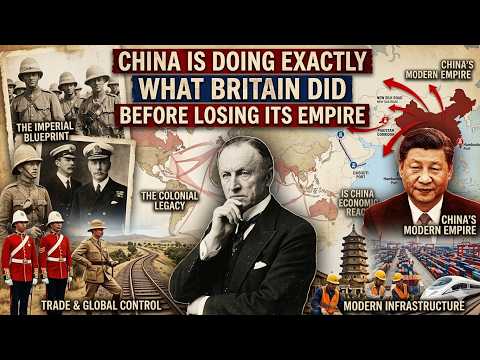
China’s military footprint is still small compared to Britain’s at its peak, but the direction is unmistakable. In 2025, China inaugurated a joint military operation center at Cambodia’s Ream Naval Base. A 2024 Pentagon report assessed that China seeks to expand its global basing infrastructure to project power at greater distances—precisely the capability Britain built in the 19th century. Meanwhile, China is methodically constructing an alternative financial architecture: the Cross-Border Interbank Payment System (CIPS) to bypass SWIFT, the digital yuan, and yuan-denominated oil futures. President Xi has explicitly stated the goal of attaining reserve currency status for the renminbi. The pound’s reserve status masked Britain’s industrial decline for decades; China may be making the same gamble.
But here’s where the parallel becomes alarming. Britain’s fatal trap had three interlocking components: overextension, internal economic weakness disguised by external financial strength, and the inability to recognize both until too late. China today shows all three. Its property sector, once 30% of GDP, has been in crisis since 2021. Deflation has gripped the economy for two consecutive years—the first time for a major economy outside Japan since the 1960s. Youth unemployment remains above 17%. In late 2024, Beijing launched a 10 trillion yuan debt swap program to address hidden local government debt, estimated at 46% of GDP. This is not the picture of an unstoppable ascending power. It is the picture of an economy grappling with serious structural problems.
Britain in the early 20th century was in a strikingly similar position: enormous external footprint, extensive global financial commitments, and accelerating domestic industrial decline masked by reserve currency status. The pound remained the world’s primary currency even as British manufacturing slipped, because reserve currency status lags behind economic reality. China is not in that position yet, but it is in the position Britain was in approximately 20 to 30 years before the collapse—a position that looks fine from the inside and alarming from the outside to anyone who has read the history carefully.
And then there is the third component: the failure to recognize the pattern until it was too late. Britain’s leaders in 1900 did not feel like they were watching their empire fall. They felt like they were managing temporary inconveniences. By 1945, they were bankrupt. Today, Washington is engaged in debates about China that are almost entirely reactive and transactional—tariffs, semiconductors, TikTok, Taiwan. Nobody in any position of real political power is standing up and saying, ‘China is executing a recognizable historical template for imperial expansion, and that template has a well-documented end stage.’ That conversation is happening in think tanks and academic journals, but not where it matters.
China’s expansion is not identical to Britain’s. It does not claim sovereignty over other nations; it lends to them, builds for them, negotiates contracts. But the outcomes accumulating from these relationships are beginning to look less unlike colonial outcomes than the initial framing suggests. As of 2023, over 25% of the world’s bilateral external debt was owed to China, according to the World Bank. Kyrgyzstan owes China approximately 40% of its GDP; Tajikistan owes 27%. Djibouti, formally rated in debt distress, has over half its external debt held by Chinese institutions—and a Chinese military base next to its most important port. Whether or not you call this a debt trap, these are not relationships between equals.
Britain built railways and ports and a reserve currency and a global military presence, and it worked brilliantly for a century. Then the costs exceeded the returns, and the edifice came down with a speed that surprised almost everyone. China is building railways and ports and a nascent reserve currency architecture and a cautiously expanding military presence—while managing deflation, a property crisis, demographic decline, and a debt load growing faster than the economy that must service it. That combination of external ambition and internal fragility is not unfamiliar territory in the history of empires. It is, in fact, one of the most recognizable places in that history.
The question is whether China is making the same mistake Britain made. The answer cannot yet be known with certainty. But what can be said is that the question is not being asked loudly enough or seriously enough in the places where it would matter most. History has a long record of punishing nations that failed to ask the right questions at the right moment. And right now, from a certain altitude, the rhyme is beginning to sound very familiar.
But there is a deeper layer to this pattern that rarely makes it into the policy debate, and it is the one that historically determines whether a rising power’s expansion ends in managed adjustment or sudden collapse. It is the question of what happens when the infrastructure you have built abroad stops serving your interests and starts serving as leverage against you. Britain discovered this in the 20th century in ways its planners never anticipated. The railways, ports, and telegraph networks that had once projected British power became, in the hands of independence movements and rival powers, instruments of British vulnerability. The very connectivity that had bound colonies to London became the channels through which anti-colonial movements organized, communicated, and eventually dismantled the empire. Infrastructure, it turns out, is not a leash that only pulls in one direction.
China faces a structurally similar risk, and it is already visible in places the Belt and Road’s architects did not anticipate. Pakistan’s Gwadar Port, the crown jewel of the China-Pakistan Economic Corridor, has become a security quagmire. Baloch separatist groups have repeatedly attacked Chinese personnel and facilities, forcing Beijing to contemplate a security presence it never wanted and cannot easily sustain. In Myanmar, the Kyaukphyu deep-sea port and pipeline projects sit in the middle of an active civil war. In Ethiopia, Chinese-built industrial parks stand half-empty after the country’s conflict and debt crisis. Each of these investments was designed to generate influence. Each has instead generated obligation, risk, and entanglement.
This is the trap Britain knew intimately and never solved. The more territory you connect to your system, the more territory you must defend. The more debt you extend, the more defaults you must manage. The more governments you cultivate, the more governments can fall and take your investments with them. Empires do not collapse because their expansion fails. They collapse because their expansion succeeds too well, and the cost of maintaining success eventually exceeds the returns. Britain’s garrison in India, its fleet in the Mediterranean, its administrators in Africa—all of it was profitable at the margin for decades, until it wasn’t, and then it was catastrophic.
China’s leadership is not blind to this. The very scholars who warn against overextension are reading the same histories. But there is a difference between knowing a risk intellectually and being able to stop a machine that has already been built. The Belt and Road Initiative employs hundreds of thousands of Chinese workers, sustains state-owned enterprises that depend on overseas contracts, and has become a central pillar of the Communist Party’s legitimacy narrative. Slowing it down is not a policy adjustment; it is a political problem for a leadership that has staked its credibility on the promise of national rejuvenation. Britain faced the same dilemma in the 1930s, when its imperial commitments had become a domestic political trap. No British government could afford to look weak by retreating, even as the empire’s strategic position eroded.
And here is the part that should genuinely unsettle anyone watching from Washington. The end stage of the British pattern did not arrive as a single dramatic moment. It arrived as a series of small, individually rational decisions that collectively made retreat impossible. The 1931 Statute of Westminster granted dominion autonomy but preserved the appearance of unity. The 1932 Ottawa Conference created imperial preference but deepened the empire’s economic isolation. Each step was defensible. Together, they locked Britain into a structure it could no longer afford and could no longer abandon. China’s own sequence of decisions—the port in Djibouti, the base in Cambodia, the debt swaps, the currency infrastructure—may be following a similar logic, each step rational, the cumulative effect irreversible.
The question that history asks of every empire is not whether it can build. It is whether it can stop building when the building stops paying. Britain could not. The costs of its commitments became visible only after the returns had already vanished, and by then the political and institutional momentum was too great to reverse. Whether Beijing can do what London could not is the single most important question of the coming decade, and it is a question that almost no one in power is asking out loud. The pattern is visible. The rhyme is audible. The only thing missing is the will to look.
And yet the most unsettling part of the British story is not that London failed to see the pattern. It is that London saw it clearly and chose to do nothing, because the alternative—retreat, retrenchment, admitting that the empire had become a liability—was politically unthinkable. In 1902, Joseph Chamberlain openly proposed an imperial federation to bind the empire tighter, not loosen it. The response was not retrenchment but more expansion. When the logic of a system demands more of the same even as the returns diminish, the system has already begun to die.
China’s Belt and Road is not a policy that can be quietly wound down. It is woven into state-owned enterprises, provincial growth targets, and the Party’s promise of national rejuvenation. The same institutional momentum that made British retreat impossible now makes Chinese retrenchment equally difficult. Beijing may understand the historical trap intellectually, but understanding has never been the same as escape.
History does not offer a verdict in advance. It only offers a mirror. Britain in 1900 could not imagine a world without its empire; by 1960, the empire was gone, and Britain had survived—diminished, but intact. China may find a similar path, or it may find something worse. The one thing history guarantees is that no empire has ever been exempt from the arithmetic of overextension.
So here is the question worth carrying with you: if the pattern is visible, the rhyme is audible, and the arithmetic is undeniable—why do the most powerful nations still walk into the same trap, generation after generation? Is it hubris, inertia, or something deeper in how power blinds those who hold it? What do you think—is China repeating Britain’s mistake, or is history simply too seductive a mirror to resist? Let me know in the comments.
Report this article
Select a reason for reporting: